

The Exquisite World of Amel Bashir
This week’s post celebrates the work of the remarkable and widely exhibited Sudanese artist, Amel Bashir, pictured below. In this article I offer a small selection of her extensive portfolio. Next month, I reproduce an in-depth interview with Amel, first published in the journal of The Society for the Study of the Sudans UK (SSSUK) in 2021. The interview explores the wealth of imagery within her work and her many sources of inspiration. At this time of great tragedy for Sudan, art reminds us to keep hold of our hope and humanity.

I am grateful to SSSUK for allowing me to republish my article next month. Scroll down to learn more the society and its vital educational and academic work.
Amel has very kindly given her permission for me to feature her works below. These are copyright Amel Bashir and may not be reproduced without her formal permission.

Above, and title photo, Amel captures a moment of Sudanese domesticity which is at once delicate and disconcerting. A young woman sits, calm and still on the edge of her rope-strung wooden bed, her hands resting lightly on her lap. So powerful is the sense of her quietude that, were it not for the fluttering of her scarf behind her, we had almost assumed the air enveloping her to be equally still. She holds us with her clear, unblinking gaze while fragments of branches and leaves are caught, transfixed, mid-fall.
Amel prefers not to title her work, tempting the viewer to draw their own conclusions.
Learn more about her work and why she focuses on black and white imagery in Amel Bashir Taha Delicate Defiance
Below, more examples from the worlds of her artistic imagination.
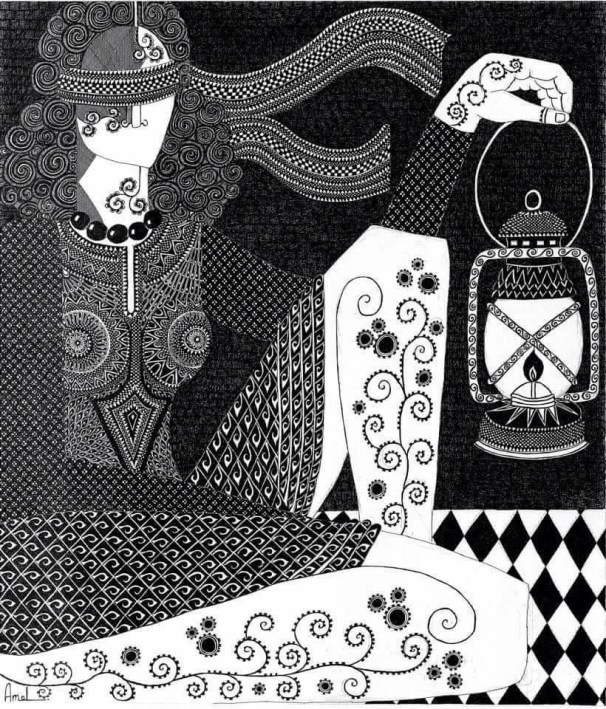
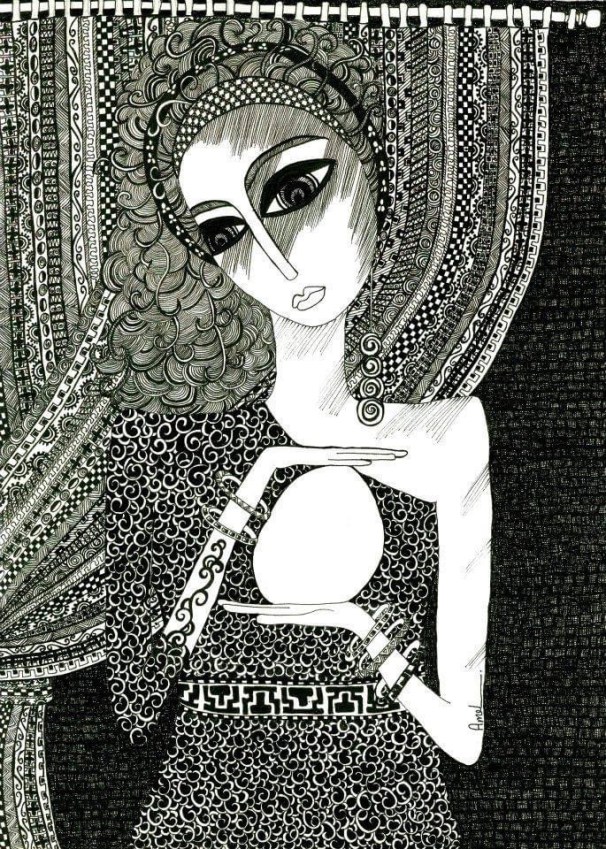
Flowing, floral henna tattoos contrast with dense, geometric motifs, illuminated by the rays of a lantern which is both oriental and Picasso-esque. Hennaed limbs and lanterns are recurring motifs in Amel’s work:

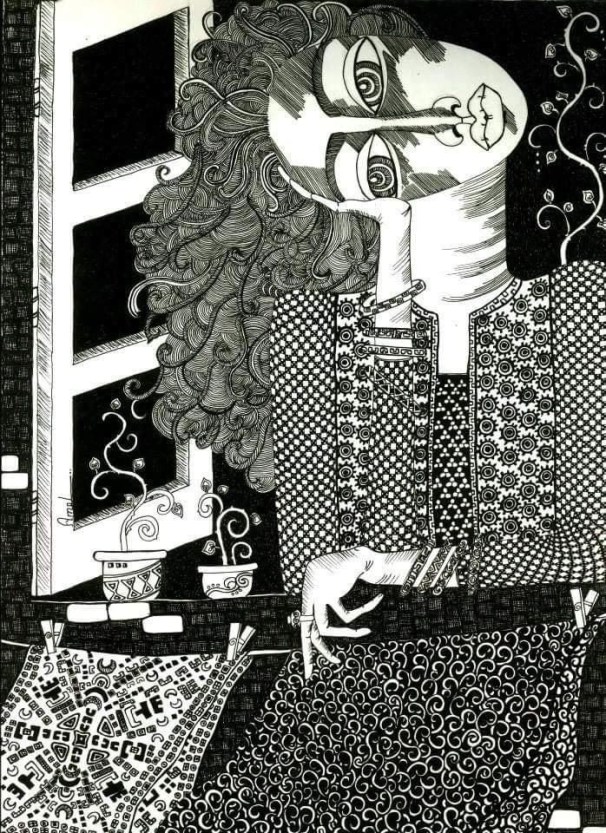
Another recurring motif is the window, framing the delicate features and graceful wisps of hair of a female observer. She looks out eagerly into the external world, or sometimes appears intensely reflective while performing quotidian tasks, which under her gaze, are elevated with an exquisite grace.

Flowing, sinuous tresses both echoing and working in harmony with the organic forms of stems and flowers also recur in Amel’s work, as do delicate examples of jewelry that complement dense tapestries of texture and motif, often in the form of screens and curtains.
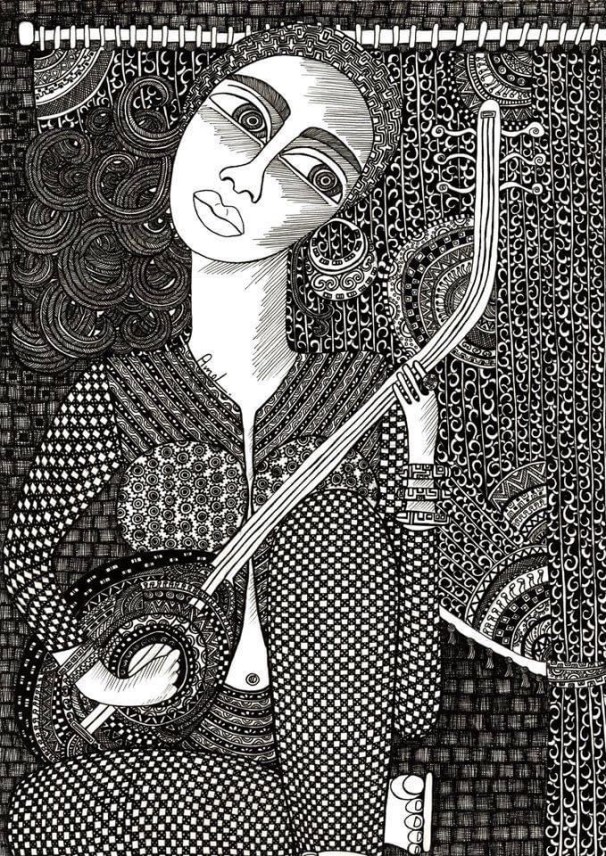
Her women embody a grace, fluidity and self-assurance, hinting at a nobility inherent to all women. They are both the embodiment and guardians of their esthetic and artistic heritage and bear the blessings, dilemmas and weight of their womanhood.
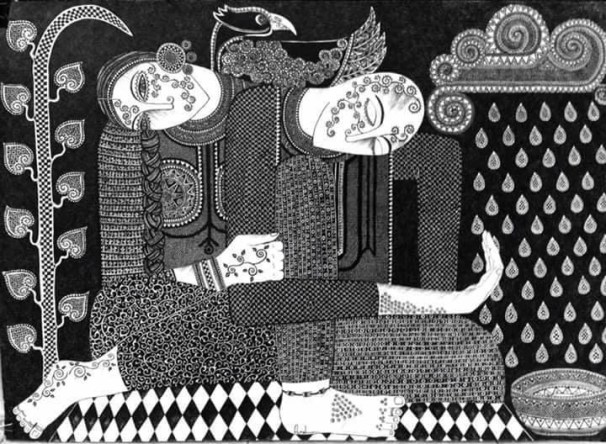
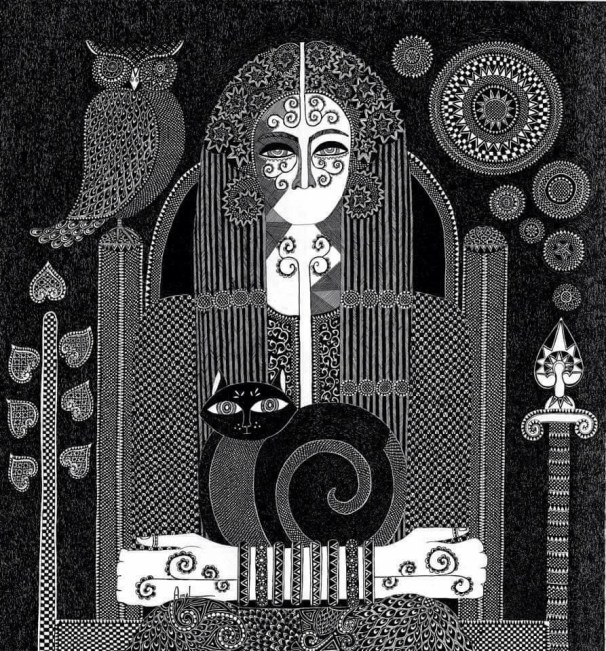
Amel’s world is also inhabited by birds and other creatures that seem to have talismanic or oracular powers.
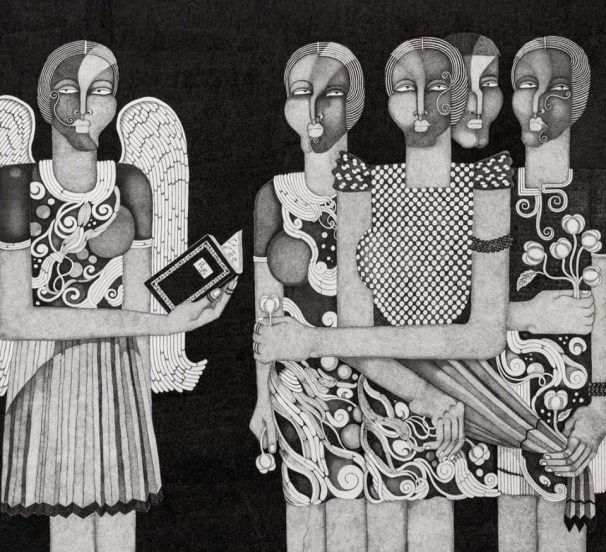
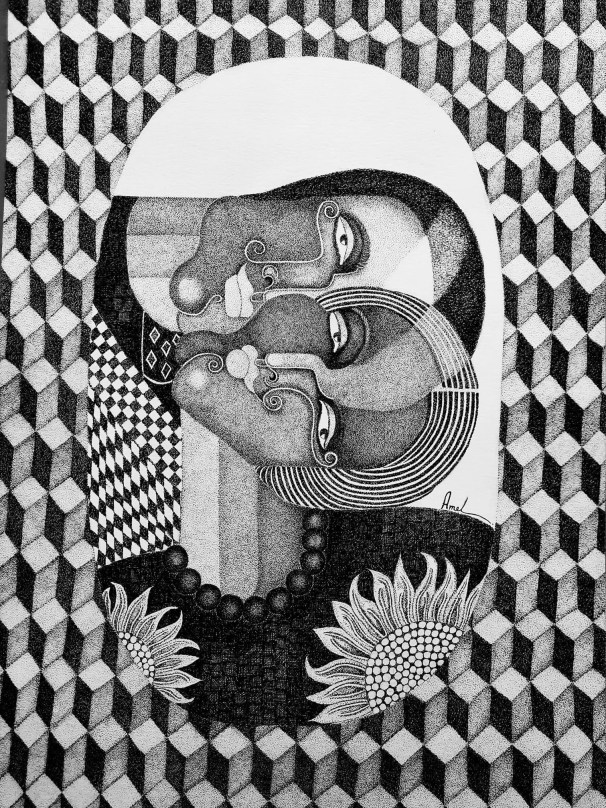
Below, two of Amel’s arresting recent works.
Society for the Study of the Sudans UK
The Society for the Studies of the Sudans (SSSUK)
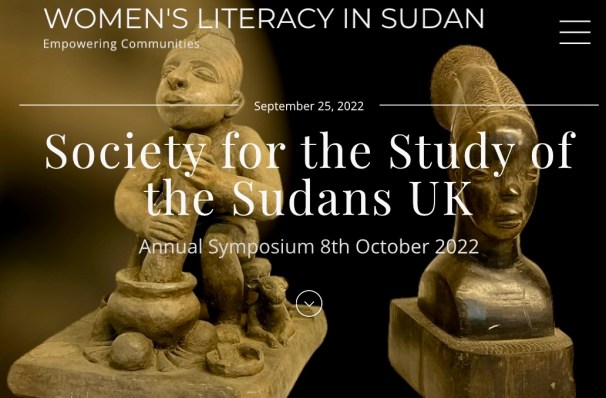
The Society for the Study of the Sudans UK (SSSUK) is a remarkable meeting space and resource for anyone interested in Sudan or South Sudan. Its members include academics, development workers, artists, journalists, writers but also many folk, who like me, are just interested in Sudanese current affairs and culture. Its journals, online resources and annual symposiums provide a wealth of information, discussion and food for thought for scholars, political analysts and indeed anyone wishing to further their understanding of Sudan and South Sudan.
Keep up with all the news from SSSUK in

SSSUK’s symposiums have hosted leading figures in Sudanese and South Sudanese cultural and political life and have always pursued constructive, open-minded dialogue, even on the most contentious and painful of issues. They have been annual events to look forward to for more than twenty-five years, weathering and commentating on the many profound changes Sudan and South Sudan have witnessed in recent years.
On a personal level, SSSUK has been an enduring and inspirational presence for nearly thirty years. Some of the most remarkable, brave and knowledgeable people I have had the privilege to know I met for the first time at SSSUK.

 Women's literacy in Sudan
Beautiful illustrations
LikeLike
🙏❤️
LikeLike