

Rashaida Dress and Adornment Part 2
Background to the Rashaida in Sudan – Changing Worlds
From Girl to Woman; Key Elements of Rashaida Dress
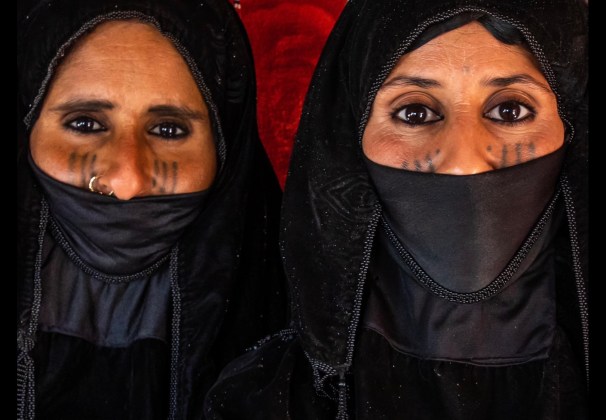
Above, a stunning portrait of Rashaida women in the clothes typically worn inside their tents and compounds, Kassala State, Sudan. Photo by Eric Lafforgue, copyright, Alamy, used under licence.
See Rashaida Dress and Adornment Part 1 for more background to Rashaida women’s dress and wedding scenes.
In Part 3, I will be exploring the symbolism of Rashaida jewelry, the secret language of tattoos and theories of Rashaida esthetics through the voices of Rashaida women.

Above, Rashaida silver anklets.
Rashaida Dress and Adornment Part 2
Background to the Rashaida in Sudan – Changing Worlds
From Girl to Woman; Rashaida Dress
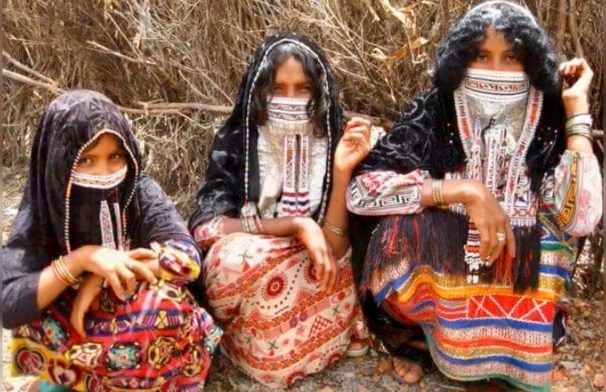
Above, Rashaida girls in eastern Sudan, wearing their striking, richly patterned dresses and revealing their glossy, thick fringes, known as hiffa. Unlike other Muslim communities, the unveiled fringe is considered acceptable, whereas the nose and mouth are always covered in public. Photo, still from بدو الرشايده بالسودان
Estimates of Rashaida numbers vary widely, with sources quoting anything from some 40,000 to 168,000 living in Sudan. The community is predominantly distributed across the Kassala – Port Sudan regions. The Rashaida are believed to have migrated to Eritrea and north-eastern Sudan from Saudi Arabia in 1846, fleeing ethnic warfare in the Hejaz. According to some sources, the Rashaida name means “refugee”. https://en.wikipedia.org/wiki/Rashaida_people and Atlas of Humanity Rashaida People
See too: Robert Purdue The Rashaida Bedouin
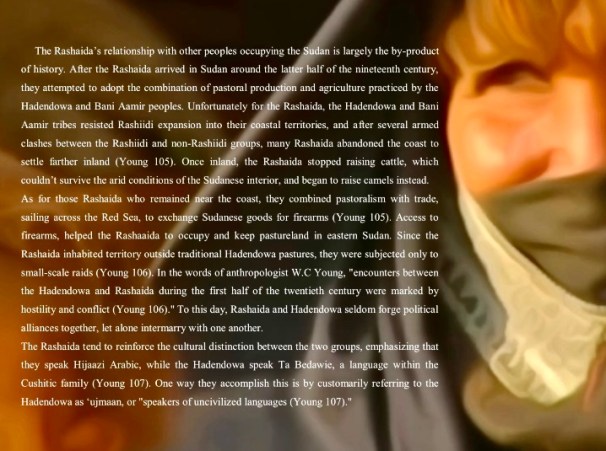
Above, Purdue’s historical overview of relations between Rashaida and non Rashaida peoples in Sudan and their abandoning of cattle for camel husbandry in the Sudanese interior. The Rashaida are known in Sudan for their cultural distinctiveness, reflected in their language, dress and pastoral customs. They rarely marry outside the tribe.
Robert Purdue The Rashaida Bedouin
Background to the Rashaida in Sudan – Changing Worlds

Writing in the 1980s, Marjorie Hall and Bakhita Amin Ismail, (Sisters under the Sun), set down their compelling first impressions of Rashaida life while travelling near Suakin, noting that not long before, this tribe of “Arabian purity in looks and language” had been “entirely nomadic”:
“At the camp site, teeming with hobbled camels grazing on the meagre thorn and scrub, we passed by groups of tents from which inquisitive faces of women and children peeped and a posse of fierce-looking men armed with crusader-type swords emerged to check on the identity of the strangers. After a formal introduction, the Shaykh of the tribe entertained us to a pot of tea brewed over a wood fire and spoke of the problems of eking out an existence from the barren land in the summer months. Problems meticulously detailed in William Young’s fascinating account of life among The Rashaayda Bedouin, Arab Pastoralists Of Eastern Sudan of the early 1980s.
Above, left, stills from John Yannopapas’ Day 17-Rashaida Village views, Sudan; scenes of contemporary Rashaida life near Kassala. Below, right, still from سلسلة نقطة ضوء : قبيلة الرشايدة بالسودان
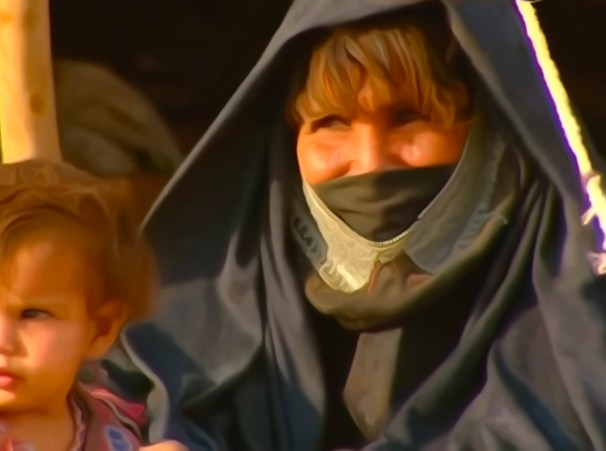
When Hall and Amin Ismail returned three years later, the same community was settled in wooden dwellings, owned pickup trucks and bicycles and enjoyed access to schooling and hospital care. Yet, on approaching the “expanding shanty village” the authors encountered upon their return, they wondered if these benefits of urban life were in fact a mixed blessing, struck by how “distressingly apparent the squalor of people living in the closest proximity without modern amenities” was.
Writing in the early nineties; Jane Perlez was also struck by the cultural costs incurred in the transition from the largely self-sufficient nomadic and pastoral to the increasingly sedentary way of life, noting that “instead of containers of camel milk, depleted sacks of corn, marked as foreign aid, lay near the fire. Modern vinyl suitcases competed for space with hide saddle bags, which used to be draped on either side of a pack camel for long journeys.” She also claimed that precious jewelry, so integral to Rashaida dress, was being “sold to compensate for lost earnings from their disappearing nomadic trade.” (Sheeb Journal; For the Bedouins of Africa, Sands Are Running Out; Jane Perlez, New York TImes 1992).
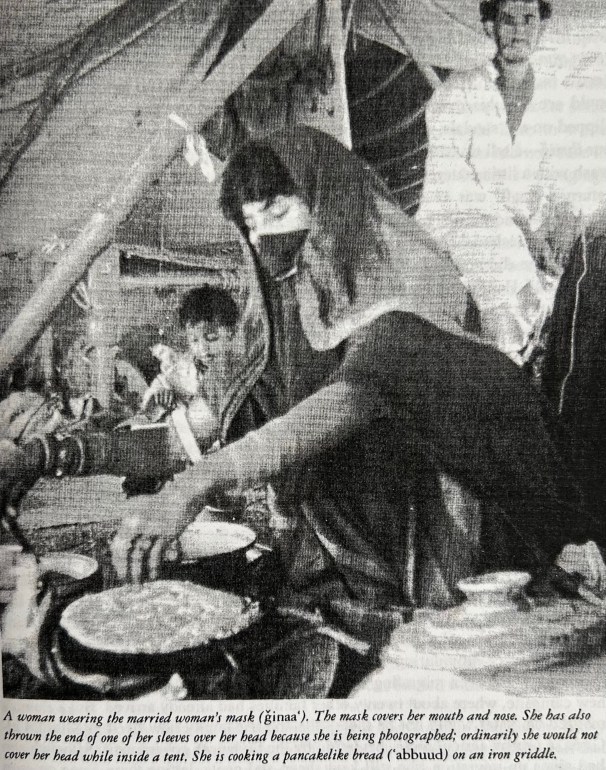
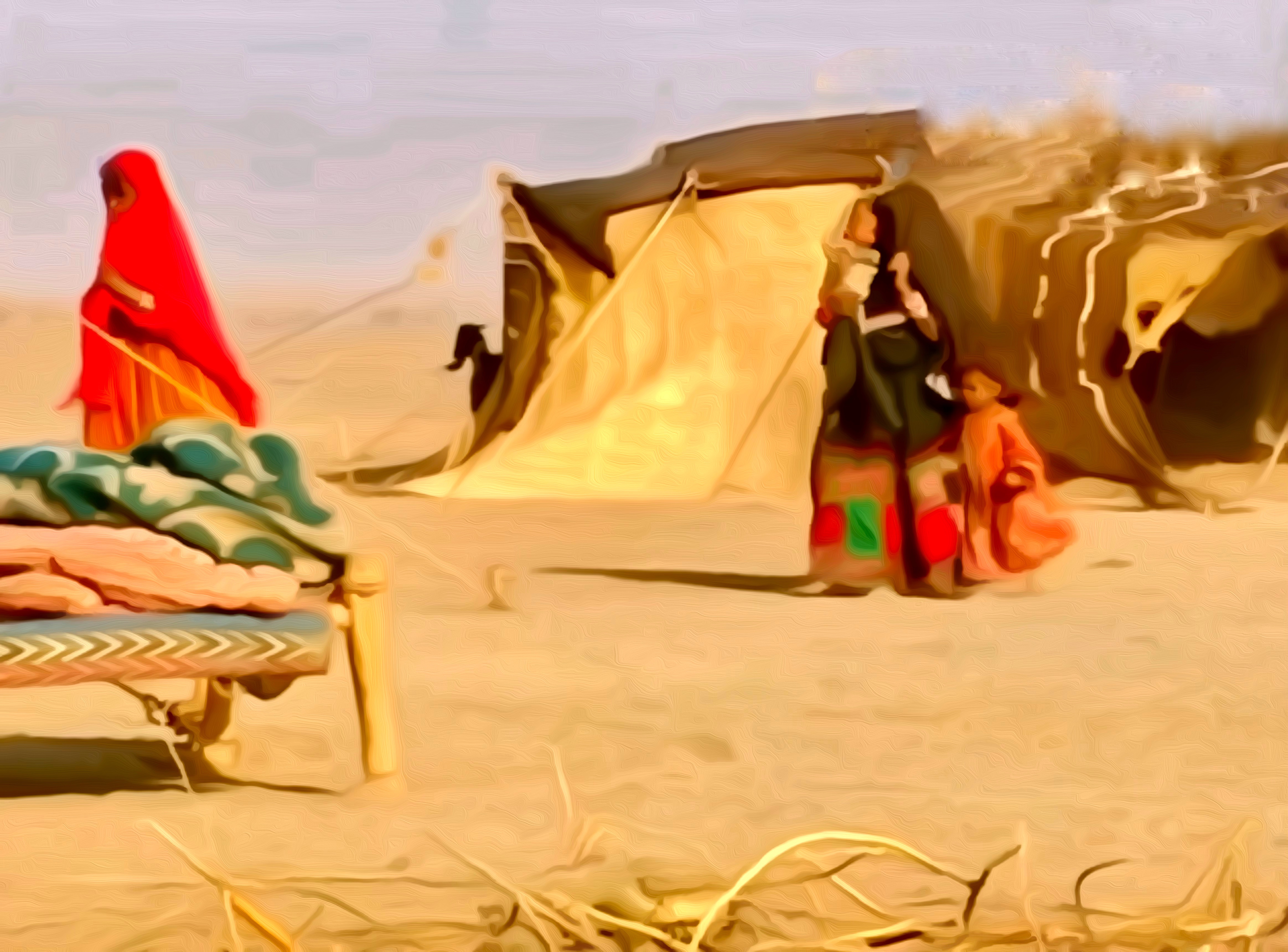
William Young, writing in the early 1980s, embedded himself with the Rashaida for over two years, tracking their seasonal migrations in search of grazing land for their camels and documenting their cultivating of land for fodder and subsistence needs. Even then, the stresses upon the Rashaida way of life were being felt, with long-standing hostilities and competition with other tribes over grazing rights and access to wells and water, the latter controlled by non-Rashaida tribes and subject to carefully negotiated agreements, intensifying. He noted too the growth of semi-sedentary Rashaida communities and the impact of government settlement schemes of the day.
Today, although the Rashaida still derive substantial income from the Sudanese-Egyptian camel trade, many also earn a living as emigre workers and herdsmen in the culturally and linguistically akin Hejaz. Rashaida women in the Lower Atbara region, Sandra Calkins noted in her 2009-10 study of insecurity, Taming Unknowns in Sudan, often experienced acute food shortages while their menfolk were working away from home, and lived out their lives against a permanent backdrop of precariousness and uncertainty. As climate change and increasing economic fragility impact an already marginalized community which prides itself on remaining culturally distinct, the precariousness of Rashaida life looks set to worsen. In recent years Rashaida have been implicated in both people and arms smuggling.
Above, breakfast before breaking camp, The Rashaayda Bedouin, William C. Young.
Work within a Rashidi household is divided between feminine and masculine tasks. For
example, only men may carve the wooden components of the tent, whereas, the women sew the
tent cloth. Churning milk is another task that is done exclusively by women as is tanning animal
skins. In addition when preparing food, only men skin and butcher animals while women are
assigned the task of grinding grain. However there are certain tasks that fall within neither
category of masculine or feminine labor. Coffee brewing is one such example and is an act that
may be performed by either sex. Also, either sex may milk the camels, sheep, and goats that
belong to the household. Stewing meat is another gender-neutral task. Both men and the women
do not work in isolation; the whole household works together to achieve the desired result. For
instance, when a woman wants to sew or mend a tent, the man goes out and collects wool from
the camels while the young boys of the family shear the wool off the goats. If the quantity of raw
fiber isn’t enough, then the male head of the household will make up the difference by
purchasing the remainder with his own money. Generally, women remain in close proximity to
the tent, while the men herd the animals. Therefore the separation of labor between the man and
the women revolves around feminine tasks, associated with the tent, and masculine tasks, such as
herding or butchering and skinning animals.
Contemporary Rashaida society is one where household labour is still highly gendered. Above, some examples, drawn from Young’s research, quoted by
Robert Purdue The Rashaida Bedouin
See too From Many, One: The Social Construction of the Rashāyida Tribe in Eastern Sudan William C Young
With an increasingly sedentary lifestyle, many Rashaida have become skilled tailors, jewelry craftsmen and sometimes craftswomen. This has led to an interesting paradox, according to Young. Writing in 2010, he noted:
“the dresses now worn by all Rashiidy women are sewn by Rashiidy men. Although Rashiidy women are expert seamstresses with needle and thread, almost none of them have learned to use a sewing machine. Their husbands, on the other hand, have been forced to learn new professions as a result of sedentarization, and many of them have become tailors. They have acquired women’s traditional knowledge of cloth and decoration and have combined it with their new knowledge of machine sewing. Sedentary Rashiidy women, whose families provide them with cash for their needs, can buy machine-made dresses in the market shops but have not learned how to make them.”
Cultural Change and Women’s Work The Sedentarization of the Rashiidy Bedouin in the Sudan
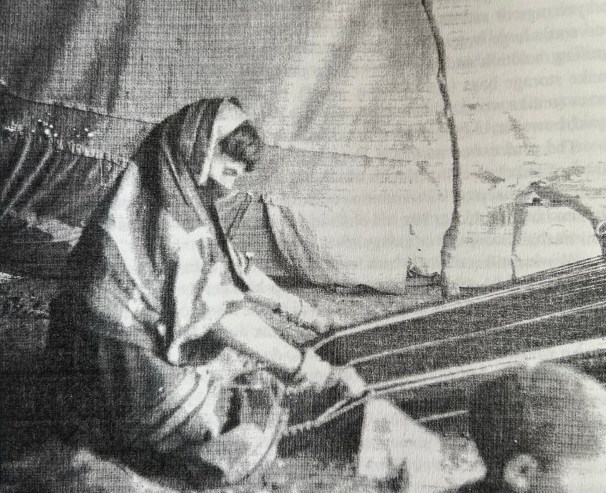
Above, Rashaida woman at her loom, William Young, The Rashaayda Bedouin. Women’s finely woven, waterproof and highly durable tent fabrics, together with their colours and motifs are treasured by the community and bear their own unique esthetic codes, determined and safeguarded by the women, who alone own their tents and keep them upon divorce.
Cultures of the Middle East / Professor Salih Who are the Bedouin? Debra Gorski

Illustrations of Rashaida dress by Griselda El Tayib, detailed below (Regional Folk Costumes of the Sudan)

From Girl to Woman; Key Elements of Rashaida Dress
Setting the Scene
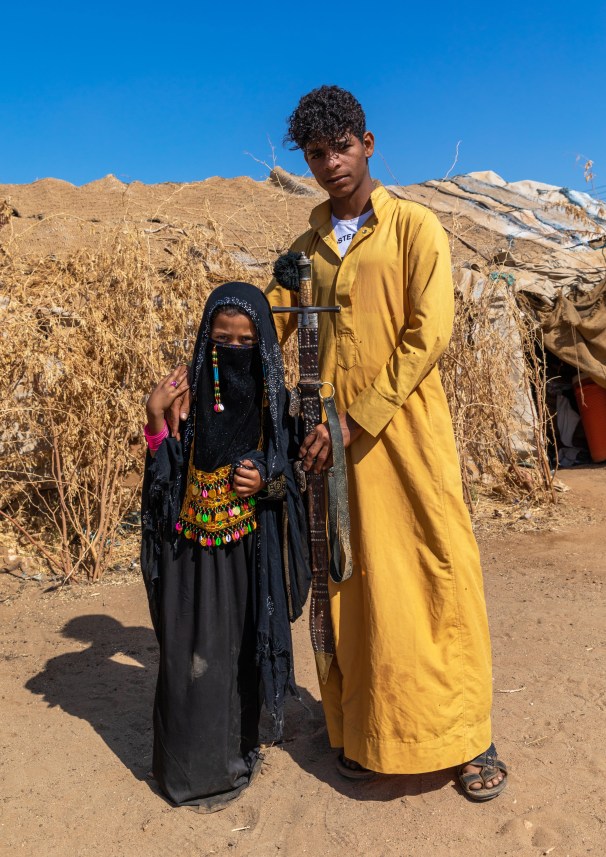
Above, contemporary portrait of a Rashaida teenage boy and girl in traditional clothing; Kassala State. Copyright, Alamy, used under licence.
The young girl’s attire above has much in common with the youngster described several decades ago by the late costume expert and artist, Griselda El Tayib; “Her veil, called a gargosh, was made of black shash decorated by her mother with tiny silver beads in a band which framed her forehead, and had a few touches of bead decoration at the corners to weigh it down. It covered her neck and shoulders at the back.” Girls customarily adopted the face veil and headdress before or at the age of thirteen, El Tayib noted.
While the girl above has a face veil with vibrantly embroidered edging, the youngster below wears a veil more closely resembling that described by El Tayib;
“The young girl’s face veil, called a mungab, was made of black material decorated with lead and sliver beads called rusas. It was worn just above the tip of the nose and usually fastened behind the back of the head usually with a leather thong in a way that cannot be seen under the head veil. Such veils would be decorated sometimes with leather tassels hung down at each side of the veil to disguise the ears. This face veil gave the appearance of being fairly rigid and was outlined in pearly buttons and bands of tilul. The centre of the face mask was weighed down by a vertical row of coins – some real and some imitation and known as dumu´a or tears.”
Below, a mungab closely resembling that described by Griselda El Tayib, Pinterest.

Many elements of Rashaida dress, such as the mungab above, reflect parallels in traditional Hejaz and Yemeni attire.
From Girl to Woman
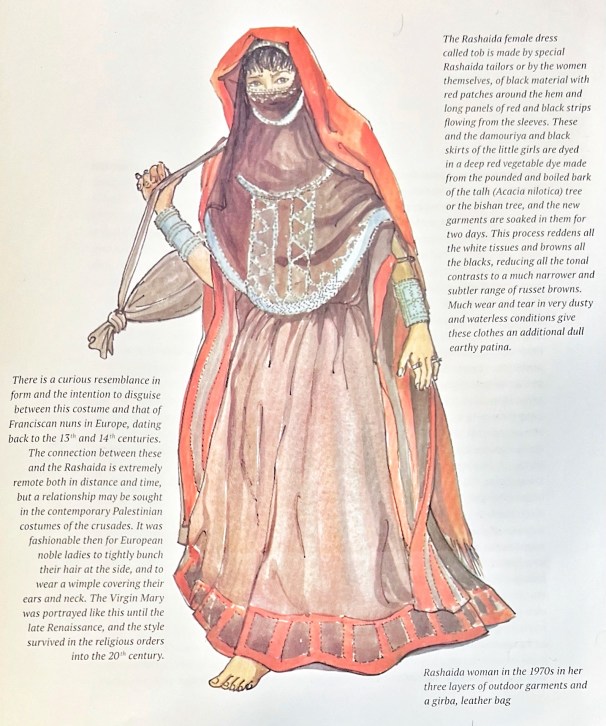
Above, Griselda Al Tayib draws fascinating analogies with the attire of 14th century European nuns and explains the traditional dyeing process of Rashaida cloth and the “earthy patina” it takes on with wear. In the past, many Rashaida women had but one outside dress, worn for a year and then repurposed. Griselda El Tayib, Regional Folk Costumes of the Sudan, p 55.
From Girl…
Griselda El Tayib provides a meticulously detailed and fascinating account of the layer upon layer of elaborate accretions to Rashaida dress and adornment as young girls grew into womanhood in the 1970s. Little girls under seven, expected to help in the herding of sheep and goats, wore long skirts, known as tikka, or ticha in Rashiidi Arabic. “Formerly of black and white stripes”, she observed, “now plain damouriya with ornamental black square patches around the hem and drawn at the waist by string”, they were soon to be replaced by simple market bought dresses. Young girls would wear a few bead necklaces and inexpensive bracelets. El Tayib notes that formerly, before fears of theft became an issue, these would have been of silver.
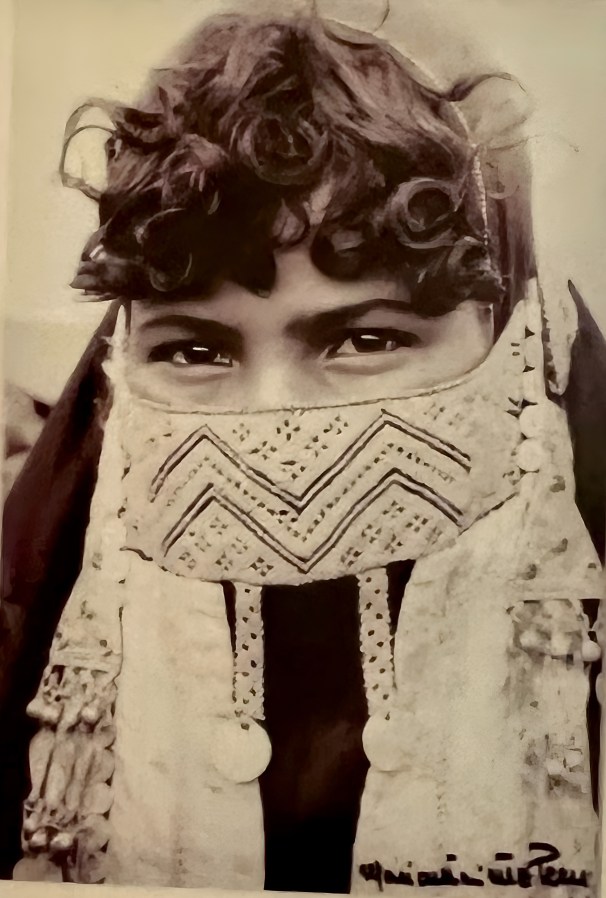
Once a young girl adopted the face veil, or mungab and her gargosh headdress pictured above, her mouth will remain covered in public for the rest of her life.
Between the ages of twelve and seventeen, girls adopted the enveloping tawb dress and the hijab gargosh, described by El Tayib as a “heavier and more voluminous head veil”, bearing three squares of “folded cloth heavily embroidered in geometric patterns with silverly lead beads and green and red beads and knots of wool hanging down from these panels. The plaited and knotted tassels of red and green wool are also threaded with silvery beads.”
The face mask becomes very elaborate too and is known as mungab butaihi. It consists of a large panel of stiff black cloth worn at all times. It is a “remarkable object of folk art and always richly decorated with pearl buttons, silvery lead beading or rusas, silver plaiting, called tilul and additional real or simulated silver coins, known as duma’a or tears.”
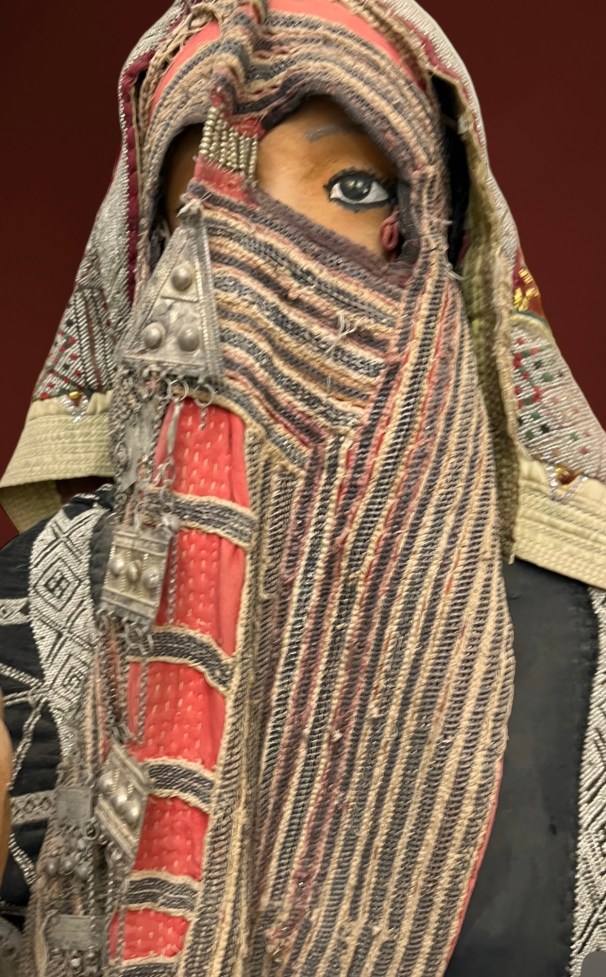
Two years later, if the girl is still unmarried, “a large perpendicular fold is made in the mungab, projecting forward about an inch and decorated with coins and discs and triangular silvery trinkets”. This type of mungab, the mungab – filaiti is worn for another two years.
If the girl remains unmarried after this point, a forehead piece called jabba is added so that the mask now covers the entire face and neck, leaving only the eyes visible. “The border patterns of tilul are carried up around this forehead piece, and its central perpendicular fold is joined to the fold of the mungab by three or four rows of yellow or golden – coloured beads forming a little barrier that projects forward on the bridge of the nose.” For Griselda El Tayib, this addition created an “incredible impression of downcast modesty”.
Below, young Rashaida girls dancing in their traditional dress.
…To Woman

The Rashaida women in Lafforgue’s superb portrait above fix us with a confident, steady gaze that reveals perhaps just a hint of a smile. They are swathed in their wimple-like head veils, known as ginaa`. Their clear eyes are etched with kohl and their noses flanked by beauty spots and fine vertical tattoos, known as mishaaly, half concealed by the taut silky mouth veil, or lithman.
Read more about Rashaida tattoos next month.
The Rashaida married woman’s wardrobe consists of the wimple-like, tubular ginaa, pictured above, with its heavily embroidered and beaded edging around the opening, known as the bakrah, and the taut mouth mask or lithman. The lower edges of the ginaa “hang well down over the breasts and here, there are long silver embroidered manajis bands going down from the chin, that help to hold the veil heavily against the chest.” The ginaa rests on and is secured by the marbata; a flat square of black cloth decorated with lead beads and laid atop her head, which El Tayib noted, swiftly becomes impregnated with oils. The marbata is tied round the two tight bundles of hair, or jimrab, gathered on either side of the wearer’s skull with leather thongs.

A Rashaida woman, wearing compound attire.
Griselda El Tayib, Regional Folk Costumes of the Sudan, p 59.
While the ginaa is considered modest enough to be worn constantly around the compound, El Tayib notes that “further afield”, a Rashaida woman would often wear a folded red milaya over their heads. Described by El Tayib; “when folded, the part which is supposed to hang down the back is decorated with three vertical bands – 4 inches wide – of embroidery thickly decorated with heavy lead beads. At the bottom of this panel is a deep ornamental border of netted silk threads and a tasseled fringe of red and grebe silk interspersed with silver beads. This is a garment used for important occasions, and is worn with conscious pride and carefully folded and put away, often in a cloth or leather bag, when not in use.”
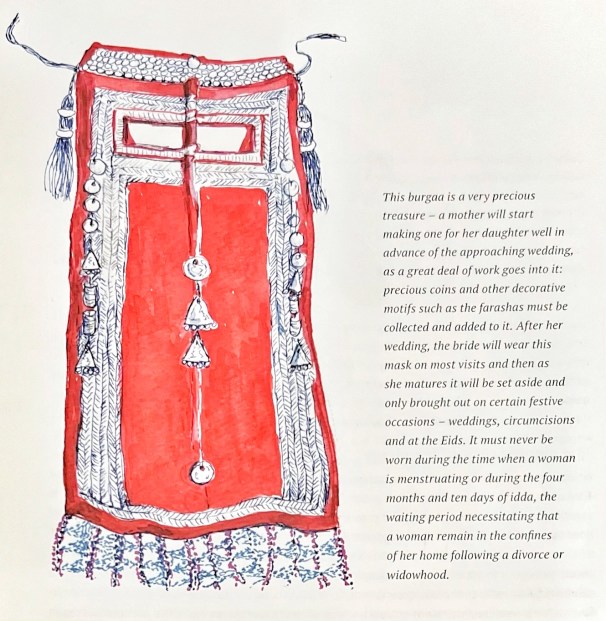
Above, Griselda El Tayib’s beautiful illustration of the married woman’s burgaa, the pièce de résistence of Rashaida married women’s dress.
El Tayib explains that the married woman’s burgaa resembles the mungab filaiti of young girls. It is distinguished from the latter, however, by its central panel being red, although El Tayib notes it may often be “off white material on which some red and pink dye has been splashed in an ornamental way.” As El Tayib observes above, the burgaa is a treasured part of every married woman’s attire and gifts of coins, buttons and pendants are lovingly added to the veil over time, with some sources relating that it is restyled every three years. As El Tayib also notes above, the burgaa is so precious that its use is restricted to specific, high status social events.
See too: https://www.wearableheritage.com/rashaida
See a stunning example in Weddings of the Rashaayda People of Sudan

Above, Rashaida women, imposing presences in their highly ornamental face masks, Sisters Under the Sun, The Story of Sudanese Women, Marjorie Hall and Bakhita Amin Ismail, 1981.
 Women's literacy in Sudan