


Melted Amber
Gum Arabic in Sudan Part 1/2

Setting the Scene “Melted Amber”
Tapping Harvesting Traditional Uses in Sudan
Setting the Scene
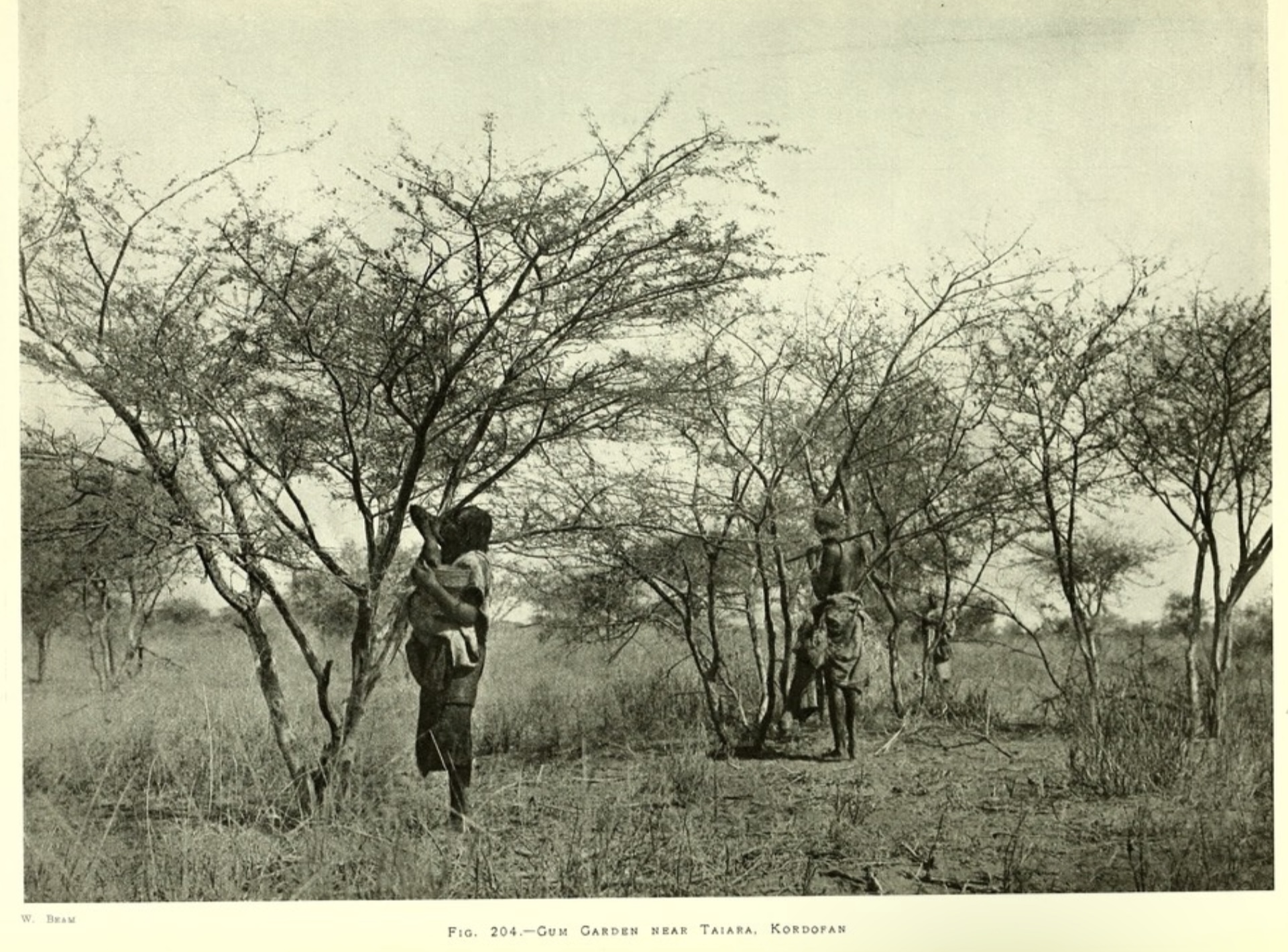
The title montage and the photograph it is based on above depict a Kordofani woman collecting gum arabic from the upper branches of an acacia senegal tree. The photo is one of several plates illustrating gum arabic tapping, harvesting and processing in the 1908 Third report of the Wellcome research Laboratories at the Gordon Memorial College, Khartoum. Though the colonial gaze of the authors permeates its pages, this fascinating document compiles painstaking and wonderfully enthusiastic studies on everything from the bacterial filtration powers of the traditional water zir to the efficacy of indigenous medicinal herbs and the use of healing incantations.

Above, a colonial postcard of women sorting and cleaning gum arabic in Omdurman. More next week on women’s roles in gum collecting and processing.
My thanks to DO YOU REMEMBER SUDAN? for this and other images reproduced here.
This week’s post is the first of two articles dedicated to gum arabic in Sudan. Over the centuries, this remarkable substance, sustaining communities in times of famine, was widely believed to be the biblical “manna from heaven” and enjoyed prophetic status as “remedy to every ailment” (Dorrit van Dalen, see below) in the Islamic world. It has been used in everything from glues, inks and artists’ paints, silk and fine textile printing, to falsifying identity cards in World War II. It is the adhesive of the humble postage stamp and cigarette paper. Better known to many as The Food and Agriculture Organization’s additive 414, gum arabic has become the indispensable emulsifier of the global soft drinks industry and an essential binding and stabilizing agent in pharmaceuticals. It is complex to synthesize, sometimes frustratingly unpredictable and often most plentiful in the harshest of summers. Though vast quantities – until the present conflict, 70% of the world’s gum arabic – are exported from Sudan, it remains a central ingredient of Sudanese daily life and culture.
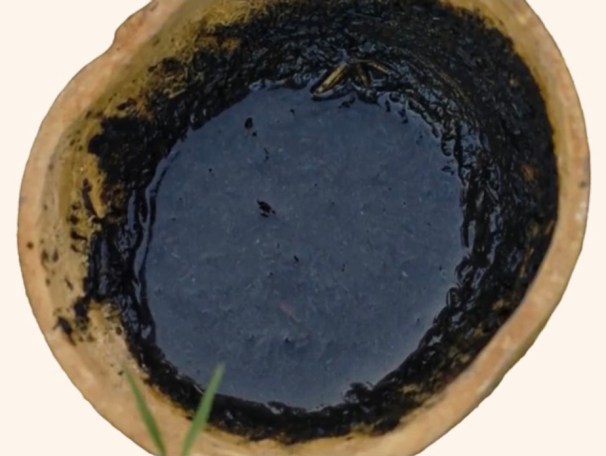
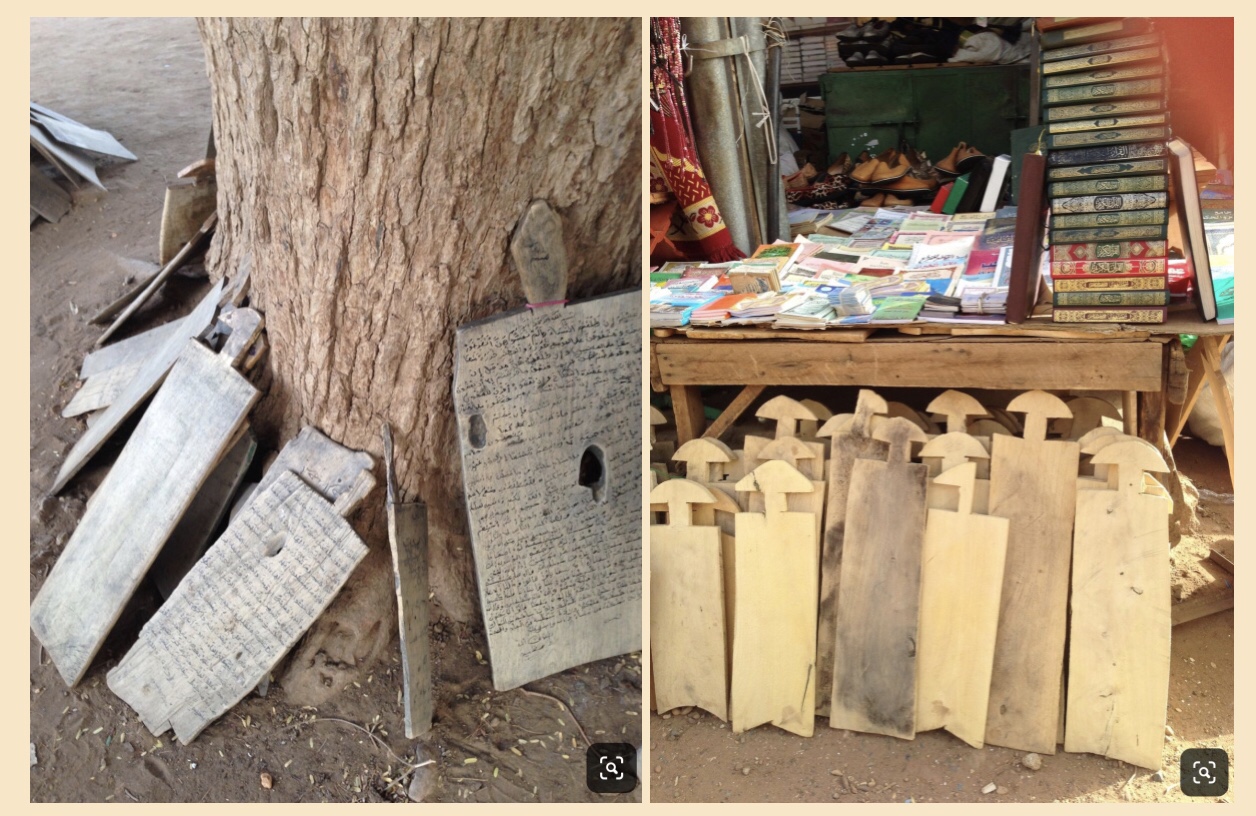
Above, an hollowed out calabash inkwell, or dawaya, in western Sudan. It contains ink made from a mixture of charcoal or soot, gum arabic and water possibly “containing a tuft of hair” (Prof Ahmed El Safi). Researcher Dorrit van Dalen (see below) recalls one of her informants describing how, as a child, he learned to recite the Quran on traditional wooden boards, pictured below, using charcoal and gum Arabic ink. When the board or lawH was covered in verses,“ we rinsed it off with water and then drank it. They say that the spiritual wisdom of the Quran enters your body and protects it that way. Known as Amar ink, it is prepared by fakis for writing in the khalwas (Quran schools), general writing and in the making of leather bound amulets or hijbaat. (Prof Ahmed El Safi, Traditional Sudanese Medicine)
Read more on the role of Arabic calligraphy in Sudan in Birds of the Soul.
Photo, Pinterest.
Next week, I will be reviewing the impact the present conflict has had on Sudan’s gum arabic industry, its historical, geopolitical and ecological context and the words of women who work in the trade.
“Melted Amber ”

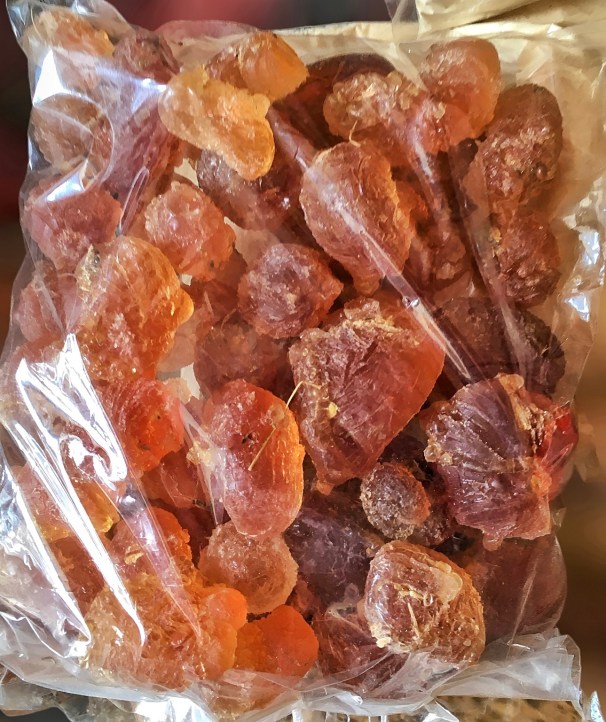
Above, harvesting gum arabic. The glistening globules of hardened tap are known as ka`kuul and the tap droplets as dumuu or tears. It is still uncertain why tap is exuded but it now assumed to be as a result of general stress to the tree, and not, as previously thought, wholly as a reaction to bacterial attack.

baTun hashaaba taldii aS-Samugh w-al kadaaba; the womb is like the hashab tree; it brings forth gum arabic and false gum, popular Sudanese proverb. My thanks to Muna Zaki for this and the proverb below.
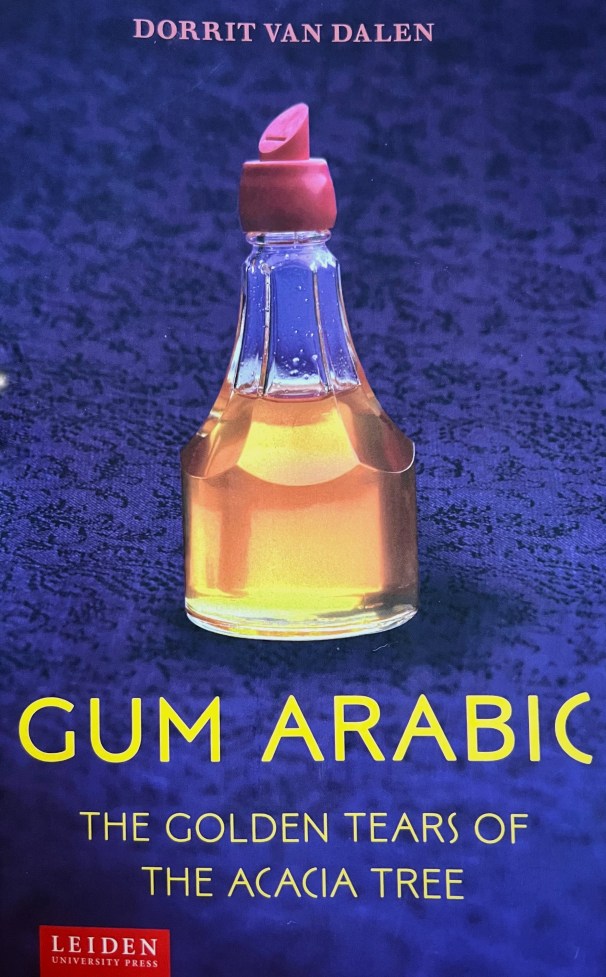
Dorrit van Dalen’s eminently accessible monograph, Gum Arabic, The Golden Tears of the Acacia Tree, (Leiden University Press, 2019) provides a gripping historical and geopolitical biography of what on first sight would seem an unlikely substance to have excited deadly international rivalries, trade and actual wars, yet alone to have drawn the attention of and eluded the all-powerful American sanctions lobby. In her work, van Dalen, quotes the reaction of explorer, Samuel Baker on seeing gum arabic for the first time while on an anti-slavery expedition in western Sudan.
He was stunned, describing what he saw as:”beautiful, amber-coloured masses upon stems and branches”. The size of nutmeg to oranges, the crystalline circles of gum were ” as hard as ice on the exterior, limpid in the centre, resembling melted amber”. These “beautiful balls of frosted yellow gum recalled the idea of precious jewels upon the trees in the garden of the wonderful lamp of the Arabian Nights”. He also recorded that the fresh gum he ate while hunting rhino was “exceedingly sweet and pleasant to the taste”.
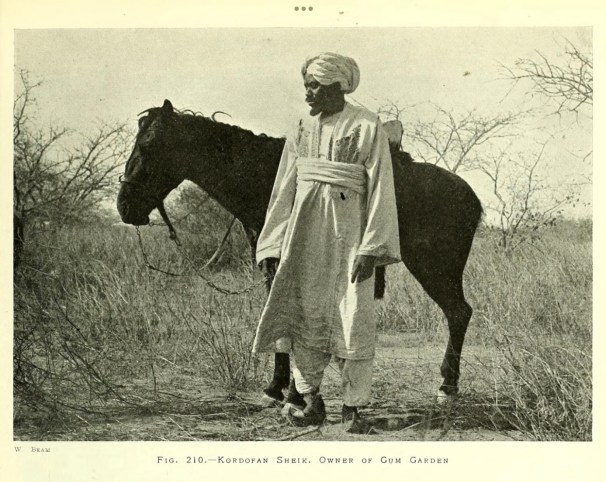
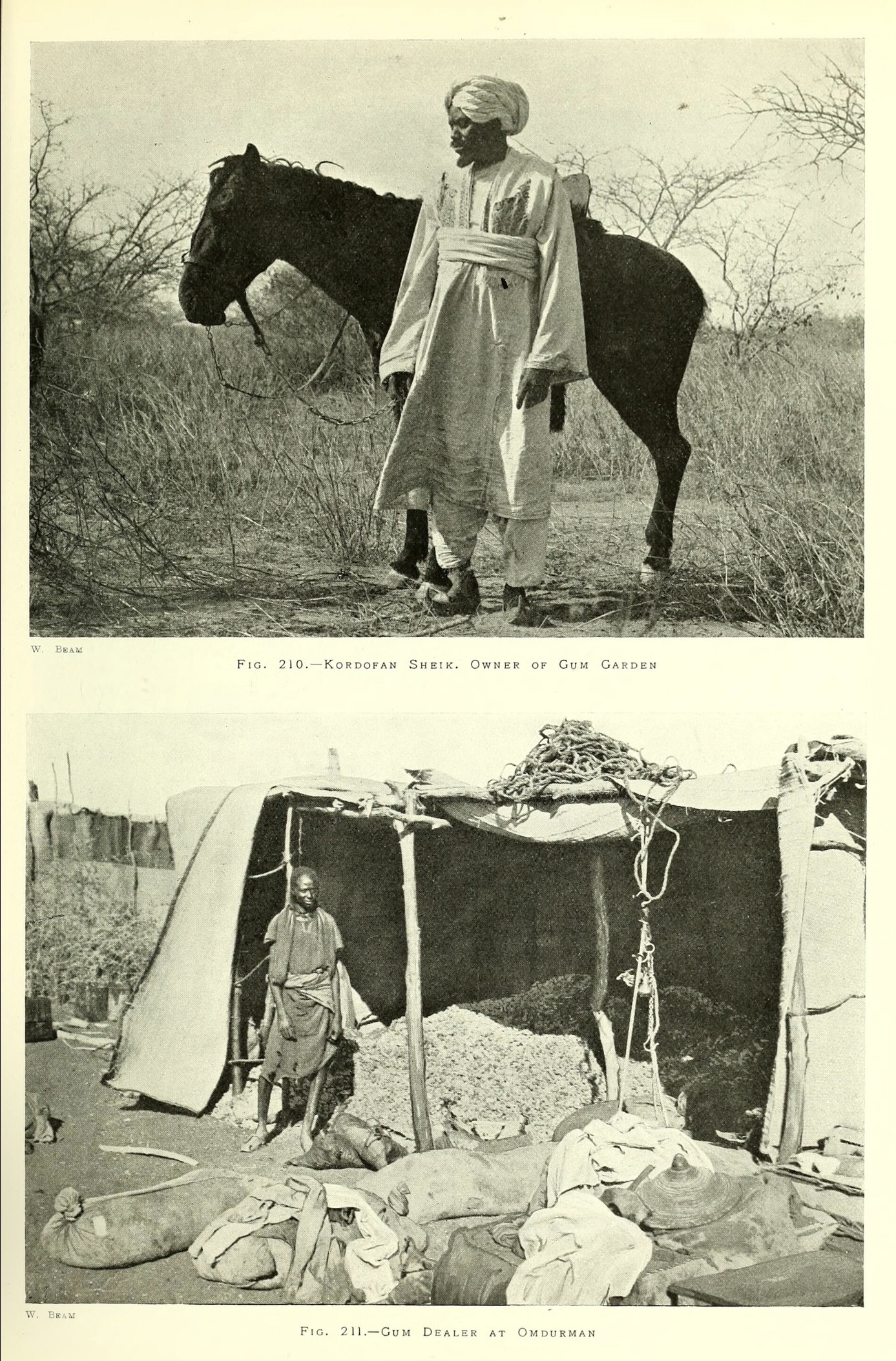
See a review of van Dalen’s work in Tears of gold: how gum arabic conquered the world Right, a Kordofani owner of a gum garden,1908, Wellcome CC, as above.
Gum arabic was to draw countless adventurers, colonialists and merchants to the wild sunt forests and “gum gardens” of western Sudan in search of easy money. One such was the German merchant and author of A Prisoner of the Khaleefa, Karl Neufeld. Another was Alfred Wolff, whose family business was to become one of the three largest gum traders in the world. Desire to control Sudan’s gum arabic in part drove the Turkish-Egyptian invasion of Sudan with its brutal taxation policies that came to be hated by the Sudanese. And in turn, it led British imperialists strategically to temper their approach to Sudanese producers and traders.
Below, a glossary of key terms related to gum arabic, as recorded by colonialists in 1929, (Volume 12, Sudan Notes and Records). Many of these terms are still used today and feature in popular sayings and proverbs, as above.

The gum bearing acacia variety outlined below (Wikipedia), acacia senegal, is known in Sudanese Arabic as hashab or sunt. Sudan is the largest exporter of top grade hashab gum arabic. Gum, often indistinguishable from that of the acacia senegal but considered of slightly inferior quality, is also harvested from the talH tree, acacia seyal, whose aromatic wood is used in incense and smoke baths.
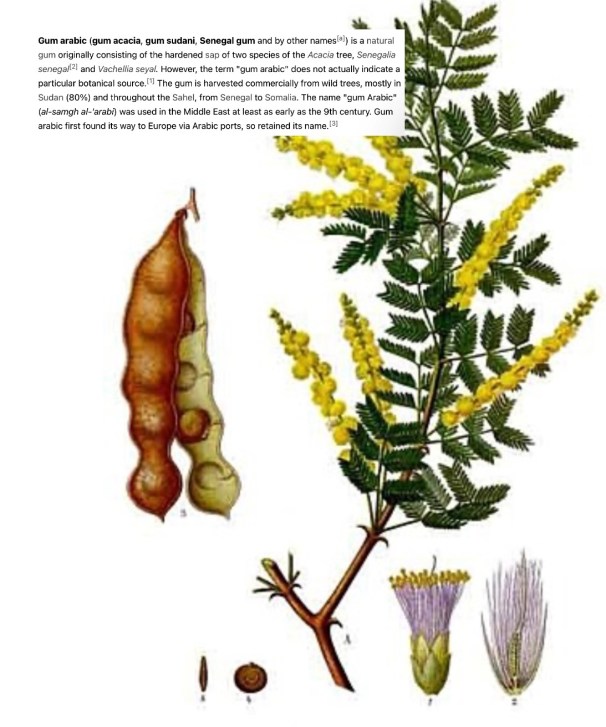
Unlike resin, gum arabic dissolves in its own volume of water. Its protein and carbohydrate properties enable it to bind oil and water molecules in emulsion.
Tapping Harvesting Traditional Uses in Sudan
Tapping
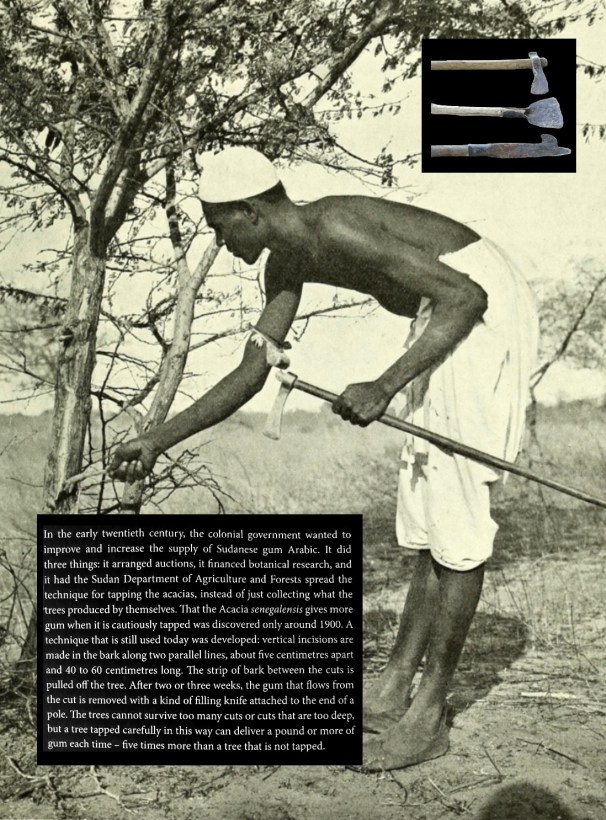
Photograph of acacia tapping, from Third report of the Wellcome research Laboratories at the Gordon Memorial College, Khartoum. Skill, instinct borne out of experience and providential weather conditions all play their part in sap production and successful tapping. As van Dalen’s informants noted, the “tears do not flow every year. Only when the dry season has been too dry, when too much wind has blown or when insects have done some damage to the crops, but not much, will something happen.”
Text inset, tapping techniques, as described by Dorrit van Dalen, as above, p 136. Inset, top right, traditional tapping tools: top, the small axe or farrar, middle, the makmak, used for tapping the aciacia seyal or talH, and bottom, the sonki (Effect of tapping tools and date of tapping on Acacia polyacantha gum yield in South Kordofan State, Sudan, Idris Musa and Kamal Fadl). Recent research has focused on redesigning of the sonki to reduce damage to the tree, see for example ETFRN Restoring the gum arabic belt in Sudan with local communities

ash-shadar al-kubaar fiihu aS-Samugh.
The old trees have the gum. Reminding us of the wisdom and experience of older people in society, the proverb above plays on the fact that only trees over seven years old can be usefully tapped. A tree can then be tapped for four more years.
See more proverbs in The Dung Beetle and the Moon
When the colonial administrators van Dalen refers to above came to study gum arabic production in Kordofan, they noted two types of gum collected; that of the privately owned gum gardens, known as hashab geneina, tapped between October and February, and the other from curiously greater yield wild, untapped trees and known as hashab wady gum, a term also used for any large tear of gum dark in colour. Gum is also gathered when it naturally exudes from cracks or fissures in the bark of gum garden trees. Care was taken during tapping to ensure that the incision did not “penetrate into the wood, a thin layer of the inner bark being left to cover it” (Wellcome).
As today, the gum arabic crop in colonial times was tended when the sesame, millet, sorghum and peanuts that could be grown in the shade and enriched soil of the acacia forests were safely planted. Acacia pods provided fodder for livestock.
Read more details of the tapping process in Third report of the Wellcome research Laboratories at the Gordon Memorial College, Khartoum, p 415.
Harvesting
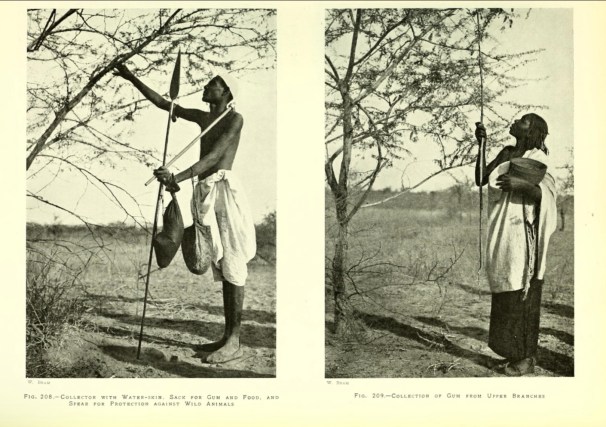
Collecting gum while carrying water skin and spear to protect against wild animals, Wellcome CC, as above; an arduous, prickly and sometimes even dangerous task.
Also as today, water or the lack of it determined when and indeed whether the gum could be collected at all. In 1908, colonial researchers noted “the working of the whole of the vast gum-producing district of Kordofan was dependent upon the existence of a very small number of wells.” Those collecting gum further afield from sparse water sources were “forced to carry their water, food, and the collected gum with them; and as collections take place in the hottest and driest months of the year, it is not a matter of surprise that, in most cases, they will not go any further than their actual needs force them.”
Climate change with its droughts and higher temperatures, coupled with increasing economic instability have made the labour of gum collection in recent years just as, if not more arduous today. Although pickers today receive “gifts” of food, water and camp beds for their dry season trek into the acacia forests, they still “earn ten times less than an unskilled worker in Khartoum” (van Dalen) and many have migrated to Gezira to secure work or turned to gold mining. Pickers on average earn no more than 3-10% of their gum’s export price. It has become, many Sudanese lament, an old man’s trade. When a tree stops producing gum it will be cut down to sow sorghum or beans in the leaf-fed nitrogen-rich soil around it, but sadly for many, need drives the premature cutting down of trees.
The challenges facing gum arabic producers are powerfully expressed in this 2-minute AFP video report, subtitled in English:
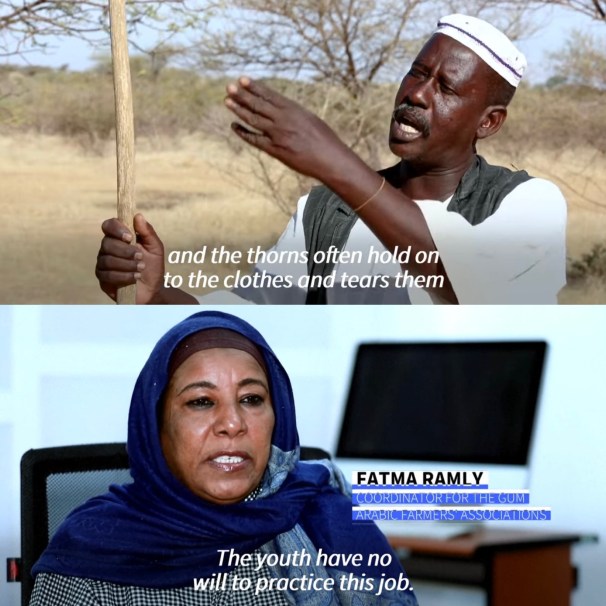
Sudanese gum producers hold on trade
More on the ecological impact of gum arabic cultivation and the Green Wall initiative next week.
See stunning photographic accounts of gum arabic harvesting in:
Harvesting gum arabic in Sudan in pictures The Guardian
“The atmosphere was quiet but tense. Some of the traders had boys with them who offered glasses of tea on small trays to village merchants, inviting them inside to discuss a price….Only hashab never sleeps here” Dorrit van Dalen on gum trading in El Obeid
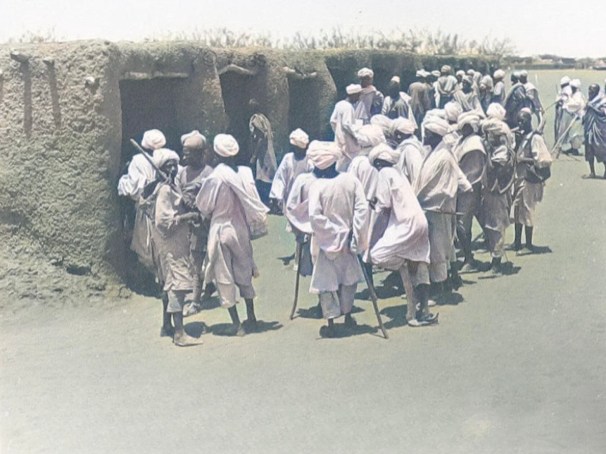
Above, gum arabic merchant traders in El-Obeid, colonial postcard. El Obeid is the largest of four central markets for gum arabic in Sudan, ahead of En-Nahud, Um Ruada, Rahad). In the early 20th century “two hundred kilos of gum were unloaded every month from November to March in El Obeid from each of a few thousand camels. Now some three hundred truckloads of twenty tons are deposited every month.” (van Dalen)
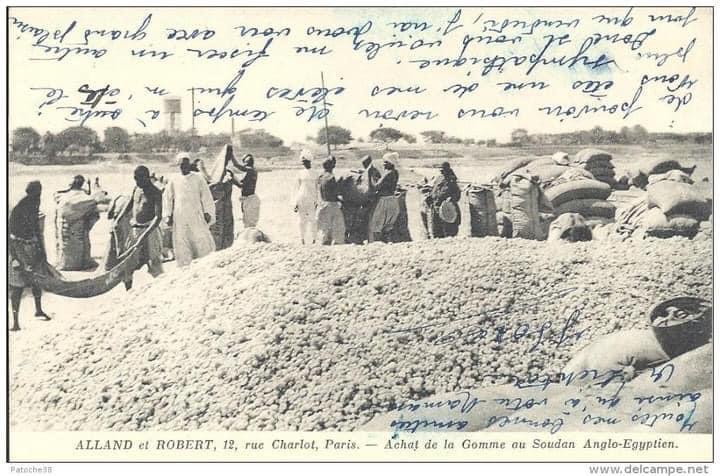
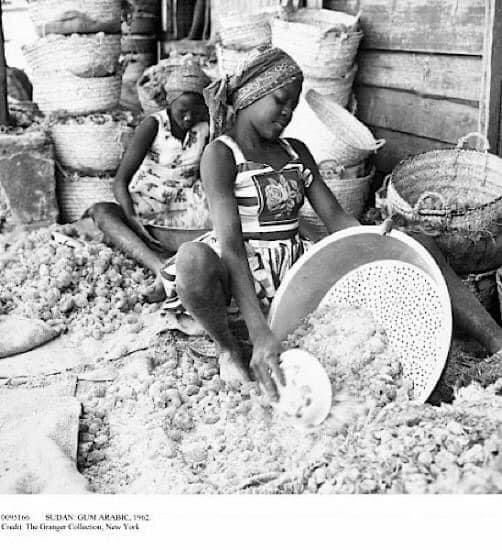
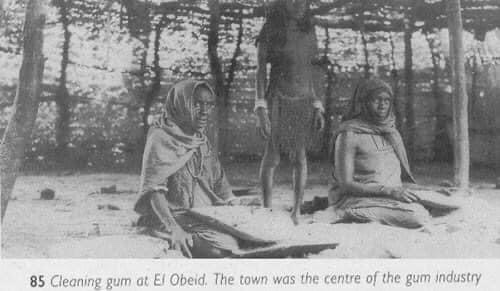
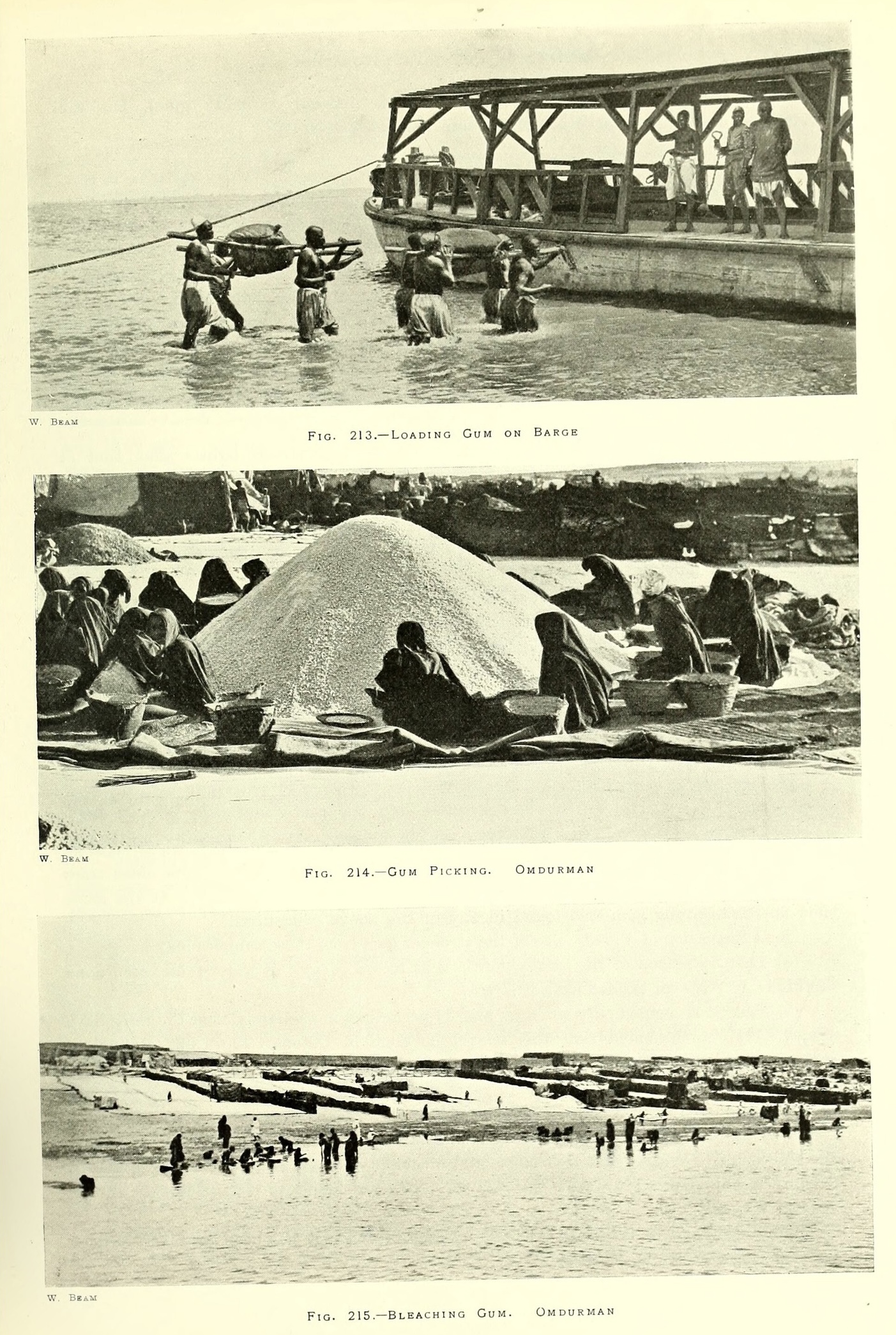
After picking, the gum arabic globules are separated out, sorted and cleaned. Get a feel for this backbreaking work, often undertaken by women in this evocative one-minute Sudan Layout video:
Below, more colonial – era scenes from the gum arabic industry in Sudan.
Traditional Uses of Gum Arabic in Sudan
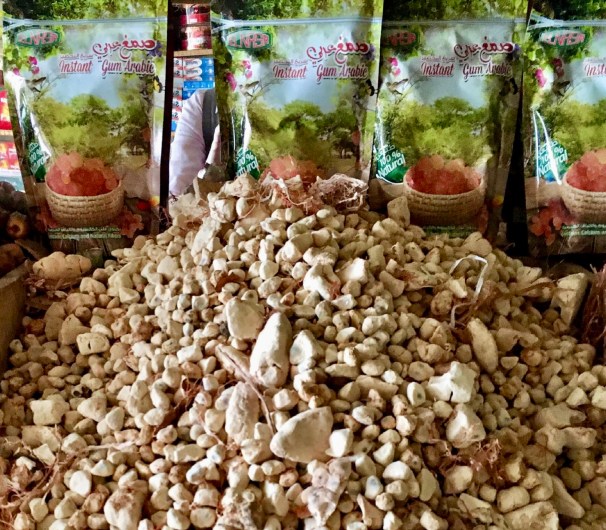
Pouches of gum arabic propped behind nuggets of tabaldi fruit at a Souq Al-Arabi grocery stall in 2019.
Without gum arabic to stop the charcoal or soot settling out from water, there would be no ink, as the 11th century North African sultan and scholar Tamim ibn al-Mu’izz ibn Badis observed. For the sultan, however, gum arabic was vital to the transmission of sacred text in another, far more sublime way. It enhanced the lustre, or “rawnaq” of the written word; the “semblance of water that is seen upon a sword” and the “clarity of light in the first hours of the morning”. (Dorrit van Dalen) The researcher also noted on her travels in the Sudanese gum arabic belt that adobe walls of homes were smeared with gum arabic to deter termites and women used it to “lighten the dough”, the latter effect echoed in recent food research.
Among the many other uses of the bark, pod and gum of the acacia senegal, Dr Ahmed El Safi (Traditional Sudanese Medicine) records their use in the treatment of peptic ulcers, diarrhoea, coughs and chest complaints as well as in water purification. His observation that the gum has also been thought beneficial in the treatment of diabetes and renal failure appears to have the backing of recent scientific studies as well as a means of combatting obesity. If Sudan is not thwarted in its ongoing campaign to redefine gum arabic as a probiotic superfood, revenues will increase substantially for Sudan in world markets where raw commodity prices favour the buyer. More on this next week.
Next week, I will be reviewing the impact the present conflict has had on Sudan’s gum arabic industry, its historical, geopolitical and ecological context and the words of women who work in the trade.
 Women's literacy in Sudan