

The Mourning Maidens and the Bier; The Sudanese Story of The Big Dipper
The star formation known to Sudanese as The `’Angareeb (The Bier)
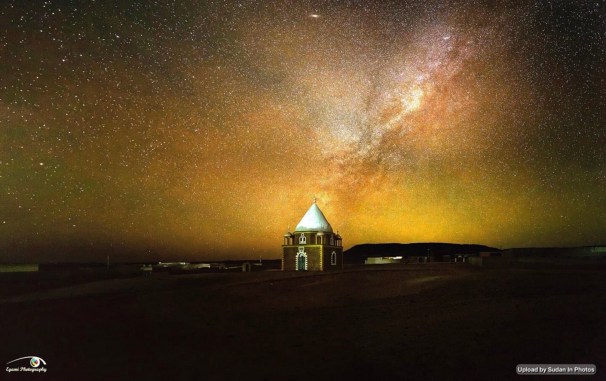
Pinterest; Clear Night Sky over Sudan, Mohammed Egami Photography, Upload by Sudan in Photos.

Setting the Scene
The Night Sky in Sudan
The Moon and Stars; A Lore of Their Own
The ‘Angareeb and The Milky Way
The Mourning Maidens
Setting the Scene

Above and title image, The Great Bear, as depicted in the brilliant, tenth-century Muslim astronomer, Al Sufi’s Book of Fixed Stars. The familiar seven stars of The Big Dipper, an asterism of The Great Bear constellation, recorded by Ptolemy, are visible in the rump and tail. They occur here in mirror-image to what we actually see as Al Sufi provided two images of each constellation; one from the outside of the celestial globe and the other from within. Image, from 1009 edition, Bodleian Library, (CC, Wikipedia). Al-Sufi not only documented Ptolemy’s astronomical corpus but substantially extended its scope.
The stars’ names in Arabic reference both the Great Bear constellation and the Arab world’s poignant vision of what we call the Big Dipper / The Plough / The Ladle. For their meanings and English equivalents, see spacetheology, from which the diagram below is taken.
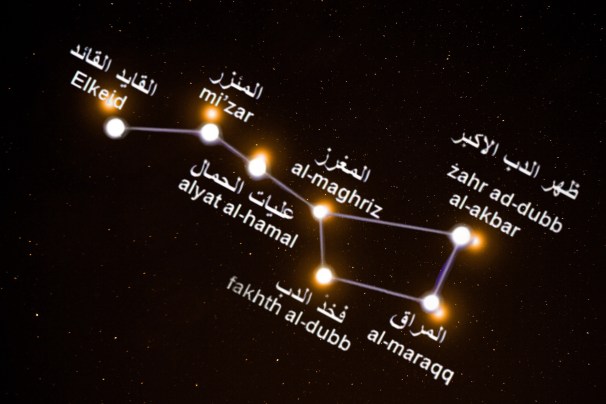
In Sudanese tradition, echoing other ancient Arab astronomical sources, what we know as the Big Dipper is a star-etched funeral cortege that makes its stately way across the vault of heaven.
In the bear’s body, there are four stars / They form a square / it turns around the North Pole like a wheel / The Arabs call it the bier (na ` ash) / Three stars are in a line / At dusk they appear to the eye / The Arabs call them the Daughters (al-banaat). From Al-Sufi and Son: Ibn Al-Sufi’s Poem on the Stars and Its Prose Parent
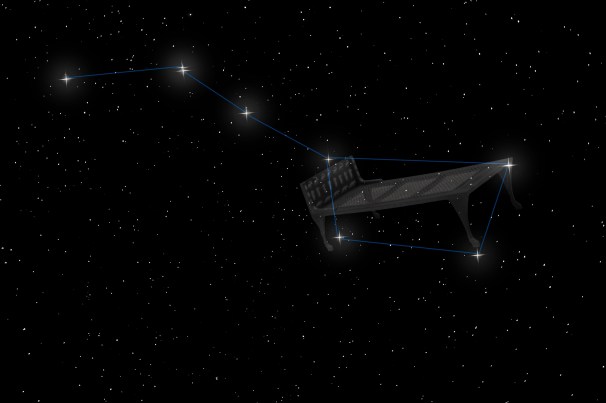
Above, the ‘Angareeb star formation and ancient Kerma funerary bed. A special, squat-legged Sudanese wood and rope bed or ‘angareeb is still carefully stored by some households in northern Sudan, to be used as a bier:
“The body is first washed by a close relative as a ritual purification then wrapped in a white shroud and laid on an angarib. A green cotton cloth especially brought from Mecca and bearing the inscription attesting to the unity of God, is placed over the body. Most households have such a cloth which is carefully preserved and used for successive funerals……When the time for burial arrives, the angarib on which the body lies is carried by four male relatives or friends of the deceased to the cemetery……After the burial the bed and the green cotton cloth are brought back to the house and kept in a special room for two weeks. After this period water and milk are sprayed on them, sandalwood is burned and prayers said in honour of the deceased.”
From Sisters under the Sun, Longman 1981, p 182.

Above, a Sufi funeral procession at Hamid Al-Nil, the departed borne aloft on their ‘angareeb bier.
Learn more in The `Angareeb.
Unless credited otherwise, the images in this article are CC or copyright Dreamstime.com, used under contract.

The Night Sky in Sudan
Below, the night sky of Khartoum, seen 29th December, from The Sky Live.

In the early 1980s, before today’s slick highways from Khartoum to Dongola, travelling north meant a twenty-four hour bone-bruising and teeth-shattering trek across the Nubian Desert in a bus which bucked, heaved and roared as it toiled through the dunes. On my first journey north as a contract teacher new to Sudan, an old-hand teacher-minder advised I took a seat over the back axle and in all my delicious greenness and to his evident delight, I did. It would result later in the loss of two front teeth. Yet I can bear him no ill will.
Every few hours after nightfall, the bus would stop and I would clamber stiffly down, and sit in sand still warm from the sun while the driver smoked and brewed tea and snatches of Mohammed Wardi stained the silence from a slack cassette tape playing in the cabin. And then I looked up and, for the first time in my life, saw what a 1930’s colonialist was blessed to see:
Above the great vault of heaven with its myriads of stars whose brilliancy is intensified by the clear, dry atmosphere, and all around the boundless desert, which blends with the sky, making the horizon invisible, and giving one the strange impression that the little camp is perched on the summit of some solitary mountain.
(Game Animals of the Sudan: Their Habits and Distribution, Sudan Notes and Records, 1931).
For the first time too, I saw shooting stars. For the Darfuris, colonial observers related, shooting stars were starry shards thrown by angels at those wilful spirits or jnūn who “try to climb up to heaven on each other’s shoulders.” (Sudan Notes and Records 17, 1934).
And for the first time, I had journeyed with those who knew how to navigate by the stars.
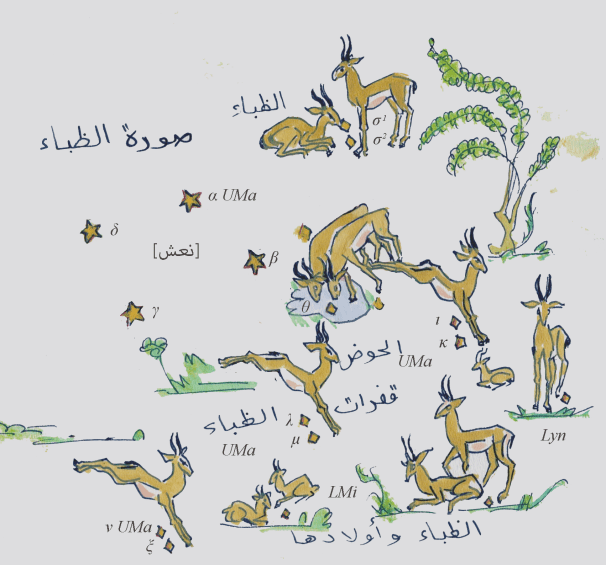
Al-Zhiba Ursa Major Al Sufi; the figure of al-HawD, The Watering Place, in the great scene of the Gazelles, in the traditional Arab sky, as described by Abd al-Rahman al-Sufi, 964, Wikipedia CC, explained in Al-Sufi and Son: Ibn Al-Sufi’s Poem on the Stars and Its Prose Parent thus;
“Below the stars of na’ash and al-banāt / There are the stars known as the Galloping Leaps (al-qafzāt) / They are along the edges of this Bear / Nearby to al-banāt and al-suha”
See too Arabic in the Sky
The Moon and Stars; A Lore of their Own
British colonial researchers were fascinated by Sudanese understandings of astronomy and astrology and were quick to acknowledge the complex and careful observational value of their star-plotting woven into the fabric of daily life. In Notes on an Arab Stellar Calendar, T.R.H. Owen, writing in 1933, notes that the Sudanese year was divided into four seasons, seyf (summer), kharif, (autumn), rabi ` a, (which he hesitates to call spring, falling as it does from mid-September to mid-December), and shita; (winter). The seasons and their waxing and waning are signposted by the visibility of certain stars. Each of the four seasons, he explains, has “seven “’eynas, each covering thirteen days so each season has 91 1/4 days an ‘eyna begins – dakhal- when the star governing it is visible just above sunrise in the earliest morning until 13 days later the next one takes its place and it has climbed higher up the sky.” See too The Arabs and The Stars, Correspondence, SNR, Vol 19, 1936, for corrections to Owen.
Below, Owen’s ‘eynas of the seasons, from Notes on an Arab Stellar Calendar.
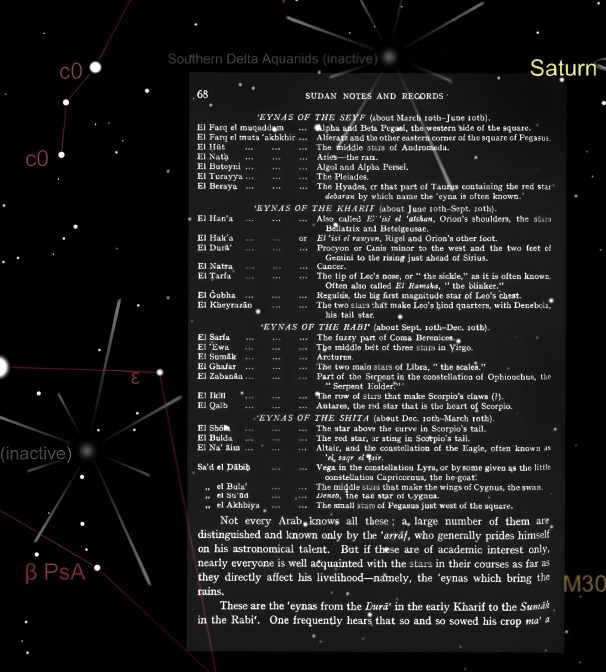
Owen goes on to observe that while the `’araaf, ‘arrāfīn, the soothsayer, astrologer or forecaster “generally prided himself on his astronomical talent” and that not all the ‘eynas meticulously listed above were common currency, everyone at that time was “well acquainted with stars in their courses as far as they directly affected their livelihood” – those that ushered in rain, fruitful planting and harvesting. His account includes numerous, often humorous sayings and rhymes current at the time; “doggerel” aide-memoirs for the farmer and others who depended on the skies. Crowfoot, writing in 1920, sets out in fascinating detail the twenty-eight “mansions of the moon” that he understood to constitute the Arab astronomical year, each mansion dependent on “the heliacal rising of certain stars”
The ‘eynas Owen plotted could augur more than “heat, cold, rain and mist”. For many Sudanese, they were omens of more universal good or ill fortune. “The moon and stars have a vast lore of their own”, colonialist observers of the customs and beliefs of the northern Beja in 1938 noted. The ‘eynas could determine propitious or ill-starred dates for weddings, for which the counsel of a fikih or holy man “learned in the stars” was called upon (Wedding Customs in the Northern Sudan, SNR, Volume 5, 1922. Their observance could ward off poverty, divorce, or adultery, and even aid the efficacy of the mixing of deadly poisons, performing works of science, meaning magic, approaching kings and the writing of love charms.
The ‘Angareeb and The Milky Way

Hamid Dirar, the late biochemist and author, wrote of his nomad childhood in The Amulet. Like all nomads, he was taught to navigate by the stars and below are his accounts of The ‘Angareeb and The Milky Way:
I slept very little that night, but lay looking at the stars, at the four rather crookedly arranged stars in the form of the four legs of a bed that make up the constellation we call the Angareib. The bed is said to carry the corpse of a dead man and the three stars that follow the pall bearers are the dead man’s daughters, Banat Naash. The one in the middle is the divorced daughter and the tiny star close to it is her own daughter. (If you can see this one then your eyesight is excellent). The girl farthest back is the lame girl Ireij. The star nearest the coffin is the unmarried daughter. The Angareib is (part of) the constellation known in northern lands as the Great Bear or the Big Dipper. If you draw a straight line joining the two front legs of this Angareib and extrapolate it northwards it will pass through the Jedi, the gazelle fawn, the Pole Star.

The Milky Way

The Milky Way, also known as darb at-tabbāna; Haymakers’ Way, and Majar al-Kebish, The Track of the Dragged Ram in Arabic, image, Wikicommons.
“But as an infant star-gazer I was more fascinated with Majar el Kebish, the Track of the Dragged Ram, elsewhere known as The Milky Way. When Allah incited the Prophet Ibrahim to slaughter his son Ismail as a sacrifice to Him, Ibrahim told his son about the matter. The young prophet consented and told his father to obey Allah’s orders. Allah willing, the young man said, he would endure death. Thus Ismail lay down and Ibrahim brought his knife to slaughter his son. At this point, Ibrahim, the Friend of Allah, heard a sound in the sky above him. When he raised his face to investigate, he saw an angel dragging a ram bringing it to him to redeem his son. The track of the dragging of the ram is marked by the myriad stars of Majar el Kebish.”
From scientist and nomad, Hamid Dirar’s The Amulet.
The Mourning Maidens
And still the earth revolves, and still the blaze / Of stars maintains a show of vigilance / It should, for long ago, in olden days, / We came from there. By luck, by fate, by chance,… From Star System, by Clive James.
Today Sudan’s dazzling canopy of stars must compete with the flare and blaze of exploding shells and anti-aircraft fire. The clear night air is wreathed in acrid smoke of burning homes. In African American folklore, the Big Dipper or “drinking gourd” was used by escaped slaves from the south to guide their path northwards and to freedom. For me, today, the Banāt al-Na’ash holds an equally compelling but darker symbolism. As its maidens process with vast dignity across the heavens, they do so in solemn witness to all that Sudan has lost, a star-lit etching of every funeral cortege denied.
 Women's literacy in Sudan