

ElTayeb DawElbait
Integrity of the Nomad
“Inside the war, the physical war, there’s another war for art.”
ElTayeb DawElBait, interviewed by New York Times; Inside Sudan’s war

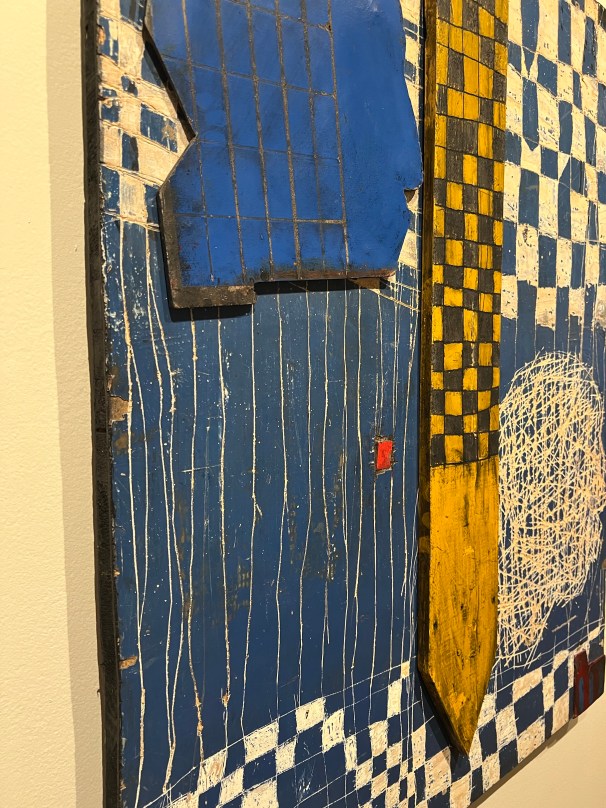
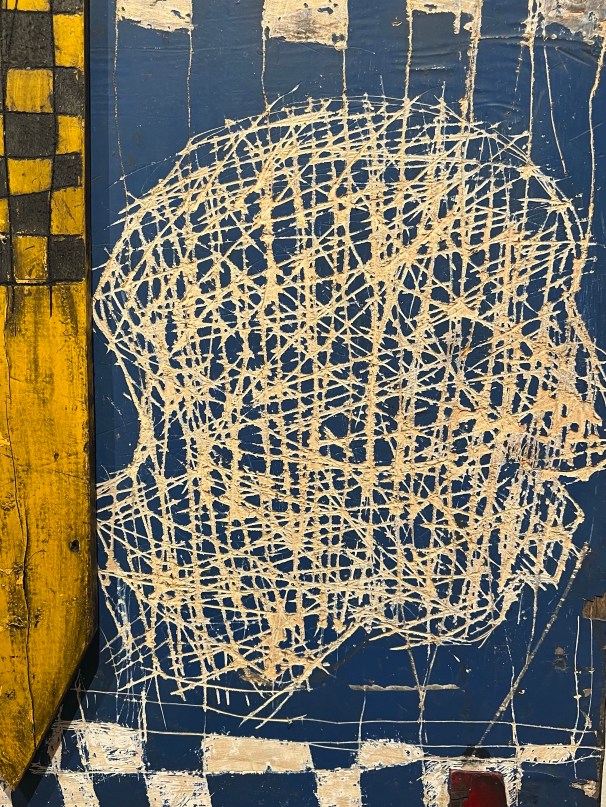
Above, Integrity, acrylic on wood, one of several works by Nairobi-based Sudanese artist ElTayeb DawElbait exhibited in Disturbance in the Nile; Agitación en el Nilo, hosted by Casa Árabe, Madrid until 30th June, 2024. ElTayeb DawElbait, (Karraw, Kosti,1968), has exhibited widely in Africa and Europe.
See more of his work in Eltayeb DawElbait
This week’s article is the first in a series of brief posts profiling the Sudanese artists featured in Disturbance in the Nile, Agitación en el Nilo at Casa Árabe, Madrid. The exhibition is unique in bringing Sudanese artists from across the generation to the global north, charting their artistic response to the political and cultural upheavals of their time in the midst of a brutal civil war now entering its second year.
ElTayeb DawElbait
Integrity of the Nomad
The Sudanese military coup of 1989 established a regime under Omer Bashir that was to last three decades. For many, the regime exercised a policy of undisguised hostility towards the arts, actively persecuting artists whose work failed to meet its ideological requirements. One of those many artists was ElTayeb DawElbait, suspended for two years from art school in the early nineties for resisting compulsory “Islamification of art” and gender segregation at universities. He fled to Libya, later returning to complete his studies and graduating in textile design in 1996. Tale of Two Creatives, Exiled but at Home. See too Artists on the run.
Throughout his artistic career, ElTayeb has continued stubbornly to defy containment or categorization. Pursuing a career in the arts in the teeth of “family displeasure”, ElTayeb has “never belonged to any art school” and insists that it is not artists but “art scholars who create art movements when they seek to describe and label.” He “does not want to be characterized or form alliances.” (Contemporary Artists of The Sudan, Art in Times of Adversity). When pressed on his artistic vision, ElTayeb speaks of re-creating “life and love” and enhancing “human behaviour”.
Like so many other Sudanese artists of the Bashir years, ElTayeb has lived a nomadic existence in exile, now permanently based in Kenya. Tragically the outbreak of war last April has led to yet another wave of artist exiles, as the world watches on with horror the wanton looting and destruction of Sudan’s unique artistic heritage. The flowering of artistic expression, so much a part of the 2018 revolution has been smothered. As ElTayeb urges us to remember; “Inside the war, the physical war, there is another war for art”.
Above, details from Integrity, revealing the strong textural, three-dimensional and installation-like qualities of his work. Also evident is his fascination for faces and facial fragments, etched deep into wood with numerous overlapping scorings that crisscross and converge into starry points.

Above, Far from Home, by Eltayeb DawElbait; engraving and acrylic on wood.
Resurrections; Recurring Themes
“…my history and everything around me, scratching on doors or drawers that have seen a thousand lives.” ElTayeb on his artistic inspiration.
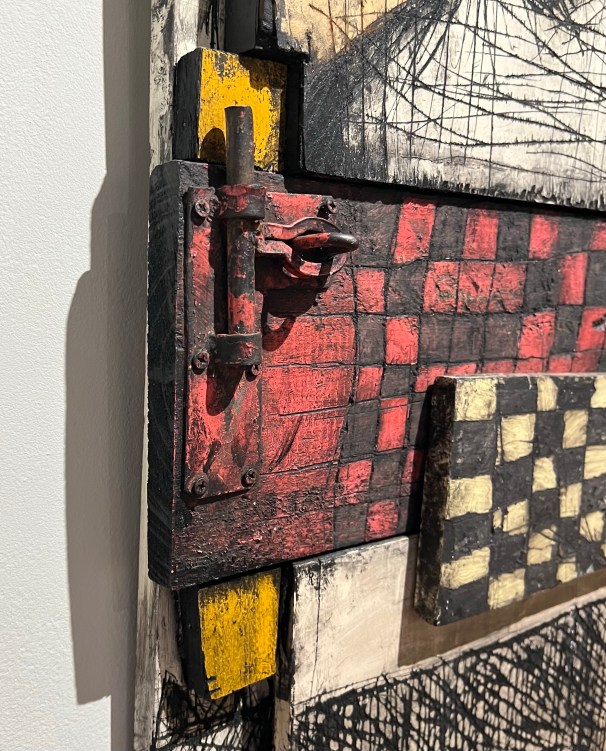
ElTayeb DawElbait’s raw and often searingly melancholic portraits of those dear to him in childhood, faces framed in windows and doorways of Sudanese coffee shops, his Kenyan contemporaries; all emerge as stark forces from canvases of discarded wood and metal. He reuses doors, drawers and wooden panels, creating frieze-like, sculptural motifs, while retaining their “original colours and echoes of their functionality”, their hinges and handles often preserved. In this way, ElTayeb seeks to honour and breathe new life into old materials. His work is imbued too with a haunting sense of history and lives lived. (Rahiem Shadad, Disturbance in the Nile, Casa Arabe, Madrid). See too Resurrection of worn objects, Noho House
Below, ElTayeb’s 2019 piece, Encounter, using natural, hand-mixed paints, and depicting male and female forms on a set of doors found in Nairobi, GravitArt; humans “that are abstracted, almost solidified as a primitive impulse”, (Danny Shorkend, Making his mark à la Art Brut)


The artist spent much time in his youth with his uncle, a professional painter and decorator and these encounters gave him “large backgrounds to work and a chance to use plaster and colours”. (Art in Times of Adversity). Perhaps this experience also contributed to his fascination for walls and sweeping surfaces that he senses “carry the spirits of the people who have passed by them regularly”. He is drawn to “details on walls; graffiti, layers of paint, numbers scribbled….., streaks left behind by water, scratches made by animals, cracks made by humans.” (Art in Times of Adversity)
Below, Recalling History, engravings and acrylic on wood.

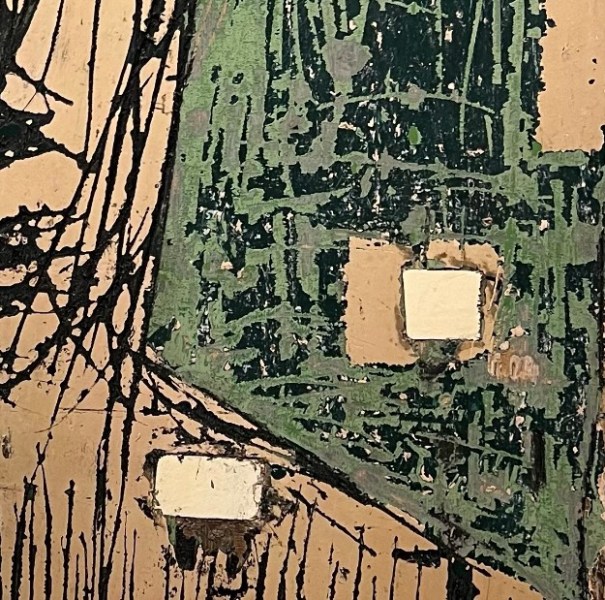
ElTayeb’s faces, urgent and raw, impose themselves on the grazed surfaces of wood and metal which nevertheless retain their dynamism. It is, as Danny Shorkend notes, “as if the artist is driven to create these images as he furiously struggles with the medium in order to do so”, (Making his mark á la Art Brut), reflecting ElTayeb’s tendency to pour his energy into series of works, “until the inspiration is complete” (Art in Times of Adversity).
Critics have noted ElTayeb’s palette alternates from restrained greens and greys to the vibrant colours (“Rainbow”) of Sudan’s vast desert and tropical landscapes. And Sudan remains a profound source of inspiration for ElTayeb. Memories of navigating by the desert stars with his father, a rural childhood and the sculptural forms of ancient Nubia he saw as a youth all inform his work. Though faces predominate, “sometimes the stars take precedence. In Navigation for instance, “a grid of dots in the bottom left hand corner of the piece represents the maps of stars by which the desert nomads, like sailors, find their way through the endless, rolling sands”. (The East African)

Above, hand-painted coat by ElTayeb Dawelbail, KokoRomeo, MAFF
ElTayeb has also continued to pursue his talent as textile designer, collaborating with Italian and Kenyan fashion houses to produce unique hand printed, bleaching and block printed designs, with architectural and geometric, African-inspired motifs. Observing Kenyan roadside advertising, he is also exploring the symbols and iconography of advertising.
ElTayeb DawElbait and so many other Sudanese artists living within and outside their homeland are keeping the flame of Sudanese artistic life alive until peace is restored. Every piece is an element of the quiet but certain resurrection of the creative spirit to come.
 Women's literacy in Sudan