

Tariq Nasr Othman
A Brief Profile
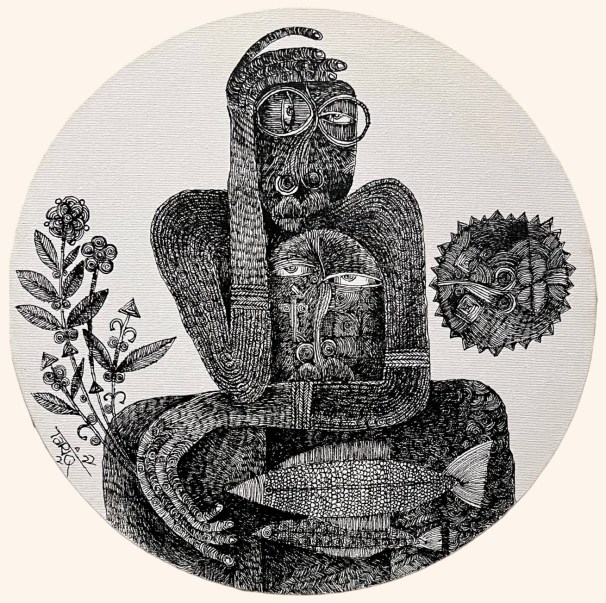
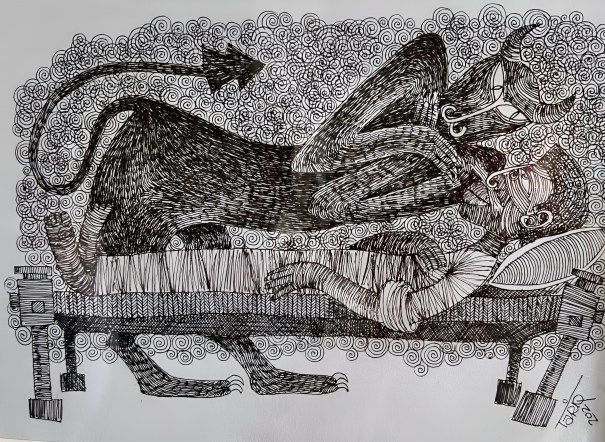
Above, the sinuous, densely textured forms and folkloric symbolism characteristic of Tariq Nasre’s work. Sadness, consolation and hints of stories untold permeate this 2022 piece, exhibited in Disturbance in The Nile, Casa Árabe, Madrid. Title illustration, work exhibited in Mojo Gallery, Khartoum, 2019. A figure lies on a traditional Sudanese rope bed or angareeb, meeting the gaze of the mysterious chimeric form that hovers over him. Is it sinister complicity or calm acceptance that marks their encounter? Ambiguity and humour inform Tariq Nasre’s work.

Above, Tariq Nasre, Lambiek Comiclopedia.
See more of this gifted artist, illustrator and cartoonist’s work in Tariq Nasre Instagram
Tariq Nasre Othman Fadl, (Dongola, Northern Province, 1964) graduated in 1989 from the College of Fine and Applied Arts, Institute of Technology, Khartoum, specializing in colouring techniques / painting. He became an illustration designer for Sudan Printing and Publishing House, former publisher of Sudanow, and is viewed as a pioneer in computer-aided graphic design in journalism. He has worked as a designer and cartoonist for many magazines and newspapers in addition to illustrating several Sudanese children’s books and magazines, such as the much loved Al-Subyan, The Boys’ Journal, (see Lambiek Comiclopedia). He was awarded the UNESCO Noma prize for the promotion of literacy in 1991 for his work exploring Dinka heritage, whose rich iconography still informs aspects of his art today.
Source; طارق نصر عثمان تشكيلي سوداني يستلهم تراثه الشعبي .
All photos of Tariq Nasre’s work featured in this article were taken by the author with permission of curators.

Above, recurring motifs drawn from multiple ethnic traditions are delicately interwoven in Tariq Nasre’s dense, flowing canvases. Note the ornate hulaal comb worn with pride in thick curls and emblematic of Hadendoa male dress of eastern Sudan. It appears next to the tightly woven plaits beloved of northern Sudanese women, and flanked by forms echoing both Arabic calligraphy and creatures redolent of Nile mythology and southern Sudanese animism.
Disturbance in The Nile, Casa Árabe, Madrid
Aspects of The Artist’s Work
Fascination for Monochrome; Black and White
Symbols, Folklore and Mythology
Fascination for Monochrome; The Power of Black and White
“I find myself in constant dialogue with the white of the paper and the black of the ink pen.”
طارق نصر عثمان تشكيلي سوداني يستلهم تراثه الشعبي
In a recent, wartime work, two black ink figures stand side by side, their heads touching in a sheltering embrace. Arms are outstretched towards each other yet they remain separate, one figure starkly bisected by white space. There is a tension between the full, female, oval forms of the figures and the geometric planes behind.
Exhibit, Mojo Gallery, Khartoum.
In the 2018 interview referenced above, the artist explains that it was his work as a children’s illustrator and cartoonist that drew him so powerfully to artistic expression in black and white, a medium upon which he has unquestionably succeeded in leaving “his own unique fingerprint of style and execution”. Tariq Nasre is one of several leading Sudanese artists enriching and driving forward the discipline of black and white art and illustration; see فنانون سودانيون يضعون الألوان جانبا ويشاركون في معرض «أبيض وأسود»
See too the work of Amel Bashir, In Conversation with Amel Bashir
and Reem Alsadig, A Date With My Memory

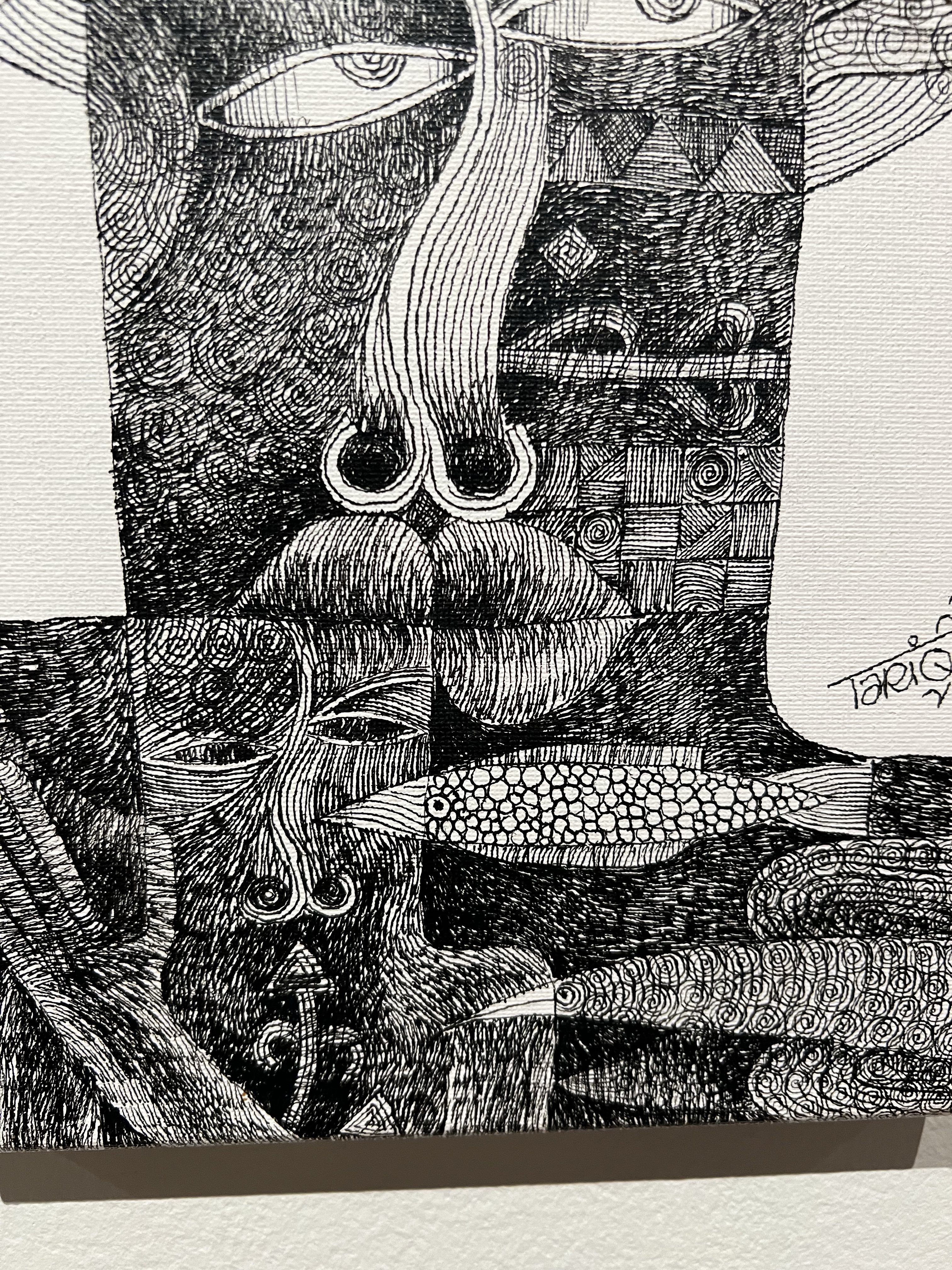
Above, detail from one of Tariq Nasre’s work, exhibited in Disturbance in The Nile, Casa Árabe, Madrid.
In the same interview, Tariq Nasre describes his relationship with colour in the context of the crowded, “hustle and bustle” or “noisy” world of those artists who use colour as one of “coming to terms or reconciliation”; “colour snatches me from the clutches of black and white”, he explains, its qualities oscillating “in me between reality and imagination” as they interact, overlap within and among the forms he creates.
Below, just some of Tariq Nasre’s many finely executed, delicate colour works, depicting Sudanese rural and domestic life with affection and humour, Mojo Gallery. See too Mojo Gallery Facebook
Symbols, Folklore and Mythology
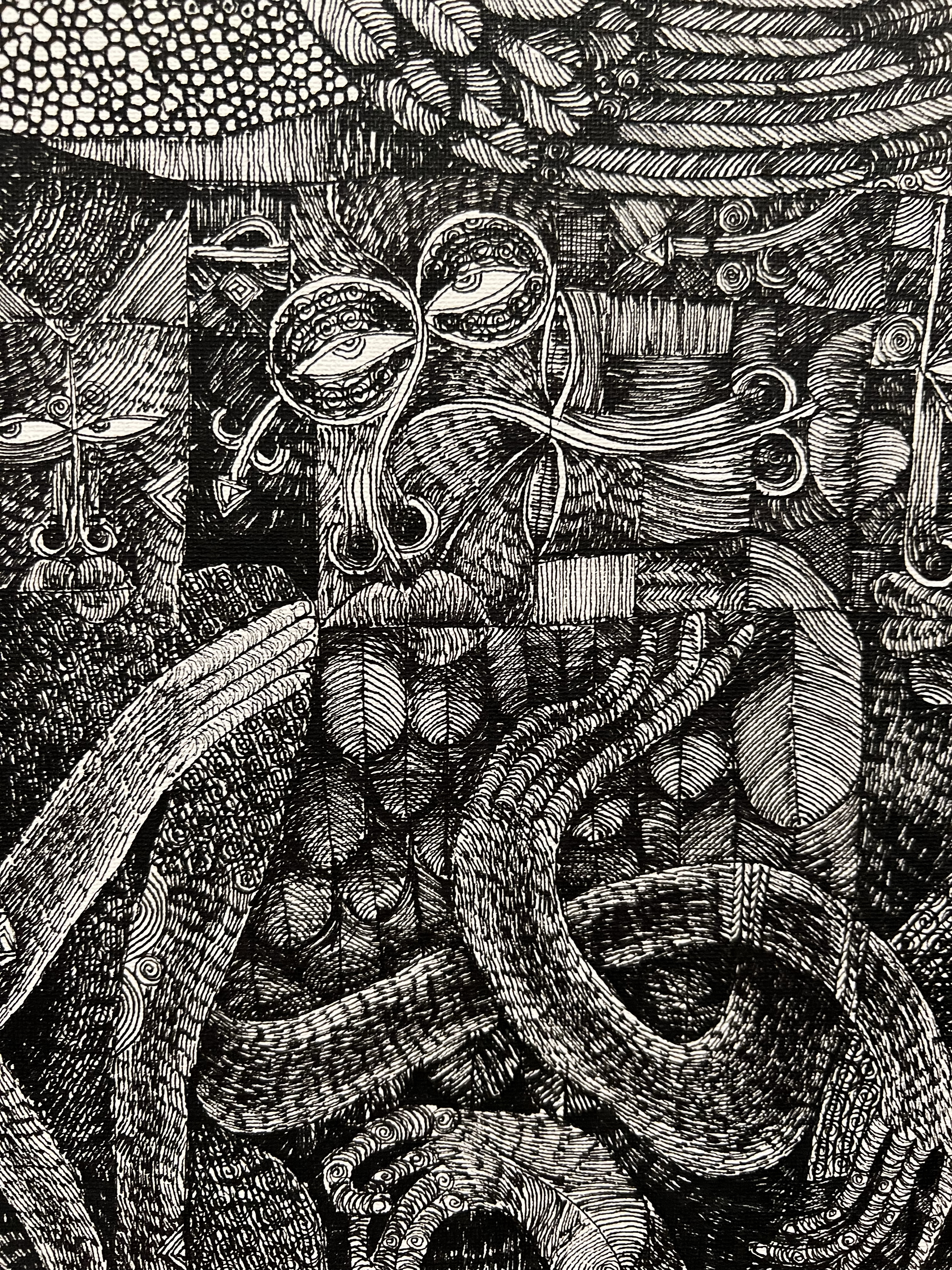
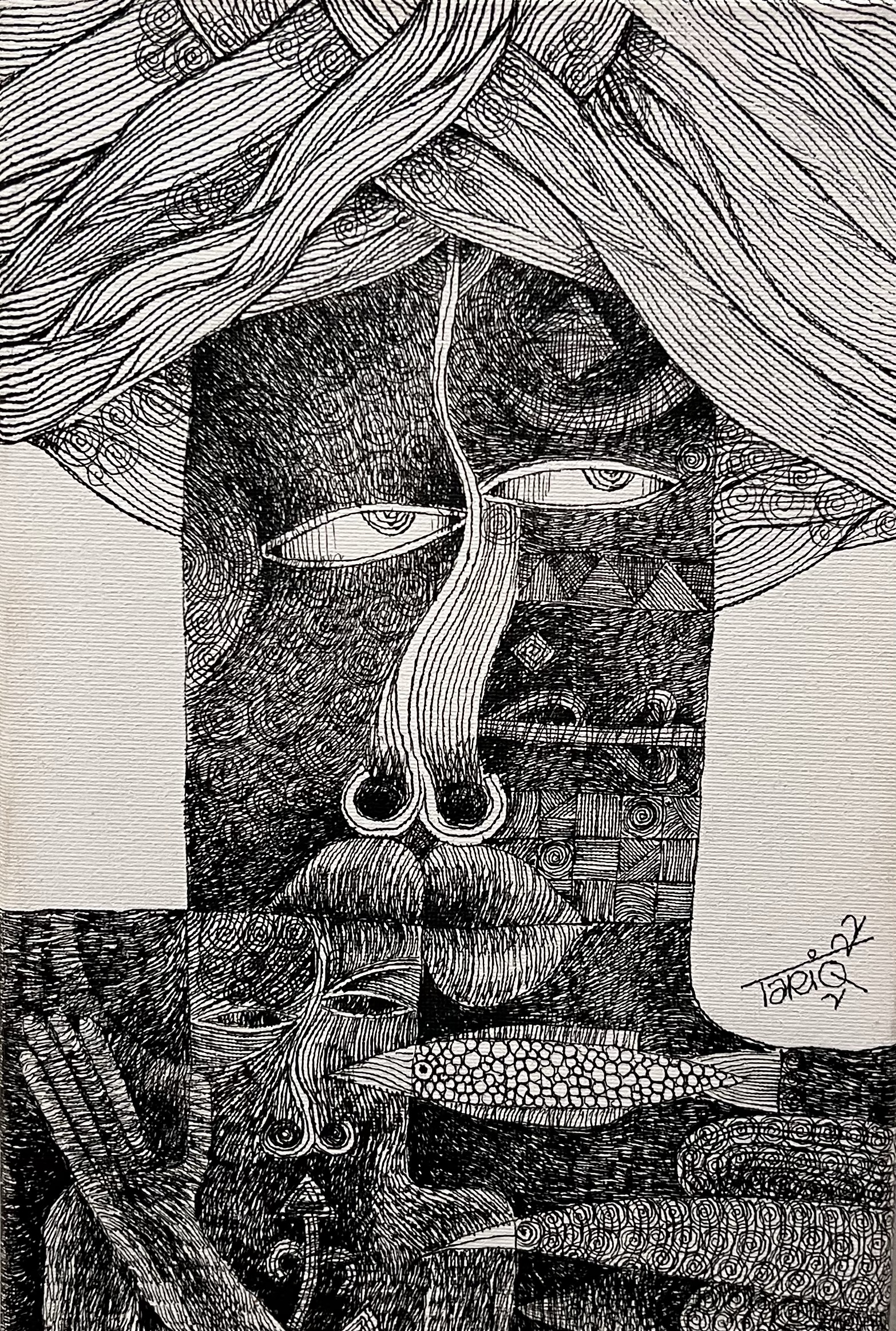
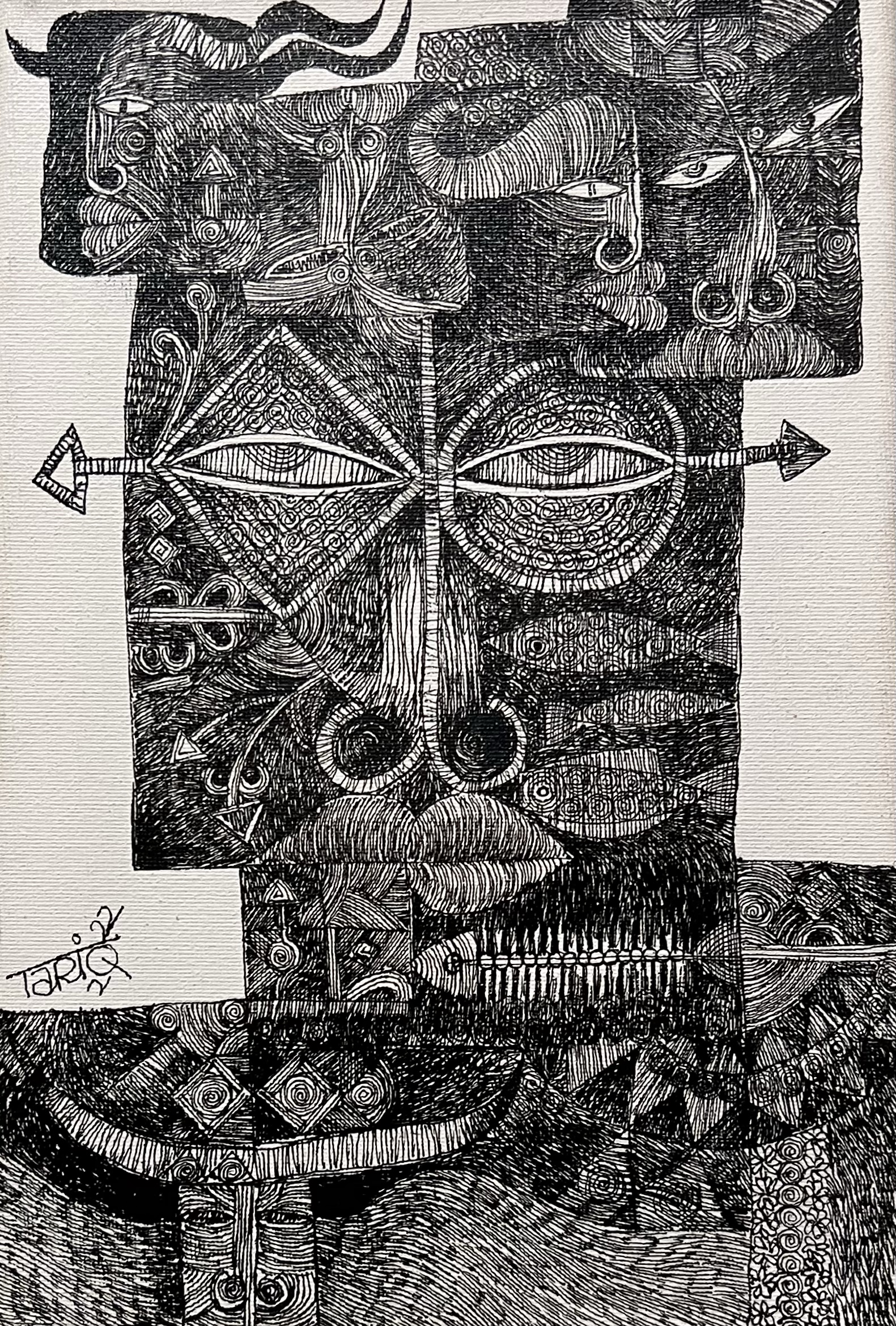
Tariq Nasre’s work teems with fluid organic forms. They emerge from wood-grained, feathered, fish and snake-scaled, leaf-layered surfaces. Delicate shoals of fish or their skeletal forms float across his canvases or lie on plates and tables, with propitious heft. Vast fish, reminiscent of Nile perch, are offered in baskets on the heads of kneeling suitors in homage to seated maidens, tender hands cupping a fruit held between them. Lizards, crocodiles, geckos and snakes inhabit his canvasses, fish and birds perch on shoulders, heads are swathed in turbans and tattooed with calligraphic forms or bear the bull’s horns revered by both the Nuba and Dinka peoples. Bull’s horns crown the doorways of northern village homes as graceful birds strut before them. A couple, intimately framed by the curtains of a traditional camel litter, or hawdaj of nomadic tribes, gaze into each other’s eyes. Line drawings of Sufi mystics gather against a backdrop of a giant water-colour lawH or prayer board.
Tariq Nasre’s work is imbued with magical, ancestral voices, hints of folklore, mythology and sacred belief we, the non-Sudanese, cannot fully read but are inspired to learn more of as we view his works. There is a rich synthesis of northern and southern Sudanese cultural symbols and the merging of stories speaking of shared origins. It is possible to see in Tariq Nasre’s work references to divinities in snake form of the Dinka pantheon and the symbolic power of the Nile and its denizens. It is this creative synthesis of Sudanese narratives and traditions that restores hope in times of division and tragic misunderstanding.
Below, detail of works exhibited in Disturbance in The Nile, Casa Árabe, Madrid.
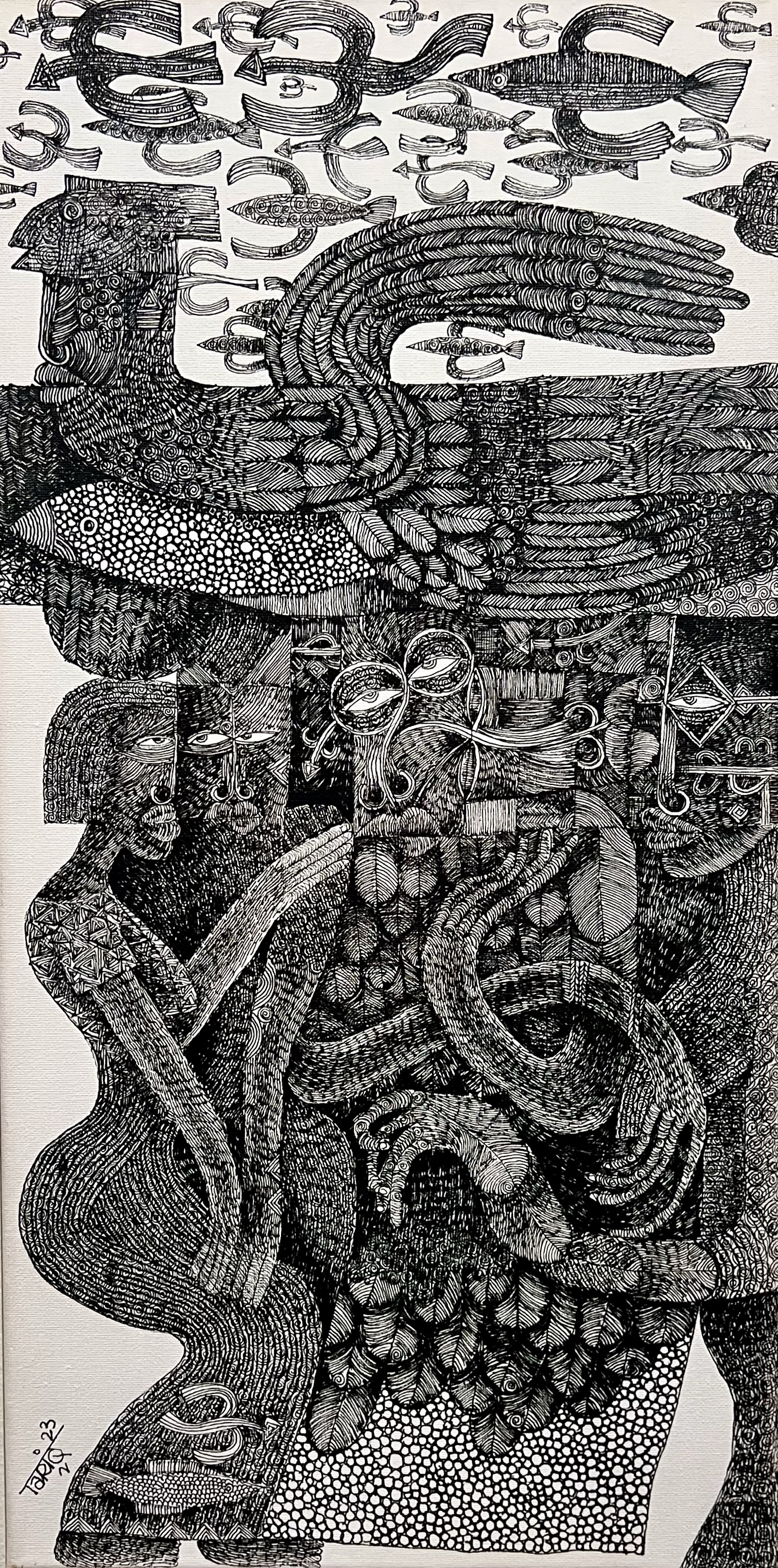
In Dinka religion, Abuk was the first woman, often represented as a snake. She was the first to cultivate and harvest grain and plant trees. She sustained families as the the keeper of river water sources. When she accidentally struck the creator with the long-handled hoe she used to till the earth, the creator withdrew from the lives of human beings and sent a blue-coloured bird, the atoc to cut the rope that humans had used to climb up to the sky.
 Women's literacy in Sudan