

The Toub’s Enduring Appeal
Origins of the Toub Indigo in Sudan and the Zarag Toub
“Land of The Blue Veil”

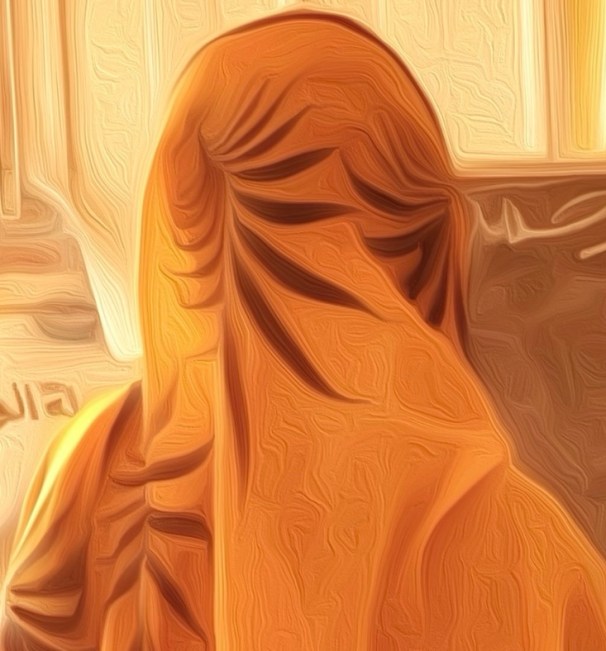
Above, a Sufi adherent attending the Friday zikr at Hamed Al-Nil, Omdurman, 2018. She is swathed in her toub, the flowing sari-like garment which has become synonymous with Sudanese identity. The wearer’s sense of modesty, elegance, her personality and unique understanding of style can all be expressed in the subtle draping and folding of her toub. This versatility has ensured the garment’s continuing relevance in Sudanese life.

The toub / tob / tobe is a seamless outer garment of 4 or 4.5 meters long and two meters wide. Although the word thawb in classical Arabic refers to garment or robe in general, words in Sudanese Arabic for this type of garment; firka, farda and toub designate varying lengths of cloth. Wrapped in the Fabrics of Home
This week I offer the second in a series of articles on the Sudanese toub. Today’s article explores the factors behind the toub’s enduring appeal, the theories surrounding its origin and the fascinating role of indigo in toub manufacture. I draw on the research of Sittana Badri and Griselda El Tayib (Regional Folk Costumes of the Sudan), in addition to many other Sudanese sources, cited below. I very much welcome any corrections or additional information readers can offer. Next month’s post will focus on the toub’s many styles, designs and regional variations.
For the intriguing story behind the names of Sudanese toubs, see “Migrating Bird”.
The Toub’s Enduring Appeal
The fluttering toub so becomingly framing her plaits; paraphrasing the words from just one of numerous songs celebrating the toub in Sudanese popular culture. Click on the link above to hear the song.
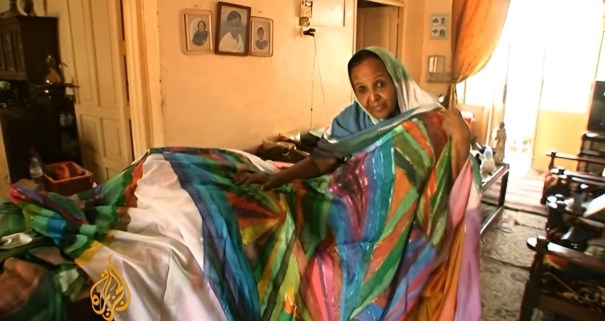
Interviewed by Aljazeera shortly before the secession of South Sudan in 2011, the formidable textile designer, artist and educationalist, Sittana Badri, seen left (still Aljazeera English, Sudan’s Unifying Fashion) described the toub as a Sudanese woman’s “spirit or essence”, a canvas for her personality. In an increasingly “serious and no fun Sudan”, she noted, the toubs of bold and vibrant colours then all the rage embodied a joyful pushback against the uncertain, even dour political landscape of the time. As Sudan faced territorial and – many feared, cultural excision, Aljazeera reminded its viewers that the toub offered reassuring continuity to many Sudanese.
Remembering a pioneer of Fine Arts; Sittana Babikir Bedri

When midwife Sitt Hawa Ali Bashir arrived in London to receive the Florence Nightingale Medal for services to nursing in 1950, the press, Al-Hadaatha (لتوب أرشيفا: موضعة تاريخ النساء في السودان) reports, were fascinated by her appearance as she emerged through the crowds, swathed head to toe in “nine yards” of fabric. Though the report doesn’t say whether she was dressed in the fine white toub de rigor for the midwives and public servants of the day, it is safe to assume she probably was. Commentators were perhaps, it is hinted, mildly surprised too by her refusal to compromise for the sake of western dignitaries on a form of dress she felt to be part of her national identity. For many Sudanese living far from their homeland today, donning a toub restores a profound and very comforting sense of belonging and cultural identity; see Leena Kheir: She is a Country and sudania mia almia

The scenarios described above point to the chameleonic power of the toub. A garment the Mahdist “puritans” (Grisleda El Tayib’s words) enforced upon women for its power to conceal the face and be all-enveloping would be worn to frame the face to stunning effect decades later in complex fusions of Sudanese and western fashion trends. The toub could be read as a uniquely Sudanese marriage of values of public modesty and decency, Hishma, and Afro-Arab feminine elegance. It could be worn as an expression of anti-colonial defiance, a celebration of national identity, a cypher for sophistication, education, and professional status; an indication of marriageability or married state and family wealth. Most recently, donning the white toub with gamar boba earrings of their grandmother’s era has taken on a new visual lexicon of public political activism for today’s young Sudanese women.
Above left, Sittana Badri demonstrates the bullama style of covering the face, using the edge or jeda` of the toub normally worn over the shoulder, so that it is drawn across the face and tucked in at the cheek. This remained the correct way for Sudanese women to wear the toub until the 1950s, when undergraduates and the first women elected to parliament began to uncover their faces and other women gradually followed suit (Sittana Badri, Griselda El Tayib).

Above, an image reproduced in African Feminism: Going too far? Insights on Sudanese Women’s Organizing and the Revolution.
From kandaka khronicles Instagram

The decline in popularity of the toub and its recent passionate defence in the Sudanese media are more than just economic or practical in nature; they are profoundly political and reflect notions of Arab-Islamic orthodoxy, the geo-political influence of Saudi Arabia and the cultural assimilation of Sudanese guest workers of the Gulf States.

The rivalry between the toub and the abaya and other conservative, Arab-inspired female dress endures. A Sudanese friend explained to me that those girls hoping to win a well-off mughtarib or Sudanese guest worker husband returning from The Gulf might well feel that abaya, niqab and black gloves could just do the trick. Griselda El Tayib notes, the toub has been worn to set off the bouffant hairstyles of the 1970s, and to softly frame the face of a meticulously veiled muhajaba. She reminds us too that the transparency and weight of fabrics used may be carefully chosen so as to conceal or reveal the length and cut of skirt worn beneath. Above right, stills from 100 Years of Beauty.

While the toub enabled Sudanese women of the past to engage more visibly in public life and access public spaces without recrimination, many young women today feel the toub to be cumbersome, unnecessary or just too costly. Yet, as Griselda El Tayib notes, for the rural woman, thanks to its versatility, the toub still holds its own; being “her overcoat, mosquito net, the pouch for gathering cotton or other crops, her nightdress, or the curtain behind which she can breastfeed her baby in public spaces.” Above right, still from Sudania TV 24, showing a striking, richly sequined jeda`; the edge of the toub which drapes the shoulder, from jada`; to throw.
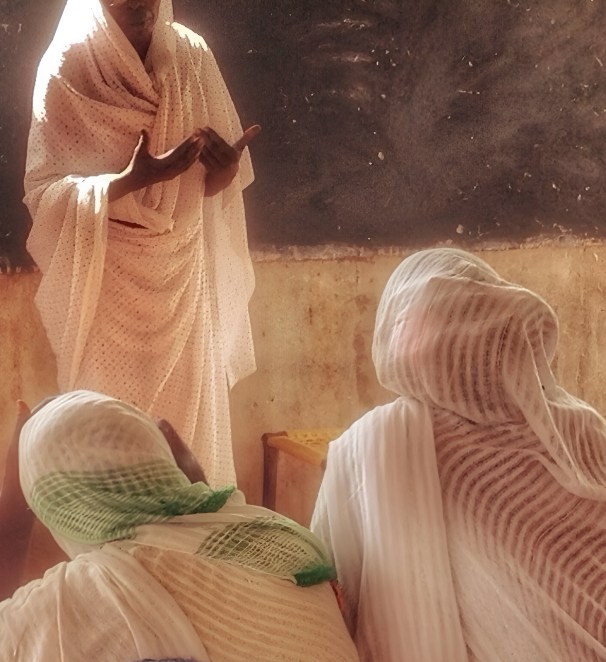
Above, graceful modern variants of the traditional white toub. Considered sunna and traditionally associated with public service, nursing, midwifery and academia, as well as standard funeral attire, the white toub, symbol of education, professionalism and wisdom, was creatively re-interpreted over the decades, with white-on-white embroidery, patterning, transparencies and banding added (Griselda El Tayib). It is still favoured by leading television presenters and parliamentarians in Sudan. For some time, the use of coloured toubs at work was frowned upon.
More on the white toub and its surprising political and cultural impact next month.

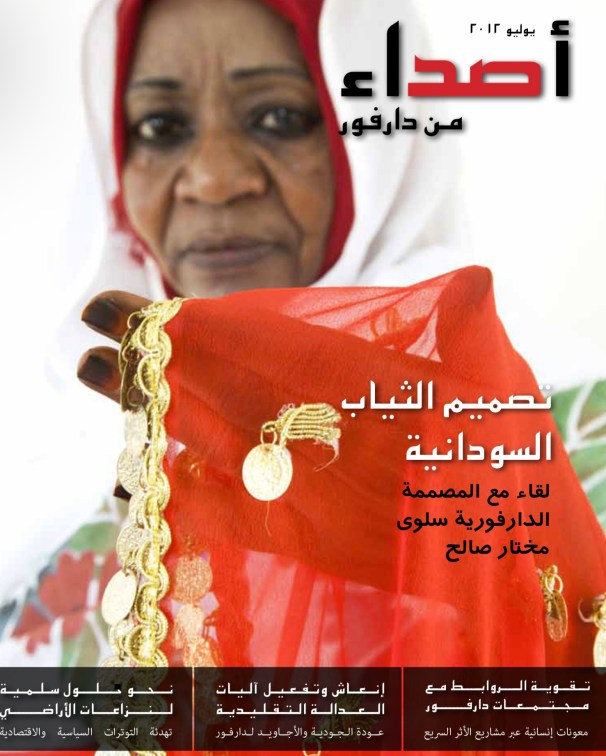
Above, toub designer Selwa Mukhtar Saalih, featured in UNAMID Darfur أصداء:
See too The Darfur Sartorialist
The importing of toub fabrics, its manufacture and sale, as well as the hand-crafted customizing of designs and essential accessories in the form of matching veil, undergarments, shoes and bags, remain powerful income generators. Several Sudanese women toub designers have gained international recognition and workshops and studios offering training in design and toub embroidery have mushroomed, offering the chance for women to grow their household income.
The toub has inspired numerous love songs, patriotic anthems and poems. It has been a central motif in contemporary Sudanese art. For the renowned artist, Rashid Diab, the forms, movement and colours of the toub take on unique spiritual and temporal presence in his homage to Sudanese womanhood.
More on the toub in Sudanese art coming soon.
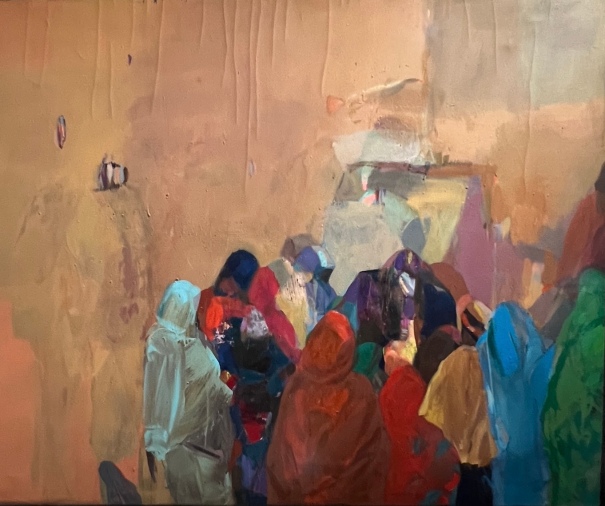
Above, Conversation 1, Rashid Diab, Disturbance in The Nile, Casa Árabe, Madrid.
Origins of the Toub

Above, colonial-era photograph depicting young rural women wearing the coarse zarag toub of the day.

Experts differ on the origins of the toub. Some, such as Zainab Abdullah, see historical parallels in the robes of ancient Egyptians and Assyrians, while others cite Nubian murals such as those depicting Queen Amenshakhet wearing similar body-length garments. In contrast, Griselda El Tayib, focusing on the toub’s 19th century form, contends “Neither the murals at Faras nor the portraits at Musawarat nor the accounts of nineteenth century travelers, point to the continuity of the habit of wearing a long white veil.” She suggests the possible ancestor of the toub may have been the toga of Roman matrons of North African territories of empire.

While the toub is similar to garments worn in Chad, Mali and Mauritania, such as the malhafa or “wrapper”, El Tayib stresses it is, curiously, very different from Sudan’s closest cultural neighbours. Some researchers believe the toub in its present form was first introduced in the 18th century as an imported luxury item worn by merchants’ wives and the urban elite. Others see similarities with the futas of eastern Sudan, believed to have originated in part from popular imports of Indian sari-like fabrics and suggest this garment was later to spread inland from the Red Sea.
“After a century of consistent use among the upper classes, the tobe had gained an air of local authenticity in spite of its foreign origins. More practically, as religious fervor increased under the Mahdi, the tobe aptly satisfied women’s need for chaste clothing.” Marie Grace Brown, Khartoum at Night, p20″
For El Tayib, the fact that the Mahdists enforced the wearing of the toub when they banned Turko-Egyptian and Ottoman dress would suggest it wasn’t widely worn before that. Whatever the earliest forms of the toub, she suggests it is the influence of Islam in Sudan that accounts for the lengthening of any prototype garment and its use in draping around the head. Until the 1950s, the toub was worn exclusively by married women. With the growth of girls’ education unmarried girls began wearing the toub to school where it would be folded away and a tarha donned (Griselda El Tayib).
Above, colonial postcard of Sudanese women wearing the zarag toub. Below, colonial-era postcard showing women wearing both the zarag and white toubs at a crafts exhibition in Omdurman. They display the traditional rahat skirt that the toub replaced.
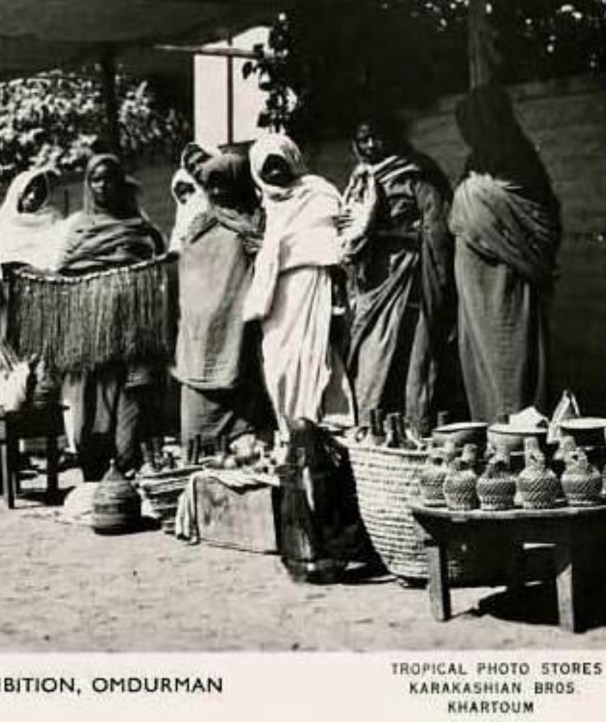
See too the highly informative video report on the Sudanese toub, subtitled in English, by the Sudanese Ministry of Culture, embedded at the end of this post.
Indigo in Sudan and the Zarag Toub; “The Land of The Blue Veil”

Above, indigo dye, photograph, Wikicommons.
الزراق فوقا تقول حرير
“On her, you’d say the (coarse, blue, workaday) zaraag toub was silk.” “The Gamar Boba” (“القمر بوبا”) by Mohammed Wardi
The song lyrics above echo the deep affection and rich folklore surrounding the once commonplace indigo-dyed toub.

There is a long but patchy history of indigo use in Sudan. Evidence of indigo textile dye has been found among the Meroitic elites of the 4th century CE and in the medieval Christian kingdoms of the 12th-15th century CE. Read more in Textile Dyeing in Medieval Sudan Interestingly, the dye was used to mark stripes or bands in plain cloth, possibly similar to those of the 19th century toub with its blue banded borders.
For more on Sudanese fabrics weaving and embroidery, see The Thread of Fate and Cowrie Shells
Griselda El Tayib relates that indigo was introduced into Sudan in the early 19th century under Turkiya Khedival rule, where it was grown in the Dongola region. Sudan Notes and Records also describe the setting up in the 1840s of indigo factories in Kassala Province and Soba, Khartoum, the latter run by Egyptians. In Ibrahim Elnur’s fascinating study, “Contested Sudan, The political economy of war and reconstruction” (ResearchGate), exploring the state-led industrialization of Mohammad Ali in Sudan, we note that in 1837 alone, roughly 62,000 kilograms of indigo was produced in the Dongola area. The Turkiya had a monopoly on the manufacture of indigo and “peasants were compelled to grow it.” (Griselda El Tayib). Left, photograph of young woman in indigo-dyed toub, Land of the Blue Veil, see below.
The plant proved to be water-thirsty and difficult to grow. As in the tragic history of British colonial exploitation of indigo producers in India, the indigo growers of Dongola suffered harsh conditions, resulting in protests and rioting upon the visit of Khedive Mohammad Tewfik, thereafter indigo was “less commonly grown and replaced by chemical dyes.” (Griselda El Tayib)
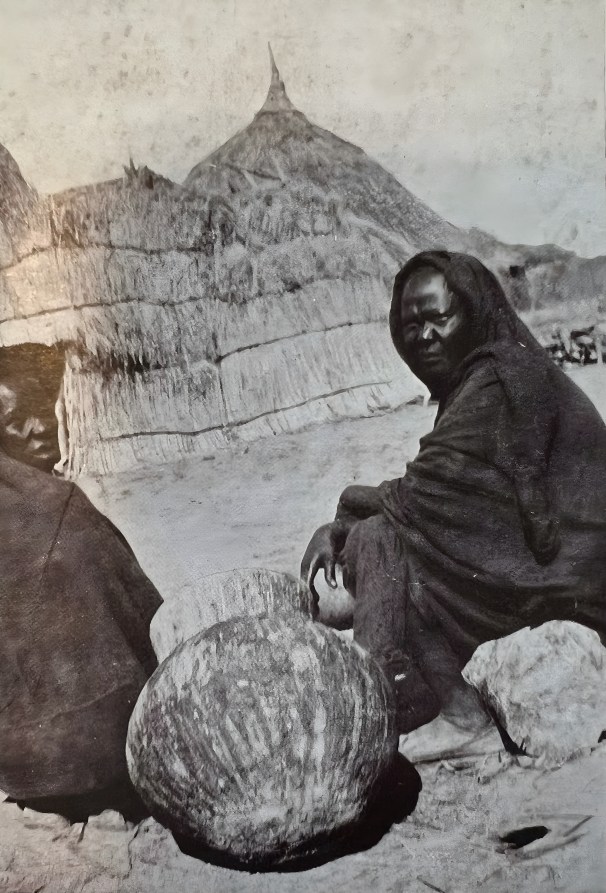
Above, Village scene, White Nile, photographic plate from My Sudan Year, E.S.Stevens, Mills and Boon, Limited, 1912.
“At the tent of the deceased, ululating women danced the death dance, their indigo-dyed calico tobs tightly wrapped around their waists and uncovered hair piled with earth and ashes.” Hamid Dirar describing the funeral of Sheikh Umara Abu Sin, The Amulet.
El Tayib explains that the blue-dyed toub of rough cotton or homespun damouriya, known as zarag / zaraag came into being as a result and “until the 1960s was the cheapest and most practical and commonest tob.” She goes on; “it was worn by peasants of the riverain area until recently” and until the late 1970s an Omdurman workshop was still producing the tob zarag, “mainly for western Sudanese”. Until the 1950s, El Tayib notes, most women possessed only two toubs; the zarag for everyday and agricultural wear and the abyad or white toub for “ceremonial visits, funerals, bika, or weddings, farah.” In rural areas, women’s indigo toub was gradually replaced by the krib aswad or black voile.
“she was wearing, like most women then, a tirga, an indigo-dyed blue stole, the indigo staining part of her shoulder…” Hamid Dirar, upon meeting his stepmother for the first time, as above.
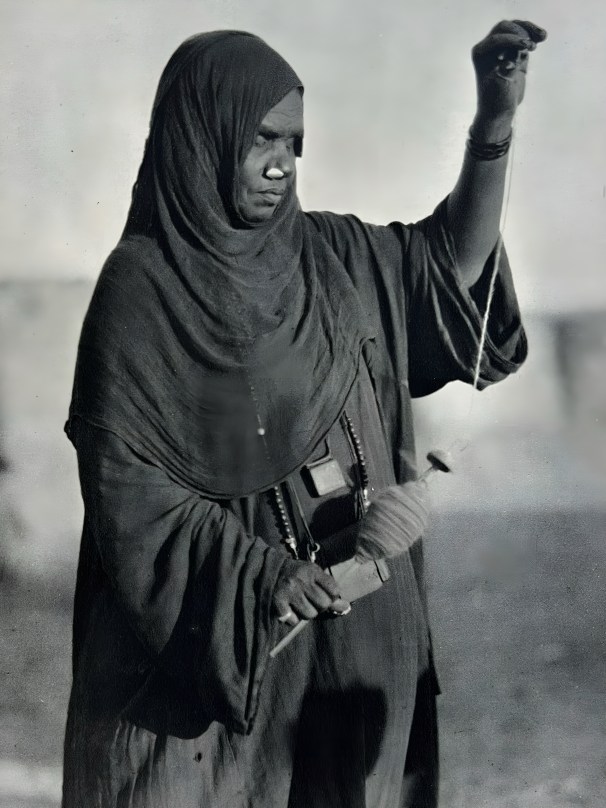
Above, the indigo robes of a Bisharin woman, Nubian desert, Der Dunkle Erdteil, personal collection.
Land of the Blue Veil
“When all women’s tobs are blue, to find a purple one is not difficult.”
Allan Worsley’s 1940 collection of personal anecdotes and folktales from Sudan, The Land of the Blue Veil, includes the tale of “The Girl in the Purple Tob, A Sudanese Coffee-Story”. The colonial medical officer, known for his love of recording folktales, was watching the intricate skill of Idrees, a weaver at work:
Idrees then set the machine into rapid motion. With the dexterity born of long practice, the gear lever shot backwards and forwards like a pendulum, and the transverse movements of the spindle were like a man tossing a ball to and fro, from one hand to the other. Inch by inch beautifully woven cloth crept forward. He was using the cotton-thread that one so often sees Sudanese women spinning, and I asked him what he was making. ‘Tobs’, he replied, ‘the blue cotton gauze that all our women wear. When finished, they go from me to the dyer, who dyes them deep indigo blue.’ I recalled how a new tob deposits its colour upon everyone and everything, and that it is not until it has been washed many times that it loses its stiffness, and goes a “safe” butcher-blue.
For more on Sudanese textiles and weaving, see The Thread of Fate and Cowrie Shells
While the author watches, Idrees remarks; “Talking about dyers, genaabak, reminds me of one of our Sudanese tales. I will tell it, if genaabak (a respectful form of address) would care to hear”. The weaver goes on to tell the tale of a carpenter who, on being led to the gallows for failing to secure a shutter that had fallen on an elderly woman, causing her death, claimed in desperation that he had been helplessly distracted by the sight of a girl in a purple toub. The girl is swiftly apprehended, but is adamant that an incompetent dyer is to blame for the uncalled-for attention her toub has caused.
The dyer was soon found and brought before the shereef. He was a very big man, this dyer, moreover he belonged to the Jaaleen tribe, renowned, even among Sudanese, for their fearlessness. He gazed at the Shereef eye to eye, as one man to another.’Thou shameless son of perdition!’ bellowed the shereef. ‘Mixing thy dyes so carelessly that they dye tobs of such unholy colours and of such vividness that they draw aside the eyes of carpenters from their work, causing screws to be put in crookedly, and shutters to fall, that kill old women.’
Sadly, the ending of the tale is grossly anti-semitic. Sudanese folktales of the time – and they must be seen within the context of their time – often used racial, religious and gender-based slurs found unacceptable today. I have reproduced the sections above because they remind us just how prevalent the zarag toub was only a few decades ago and how much a part of Sudanese life it played.
 Women's literacy in Sudan