

The Resonance of Place
The Luminous “Mindscapes” of Miska Mohammad

Above, Abandoned, from Lost Cities Series, acrylic on canvas, by Miska Mohammad (Omdurman,1995), a work shown earlier this year in Casa Árabe, Madrid, as part of the Disturbance in the Nile exhibition tour. Movement, turbulence, glowing colours and a balming, dream-like tranquility infuse her painting. See more of Miska Mohammad’s remarkable work in miskamohmmed.art instagram and Miska Mohammad in artsy

Above, Nile and Other Nostalgic Memories, acrylic on canvas, Disturbance in The Nile, Madrid.
Miska Mohammad defines herself as a plein-air landscape artist and her works are informed by the colours and features – abstracted and distilled – of her Sudanese homeland; the River Nile of her beloved Omdurman and city and the coral-encrusted waters of Suakin. The artist states; “I don’t paint people”, explaining that without them, “I imagine the energy of a place makes the painting stronger and deeper.” Yet, as she herself stresses, the landscapes Miska Mohammad captures are those of the energies, resonances and sense residues of place at a particular moment, rather than representations of specific places. They are what she calls “mindscapes”,OOA; Gallery of Contemporary African Art Barcelona / London
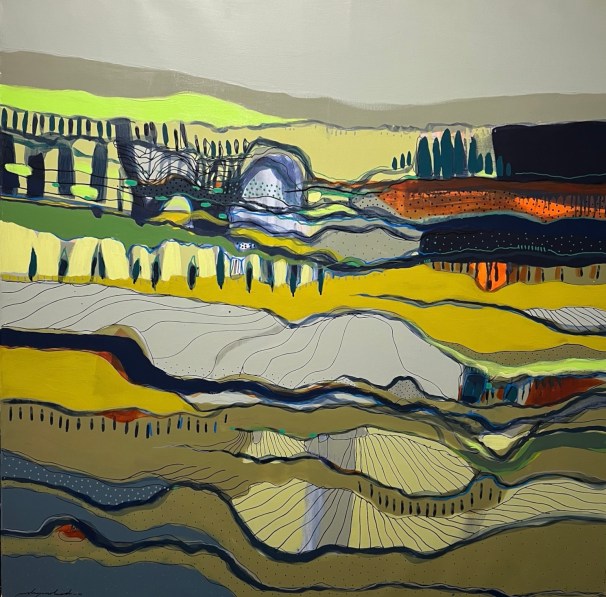
Above, Coffee Plantations, exhibited in Disturbance in The Nile, Casa Árabe, Madrid.
“Her works feature undulating gestures let loose across the picture plane, with luminous colors, hues of deep blues and shadowy blacks as well as grassy spring greens, suggesting an interplay between land, water, air, flora and fauna.” Schulting Art Collection
This week’s article offers a very brief introduction to Miska Mohammad’s art and her creative process in the hope that more people will be inspired and sustained by her work at a time when the power and consolations of artistic expressions have never been more needed.
The Artist

Miska Mohammad, still from The Magic of Forgotten Places, Circle Art Gallery, Youtube (video embedded below)
Miska graduated from the College of Fine and Applied Art, Khartoum University in 2016. She was the youngest artist and the only woman to exhibit in Circle Art Gallery’s 2017 Khartoum Contemporary Exhibition. Since then, she has exhibited elsewhere in east and southern Africa and had her first solo exhibition at Circle Art Gallery, Nairobi in 2021. Her work has been exhibited widely at international level, including in Dubai, United Kingdom, The Netherlands and Barcelona. Since 2021, Miska has lived in Nairobi.
Before the outbreak of war in her homeland last year, Miska had spoken with optimism about the recent burgeoning of the Sudanese art scene and the sensing of new opportunities for women artists there. She found inspiration in traveling outside the capital to other regions of Sudan, “looking for something new in nature”, and learning “how far people are the same.” Journeying also to Tunisia, Nigeria, Saudi Arabia, where she had lived as a child, and Cairo, she says she has learned from so many cultures how to accept and respect others, finding “new sources for my art” (interviewed in The Magic of Forgotten Places, see below). She describes Kamala Ishag as her idol and treasures the opportunity she recently enjoyed to visit her studio where the renowned artist treated her “like a daughter and let her paint with her on materials.”
Aspects of Miska Mohammad’s Work
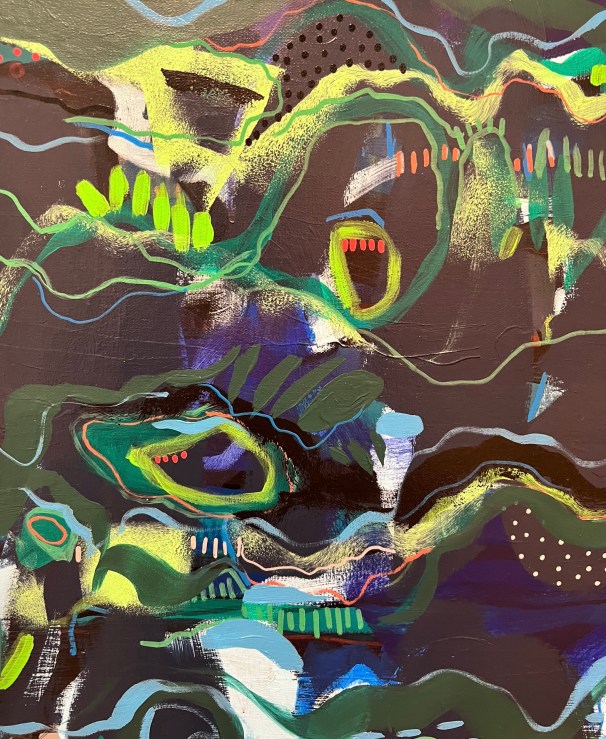
Sand Ripples, Sand Dunes, Drought, Suburbs, the glowing orange of Dusks heavy with sand-laden air, the dense vibrancy of Autumn Forests; Miska Mohammad’s work celebrates the natural and urban worlds she is drawn to. She speaks of the blue-green tones and ever shifting light of The Nile at Omdurman and the colour and movement of its markets as constant inspiration. But there are also echoes of volcanoes, mists, flower-scattered waters and strange fluidities in the worlds she creates, prompting The Kenyan Art Review to describe her landscapes as magical realist in character. The abstract and the organic, the familiar and the strange are interwoven in deeply personal, layered portraits of place, time and sensation which are both “soothing and invigorating” (Kenyan Art Review). See too Miska Mohammed: Highlands of Sudan

Miska Mohammad finds inspiration in van Gogh and we can perhaps see echoes too of Fauvist interpretations of colour and form in her landscapes as well as their experimentalism. She explains that she starts off with small sketches as a way of organizing her thoughts. She uses mixed media; watercolours and inks and then adds touches with soft pastels, gouache and white charcoal. She start with transparent layers to give depth and then works in dark tones, gradually building up solid layers, adding the final touches with acrylic.
Above, left, and right, detail from Nile and Other Nostalgic Memories, acrylic on canvas.
For anyone who has lived or travelled in Sudan, Miska Mohammad’s landscapes feel like a sudden homecoming; a fresh yet disconcerting capturing of essence of place. At this time of great tragedy for Sudan, the artist’s paintings resonate with the beauty and strength of the Sudanese land, defiant and serene against the horrors of war.
If you are interested in Sudanese contemporary art, you might enjoy
In Conversation with Amel Bashir
In Conversation with Amanda Abdel Aziz
See the Artist at Work (in English)
 Women's literacy in Sudan