

On Honouring Sudanese Women
The Words of Rashid Diab
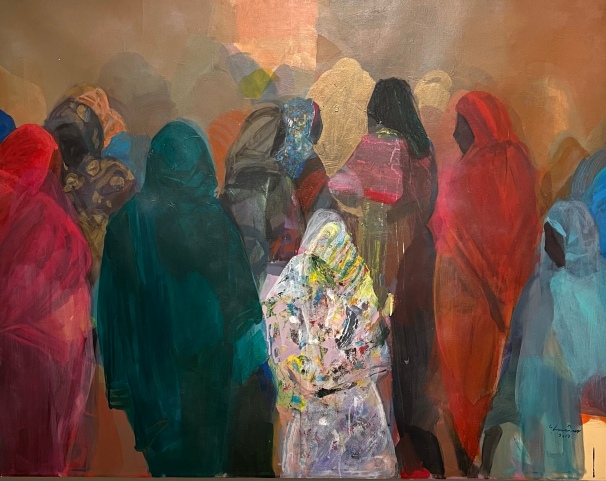
Above, Conversation II, acrylic on canvas, exhibited in Disturbance in the Nile Casa Árabe, Madrid earlier this year. “All Sudan’s bright colours are in the toub”; Rashid Diab speaking to The Guardian way back in 2001, when the black abaya and niqab were gaining popularity in Sudan.
Speaking to Arab News in 2021 about the centrality of women in his work, the internationally renowned Sudanese artist, art theorist and historian, textile designer and educator, Rashid Diab, explained “Many women in Sudan have lost their husbands or kids; they have suffered a lot but they keep going. They are very strong women. I show them respect when I paint them. These women have to be recognized.” Arab News Poetry on Canvas
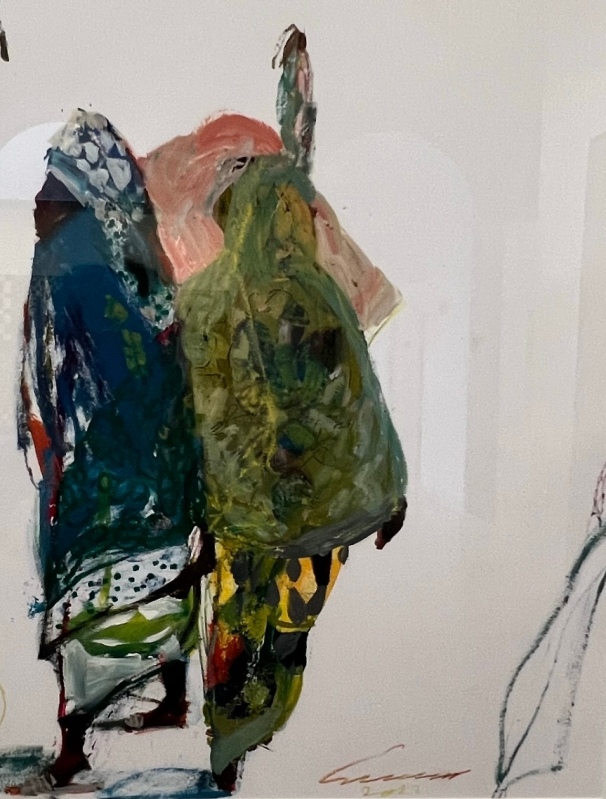
Above, detail from Leaving, acrylic on paper, Disturbance in the Nile Casa Árabe, Madrid.
In the same year the artist discussed a new series of paintings he was working on where women again played a central role; “Women’s pivotal role in Sudanese society – the part they play in keeping families together and the suffering they endured during the civil war – has long been a source of fascination to me. In this first series, the women I’ve painted are fading away to reveal a large void. I like to steer away from politics in my work, so the motif and messages are created in an artistic, colourful way that suggests hope. I see my work as a continuous reflection of the society we live in and its evolution.”
artscoops On the importance of looking back when looking forward
On Honouring Sudanese Women
The hope Rashid Diab speaks of above has never been more needed in Sudan. As the country approaches its sixteenth month at war, the appalling toll paid by Sudanese women for a conflict they have never sought worsens by the day. Sexual and physical violence as weapons of war against women and their families is becoming ever more prevalent as civil society collapses. The documentation of such abuse points to huge numbers of victims caught up in war zones yet to identified. I have included links to several expert sources at the close of this post, together with video testimony on this issue. The content is by definition highly distressing.
As a way of holding on to hope, this week’s brief post offers a rough translation of Rashid Diab’s personal tribute to Sudanese women, explained in 2018 during an interview with Picasso East Art Gallery (video embedded below).
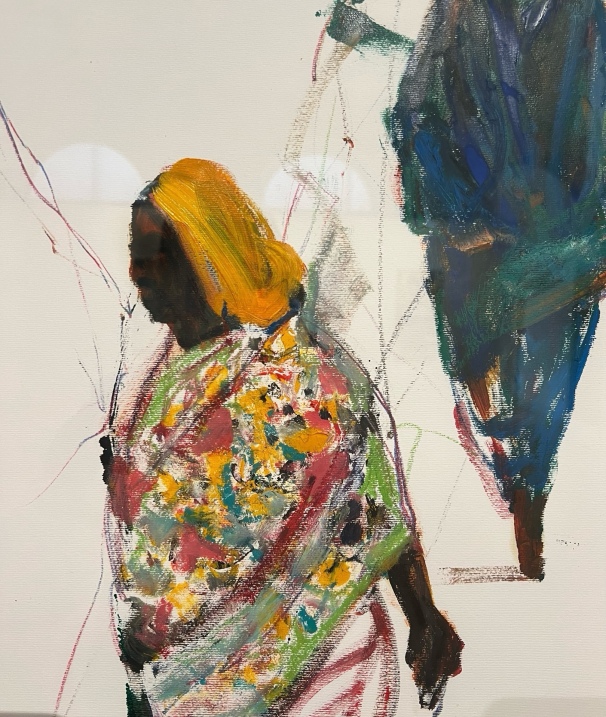
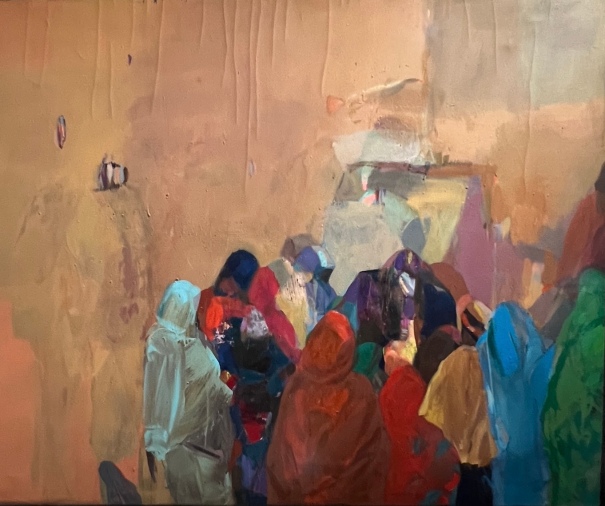
The tall, toub-swathed figures that inhabit the stark, semi-abstract spaces of the artist’s works are assured, enigmatic – archetypal perhaps. They speak of African and Arab spirituality and enduring memory. Women trace luminous, geometric trails as they make their way across pared back, sun-blanched landscapes or they stand alone, serene and sentinel-like against the vastness. Rashid Diab sees in his work an essential homage to the women of his homeland.
“They create a moving painting. When they come together you get very interesting combinations ond color and movement – like an art installation.” (Rashid Diab, on women in his art, Arab News, as above).
For more on the Sudanese toub, see “Migrating Bird” and The Enduring Appeal of the Sudanese Toub
Above, left, detail from Leaving. Right, Leaving II, Disturbance in The Nile, Casa Árabe, Madrid, 2024.
Rashid Diab talks about Sudanese Women (one minute, translation provided below)
“You might have noticed the presence of women in my work; it’s because for me it’s a a very special expression of my feelings for Sudanese women and my esteem for them; an esteem which only grows when you add what has happened in Sudan when it comes to crises and wars and displacement and disease and hunger and so on. Sudanese women are first to sacrifice themselves, the first in the struggle for enabling life to continue in Sudan. That’s why, in my work, as well as the special appreciation I hold for Sudanese women in general there’s that I have for my mother; a magnificent person, and the first to recognize me as an artist. She used to call me; Rashid, my son, my genius.” She saw something different in me from my siblings and rest of my family and she was a great support to me, always defending me.”
Diab’s words on his mother’s unerring support are especially poignant, given as a child “Rashid got little or no encourage to be creative. Yet he says he never wanted to do anything else. Being the last born of 14 offspring, his family felt he’d never make a living as an artist.” Kenyan Arts Review
Violence against Sudanese Women in the Present Conflict
Aljazeera Don’t Let the Other Soldiers Watch
UN Women Women Grapple with Unplanned Pregnancies
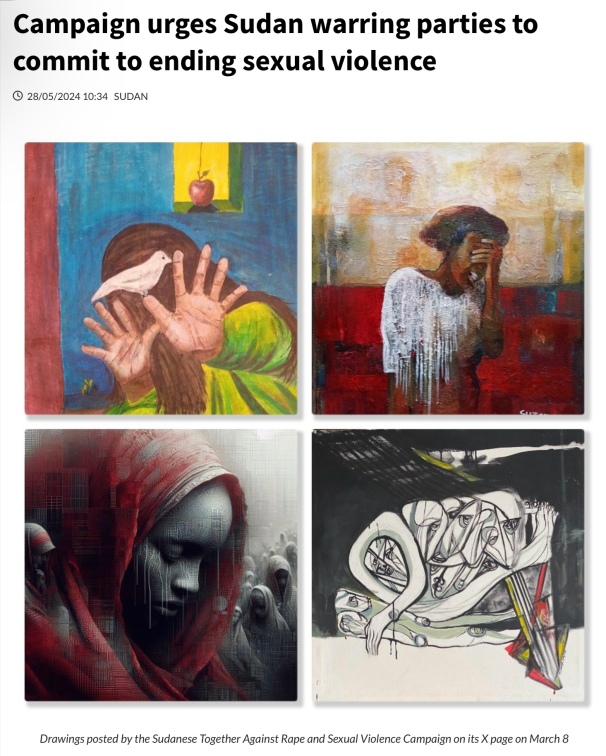
Dabanga Campaign urges Sudan warring parties to commit to ending sexual violence
See too this moving work; ranaart21
United Nations Population Fund A War on the Bodies of Sudanese Women and Girls
 Women's literacy in Sudan