

Sources of Light
The Visual Poetry of Yasmeen Abdullah
“Dialogue of Dreamers”; Yasmeen Abdullah and The Poetry of Mahmoud Darwish
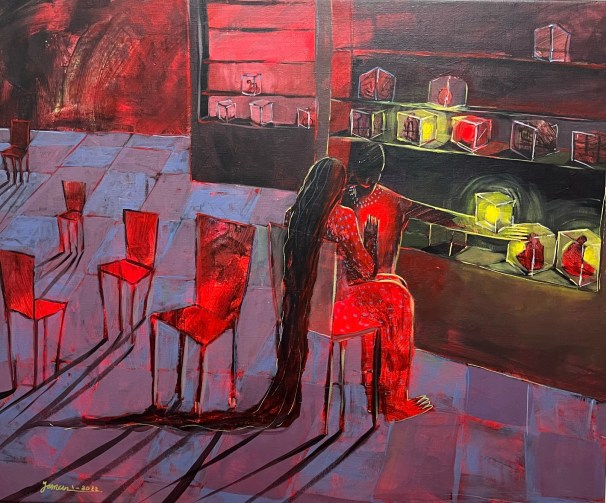
Above, the familiar becomes uncanny dreamscape as the separateness of interior worlds and the promise of connection are evoked in Yasmeen Abdullah’s Be a Neutral Hero to Survive. The work was displayed at Casa Árabe, Madrid earlier this year as part of the Disturbance in the Nile exhibition. Intimate, suspended chequer-tiled spaces awaiting moves to be made and glowing spheres of light, encased in crystal cubes or tenderly cradled in arms and laps inform this groundbreaking Sudanese artist’s visual lexicon.
See more of Yasmeen’s striking work and its symbolism in Arak Collection Yasmeen Abdulla and Yasmeen Abdullah Instagram
Read about Yasmeen Abdullah’s background and artistic trajectory in Finoon and
Interview with Abstract Artist Yasmeen Abdullah

“Dialogue of Dreamers”; Yasmeen Abdullah and The Poetry of Mahmoud Darwish
“One day I’ll become what I want / One day I’ll become a bird / that plucks my being from nothingness. / As my wings burn I approach the truth / and rise from the ashes / I am the dialogue of dreamers / I shunned body and self to complete the first journey / towards meaning / but it consumed me then vanished / I am that absence / The fugitive from heaven ”
From Mural, an exploration of loss, longing and exile by the Palestinian poet Mahmoud Darwish, (read a longer extract in Verso). Yasmeen Abdullah pays homage to these verses in her beautiful work, I Will Become

Above, “He is calm and so am I”, acrylic on canvas, exhibited in Case Árabe, Madrid, Disturbance in The Nile. See Mahmoud Darwish’s poem which inspired this work here.
“Yasmeen painted vases of flowers and fruits to symbolize life; she painted fish to express the flow of thoughts in our heads; she painted crumbs that represented the past; and she gave the paintings light to express hope. Yasmeen also painted furniture as a representation of history. “If the furniture could speak”, Yasmeen says, “they would have told the stories of everything that went on around them, Yasmeen Abdullah Inspire
The Dialogue of Dreamers
Reading the poetry of the great Palestinian poet, Mahmoud Darwish was to transform Yasmeen Abdullah’s trajectory as an artist. So many of her works (see Yasmeen Abdullah Instagram) draw inspiration from fragments of the poet’s verses and are intensely personal visual explorations of the universal emotions and mysteries they express; Darwish’s “flaw of excessive clarity” in a poem, for example, and “the spiritual confusion evoked by a clear sky and a green garden” (Mahmoud Darwish; A clear sky and a green garden, A River Dies of Thirst). Her work seeks to embody powerful poetic concepts, “the hidden links between the word and the painting”, in a visual language all its own. For Yasmeen Abdullah, art reveals the “raw, intricate beauty that lies within our souls” and empowers us to “traverse the chasm between what is seen and what is felt” (Yasmeen Abdullah, Instagram).

Pairs of glasses and cups resting on tables hint at dialogues past or yet to be shared; moments of connection and commitment in landscapes at once strange and familiar and rich with symbolism; the wistful “dialogues of dreamers”, perhaps, that Darwish speaks of. Through her paintings, Abdullah also encourages “a dialogue not just about the visible world but about the layers of stories, emotions, and truths that lie beneath the surface, waiting to be discovered and understood.” See for example, her work On the outskirts of eternity we play chess sometimes, 2022
Drawing on Darwish’s layered portrayal of women, Yasmeen Abdullah found ways to make the women that people her canvasses both individuals with their own quiet interior worlds and cyphers for wider social themes, see Yasmeen Abdullah Inspire. The artist’s first solo exhibition, ‘The Other Me’, held in collaboration with the Mojo Gallery and The French Institute, Khartoum in celebration of Women’s Week sought to “express the power of women” and “make the viewers imagine another world in order to look beyond the the colourful surfaces and tell stories of their own.”
In these times of great suffering in Palestine and Sudan, the artist draws inspiration and hope from the poet’s evocations of light. It is a constant presence in her work, whether contained, treasure-like, in boxes and crystal cubes, captured in the candle glow illuminating moments of tenderness or radiating from the open chests of her figures.
A Candle in the Dark
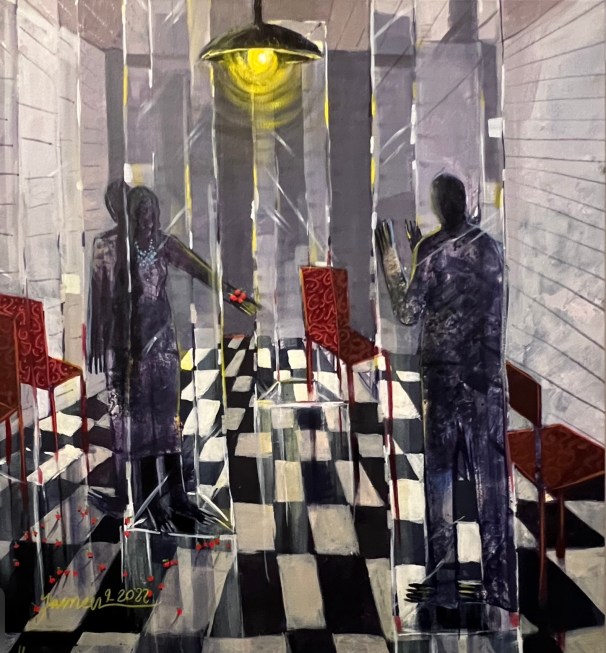
Light is both the precious gift of individual souls and a symbol for hope and social engagement. Quoting from Darwish’s Think of Others, she reminds us “if only I were a candle in the dark”. See too her beautiful work inspired by Nothing but Light. Forced to flee Khartoum at the outbreak of the war last year while heavily pregnant, (see Sudan’s war scatters country’s emergent art scene) Yasmeen and her family finally reached the safe haven of Muscat and in her instagram account gives thanks for the many sources of light in her life, vowing to being a source of light herself. “We need to spread beauty and hope, art has become a sanctuary, and it will speak on behalf of our nation telling all the untold stories” Yasmeen Abdullah, speaking on the Wandering of Dreams exhibition, Instagram.
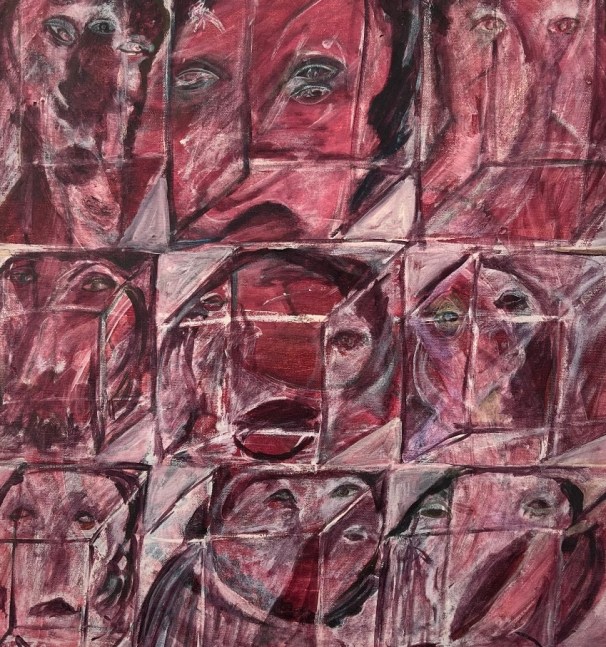
Light in the artist’s work is often refracted through mirrors in an endless mise en abyme or nursed by figures in their own, almost atomized, fractured worlds which yet also reflect “the joy of something hidden.” There is a tension here between separateness and wholeness, the seemingly discrete and the integrated, reminiscent of Kamala Ishag’s crystalist vision where the Cosmos is likened to “a transparent crystal with no veil and eternal depth, where many truths can be held at once; such that whatever is infinite may be finite, too, and delineation need not be synonymized with division.” Kamala Ishag – A Homecoming
Above left, Faces in a Glass Tube,1998, Kamala Ishag. Above right, We do not part but we will never meet, Yasmeen Abdullah.
The Butterfly Effect
It is the attraction of mysterious things / which entice meaning, and depart / when the way becomes clear / It is the lightness of the eternal in the everyday / a longing for loftier things / a beautiful brightness / It is a beauty spot in the light signalling / where we are guided towards words / by an impulse within us
The butterfly effect, Mahmoud Darwish, A River Dies of Thirst, translated by Catherine Cobham.
Yasmeen Abdullah’s painting, The Butterfly Effect was also exhibited at the French Institute Women’s Week celebrations and she explained “The painting is a simulation of what I started to do and a translation of Darwish’s poem. The main figure represents me, or anyone trying to make a big difference, trying to be kind and spread small things: a smile or a word, or anything else. Regardless of how big or small these things are, I hope they will affect other lives in a good way. It’s all about making changes with the simplest tools that you have.” (Behind the Art; The Butterfly Effect; Yasmeen Abdullah, Words without Borders). In Yasmeen’s own life she recognizes “each act of kindness, each word of comfort, and each gesture of support, no matter how seemingly insignificant, has culminated in shaping a path forward for me” and acknowledges “the notion that even the smallest actions can create significant ripples of change has never been more apparent to me.” Yasmeen Abdullah, Instagram. The intensity of this realization is captured in her glowing work, Hand that spreads Awakening.

“I don’t know who sold the country but I know who paid the price”, exhibited Casa Árabe, Madrid, Disturbance in the Nile. See the Darwish poem Yasmeen attaches to this work here.
The artist has applied the principle of the butterfly effect too in the service of change in Sudan, producing several works in support of the Sudanese revolution. Interviewed before the outbreak of war, she explains “I only used red, black and white because these colours reflected the three options we had. Either you were with the revolution (white) or not (black) and between these two there were deaths (red). But I also used blue under the well-known hashtag #blue_for_sudan to document these events in my way. The revolution changed me as a person and reflects in my work. I have more freedom to express my thoughts, feelings, and opinions.” Yasmeen Abdullah Inspire
See too How Art Helped Propel Sudan’s Revolution
“We will become a people, if we want to, when we learn that we are not angels, and that evil is not the prerogative of others
If we want to, Mahmoud Darwish, A River Dies of Thirst
 Women's literacy in Sudan