

Waleed Mohammed
Art and Memory
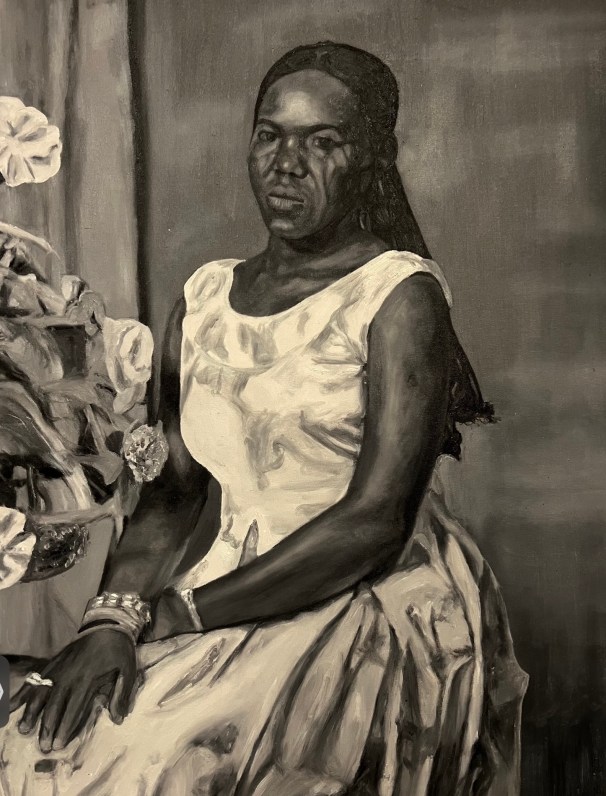
Above, Waleed Mohammed’s Something Special, oil on canvas, featured in Disturbance in the Nile hosted by Casa Árabe, Madrid earlier this year. The monochrome painting above of a young woman, composed and self-contained, bearing the ritual facial scars and striking silver jewelry of the era, plays on the studio portraiture of Sudan’s photography pioneers such as Rashid Mahdi: It captures the poignancy and tantalizing sense of potential of a bygone era while asking how the past might inform the present.
Setting the Scene
A Brief Profile Aspects of Waleed’s Work
The Discipline of Monochrome
Revelling in Colour

Setting the Scene
Inspired by the formal studio portraits of Sudan’s Golden Age of Photography and the spontaneous intimacy of family photographs of earlier generations, Kenya-based Waleed Mohammed explores our relationship with memory, nostalgia, tradition, loss, and enduring personal essence across the passage of time. In his own words Waleed Mohammed explores “the illusion of being related to memories we were never part of”. Waleed Mohammed’s Reverse Exhibition
See more of this remarkable young Sudanese artist’s work in Waleed Mohammed Instagram

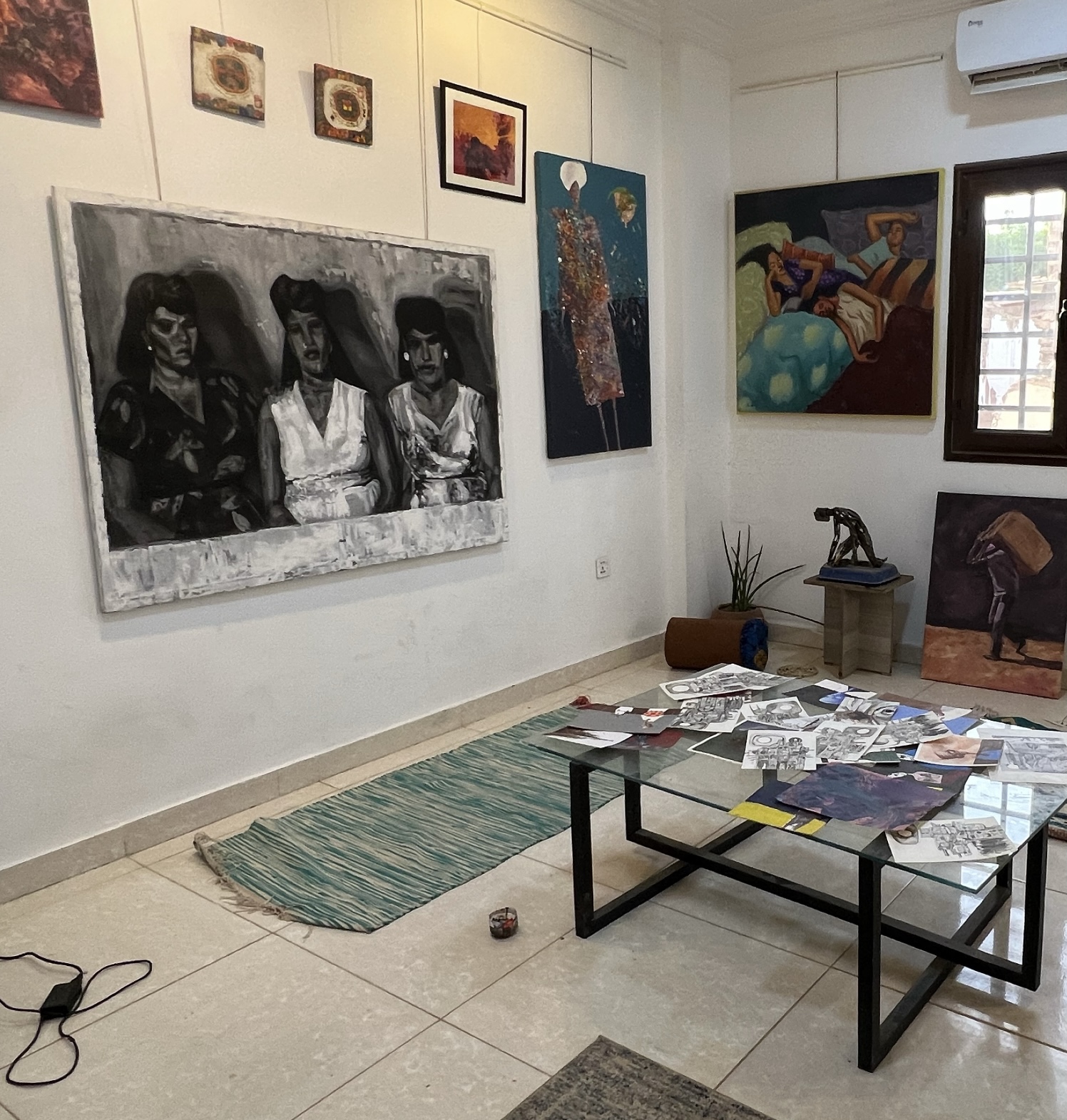

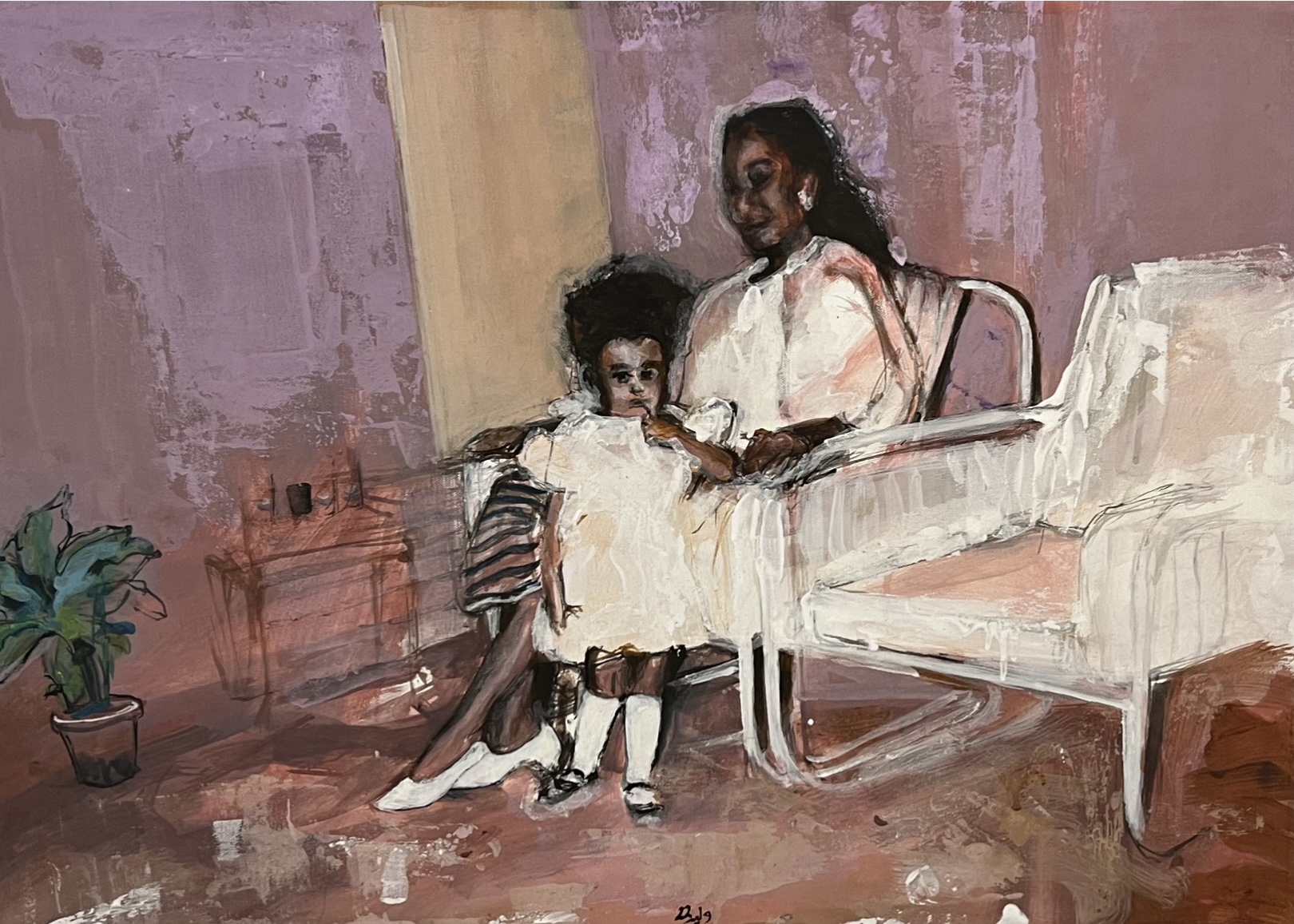
Above, more works by Waleed Mohammed, exhibited pre-war by curator and director, Rahiem Shadad at the Downtown Gallery, Khartoum. See Going Downtown and Artists in the Midst of War
Another artist profoundly inspired by photographic portraiture is Salah Elmur
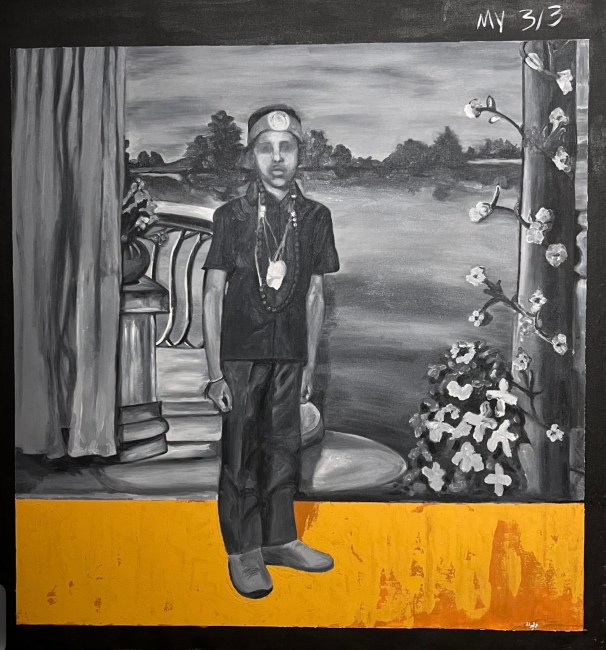
Above, My 3/3, Waleed Mohammed, exhibited in Disturbance in the Nile, Casa Árabe, Madrid 2024. A young Sudanese boy in black and white poses against the tell-tale painted backdrop of drapes and flowers of the Sudanese portrait studio. He wears the crescent-adorned headband and wrist band associated with circumcision and jirtig ceremonies. The youngster in semi-profile portrait stance, looks towards both the unseen camera lens and artist, arms straight at his sides, a painted portrait of a portrait.
Below, a studio portrait of the 1980s; photo kindly supplied by members of Sudan English Teachers Facebook.

Waleed Mohammed; A Brief Profile
Waleed Mohammed (2000, Khartoum) is one of the youngest Sudanese artists to be exhibited internationally. He was working on his graduation project at the Faculty of Fine and Applied Arts, majoring in painting at Sudan University of Science and Technology when war engulfed the capital last year. “I had a studio in the area of Al Sooq Al-Arabi which is only a kilometer away from the presidential palace and it’s why it became very dangerous.” (Waleed Mohammed, Instagram). Like so many young artists who had imbibed the creative energy and artistic freedom of revolution-era Sudan, Waleed found himself forced to flee Sudan, abandoning his studio and having to leave behind his paintings. See Inside Sudan’s war there’s another war for art

A profoundly meditative artist, Waleed is also socially committed, participating in community murals and children’s workshops and seeking to reflect the diversity of his homeland’s peoples as well as dedicating work to Khartoum’s Maygoma Orphanage, anti-racism, as in his Black People are Dope, below, and Unicef FGM awareness campaigns. In response to his personal tragedy of war and displacement, Waleed says “Still gotta smile, As I am a painter, I’ll repaint my story.”
Curator and director of Khartoum’s Downtown Gallery, Rahiem Shadad, was first to exhibit Waleed Mohammed’s work in Across Generations: A Tale of Sudanese Essence and Diversity, 2020, at the gallery. Waleed Mohammed’s first solo exhibition, Reverse, was held at the Downtown Gallery in 2022. See too Waleed Mohammed’s Reverse Exhibition. Since moving to Nairobi, the artist has participated in several exhibitions and residences there. See too Inspire Gallery
Aspects of Waleed’s Work

Above, Black People are Dope, exhibited in Disturbance in the Nile, Casa Árabe, Madrid, 2024.
“I have a different mood for every painting I paint. I also have a residual uses for each material I use, oil colors are my favorite raw material to reach the depth of the painting.” Waleed Mohammed, Instagram, writing on this piece.
The Discipline of Monochrome
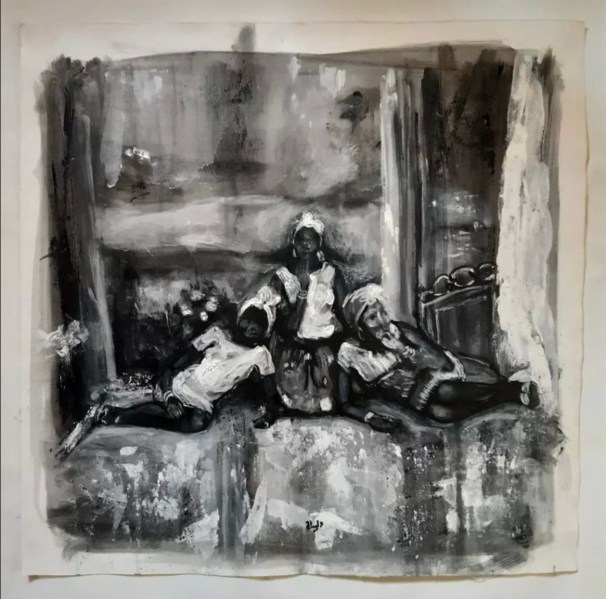
“The memories are scattered through the thin brush on the surface of the “canvas” after mixing a neutral gray shade of the two colors. From here begins the journey of painting the “monochrome”, which for me is a more difficult process of creating or drawing than coloring with primary colors and sub-colors. Painting “monochrome” requires visual perception, visual experience and practice.” Rahiem Shadad writing on Waleed Mohammed Andariya

In his unique reworking of old photographs, Waleed Mohammed says he finds “balance, mass, rhythm, shadow, and light”, Waleed Mohammed, Andariya in the process creating interplay of forms bordering on the abstract. We intuit in these forms rows of youngsters in their best clothes who sit, their feet dangling from high benches, their white socks mere thick bright brushstrokes. Two women, seated side by side are caught in a tender gesture of closeness as they extend their hands to one another. A hand on a shoulder subverts the formal studio pose of long ago. Facial features are hinted at and rarely defined, perhaps evoking the erasure of time, the universal nature of the moments captured or “perhaps the haziness of this paintings is his secret to audience attachment.”
Sometimes faces are portrayed in striking, loving detail and delicate items of jewelry picked out in silver or gold, disrupting the monochrome. For Waleed Mohammed, jewelry seems to bear a special symbolism, speaking perhaps of permanence, the beauty of past lives, customs and traditions lost or yet enduring and a lost esthetic of ornamentation and dress that seems both comfortable and graceful to the wearer. For the symbolism of gold in the present conflict, see What “the gold of grandmothers” symbolizes
Revelling in Colour

While the bulk of the artist’s work is in black and white, Waleed Mohammed also draws inspiration from iconic colonial and post-colonial era photographs, reworking them with striking indigo, magenta and other vibrantly coloured backgrounds. There is an energy and defiance in these works, as in his Peripheries of Escape series, suggesting an exploration of identity and a shift away from the wistfulness and tenderness of earlier pieces.
It will be fascinating to see how this gifted young artist matures and develops in his style and how the impact of migration, loss and new cultural and artistic input will inform his work to come.
For other Sudanese artists featured in the Disturbance in the Nile, see Yasmeen Abdullah and ElTayeb DawElbait Tariq Nasre The Resonance of Place
 Women's literacy in Sudan