

In Conversation with Artist Mohammed Mustafa
A Message of Hope
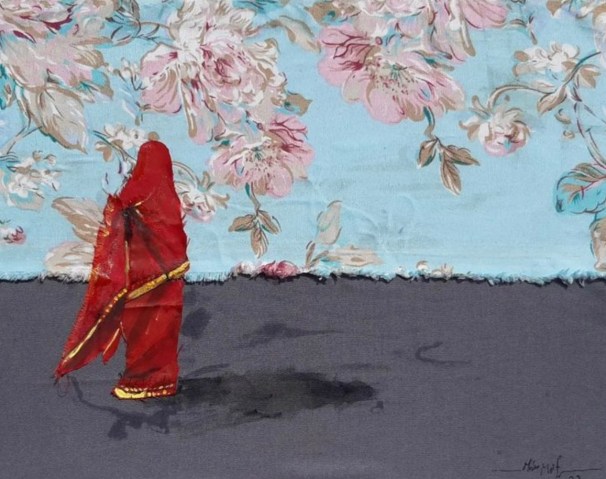
Above, a graceful figure swathed in traditional red and gold jirtig wedding toub glows against a horizon of blossoms; one of Mohammed’s recent works combining textile, paint and collage. When war erupted in the Sudanese capital last year, fine arts undergraduate, Mohammad Mustafa Abu Al-Hassan, pictured below, lost his studio and everything in it. Forced to flee Khartoum, Mohammad, or Mo, Mustafa sought the relative safety of Kassala in Eastern Sudan. There, this gifted young artist has taken to experimenting with collage, textiles and natural materials.

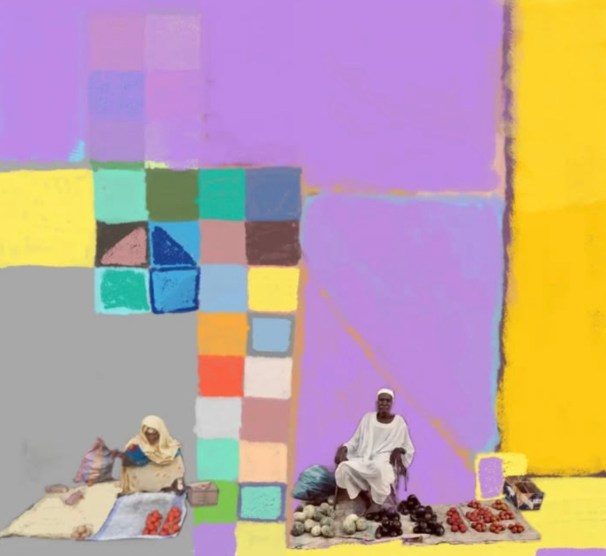
Mohammed is determined to express the tragic impact of Sudan’s war in his work while always holding on to faith in his people’s ability to rebuild their homeland and their lives. Although his work delves into the brutality and waste of war, his message is ultimately uplifting. Commenting on the work below – “a call to create a new reality full of hope and optimism”, Mohammed explains “This artwork embodies the spirit of Sudan rising from the dust of war to once again pulse with life and beauty…as the vendors go about their daily lives in harmony with the colours that fill the background.” He goes on; “The colours here are not just passing details; they symbolize the joy that will fill Sudan after the hardships…”
Mohammed Mustafa Instagram
Learn about this courageous artist and see more examples of his work in Artist Mohammad Mustafa Bears Witness.A couple of days ago, Mohammed was kind enough to talk with me about his work and what matters most to him.
In Conversation with Artist Mohammed Mustafa

Imogen: Thank you so much, Mohammed, for your kindness in speaking with me today. I discovered your work by chance while scrolling social media and one work in particular, your scene of the massacre of Noura Village, (shown right) stopped me in my tracks and I knew I had to learn more about your work. I wondered if you could start off by telling us a little about your life before the outbreak of war last April?
Mohammed: I was studying Fine Arts at Sudan University of Science and Technology, specializing in graphics, when the war started. About a month or two before that, I had actually managed to realize one of my biggest dreams as a student in Khartoum – I had set up my own studio and I was just starting to take the first steps on what was for me a really exciting, ambitious journey. Of course, the war became a major obstacle to that.
Imogen: I noticed a newspaper clipping on your instagram feed celebrating the fact that you were among the youngest artists of note in Kassala, so I’m curious to know whether you come from a family with a tradition in the arts?
Mohammed: There were no artists in my family but my mother used to create handmade crafts. I believe I fell in love with drawing because of the colours she used in her small creations

Imogen: The war has, of course, changed everything in Sudan. How did it impact your life and work in particular?
Mohammed: The biggest personal change was going back to my family’s home in Kassala. As far as my artistic life goes, much has changed because I started thinking about different ways to express the issues that matter to me now. Previously, I’d focussed on the aesthetic aspects of art; now I express the issues facing my country and try to shed light using the messages that can be conveyed through art. I also had to start developing new methods and approaches in my work because there weren’t any specialist art materials anymore. So I started incorporating lots of different materials into my work, such as fabric, paper scraps, branches or whatever is available. I guess you could say I started thinking about using what was possible, as well as other resources to express my inner self.
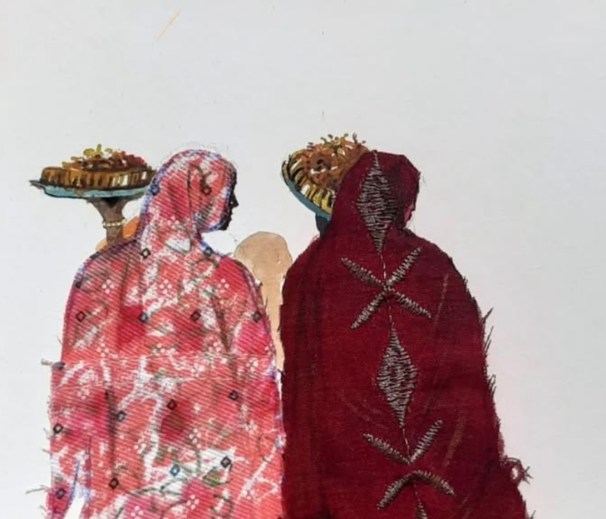
Above right, Mohammed’s work honouring the victims of an attack on Al-Sariha, Al Jazeera, one of many villages in the region to suffer destruction at the hands of the RSF.

Quoting UNICEF, Mohammed’s commentary on this work reads; Sudan is facing a catastrophe for an entire generation. Around 14 million children are in urgent need of humanitarian aid, while 20 million children may not attend school this year.
Imogen: What you are working on at the moment and in an ideal world, a world free from war, what would you be doing now?
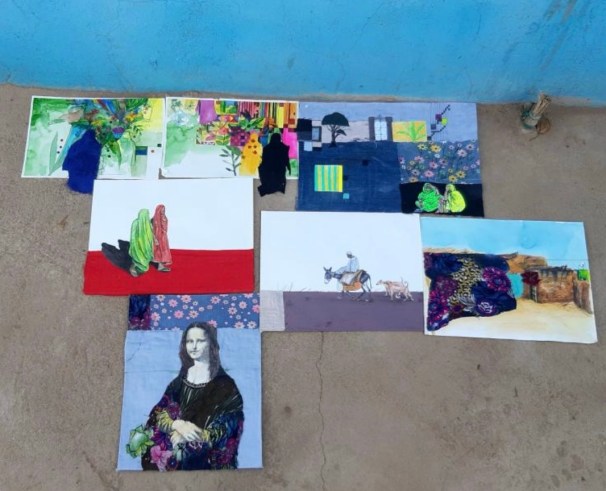
Mohammed: I’m currently continuing my university studies online and I’m also working on my project in recycling and utilizing fabric, along with other works (shown right). In a perfect world, I’d be doing two things: dedicating a large studio where I can express the love and emotions I hold within me for Sudan, with all its historic heritage, through my painting, and I’d be developing my own style to express issues, such as through the medium of expressive painting.
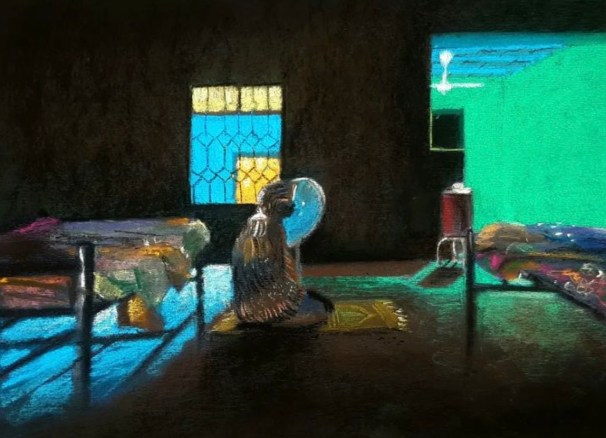
Imogen: Your recent work deals with the present crisis in Sudan in very intense and powerful ways. Would you define yourself as a socially committed artist?
Mohammed: I think I see myself as an artist who’s balanced within himself but I do change, depending on the message I want to convey. I’d like to think that my balance lies in expressing beauty and transforming the ugly into something beautiful, whether it is habits, forms of behaviour, or false traditions, turning them into beautiful and genuine customs and values that truly represent us as humans. This allows us to connect with our feelings and emotions in a deeply human way.
Imogen: Finally, Mohammed, If you had just one message you’d like to get across, what would it be?
Mohammed: End racism in Sudan.
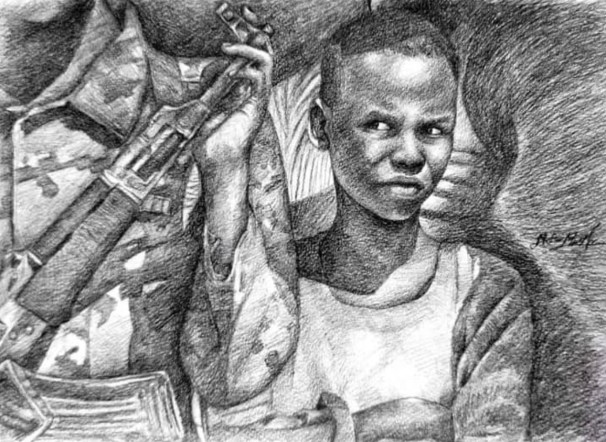
Above, Mohammed’s work on tribal conflict in Sudan.
I know everyone reading your words hopes you and all your family will remain safe. We wish you every success as you continue to develop and grow in your career. We look forward to a return to the Sudan you know and evoke so tenderly; as you say, a Sudan pulsing once more with life and beauty.
 Women's literacy in Sudan