

The Miswak in Sudan
The Sudanese Toothbrush

Above, a Mundari tribeswoman from Central Equatoria, Terekeka, South Sudan, using a wooden toothbrush or chewing stick, known as miswak / muswak, plural masaawiik, (photo, Alamy, used under licence). Below, Arak wood miswak toothbrushes on sale in souq Al-Arabi, Khartoum, 2019.
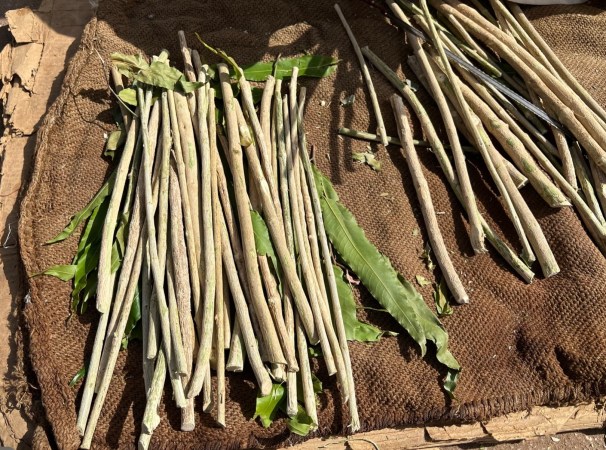
“Arak tree miswak has a beautiful taste, especially the ones which are green and especially the fine type. Close to Ramadan; it was the only one we use before ifta, the breaking of our fast. And our parents used to tell us that in Ramadan we should buy maswak…” The words of just one of many contributors to Do You Remember Sudan Facebook Group who remembered with affection the miswak of their youth.
This week’s brief post is dedicated to this humble but eminently practical tool that holds a special place in Sudanese culture. When researching this article, many kind Sudanese responded to my questions, all echoing the affectionate memories of the contributor above, recalling their many elders who retained strong, healthy teeth late into their eighties after a lifetime of miswak use, as well as relating their parents’ and grandparents’ firm belief in the health benefits of the miswak. So much part of Sudanese life is the miswak still that in Sudanese Arabic, if you are as thin as a rake, you are said to be as thin as a miswak. Although plastic and nylon toothbrushes have gained traction in Sudan, many Sudanese from north and south alike still prefer the miswak; “For a long time I have been using the miswak, with ground faham (charcoal) mixed with salt to fight tartar and bacteria”, a young, South Sudanese Facebook contributor posted.
“The young nomad leaned on a large rock and stared at her curiously. His dirty clothes were too big for him and torn in several places. His cap was perched at an angel on his head, and he was chewing a worn miswak branch with leisure.” From A Mouth Full of Salt, by Reem Gaafer.
The Miswak – A Noble Tradition
The Arak Tree The Benefits of Miswak Use
The Miswak – A Noble Tradition

Gustav Nachtigal, the famous nineteenth-century traveller and explorer of the Sahara and Sudan, observed that the women of Wadai region of Sudan, “rarely go out without their toothbrushes in the corner of their mouths.” He went on to explain that the thin toothbrushes or “chewing sticks”, frayed at one end into a brush, were prepared from the wood of the siwak or Arak tree (Salvadora persica), also known as the mustard or toothbrush tree, shown below. “As soon as the women sit down”, he observed, “they use these brushes diligently”, the wood having “the quality of making the breath of the women sweet-smelling.” (quoted in The Miswāk, an Aspect of Dental Care in Islam by Gerrit Bos)
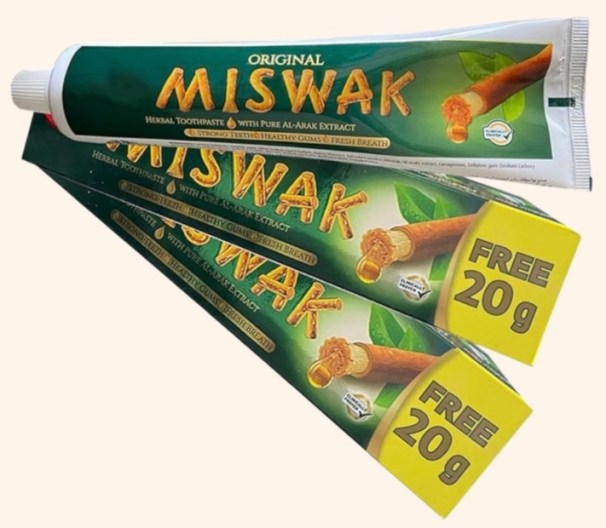
The toothbrush known variously in Arabic as miswak, miswaak, meswak, sewak, siwaki, is believed to be “one of the oldest known oral hygiene tools”, and is still used by millions across Africa, The Middle East and Asia. It is cheap, readily available, requires no toothpaste and, if used correctly, modern research has indicated, rivals the conventional plastic and nylon toothbrush when it comes to combatting plaque, caries, gum and periodontal disease. So much so that The World Health Organization recommended the use of the miswak in 1986 and again in 2000. (A Review of the Therapeutic Effects of Using Miswak(Salvadora Persica) on Oral Health). Today, the miswak can be ordered online, vacuum packed, in clove, orange and other exotic flavours, and purchased with its own, smart, cigar-cutter style metal bristle trimmer. Glossy websites advertise western style toothbrushes made of arak bristle and wood and boosting the latest Japanese technology and arak miswak toothpaste, shown right, is also a big seller.

In the Islamic world the miswak came to enjoy special status as a practice widespread among pre-Islamic Arab tribes with its own etiquette, rituals and poetic lexicon praising the fragrant mouths and white teeth of the miswak user, gained religious endorsement. Interestingly, both Islamic and pre-Islamic texts warn against the dangers of excessive use, dangers modern dental research findings echo.

Held to be a “purifier of the mouth and pleasing to the Lord“, miswak use is believed by some to bestow multiple spiritual blessings – as many as seventy -when used before prayers or recitation of sacred text and even to enhance memory. The Prophet is known to have used the miswak upon entering his house, waking and even, it is believed, upon his deathbed. He recommended its use to cleanse the mouth before ritual washing and prayer. The use of the miswak, though desirable, was not made compulsory by the Prophet, according to Hadith authorities such as Al-Bukhari, so as not to overburden his followers. The tree itself in some regions is known as siwak an-Nabi; the arak tree of the Prophet. Right, a Mundari tribeswoman with her miswak, Alamy, as above.
Millions of believers turn to the miswak in the Holy Month of Ramadan as it freshens the mouth without the risk of toothpaste or liquid breaking the user’s fast. In Sudan, the miswak comes into its own during Ramadan and as demand rises, so do prices -sometimes threefold. The long, green stems of shau miswak; held to be the finest and excellent for whitening the teeth, are spread out on mats and cloth around the mosques and markets of the capital. See too تنشط هذه الأيام تجارة بيع المساويك حيث يحرص الكثيرون على استخدامها في نهار رمضان.. الشاو والأراك and Arab News.

He told me to order my servants to remove all lethal weapons when I felt an attack of malaria coming on, and to have a miswak (a piece of stick used as a toothbrush by the people) between my lips when trying a case. “The people”, said Slatin, “can read your thoughts by watching the movements of your mouth and will know if you believe what they are telling you. With a miswak between your teeth they will not find it easy to realize what is passing through your mind.” H.C. Jackson of the Sudan Political Service, recalling the curious but much valued advice he received from Rudolf Carl von Slatin, left, Sudan Days and Ways, Macmillan, 1954.
The Arak Tree
Sudan Notes and Records of 1924 (Volume 7) describe the “Shau or Rak”, the salvadora or mustard tree “whose twigs are used for by natives for toothbrushes”, as growing in “great profusion on sandy hummocks in the Wadi Hawa region, noting its “tiny berries, like red and black currants, which the ostriches like”.


The Arak is a highly climate-resilient evergreen small tree or shrub, reaching three meters in height and bearing small, succulent, oval leaves smelling of cress or mustard. While cultivated on mass in Malaysia and Indonesia where it is used as a base for toothpastes, in Sudan the Arak, pictured right, is found in the semi-desert regions of northern Sudan, where it is said people there would distribute miswak free among worshippers at Eid prayers. It is also found in eastern Sudan and North Kordofan. Left, the leaves and berries of the arak tree, Wikicommons.
Arak is not the only wood used for toothbrushes; almost any non-toxic wood with astringent, bitter properties, can be made into effective miswak, such as balsam, turpentine and young palm wood or sa’af. In Sudan, neem wood miswak can also be found, although some say the taste is unpleasantly bitter.
The miswak toothbrush is made from the roots, stems and small twigs of the arak tree and can be harvested without substantial damage to the tree, as you can see in this brief video (in Arabic) below. The arak plays a significant role in combatting desertification.
The Benefits of Miswak Use
A 2000 Khartoum study into miswak users found that their “periodontal status” was comparable or slightly better than that of conventional toothbrush users. The same study notes; “Given the availability and low cost of miswak, it should be recommended for use in motivated persons in developing countries.” Research findings indicate miswak use not only aids in removing stains on the enamel and whitening the teeth but also protects against plaque, caries and ulcers, improves receding gums and appears to have antiseptic and even “remineralizing” properties. Analysis of the wood reveals it contains substances beneficial for dental health such as fluoride, silica, with its mildly abrasive properties, tannic acid, resins and volatile as well as aromatic oils which stimulate salivation, vitamin C, sodium bicarbonate and calcium. See too Miswak: A natural toothbrush with medicinal properties.
Ideally the miswak wood should be fresh; brownish-white rather than dark brown in colour. The end should be washed in water before use and then chewed or trimmed until bristle-like fibres are exposed. The brush end needs to be trimmed every twenty-four hours after use to maintain freshness, remove build-up of any harmful substances and release fresh sap and silica.
For fuller information on the benefits and potential disadvantages of miswak use, including lack of coverage of tooth surfaces and damage to tooth surfaces, see A review on miswak (Salvadora persica) and its effect on various aspects of oral health
 Women's literacy in Sudan