

Remembering Nafisa Ahmad Al-Amin
Pioneer Sudanese Feminist who died in Riyadh on 5th January, 2025
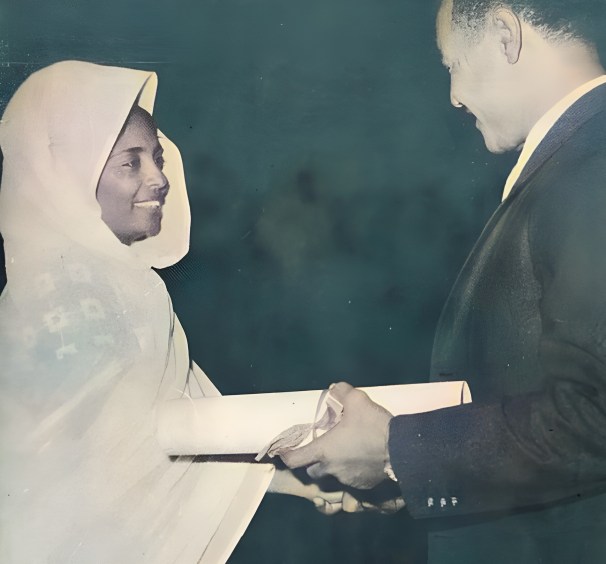
Above, Nasifa Ahmad Al-Amin “presenting the document of pledge for the Sudanese Women’s Union to President Nimeiri”, circa 1971 (Wikipedia)
An Exceptional Life; Milestones
” I am the half that contains the whole of meaning”
From Daughter of Light, a hymn to the essence and grace of Sudanese women, sung by Abdel Kamil Al-Kabli, and which came to be forever associated with Dr. Nafisa Ahmad Al-Amin. An annotated transcript and working translation will be available in my sister blog, Sudanese Arabic Documentary Transcripts with English Notes soon.
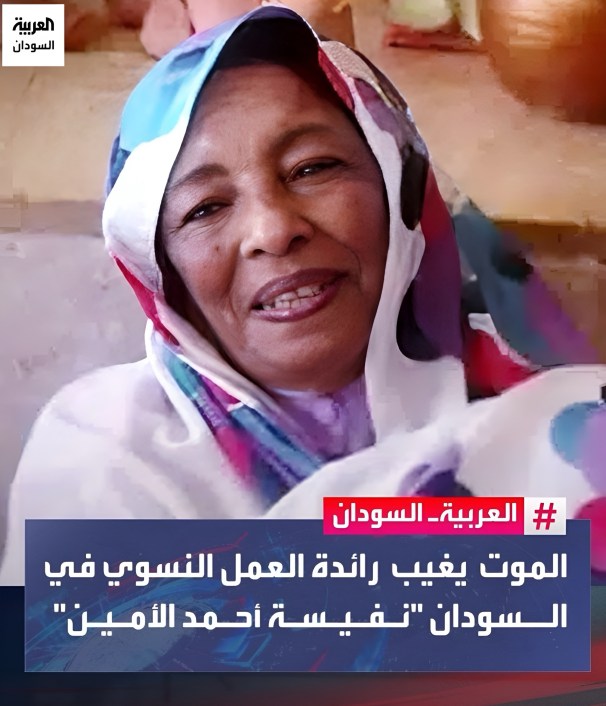
Dr. Nafisa Ahmad Al-Amin was a groundbreaking political and social activist and one of the first Sudanese women to take on major public political and cultural roles. She was a tireless advocate for the advancement of Sudanese women, to be brought about, she believed, through alignment with Sudan’s Islamic values, its social structures and best cultural practice. Her approach has been described as both gradualist yet urgent, pragmatic; she is quoted as saying absolute good intentions do not work in politics, and cautious – her self-confessed watchword in political issues. She has also been seen as socially conservative, to the point of foreshadowing some of the policies that would later be adopted by the National Islamic Front, though she was an opponent of the regime and suffered censorship at its hands (Sondra Hale, Gender Politics in Sudan).
Left, news outlet Al-Arabiya Sudan announced the passing of Dr Nafisa Ahmad Al-Amin.

In her 1981 article, Education and Family, Al-Amin emphasized the positive role of Muslim family law in distinguishing Sudanese identity from “incongruent” (1) British colonial models, acknowledging that men and women had different roles to play in a healthy society. In family law “men and women are the progeny of one soul and are equal and subject to the same moral code” (2). Yet, for Nafisa Al-Amin, the role of women is seen, if anything, as superior in some respects to that of men: “That function is not restricted to the rearing of children or looking after the house, but goes beyond that to encompass all social life in the house and outside. Man, who is commanded to exert his physical energy and earn a living, is not made a master by so doing, he is a servant to woman who is performing the real work of building the social structure…..society must pay woman for the great work she performs.” (3)
Above right, a scene from the 1964 Revolution, Instagram, Sudan zaman.
Most western analysts define this pioneer for women’s rights as a “liberal feminist” of socially privileged background. Nafisa Al-Amin’s political beliefs were forged in the 1940s and 1950s, against a backdrop of strict gender segregation both within and outside the home and about which she wrote with feeling, limited opportunities for women in public life, little educational provision for girls, fervent anti-colonial and nationalist sentiment and the heady days of the 1964 Revolution when women braved gunfire in the streets and everything seemed possible.
“They were exposed like their fellow men to different sorts of harassment and dangers including gunfire from live ammunition. A great number of them were wounded (…..) This increased the vigor of the popular revolution (…) the distinguished role played by women in bringing about the downfall of the first military rule, pushed women’s issues to the forefront of the agenda(…)”
Nafisa Ahmed al-Amin and Professor Ahmed M. Magied “A History of Sudanese women organizations and the strive for liberation and empowerment” (The Ahfad Journal Vol 18 No. 1 June 2001, 11-12.(4)

Nafisa Ahmad Al-Amin co-founded Sudan’s first national Women’s Union (WU / SWU), working closely with some of the most prominent and courageous women activists in the country’s history, such Fatima Ahmad Ibrahim and Sitana Badri. Much of their focus rested on eradicating female illiteracy and providing training in practical, income-generating skills.
As a leading women’s activist and following rifts within SWU and its suppression in the 1970s, Nasifa Al-Amin would go on with other SWU defectors to join “the vanguard of the Union of Sudanese Women”, a separate entity to the SWU though similar in name (Sonya Hale, Gender Politics in Sudan), the former women’s wing of the government-approved Sudanese Socialist Union and the only party to retain legal status after the attempted 1971 leftist coup. She became its Secretary General and the first woman appointed by Nimieri to the Political Bureau of the Sudanese Socialist Union. In 1971 she became the first woman to hold an executive post when she was appointed Deputy Minister of Youth and Sport.

After regime change in 1985, Nafisa Ahmad Al-Amin distanced herself from political allegiances and moved to UK, where she helped found and later became President of The Sudanese Women’s Association UK. In 1986 she was invited by Dean of Khartoum’s Ahfad University for Women, Yousif Badri to establish a centre dedicated to the documentation of Sudanese women’s lives and activism; the Documentation Unit for Women’s Studies. 1n 1995, she became a member of the university’s Board of Trustees and was later awarded an honorary doctorate by the university. She remained a dynamic, inspiring presence at the university for many years.
Throughout her career, Nafisa Ahmad Al-Amin conducted academic research on the Sudanese women’s movement, and promoted the arts, particularly poetry, as vehicles for her homeland’s cultural renaissance. She was from childhood an avid collector of and advocate for the preservation of Sudanese proverbs, which she felt captured true values of Sudanese social interaction. She campaigned for the preservation of what she saw as the most admirable aspects of her culture and spoke out against those elements of Sudanese life that undermined education and tolerant religious observance. She was an eminent and proactive voice in parliamentary delegations, conferences and international symposia on the changing status of women in Sudan; and a prominent member of Sudanese United Nations Association.
Above left, “Emancipation. Three of the eight Sudanese women who had the educational requirements which gave them a vote in the graduate constituencies”. Photographic plate from Where God Laughed, a colonial publication of 1954.
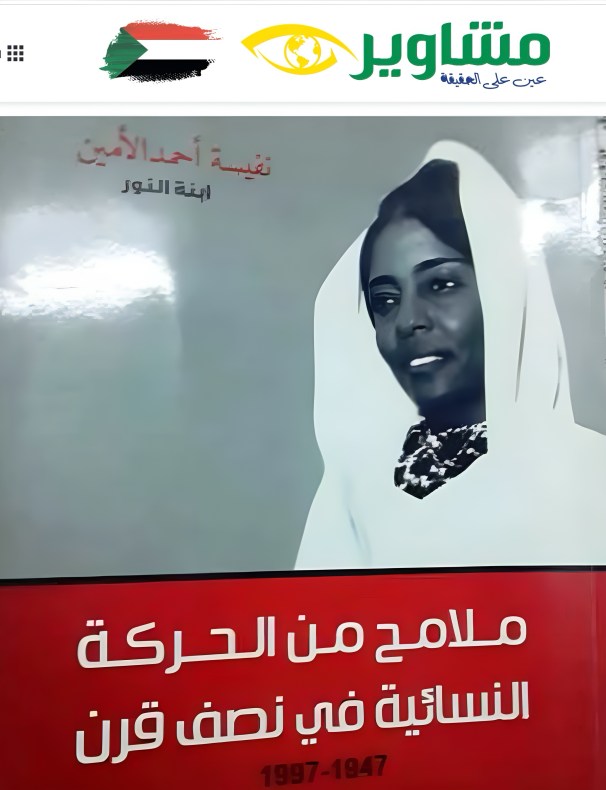
Her book, written under the moniker Daughter of Light, at a time when may women still felt compelled to write under pseudonyms, roughly translated as Features of the Women’s Movement over Half a Century, 1947-1997, reflects on how her own experiences shaped her feminist outlook; recalling her schooling in Wad Nubawi, youthful exposure to the nationalist cause and the anti-colonial struggle. It discusses the activism of the women nurses and teachers of the 1950s, traces the birth of the Sudanese Women’s Union, and provides a critical analysis of its record. The book also tracks Sudanese women’s educational milestones; Nafisa Al-Amin had qualified as a teacher and taught in Kassala and Sennar before later immersing herself in activism.
Learn more about the many pioneers of the Sudanese Women’s Movement in

The Arabic sources consulted while researching this post are available on request. Other sources are referenced below.
Formative Influences on An Exceptional Life

Marie Grace Brown recalls some of the early influences on the activist’s life. When speaking of her early life with the author, Nafisa Al-Amin acknowledged the lasting impact of her brother’s accounts of the struggle against colonial rule. Her Omdurman home was near the Congress Headquarters and the Graduates’ Club and she was invited to sit with her father as his guests talked politics and sang nationalist songs. Later, in 1952, she would watch with great interest as female nursing staff at Khartoum Hospital joined their male colleagues in striking.
Other sources highlight how her experiences of the intense contrast between urban and rural life heightened the young woman’s sense of the inequitable and the need for social change. Most sources agree that Dr Al-Amin was born and raised in the Omdurman souq district (no date given) while the family originated from Wad Ramli, a village some 75 kilometers from the capital. On her holidays to the family village, she became acutely aware of the lack of facilities and infrastructure there; recalling that the water of Wad Ramli “did not pass through pipes”, there was no electricity, toilets, flour mill, or asphalt roads, no qualified midwife – she would later be profoundly affected by the death of a village cousin in childbirth, attended by a traditional “rope midwife”, no hospital, no clinic…“ She recalled how as a young girl she was awoken early by her aunt, so that the girls of the house could relieve themselves outside before the men rose. She noticed how hard the women worked there in comparison to the men. Not all her memories were negative, however. She came to admire the order, cleanliness, the simple everyday acts of home hygiene the women undertook and lack of unnecessary indulgence in rural life; its solidarity, compassion and spirit of cooperation. It is said that many of these rural values of resilience and constraint informed her thinking as an activist. She lamented, for example, that funeral or bika customs had lost their simple austerity to become superficial and costly social occasions.
Above right, the activist, Sudan Memory.
She often recalled in interviews that songs praising the amenities of Omdurman made no mention of schools for girls, prompting her to wonder why, at the same time remembering that in the village there was no school at all. Later Al-Amin would say “my conviction was established that if women do not learn and work, this country will not develop as it must, especially in a society that establishes discrimination between girls and boys” and preferential treatment for boys, something she believed was evident even in her relatively open-minded family.
Although acutely aware of the high levels of illiteracy in women of the time, Al-Amin warned against underestimating the political awareness of women. She knew that whether in the city or countryside, women’s socio-political engagement was keener and more sophisticated than many supposed.(5) She knew too that they were a force to be respected and reckoned with. And she was astute at navigating change in a socially conservative culture. Marie Grace Brown tells us that the elderly Dr. Al-Amin laughed while recounting the story of her unveiling at a meeting in Gordon Memorial College in 1952. Realizing she could not be heard, she lowered her toub from her mouth, quickly raising it again and sitting down when she had finished speaking.
In her work Dr. Al-Amin spoke of the loss of her brother and husband and the impact of widowhood at a young age and in the midst of an intense career. She was raising her children as a widow, nursing an ailing mother and working; all of which she did with discretion and quiet determination at a time when social seclusion was the norm.
In Abdel Karim Al-Kabli’s Daughter of Light, women are celebrated as sources of light, spiritual nourishment, joy and knowledge. For many Sudanese, Dr.Nafisa Ahmad Al-Amin both acted on and embodied those words.
Sources
1) Gender Politics in Sudan, Islamism, Socialism and the State, Sondra Hale, p 202 2) as above 3) as above, p203, 4) quoted in The Politics of Women’s Representation in Sudan: Debating Women’s Rights in Islam from the Elites to the Grassroots, Liv Tønnessen and Hilde Granås Kjøstvedt, CMI, 5) Khartoum at Night, Fashion and Body Politics in Imperial Sudan, Marie Grace Brown, p5. See too Nafisa Ahmed al-Amin and Professor Ahmed M. Magied “A History of Sudanese women organizations and the strive for liberation and empowerment” (The Ahfad Journal Vol 18 No. 1 June 2001, 11-12.(4)
 Women's literacy in Sudan