

Sudanese Foods from The Baobab / Tebeldi
The Baobabs of Sudan Part 2

Above, zesty nuggets of baobab fruit pulp, at a stall in Souq Al-Arabi, Khartoum, pre-war. These may be eaten whole as sweets, or used to make the famous gongoleez Ramadan drink. Title photo, the leaves, fruit and flowers of the baobab tree, photo Wikicommons.
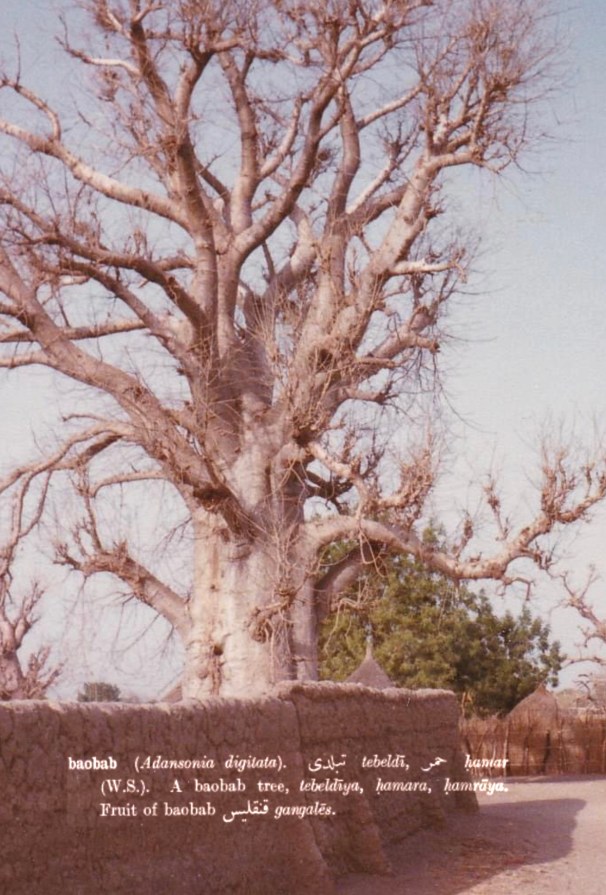
The English name,”baobab” is thought to derive from the Arabic “father of many seeds”. In Sudanese Arabic the individual baobab or tebeldi tree is a tebeldīya or less commonly Hamara. In western Kordofan, the trees are all given their own names, reflecting their centrality to the community and something of their distinctive essence. Often these names begin with the word for mother, um, as in um asal; mother of honey, for the tree that shelters colonies of bees. All are entered into the government registry. Outside Sudan, the baobab is often known as the monkey bread tree or the cream of tartar tree.
Learn more about these sentinels of Sudan’s savannahs and their vital role as water cisterns in The Baobabs of Sudan Part 1
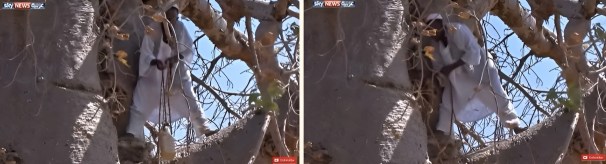
Above, storing water in the deep hollow of the tree, still from كردفان.. شجرة تخزن المياه
This week’s post explores further the myriad uses of the tebeldi and includes video footage on how the deliciously cooling gongoleez drink, made from the pith and pulp of the fruit is prepared.
The Tebeldi Powerhouse
Leaf, Bark and Flowers Fruit and Seeds, Gongoleez Medical Benefits

The Tebeldi Powerhouse

The baobab’s knotty canopy of branches, its leaves, flowers and tough, fire-resistant bark nurture delicate ecosystems of insects, reptiles, birds, bats and other mammals. At dawn the tree is alive with birdsong and in the day, in the Nuba Mountains, baboons can be found feeding on the velvet-husked fruit, helping to propagate the seeds they spit out or digest.

The fruit, shown above left, whose shape hanging from the branches has led many to coin the name “dead rat tree”, can wait out three years of drought on the bough and when the fruit and leaves fall, they serve to enrich the soil. The fruit pulp has a tangy sherbet-like taste and, together with the tree’s vitamin-rich leaves, have sustained the Sudanese and their livestock for generations, providing a measure of food security and emergency nutrition for families during drought, famine and on-going war, especially in Kordofan and Darfur. Local collectors sell the fruit to village traders, who sell it on to wholesalers or collectors may travel to nearby villages themselves or venture to the capital to sell the fruit.

Gathering and selling the fruit constitutes a valuable source of income for local women and children. It is said that up to half of all Sudan’s city dwellers consume the cooling, refreshing drink, known as gongoleez, made from the fruit pulp, on a daily basis during the month of Ramadan. Before the war, it is estimated that around twenty Sudanese companies were active in exporting the powder and oil derived from tebeldi fruit and seeds, as the plant’s international reputation as a source of “superfoods” gathered pace, offering both the tempting prospect of increased revenue and the many risks of over-exploitation.

The tree’s broad canopy of leaves in the midst of unforgiving terrain offers welcome shade to the traveller and a convivial setting for community meetings and settling of local disputes. International medical corps have even reported carrying out life-saving operations under the shelter of its branches. As well as their use as water cisterns, the nomadic Arab tribes of the region use the baobab’s cavities to store the woven woolen shalma cloths that cover the frames of their summer homesteads when they migrate. The nomad might also find a welcome mirror, toothbrush and wedge of soap tucked between its lower branches.
Above left; the tebeldi is a source of artistic and poetic inspiration throughout Sudan; verses from Arif Gamal’s The Baobab. See too The Baobabs of Sudan Part 1. Upper left, Sudanese tebeldi photographed by Peter Moszynski. The Sudanese baobab is leafless for eight months a year, its trunk is conical when young, becoming cylindrical or bottle-shaped in maturity. Above right, glasses of freshly made light frothy gongoleez.
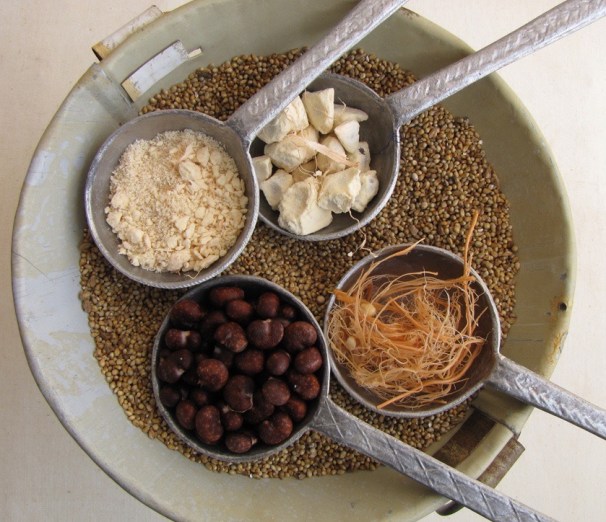
Above, the dried pulp, powdered pulp, its orange fibres and seeds. photo Wikicommons,
Leaf, Bark and Flowers
Fruit and Seeds, Gongoleez
Medical Benefits
The Tebeldi Leaf and Bark
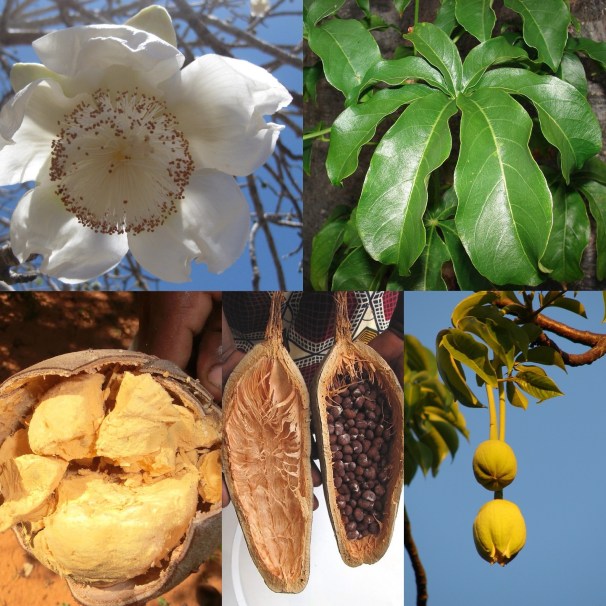
The baobab sheds its leaves in the dry season and the new shoots appear with the autumn rains. Colonial observers (SNR 1938) noted that the tender new shoots and leaves, known as tarag, eaten in autumn, made a good salad when dressed with sesame oil. Other sources relate that in western Sudan the fresh leaves are sought after and mixed with peanut butter as a salad.

The popular al-afous salad consists of buds and young leaves mixed with fava beans or sesame. Children are said to especially enjoy eating the leaves plain, just dipping them in salt water. The leaves, which can vary in shape and colour, are rich in vitamin A and C, potassium and iron. They are eaten as a supplement and to treat diarrhea and other digestive problems, fever, inflammation; kidney and bladder disorders, bleeding and even asthma and malaria. The leaves are also used as fodder for livestock. In times of war and famine, the leaves are a vital source of nourishment, indeed they may be the only source of food, as the New Humanitarian report, referenced below, photo right, emphasizes.
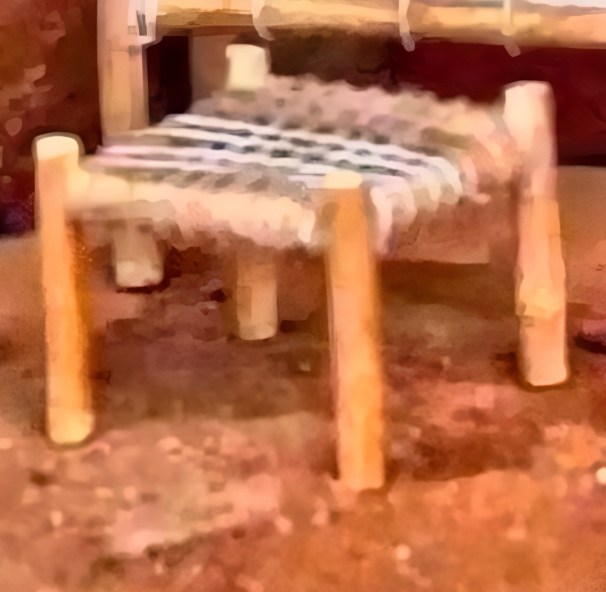
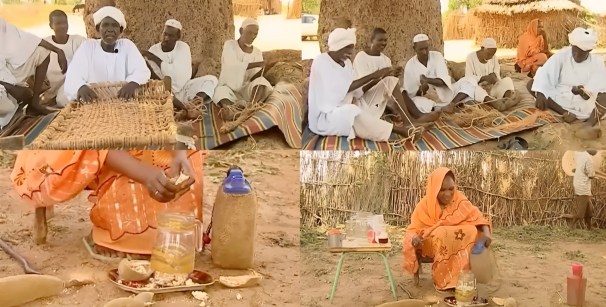
The tebeldi’s poor timber properties mean it is largely spared felling. The wood, which is high in water, can be chewed by both humans and animals in times of drought and the fibrous matter of the soaked wood can be used for packing material. The inner bark is used to make string, cordage and fishing nets. Traditional low stools or bambar, left, and rope beds known as angareeb, are also made with tebeldi rope. The bark can also be cut into shingles for roofs. Some claim it is also used to treat fevers and indeed there are references to dough being made of the bark or roasted seeds and fed to patients.
Below, scenes from Aljazeera Live report on the Kordofani tebeldi, showing the weaving of mats and beds using tree fibres and the preparation of gongoleez.
Below just some of the many other products the tebeldi can yield.

Africa’s wooden elephant: the baobab tree (Adansonia digitata L.) in Sudan and Kenya: a review
The Flowers

Above, verse by Arif Gamal, as above.
The baobab’s drooping graceful blooms serve as a marker of season change and a prompt for planting or harvesting. The flowers are night-blooming, heavily scented and are pollinated by bats. When the heavy rains end, the flowers fade, allowing the large pear or oval shaped fruit to develop. In other regions in the world, the flowers are eaten and glue is made from the pollen. In Indian oral traditions the flowers are imbued with religious significance; delicate dwellings for spirits. It would be interesting to know from any readers of any sudanese folklore or traditions surrounding the flowers.
The Fruit and Juice, Gongoleez
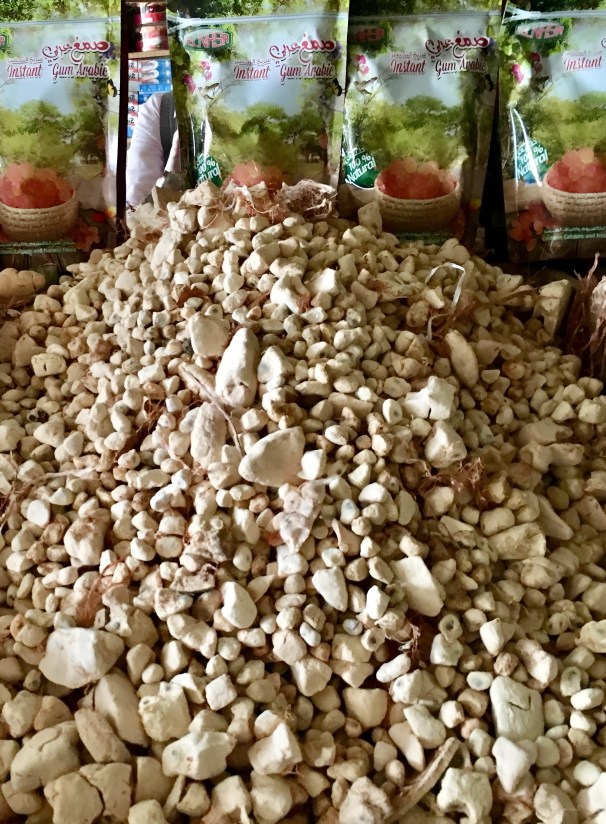
The fruit, known locally as tebeldi fruit or gongoleez, turn from bright green to a dusky brown as they mature. Typically pear or oval-shaped, the fruit has a velvety coating over a tough shell. They are harvested by local people in November and December, providing valuable alternative sources of income. The fruit can also dry naturally while still on the tree and remain preserved for up to three years. The fruits can be stored for several months without spoiling, due to their low water content. Sudan Notes and Records (1938) relates that the fruit pith and pulp were eaten fresh in early winter, or dissolved in water or milk or added to porridge. Dr Ahmed Al-Safi also refers to the fruit’s cooling properties and its use in madidat porridge. Right, tebeldi nuggets piled high to a backdrop of gum arabic sweets.
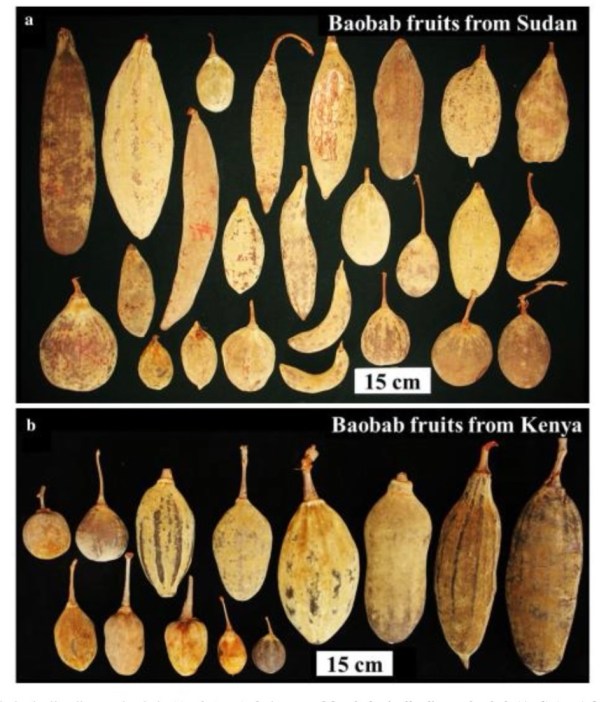
Colonial records also point to the unripe fruit being boiled and used in salad. The white, fibrous fruit pulp is described as having a flavour somewhere between a grapefruit, pear with a hint of vanilla. It has also been described as having a pleasant sharp-sour taste and is often made into children’s sweets. A paste can be made by mixing a small amount of water to a quantity of tebeldi powder. This thick, soft mixture can be eaten with the fingers or a spoon or sucked from a sachet, providing a carbohydrate and calcium-rich breakfast time drink for primary school pupils. Gongoleez is also eaten with chili or spicy shatta; the gongoleez fruit is mixed with hot sauce and salt and the hydrated mixture is sold to school pupils and university students. It can also be eaten with chili, salt, lemon and peanut butter and is a popular student snack. Left, the many variations in tebeldi fruit size and shape.
Pulp powder is high in protein, antioxidants and carbohydrate so is a valuable food supplement. The powder can be sprinkled on fruits and cereals and yoghurts, as well used as a thickening agent for soups. Dr Ahmed Al Safi noted that powdered fruit was often mixed with zirri’a, spouting grain, and boiled with sour milk. Baobab fruit flour can be used as a starter in the fermentation process of sorghum flour used for Sudanese flatbread or kisra. Powder can also be extracted from the seeds and used to make a dessert rich in vitamin C, tartaric and citric acid, sweetened with honey. Its syrup is high in pectin. Right, pulp, powder, fibres and seeds.
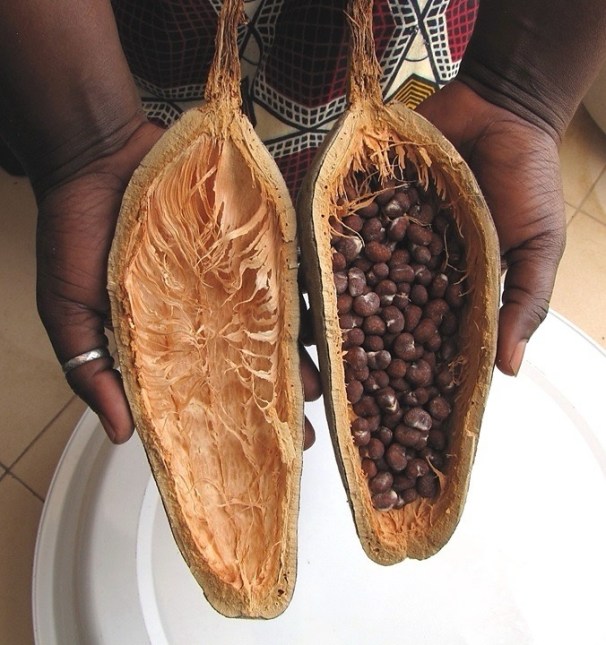
The fruit shells don’t go to waste either; they are often used as vessels, or made into souvenirs and toys.
The seeds, shown left, contain up to 19% oil and can be ground or pressed into oil. The endosperm is noted to have a pleasant almond taste, is rich in oil and can be eaten fresh, dried or roasted. The oil can be used both for cooking and cosmetics. The latter is used to enhance skin softening and overll beauty and is becoming a key ingredient in many high status international brands. In his research into the fermented foods of Sudan, Dirar reported that the seeds were ground into a course meal, then fermented and added to a traditional dish known as Kurundi. Other cultures are known to use the seeds for soap, ornaments and even ground for coffee.
Gongoleez and its Medical Benefits
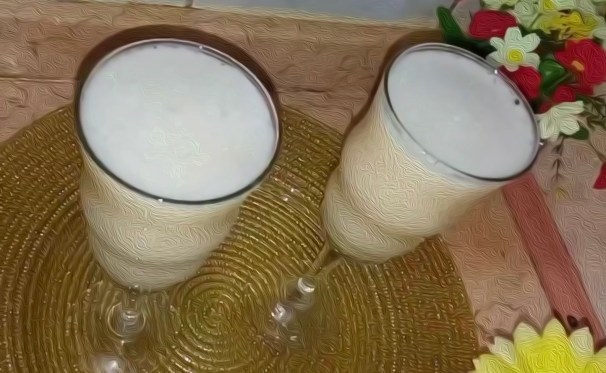
Above, freshly made gongoleez.

The first to discover this nourishing and restorative drink were believed to be Kordofani shepherds during their long peregrations. Rich in anti-cholesterols and calcium, gongoleez can be made using the fresh pulp or powder. Sometimes a couple of teaspoons of fruit powder are added to a cup of water, together with a little sugar to taste and the mixture is stirred and served chilled.
Alternatively, the fruit pulp nuggets, seeds removed, are soaked in water for an hour or so, with gum arabic sometimes added to improve viscosity. The mixture is then blended and sieved, chilled and poured over ice, creating a pleasing foamy head. See https://youtu.be/Rhb-iji52rw?si=NGJhc61B4mAIqHir. The drink should be consumed straightaway as it tends to separate fast. Of course many families have their special recipe for the dish. Sudanese ice cream popsicles, known as dandurma, are also often made from traditional juices such as hilu-murr or gongoleez. Right, a dandurma seller, Facebook Do You Remember Sudan?.
Below, a clear visual explanation of the baobab fruit and its uses (Arabic only audio).
Remarkable Medical Benefits
It is claimed the tebeldi contains roughly six times more vitamin C than an orange and twice as much calcium as a glass of milk, 21 times more anti-oxidants than cranberries, as well as significant quantities of iron, magnesium, zinc, phosphorus, potassium (four times that of a banana), sodium and manganese. International research has found the fruit’s anti-cholesteral properties as being significant and that the fruit is rich in fibre. Perhaps it is for this reason Darfuri elders have long encouraged youngsters to drink gongoleez after particularly fatty meals and why Sudanese with severe heart conditions being treated in the West, are convinced their health has improved with regular gongoleez drinking.
There are indications it may also aid in the lowering of blood pressure. It is understood to be anti-inflamatory, anti-viral and is used in the treatment of malaria, dysentry and diarrhea. As it is readily available, the tebeldi fruit is a cheap, safe and accessible source of vitamins and minerals for relieving stomach pain and treating child diarrhea at home. In olden days, Dr Ahmed Safi notes, it was also thought to induce pregnancy and enlarge breasts.
All in all, the tebeldi is a prodigious resource and a blessing for the Sudanese. Let’s hope this remains so in the future and the Sudanese will retain control of their unique superfood, its distribution and longterm preservation.
Sources
Traditional Sudanese Foods, edited by Abdalbasit Mariod, Cambridge Scholars Publishing
Note on the Baobab, Kordofan, Sudan
https://emergencemagazine.org/essay/the-eternal-tree/
Africa’s wooden elephant: the baobab tree (Adansonia digitata L.) in Sudan and Kenya: a review
Nuha Mohammed Elhassan Satti: Sudanese Baobab ( Adansonia Digitati) A review
https://poetrysociety.org/poems-essays/new-american-poets/arif-gamal-selected-by-idra-novey
https://www.frontiersin.org/articles/10.3389/fsufs.2023.1118714/full
 Women's literacy in Sudan