

The Doum Tree’s Blessings
With Excerpts from Tayeb Salih’s The Doum Tree of Wad Hamid

Setting the Scene
Above, a bowl of burnished doum palm fruit, Omdurman souq. Inside the tough, bark-like shell, lies a tangy-sweet pulp enclosing a waxy kernel. The taste of the fruit, beloved by children, has been likened to gingerbread, giving rise to the palm’s other name; the Gingerbread Tree. In her short story, Something Old, Something New, Leila Aboulela describes the fruit as “brown, large as an orange, almost hard as rock, with a woody taste and the straw-like texture. Only the outer layer was gnawed at and chewed, most of it was the stone.”
The doum palm, Hyphaene thebaica, whose preserved fruits have been found in the tombs of pharaohs, can bear up to a thousand fruit a year. Gifts of the doum fruit, Sudanese elders recall, were once a common part of a young bride’s shayla or dowry offering, possibly because they were believed to keep teeth clean and healthy and prevent mouth ulcers, شجرة الدوم المظلومة في السودان.
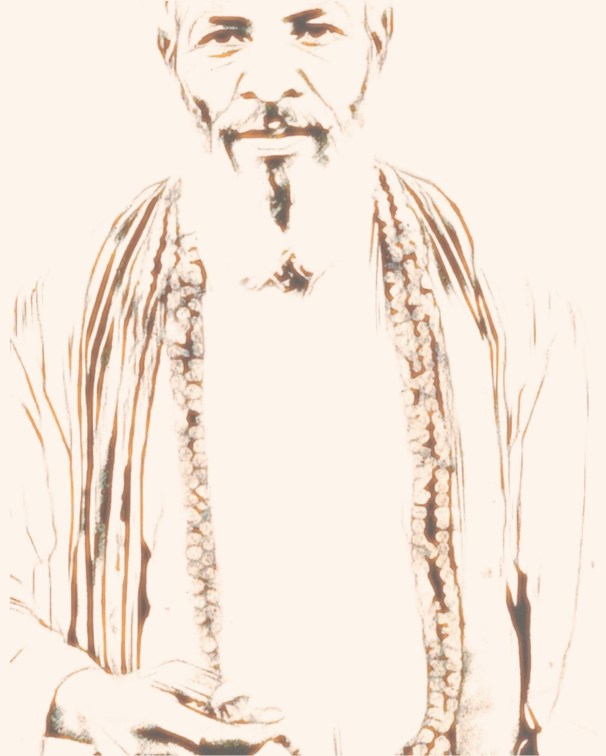
Sketch of Tayeb Salih’s holy man, Wad Hamid, Imogen Thurbon.
As I looked I saw a man with a radiant face and a heavy white beard flowing down his chest, dressed in spotless white and holding a string of amber prayer-beads. Placing his hands on my brow he said “Be not afraid”, and I was calmed. Then I found the shore opening up and the water flowing gently. I looked to my left and saw fields of ripe corn, waterwheels turning, and cattle grazing, and on the shore stood the doum tree of Wad Hamid. The boat came to rest under the tree and the man got out, tied up the boat, and stretched out his hand to me. He then struck me gently on the shoulder with the string of beads, picked up a doum fruit from the ground and put it in my hand. When I turned round he was no longer there.
Above, one of many villagers’ dreams recounted in The Doum Tree of Wad Hamid where the doum tree, its fruit and eponymous holy man offer spiritual consolation and hope in the teeth of misfortune.

Tayeb Salih (1929 – 2009) The Wedding Of Zein, A Handful of Dates and The Doum Tree of Wad Hamed; first published in African writers Series 1969, Tayeb Salih and Denys Johnson-Davies 1968. Illustrations by Ibrahim Salahi. All excerpts in this article are taken from the 1978 reprint edition.
The Doum Tree’s Blessings
Memories in Times of War
Tree of Plenty and Vegetable Ivory Curative Properties
Re-reading The Doum Tree of Wad Hamid in Times of War
Memories in Times of War

Sharing doum fruit juice at Ramadan, Aljazeera, الدوم.. عصير لا يغيب عن الموائد السودانية.
“Look how it holds its head aloft to the skies; look how its roots strike down into the earth; look at its full, sturdy trunk, like the form of a comely woman, at the branches on high resembling the mane of a frolicsome steed!”
For almost a decade before the outbreak of the war that continues to ravage Sudan, I made yearly visits to our women’s Arabic literacy circles. Scattered along the sprawling outer reaches of the capital or tucked among the maze of settlements of Hajj Yusif or Umbada, our literacy circles served some of Khartoum’s most deprived communities. It was on a two-hour trek to Jebel Awlia literacy circle that I first came across the doum fruit. I wrote about the experience in 2017:

After several wrong turns, we finally came to a diesel-belching halt in a small clearing. As we clambered out of the bus, sweating and caked in dust, I saw a young boy, barefoot and solemn under the merciless midday sky. He was clutching a small tin bowl of gleaning ovals of polished wood. It took me a moment to realize that what he held out to us in greeting was doum fruit. How far, I wondered, had he walked to find the fruit in this bare-boned, treeless wilderness?
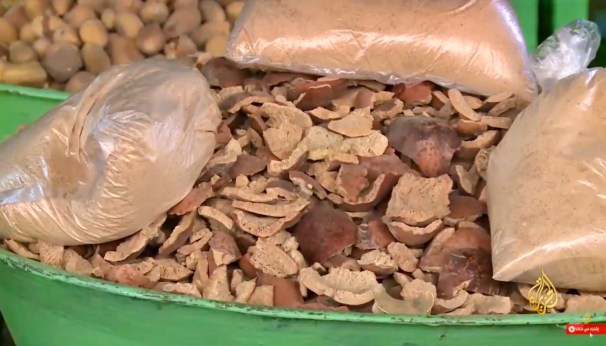
My second encounter with the doum came in 2022. Hunched on a stool sipping coffee under the colonnades opposite the now – I fear – looted and despoiled Acropole Hotel, a middle-aged man in immaculate jellabiya bent down next to me, smiled and wordlessly placed a small plastic pouch of sawdust in my hand. I recognized him as a fellow customer of the coffee stall. He had overheard my telling the tea lady that my husband was diabetic, he explained, and wanted to give me this doum powder for him. “Tell him to take it every morning. It will help with the sugars.”
Remembering the young boy and my morning coffee companion as the war grinds mercilessly on, I remember too the gentle kindness of a people, their resilience and resourcefulness, the immense solidity and solidarity of the Sudanese. The quiet, no nonsense practicality of a people and their defiant obstinacy in the face of injustice.
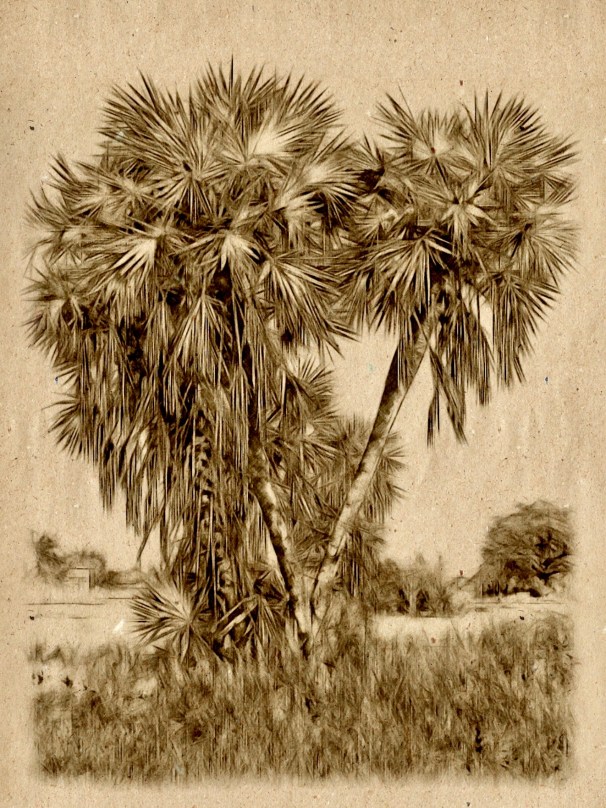
Above, doum fruit rind, pulp and powder, Aljazeera. Upper left, a doum palm, sketch, Imogen Thurbon. Right, the colonnades opposite The Acropole, 2022.
Tree of Plenty and Vegetable Ivory
“And ever since our village has existed, so has the doum tree of Wad Hamid; and just as no one remembers how it originated and grew, so no one remembers how the doum tree came to grow in a patch of rocky ground by the river, standing above it like a sentinel.”

Although the doum palm grows wild across vast swathes of the country, it is to be found in profusion among the wadis and valleys of northern and eastern Sudan. Historians credit this often overlooked desert palm with the flourishing of both Nubian and Beja cultures. Resistant to drought and desertification, the doum can be hand-cultivated, with farmers often cracking open the fruit before burying and watering the kernel, to speed up a germination process which would otherwise take up to a year. With the inexorable advance of global warming, moves to restore and grow doum populations are now gathering force.
The folklorist, Al Tayeb Mohammad Al Tayeb famously called the humble doum a tree of blessings and it’s easy to see why. The insect-resistant trunk can be used as timber for roofing and doors, as well as firewood, and its tender young leaves serve as fodder. Until recently the fruit was also processed into animal feed in Kassala.

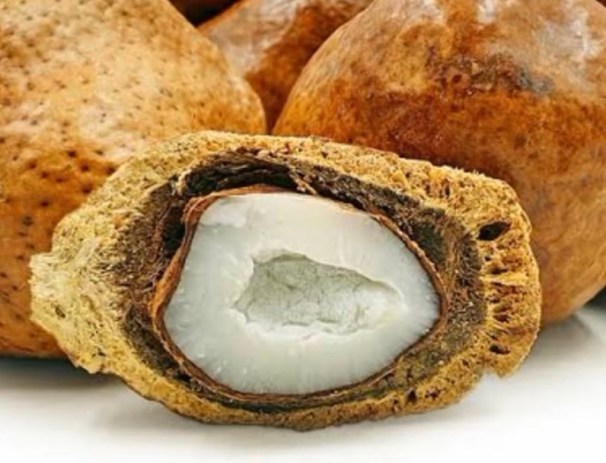
The palm’s fibres can be woven into sturdy mats, baskets, trays, rope and fabric. Ad-Damar’s weekly markets were known for the wealth of doum palm produce sold there; woods, fruit, foods, handicrafts and medicines, شجرة الدوم المظلومة في السودان. Above right, the unripe fruit upon the bough. Left, the doum fruit kernel.
Before plastics came to monopolize button production in Sudan, buttons made of doum kernel were produced in Kassala and Atbara, initially through Greek-owned companies throughout the early to mid-1900s. The doum fruit was also exported as a valuable source of vegetable ivory for buttons and beads. The powdered kernels are used in the manufacture of pastes, toothpastes, paints and dyes. See too The Doam: Important Crop, Neglected Fruit.
Above right, leaf, sectioned stem leaf stalk and whole plant, drawing by G.D. Ehret, c. 1743, public domain.
Curative Properties
“In the afternoon, when the sun is low, the doum tree casts its shadow from this high mound right across the river so that someone sitting on the far bank can rest in its shade. At dawn, when the sun rises, the shadow of the tree stretches across the cultivated land and houses right up to the cemetery. Don’t you think it is like some mythical eagle spreading its wings over the village and everyone in it?”

As Leila Aboulela described above, the doum fruit, popular among youngsters, can be gnawed or chewed as a sweet and has a pleasant taste likened by some to that of a bran muffin. The unripe kernel can also be eaten when soaked in sweetened water. Sweets are also shaped from doum flour, which serves as an enriching agent in baking and is believed to have anti-bacterial properties. In times of food shortages and drought, the doum, like the baobab fruit, proves an invaluable and readily accessible food source.

Perhaps most well known in Sudan is the use of the rind, pulp and powder to make a restorative Ramadan iftar drink, similar in flavour to tamarind or date. Recipes vary but the fruit rind and pulp, sometimes enriched with dates, hibiscus or tamarind, are usually soaked in water for several hours, then brought to the boil, often mixed with sugar, sieved and served chilled with sugar to taste. Watch a one-minute video Ramadan doum juice recipe here. Right, one of the many readymade doum juices now available.

The doum fruit’s celebrated medicinal properties are astonishingly diverse and far-reaching. It contains anti-oxidants, is rich in vitamins and minerals and has anti-inflammatory and anti-cancer properties, the latter especially associated with the prevention of prostate cancer. Research indicates it to be effective in lowering both high blood pressure and cholesterol, protecting vascular health through the prevention of blood clots and promoting hormone balance in women and enhancing testosterone and fertility levels in men.
Daily doum fruit infusions have been recommended for improved hair growth, due to the fruit’s high calcium content. It is also thought effective in the treatment of skin conditions as it is rich in vitamin B. Its high fibre content and anti-bacterial properties aid digestion and its alkaline properties relieve stomach acidity and reduce the risk of ulcers. The doum has been used in the treatment of bilharzia, eye diseases such as conjunctivitis, diabetes and inflammations of the spleen. Perhaps, most remarkable of all, the doum has been found to enhance brain health and memory and may be significant in the prevention of Alzheimers disease. Above left, doum flour discs, Facebook صور من السودان.
Re-reading The Doum Tree of Wad Hamid in Times of War

Above, illustration by Ibrahim Al-Salahi, The Doum Tree of Wad Hamid.
Wad Hamid, in times gone by, used to be the slave of a wicked man. He was one of God’s holy saints but kept his faith to himself, not daring to to pray openly lest his wicked master should kill him. When he could no longer bear his life with this infidel he called upon God to deliver him and a voice told him to spread his prayer-mat on the water and that when it stopped by the shore he should descend. The prayer-mat put him down at the place where the doum tree is now and used to be waste land. And there he stayed alone, praying the whole day.

Tayeb Salih’s Wad Hamid is a world where the mundane, the magical, the spiritual and the political intersect. Sudanese Sufi understandings of spirituality, embodied in the doum tree, the village holy man and his tomb, inhabit the waking and subconscious lives of the villagers. These indwelling sources of solace and resilience are drawn on by all in Wad Hamid, in a metaphysical unity where everyone is blessed with visions of its saint and everyone can experience the miraculous under the tree that has existed before memory.
Though plagued by horse flies, sand flies and levels of malaria that would see off any unwelcome incomer, Wad Hamid is a source of the miraculous, a place where the doum palm itself bowed in worship, bathed in radiant light.
In the complex and tense interplay between the forces of tradition versus modernity, the pull of the urban and the challenges of post-colonial identity and centralized rule, Wad Hamid retains a stubborn and sometimes self-defeating dignity, threatened by forces beyond the doum tree’s vast shade as “cryptic as talismans.” The village wins its victory over officialdom when the doum tree is threatened with destruction to make way for a steamer post, yet the narrator notes with gentle irony:

“Our life returned to what it had been: no water pump, no agricultural scheme, no stopping place for the steamer but we kept our doum tree which casts its shadow over the southern bank in the afternoon and, in the morning, spreads its shadow over the fields and houses right up to the cemetery, with the river flowing below it like some sacred legendary snake. And our village has acquired a marble monument, an iron railing, and a dome with gilded crescents.“
When I first read the story many years ago, I was enchanted by the figure of Wad Hamid and the way everyday Sufism and stubborn self-interest of a village could frustrate the machinations of both well-meaning and corrupt officials with the weight of power behind them. Re-reading the story in this year of “Trumpian” untruth, what speaks to me most now is Salih’s portrayal of the cynicism of the politicians who use the threatened felling of the doum tree for their own ends, enhancing their political-religious credentials by appropriating the sacred symbolism of the tomb. Yet, the villagers ultimately remain themselves; unswayed, unimpressed by empty gestures: “Since that day we have been unaware of the existence of the new government and not one of those great giants of men who visited us has put in an appearance: we thank God that he has spared us the trouble of having to shake them by the hand.”
Tayeb Salih’s narrator urges us at the close of the tale not to succumb to the illusion of false binaries – an illusion we can all fall prey to, perhaps today more than ever: “There will not be the least necessity for cutting down the doum tree. There is not the slightest reason for the tomb to be removed. What all these people have overlooked is that there’s plenty of room for all these things: the doum tree, the tomb, the water-pump, and the steamer’s stopping-place.”
 Women's literacy in Sudan
beautiful and interesting!
LikeLike
🙏🙏🙏
LikeLike