

Against Violence: Mohammad Abdallah Otaybi
A Brief Profile

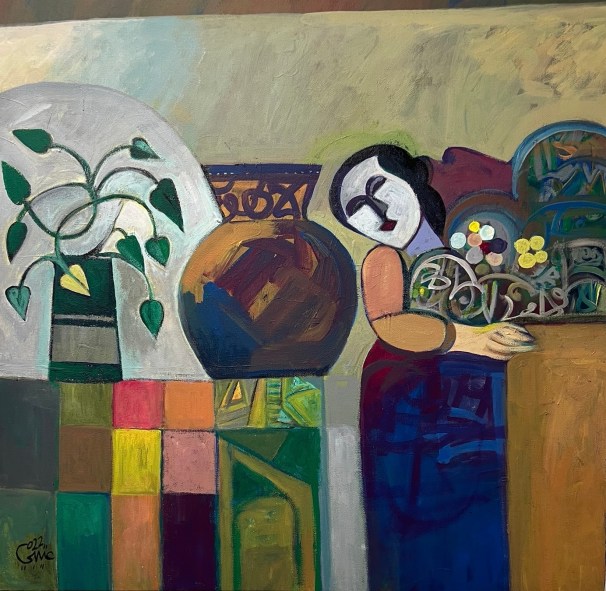
Above, Untitled 2, acrylic on canvas, one of three works by Mohammad Abdallah Otaybi, born 1948, exhibited in Disturbance in the Nile, Madrid 2024. This vibrant, taut work encapsulates many of Otaybi’s signature themes and motifs; the tense interplay of Sudanese Arab-Islamic and African cultural esthetics, the theatrical and the mythical; the masked features of Sudan’s African heritage set against richly textured panels of colour, adorned with abstract, geometric motifs. Here too are hints of Arabic calligraphic forms – evoking the sheltering power of the Sudanese Sufism Otaybi believes bonds and unifies his homeland.

Against Violence

In November last year, the London School of Hygiene and Tropical Medicine estimated the death toll in Khartoum State alone since the outbreak of war to be in excess of 61,000, adding that deaths across all regions now appeared to be significantly higher than previously believed. (See Sudan Research Group’s full report on war-time mortality in Sudan here and BBC’s Sudan death toll far higher than previously reported). At the same time, ACJPS and the Sudanese Music Research Centre, in Tears of Guitars and Screams of Museums, reported that at least 55 artists had been killed through shelling, shooting and torture during the war. See too Sudan’s Cultural Treasures Looted 1 and Sudan’s Cultural Treasures Looted 2.

Against this tragic backdrop, Sudanese civilians in their thousands have rallied to uphold values of unity, non-violence and co-existence. Among them, many artists, including the award-winning Sudanese modernist painter, “gentle activist and powerful colourist“, co-founder of the Madrasat-al-Wahid, School of The One (See below), Mohammad Abdallah Otaybi. This eminent artist, illustrator, graphic designer, cartoonist and teacher, now based in Cairo, launched his first solo show there in 2023, under the title War and Peace; an exhibition he dedicated to celebrating the diversity, tolerance and enriching cross-fertilization of Sudanese cultures.

A year later, in a continuing artistic dialogue on the impact of the conflict, Otaybi presented the exhibition Love and Peace at the Maqa’d of Sultan Qaitbey, honouring “the immense efforts of the vast majority of Sudanese for peace”, MASQ Instagram.
Upper right, the artist Abdallah Otaybi, explaining the inspiration behind his exhibition War and Peace, Cairo 2023, BBC Arabic, الحرب والسلام” معرض أقامه الفنان التشكيلي السوداني محمد عبد الله عتيبي في القاهرة للتعبير عن ما يعيشه (three minutes, Arabic). Left and lower right, examples of the artist’s work in this and Love and Peace exhibitions, MASQ and Motion Art Gallery.

Above, Against Violence, Mohammad Abdalla Otaybi, 2014, Bonhams
Among the most emblematic of Mohammad Abdallah Otaybi’s work dedicated to a peace grounded in a shared diverse cultural heritage is his 2014 Against Violence, shown above. A frieze-like figure of an archer bearing perhaps both ancient Nubian and Nilotic features, is transfixed, bow drawn in swift, balletic grace, upon a golden ground, beneath the orange disc of the sun. A mosque in sacred blues and greens echoes the shape of the church behind it, bathed in terracotta browns, reds and purple. The sturdy trunk and lower branches of a tree, perhaps a baobab – with its solitary heart-shaped leaf – a recurring motif in Otaybi’s work, draw the eye to the archer from the upper left of the canvas. In the lower foreground, flowing forms so reminiscent of Arabic calligraphy echo in their colours and brush strokes the tonal and ethnic unity of the work, while hinting at ancient motifs.
Left, Identity Card, 2014, Imago Mundi Collection.
In Otaybi’s exhibition, Faces, the artist explored the rich facial diversity of Sudanese ethnicities, seeking to remind the viewer that “we coexist in love, peace and respect for the culture of others”. In Identity Card, we see the same anxiety to integrate the complex, multifaceted qualities of Sudanese identity. The black-outlined mask-like face celebrates Sudanese African features; the ash-tinted tribal markings and high foreheads of the Dinka and Nuer peoples. Behind, the arabesques and forms reminiscent of the Arabic calligraphy embodying Sudanese unity in Otaybi’s visual lexicon.
Above, the joyful Untitled 1, acrylic on canvas, exhibited, Madrid, in Disturbance in the Nile.
Mohammad Abdallah Otaybi; A Brief Profile
Mohammad Abdallah Otaybi has worked in education, journalism and advertising, the latter in the Sultanate of Oman, and for several years managed the Otaybi Gallery in his home city of Omdurman. He also worked as associate professor in the University of Sudan’s Faculty of Music and Drama in the late 1990s. In addition to his paintings, Otaybi has illustrated two children’s books, Sudanese Singers and Fatima Sugarcane, published in Arabic and French.
The artist’s work often plays on the joyful juxtaposition of myth and reality, perspective versus flat surfaces, creating what many have described as dreamlike, almost magical realist worlds. Women float with drifting flocks of birds over cityscapes with Chagall-like charm. His canvases are peopled by ancient Egyptian and Nubian mythological symbols, Sudanese folkloric creatures such as bulls, horses, birds and flying fish (see too Bull and Dove); the patterns and motifs adorning Nubian doorways, domes, crescent moons and other Islamic imagery. In Three Figures 2019 an ancient Egyptian papyrus boat floats above three timeless, statuesque figures. Sudanese life in the form of music, dance, Sufi worship and motherhood are also lovingly portrayed. His work is also playful and humorous; see The Mirror, possibly echoing his earlier work as a cartoonist. It is also characterized by its depth and textured layering of colour, achieved through painting over layers of molten wax the artist applies to the canvas.

A graduate from Khartoum College in Fine and Applied Art, Otaybi was profoundly influenced by the Khartoum School and the work of both Ibrahim Al Salahi, (see The Bird and Arabic Calligraphy), and Ahmed Shibrain. He would later define himself as belonging to the School’s second generation of artists, determined to move away from western artistic frameworks towards more authentic, indigenous artistic expression.
The Khartoum School was in part inspired by the Sudanese literary movement, known variously as The Jungle and Desert School, The Bush and Desert or Forest and Desert School, which sought to explore, reclaim and celebrate Sudan’s dual Arab-Islamic and African identities, though later it would be criticized for binary or colonially inspired understandings of identity. Otaybi’s Desert and Jungle is a powerful visual expression of the movement’s ethos.
The 1970s saw a marked divergence from the Khartoum School’s ethos in Otaybi’s work as he increasingly sought to establish a conceptual basis to the School, centred more closely upon the Sufi spiritual and esthetic values he believed to be “closest to everyday life” in Sudan, later going on to co-found Madrasat Al-Wahid, to reflect these values. In recent years Otaybi has moved away from both schools, embracing artistic expression that connects the local with the global, speaking to the issues assailing Sudan while also seeking to re-invest ancient symbols with new relevance. Photo, MASQ Instagram.
Mohammad Abdallah Otaybi’s work has been featured in international group exhibitions, such as Forest and Desert School Revisited in addition to several solo exhibitions, including The Lost Paradise, Circle Art Gallery Nairobi, the title evoking Milton’s Paradise Lost. The exhibition gave artistic expression to the profound loss the artist experienced upon the death of his wife eight years before and was dedicated to her memory as inspiration and muse. See too Otaybi debuts in Nairobi and The Lost Paradise.
Selected sources: Circle Art Gallery Mohammad Abdella Otaybi, Bonhams Mohamad Abdalla Otaybi

Above, Untitled 3, acrylic on canvas, as above.
If you are interested in Sudanese art, you might enjoy:
Architecture and The Soul of a City
 Women's literacy in Sudan