

The Khulāl خلال or هلال
The Traditional Head Comb of the Beja Peoples
A Brief Profile
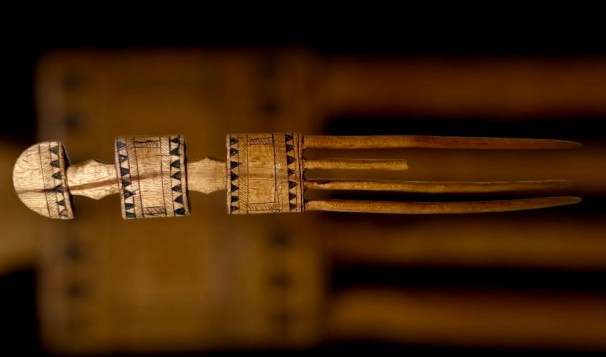
Above and title illustration, a Beja tribesmen’s ornamental head comb, from Port Sudan,1930-1950. A treasure acquired on his travels by my husband’s grandfather, who was a merchant seaman. Known as a khulāl, خلال (hilaal هلال in the Beja language), the comb is a mark of maturity, elegance and courage among men of the Beja peoples.
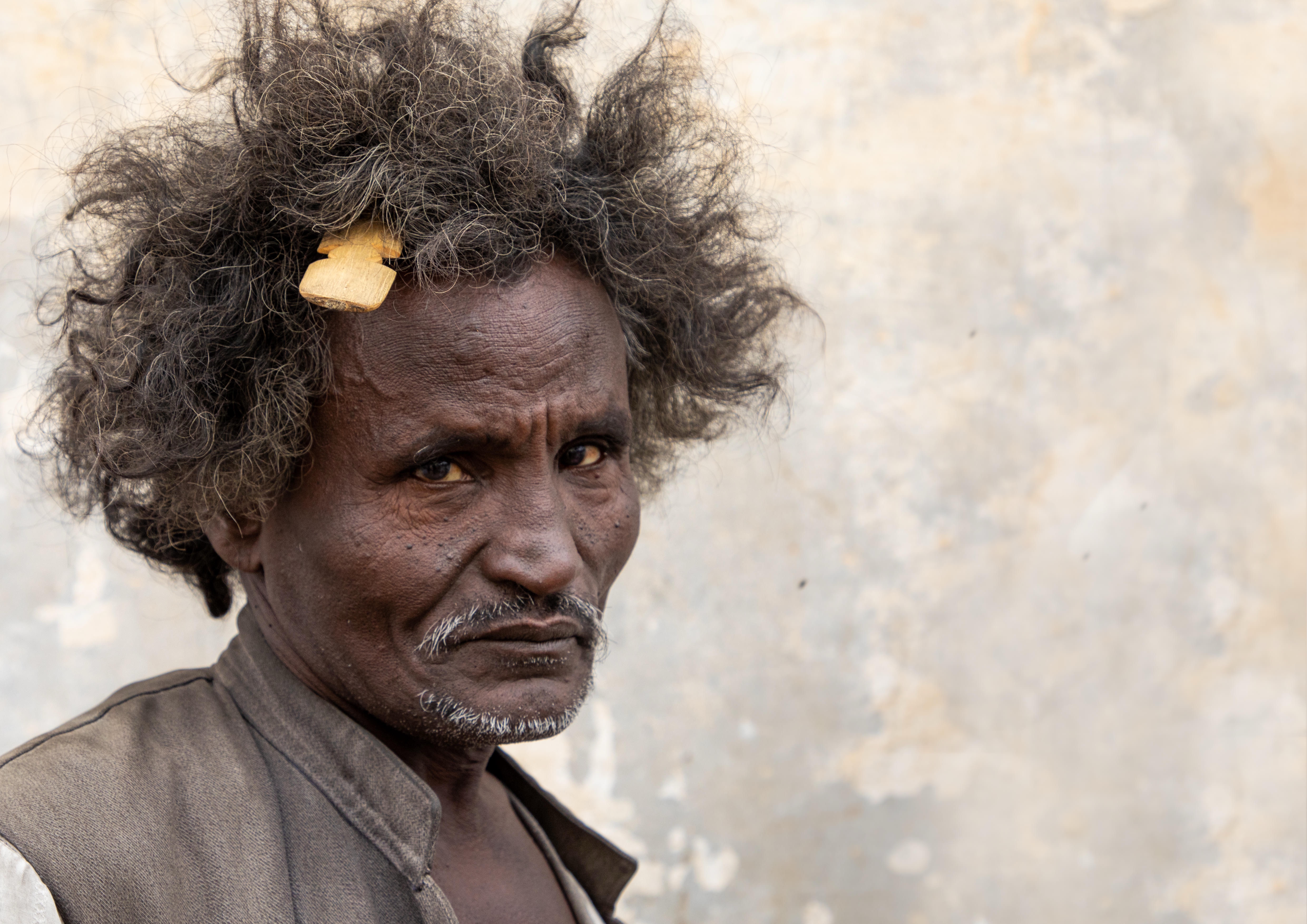
Below, the compassionate, penetrating gaze of a Beja tribesman from Kassala, eastern Sudan. In his hair, “at a jaunty angle”, as Griselda El Tayib would describe it, he wears his carved wooden khulal.
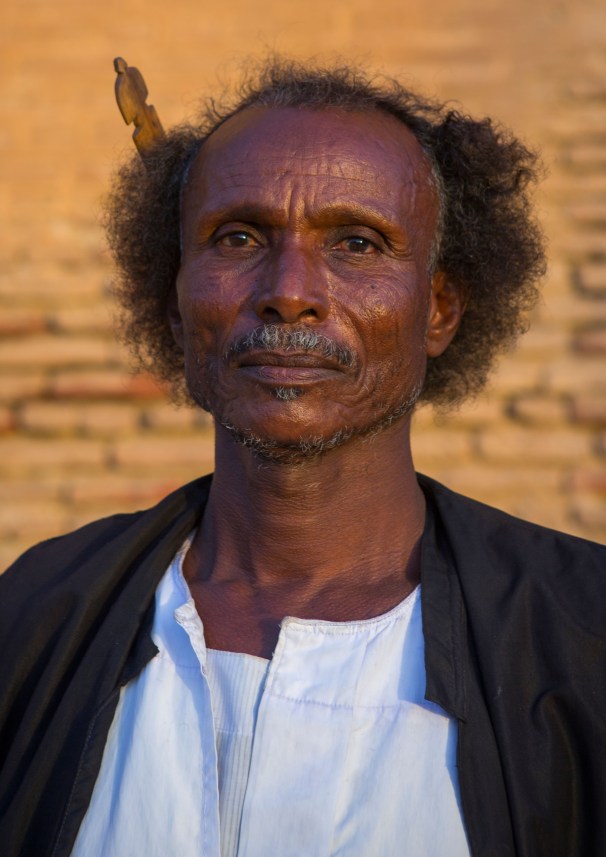
Photograph, Alamy copyright, under licence.

This brief post is the first in a series of articles on Beja culture and dress. It is also a tribute to the remarkable body of research conducted by the late expert in Sudanese dress, Griselda El Tayib. This article draws on her accounts of the khulāl, documented in her Regional Folk Costumes of the Sudan, published by Dal Group, 2017. In coming posts, I will be exploring in greater depth the history, customs and attire of the Beja peoples of Sudan.
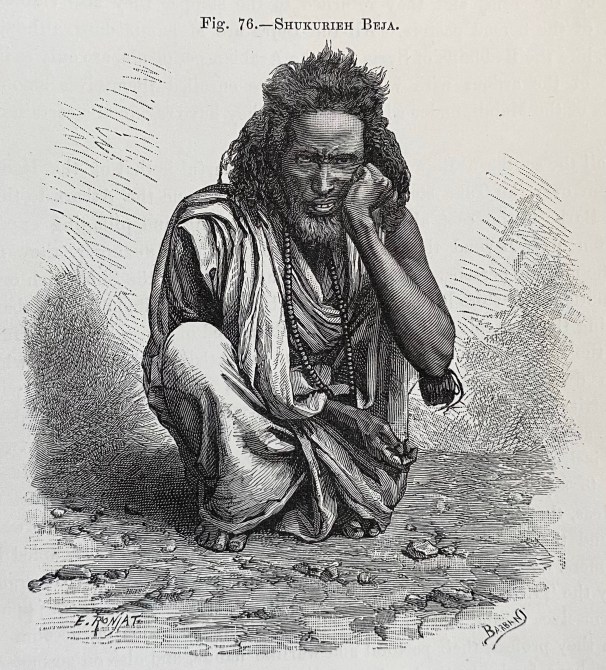
Left, a Beja tribesman, colonial-era etching, personal collection. See too Historical Sketches – People and Places.
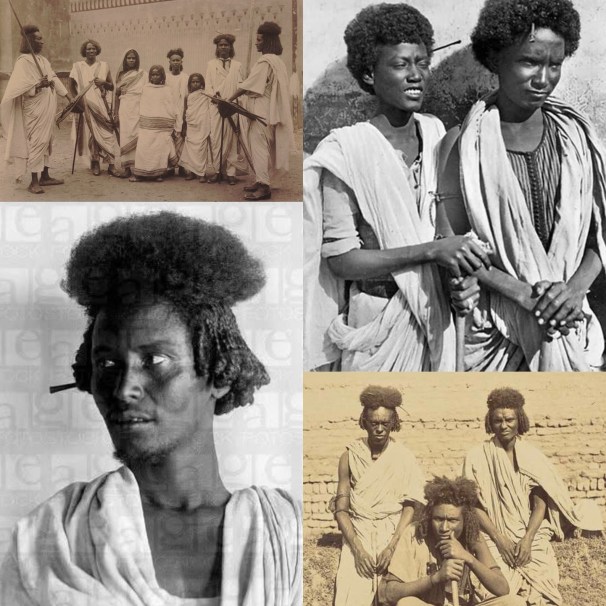
Below, open access historical images of Beja and Hadendawa (a subsection of the Beja ethnic group) men, illustrating traditional hairstyles and ways of wearing the khulāl.
“The young men in the camp had wooly manes of hair in the Hadendowa style, plaited at the back into short braids weighed down with a mixture of animal fat and clay from ground-up pot-sherds. Each of then carried a single-toothed comb, the khulal, carved from acacia wood.”
From The Amulet by Hamid Dirar
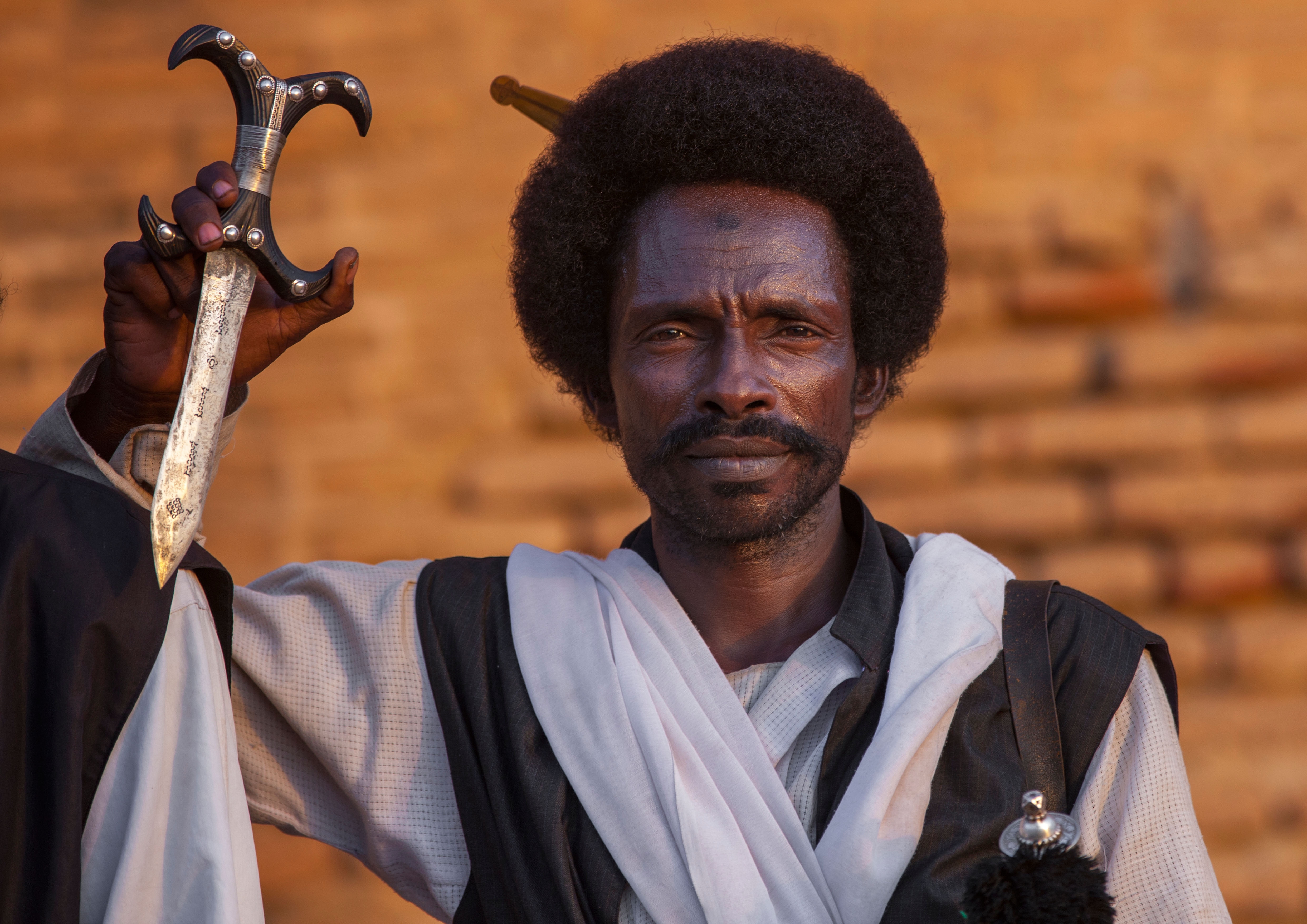


Above, portraits of Beja and Hadendawa life discussed in coming posts. These images are all copyright Alamy, reproduced under licence, except bottom right, Wikicommons.
Griselda El Tayib’s Descriptions of the Khulāl
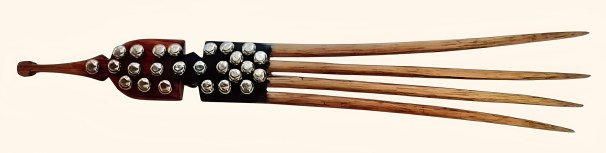
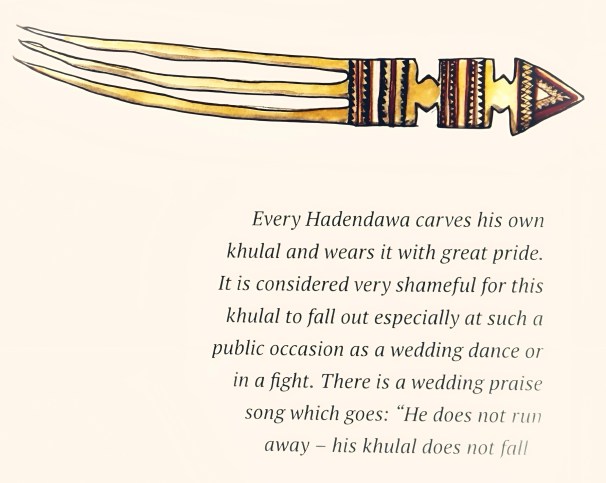
Griselda El Tayib identifies three types of khulāl. She describes a common example as being a 10-inch, 2-5 pronged comb, carved from the white wood of the amab tree and decorated with geometric designs etched with a knife and embellished by soot being rubbed into them. This comb has a curved ornamental handle. She also documents another type, made from gold-yellow wood from local indirab or sarayet tree, consisting of a long curving arc of a single prong and curved in a neat finial. The other single pronged khulāl, she writes, is similar but with a straighter shaft. This is usually made of black ebony and its finial is decorated with a silver band or coiled copper wire “for added elegance.”
Below, a delicate 4-pronged khulāl with decoratiive silver studs, Facebook Beja Heritage.
Below, Grisleda El Tayib’s notes on the khulāl, Regional Costumes of the Sudan, as above.
Griselda El Tayib’s Accounts of Beja Hairstyles
“…he was a typical Hadendowa warrior, sporting a heavy shock of greased hair into which he stuck his khulal, with his neck and upper arms clad in leather-bound amulets, and his shield, sword, stick and dagger strapped around his waist. Beyond this, his long sirwal, sideiri and tob showed that he was a man who had money. (Hamid Al Dirar, as above).
Griselda El Tayib writes: “The Hadendawa gallant liberally greases his hair with wadaq (mutton fat) for a stiffened shiny effect. This well-rounded, fluffed-out tousled mop is called tiffa in Arabic and has a protective function, as the massed curls with all the trapped air spaces on top of the head provide a useful insulation against the sun. Some men have the longer neck hair arranged in eight yawadab plaits hanging straight down. Some call the tiffa ‘the Beja turban'”. El Tayib goes on to note that the adopting of the turban in preference to the tiffa was a sign of prosperity as while both served to insulate the wearer from the sun, the tiffa cost very little to maintain.
Griselda El Tayib details the age-determined rituals of hair styles among Beja males, explaining that at ten years old, the young boy begins to wear his hair longer “to a full rounded shape”. At this age he dons a “small two-pronged khulal which he has carved himself.”
The khulāl is an essential complementary element to the great care, prestige and symbolic heft associated with the many complex and regionally distinct ways hair was worn and dressed among Beja tribesmen. El Tayib notes that while the top, bushy portion of the hair would sometimes be tied up with a leather thong for convenience when working or during dust storms, “this was considered as a state of undress ” and was not acceptable attire in public. The symbolic lexicon of Beja hair styling will be explored in coming posts.
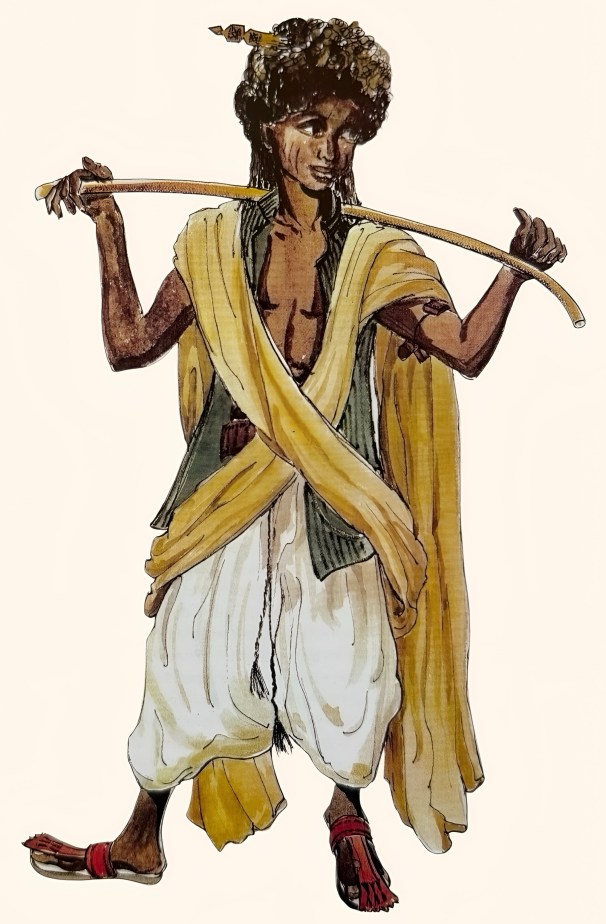
Above, Griselda El Tayib’s A Hadandowa man parading itafunjar (“show-off”, dandy style).
Below her commentary on this illustration:
“The Hadendawa are fond of carrying weapons, and they often needed to because of leopards in the area.” She recalled that a decade before documenting her observations, “groups of men with their swords, short-handled spears and stout round dirra shields of stiff pressed cowhide were common at long-distance bus stops.” She adds: “All males carry strong klai sticks curved slightly at one end to lean on when watching their flocks. In the characteristic pose, the stick is placed along the back of their shoulders and both hands are crooked over its ends. They also often carry the safarok throwing stick.”
“The long tob which the Hadendawa man wears on doneb occasions and journeys is also a portable ‘sleeping bag` in which he wraps himself at night from head to foot stretching it tightly against mosquitoes and dust storms. The trailing ends of the tob are an impressive feature of the Hadendawa man as he strides along leading his camel, or when they flap behind him in the wind as he rhythmically bobs up and down in the saddle of his riding camel.”
Griselda El Tayib, Regional Folk Costumes of the Sudan
 Women's literacy in Sudan