

Red, Gold – and Blue; The Garmasis
Sondos Shuaib’s Homage to the Garmasis
“The scent of bakhūr in the air, the rhythm of the Ganaya, the beat of drums, the sweetness of sharbot, hibiscus, and homemade cookies lingering on your tongue. The scene is drenched in color, red, blue, yellow and gold, surrounding the angareeb, the bambar, and the radiant bride, her beautiful black skin glowing at the heart of it. The Garmasis is more than a tradition, it’s a sensorial memory. It carries joy, pride, belonging, and the spirit of Sudanese culture, reimagined across generations and reflected in our homes.”
Above, architect, designer, researcher and textile artist, Sondos Shuaib, evokes heady sense memories of Sudanese jirtig wedding rituals. Sondos’s graceful and deeply personal tribute to the garmasis forms the focus of this week’s article.

Above, one of Sondos’s pieces featured below.
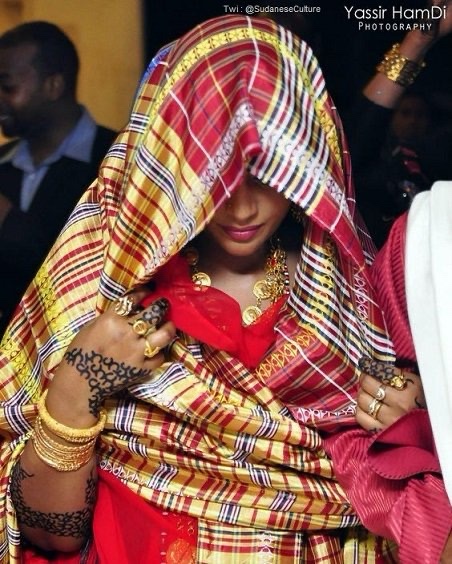
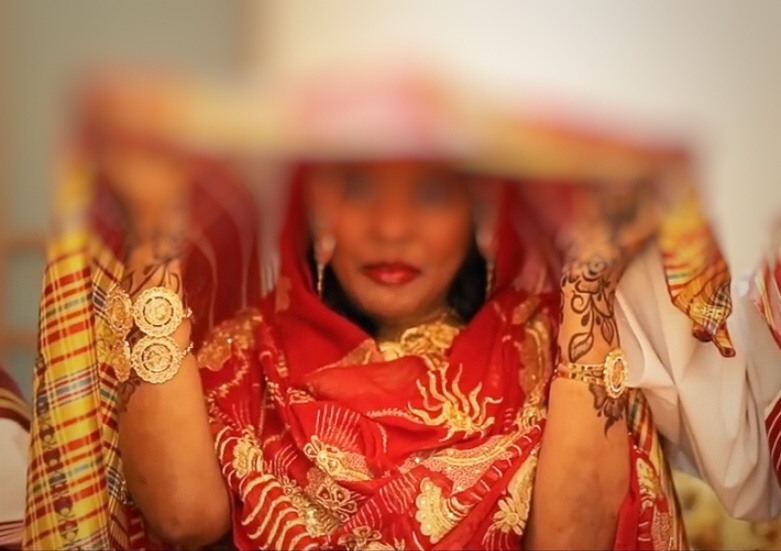
Below, a Sudanese bride being ushered into her groom’s presence. She holds back the folds of her red and gold “garmasis” veil with delicately hennaed hands, allowing us to glimpse her modestly lowered face and glittering bridal jewelry. The veil’s iridescent sheen was once believed to protect against jealous spirits. Photo, Yassir Hamdi, Wikicommons. The enduring symbolism and beauty of the garmasis have inspired and found echo in the work of modern textile designers, artists and poets, endlessly re-interpreted.

The Garmasis in Rites of Passage The Symbolism of the Garmasis
Sondos Shuaib’s Homage to the Garmasis
The Garmasis in Rites of Passage
Marriage, Childbirth and Circumcision
…”swallowed in utter darkness ; / climbing the rocky nights with a blind lantern; / longing for the deep massage of dilka, / the scent of karkaar, / and the silky garmasis gown; / watching the caravans of palm trees, / and the Nile as their escort and singers;
From Wedding Parade by Muhammad El-Mahdi El-Magzoub.

Originally made of fine silk and imported from India*, the garmasis is a key element in rites of passage for both men and women of Sudan’s Riverain peoples. The late artist and expert in Sudanese dress, Griselda El Tayib captures the drama of the garmasis, reminding us that the bride traditionally would appear to the groom “entirely wrapped in the garmasis like a mysterious parcel when she is brought in first to the dancing arena….” (Regional Folk Customs of the Sudan, p 122).

The garmasis veil is still often draped around the shoulders of bride and groom during Sudanese wedding ceremonies today, sheltering and unifying the couple beneath. It would often be laid over trays of perfumed oils and incense before the ceremony to absorb the dense aromatics of wedding perfumes. After the ceremony the garmasis would be treasured, carefully stowed away, the wedding scents still heavy within its folds. See its evocative power recalled in أيام لها أقمشة : ( جبد القرمصيص اتغاتت عليه البايخ .Sometimes, El Tayib notes, the garmasis would be used by the bride as a night cover, tied over one shoulder on the wedding night, “prior to the diaphanous nightdresses coming into fashion in the 1950s” and she adds, “It is said that the wives of some rich merchants always used the garmasis as a night garment rather than the ordinary firka**.
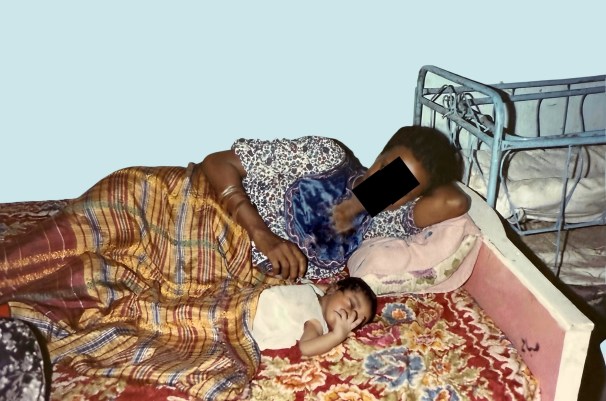
A new mother or nasafa will also don the garmasis as part of ritual adornment known as nafas-jirtig, worn draped over the lower body after childbirth and during the following forty days of confinement. Abdulla El Tayib, writing in the mid 1950s, describes how inside the kujrah*** canopy, the new mother “would be covered with all the necessary ornaments of the jartig. The tendency now in Omdurman is to make her look as much as possible like a new bride. Her hair will have been done in the bridal fashion and she is then made to wear all her gold, and the expensive garmasis of the wedding night will cover her bed.” (Changing Customs of the Sudan).
Griselda El Tayib also notes that the garmasis was used in the same way for a girl upon her circumcision; she would remain covered in it until the wound had healed. Newly circumcised boys are also covered with the garmasis in this way.
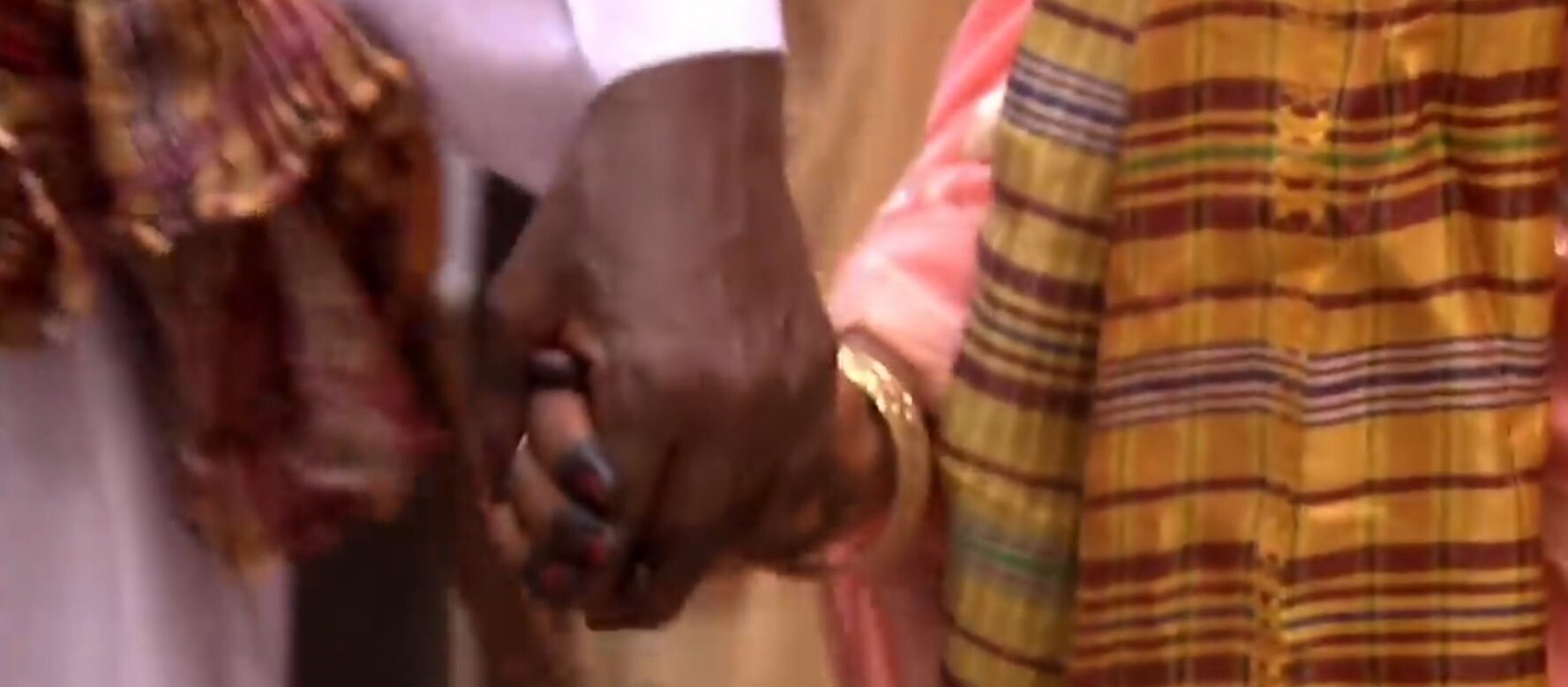
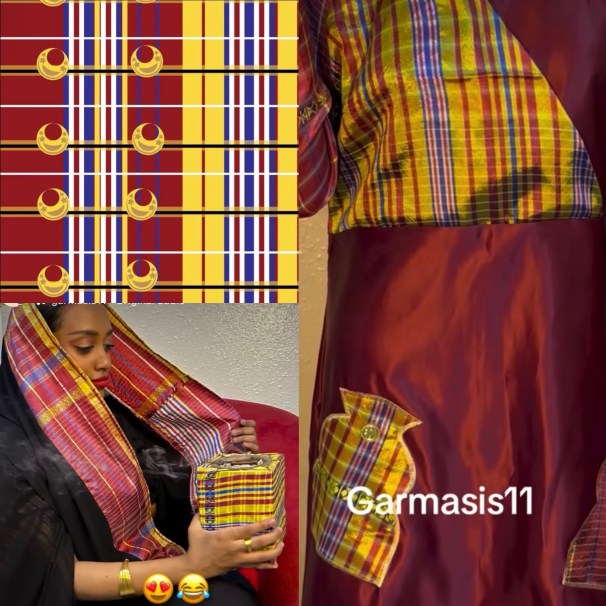
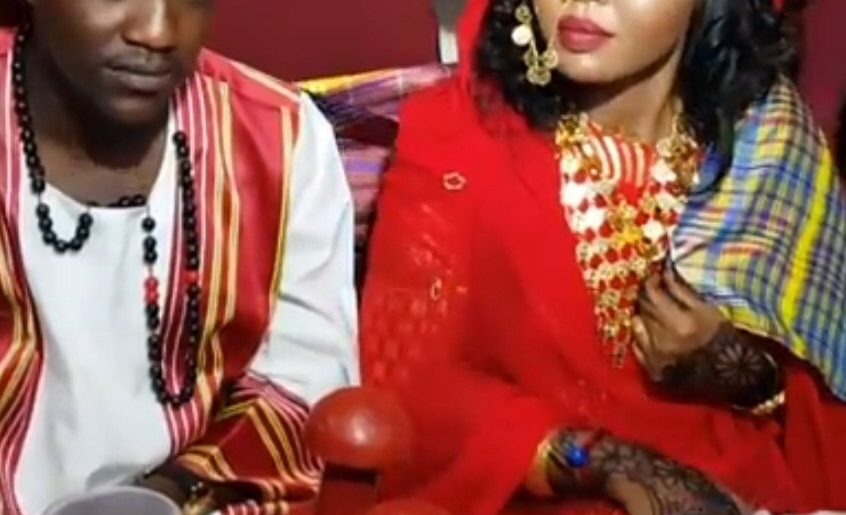
Upper left, still from Youtube’s Best Sydney Sudanese Wedding, showing the bride and groom wropped in the garmasis. Above left, a young mother with her newborn, swathed in her garmasis, mid-1980s. Above right, the jirtig wedding tray bearing perfumes, henna, jertig prayer beads and ribbons for the forehead. Right, some modern takes on the garmasis by talented designers, laya_lle and Garmasis 11.
The groom, below, holding a folded garmasis while his bride dances. Around her waist, the bride wears the al hagu – a string of beads traditionally made of imitation coral and silver balls which act as tiny rattles.
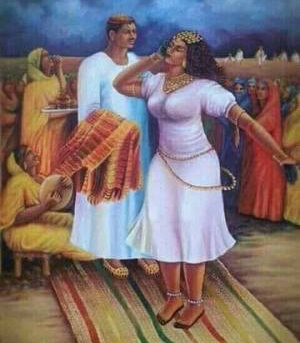
*”The garmasis is made of silk, real or artificial, woven in strips and checks of orange, red and purple across a yellow warp. Its shiny silk-effect is very important and the cheaper ones of artificial silk have a spurious shine on them attained by a thin soaking of gum Arabic and heat applied by pressure from hot rollers.” (Griselda El Tayib). Abdullah El Tayib notes that garmasis were also later imported from Lancashire.
**The firka is a heavier, coarser cover of the same dimension as the garmasis, but made of black, purple and dark red cotton, woven with distinctive patterns of stripes not covering the whole garment but ending in points. (Griselda El Tayib)
***kujrah – howdah, or litter canopy made from coloured doum mats and pitched round the mother’s bed. It was supported on a frame of green date palm branches. with sheets of expensive Indian cloth as lining inside the kujrah if available (Abdullah El Tayib).
Learn more about the drama and symbolism of Sudanese jirtig rituals in Anointing in Red and Gold: Update
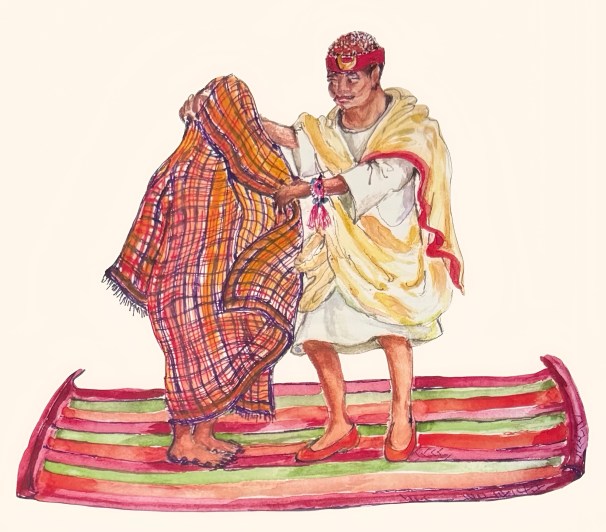
Above, groom with his bride covered in the garmasis. by Griselda El Tayib, Regional Folk Costumes of the Sudan, p123.
The Symbolism of the Garmasis
Although proudly associated for so many Sudanese with the rites of ancient Nubia and the black pharaohs of Kush, the origins of the garmasis’s role in marriage, childbirth and circumcision rituals are obscure, though similar fabrics are found in Yemen, Pakistan and parts of India. The garmasis is integral to and strikingly complements the symbolic and propitious role of the jirtig.
The red of the garmasis, against its yellow, gold, and purple, picks up the red of the wedding toub, the couple’s head bands and silken wrist threads. The colour is imbued with talismanic associations of “the foundation of life, fertility and the power to stop bleeding”. It is also held by some to offer collective protection, warding off the evil eye. فركة القرمصيص.. جزء من الحياة الاجتماعية في السودان
The joyful interweaving of colours and contrasting threads is said to represent the joyful interweaving of married life. As the bride lifts the garmasis from her face, she steps away from childhood into a new phase of her life. The garmasis, most Sudanese commentators agree, is above all, a symbol and vehicle for rites of passage. In recent years it has become a symbol and celebration of inclusive Sudanese identity.
Below, Rana Jubara revels in the multilayered semiotics of the garmasis.
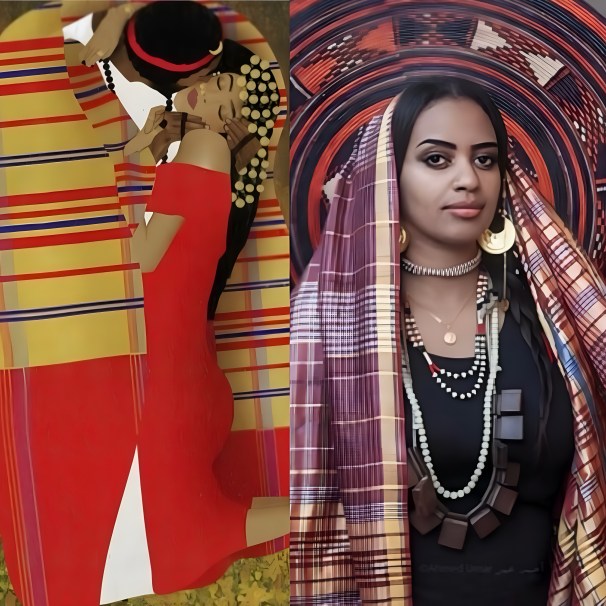
See more of her work in
The Old Tambur Player Rana Jubara

Sondos Shuaib’s Homage to the Garmasis
“I am certain that art threads souls across time and space, offering salvation to embrace.“

Milan-based architect, researcher and winner of Politecnico di Milano’s Education for Women’s Empowerment Award, Sondos Shuaib also explores the role of fiber art in the field of cultural textiles preservation. She intricately weaves tapestries to convey cultural narratives through her textile creations. She draws her inspiration from the garmasis, an art form whose abstract forms and “symbolic elegance” she believes can be extended into “modern contemporary interior and spacial design”. Exploring abstraction and the amalgamation of colours and fibres to gain more depth and meaning in art, Sondos hopes to bring her cultural heritage into the present.

Sondos’s relationship with the garmasis is anything but abstract, though. In the wake of the 2019 massacre of peaceful demonstrators in Khartoum; a massacre where hundreds of bodies were thrown into the river Nile, Sondos asks “Ever wondered if tapestry could speak? What if the garmasis cloth turned blue?” She goes on: “When the garmasis turns blue, it is not merely a change of hearts; it’s a transformation of who we are, a reflection of our Sudanese identity. Woven entirely by Sudanese hands – evoking memories of our loved ones. Everything circles back to Blue for Sudan, not in my country’s timeline but in mine.” The blue of grief for a revolution betrayed by violence and the ancient Nile waters intermingle in her work. Sondos. strives to tell the “silent and neglected stories” , the “many riddles and countless stories waiting to be unravelled, like a tapestry of blue”; “stories, each one a thread in our shared tapestry.”
Below, some examples of Sondos’s work:

” It is no wonder political conflicts lingered in our past like shadows refusing to fade.” Upon war in Sudan , Sondos writes, “I extend my deepest compassion, wishing I could mend each wound individually; my thoughts dwell on you every sigle day.”

“Preserving and promoting the rich textiles and tapestry of my culture, a testament to identity and resilience. Exploring new colour palettes, like the elegant blend of gold, indigo blue and red, at the heart of the garmasis”.
“I have been receiving stories about the Garmasis. Thank you to everyone who has shared so far. Please keep them coming, each one is a thread in our shared tapestry.”
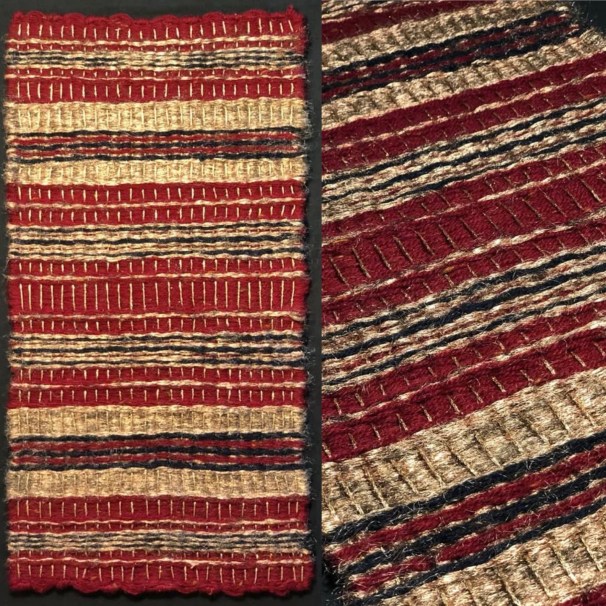
“Finishing the tapestry surprises me deeply. Inspired by the garmasis, I’ve woven this piece to capture the essence of an African tapestry. The stitches, colours, and geometry come together in harmony. It reflects my journey of self-discovery and live for my heritage.”
Sondos is one of many Sudanese striving to hold on to what is exquisite and noble in her heritage at a time of profound suffering for the Sudanese people. Her work is vibrant with hope and resilience.
If you enjoyed this post, you might also be interested in
Anointing in Robes of Red and Gold
Anointing in Red and Gold: Update
The Enduring Appeal of the Sudanese Toub
 Women's literacy in Sudan