

Omer Khairy, The Sudanese Artist with an English Alter Ego
The Sudanese Artist Who Signed Himself George Edward
A Brief Profile
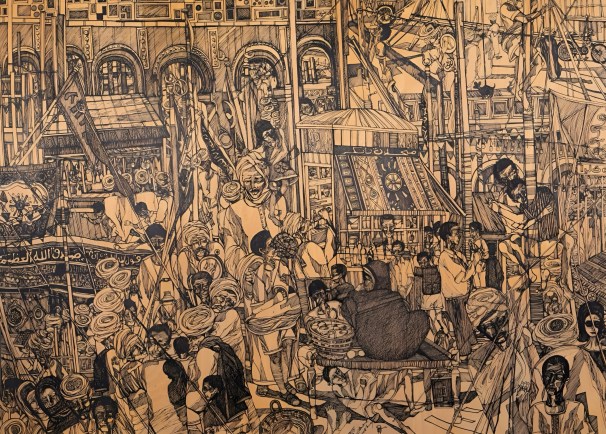
Above and title illustration, Untitled, (Market Scene) 1975, Wikicommons.
Like a raindrop under a microscope, Omer Khairy’s untitled kaleidoscopic market scene above teems with life. An intricate profusion of street hawkers, turbaned figures jostling at shop counters, children perched on shoulders or scrambling up mast-like poles, a woman seated on an angareeb amidst her baskets, her back to us. There is an energy in the meticulously drawn hustle and bustle, (see too the artist’s Nativity) but also in the mechanical, architectural and nautical, so characteristic of Khairy’s work; the dense, multi-textured backdrop of banners, poles, masts, ropes and rigging; lanterns, fans, even bicycles delicately suspended, Heath Robinson-like, on ropes, (see too The Game). Richly textured awnings are embroidered with Arabic script. Khairy would later become known for the calligraphy and written phrases he incorporated into his artwork.
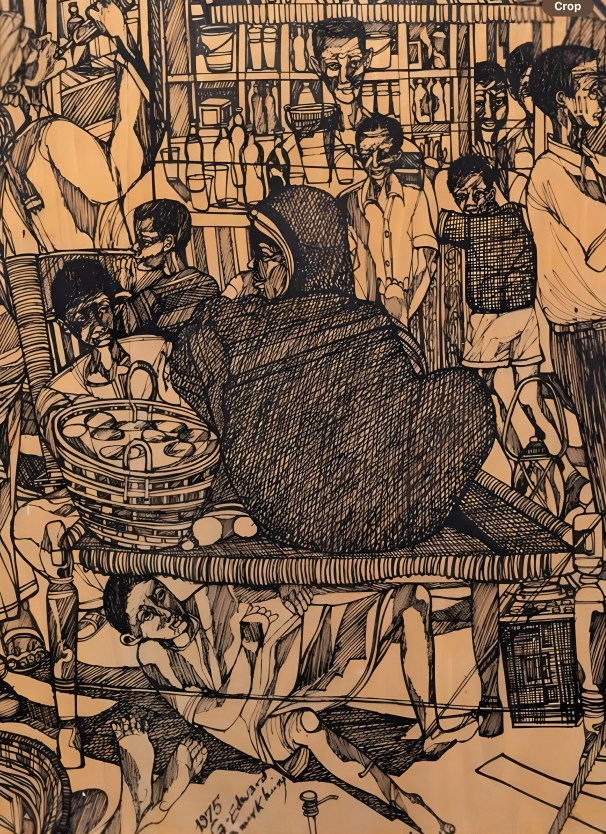
Above, detail from Untitled, (market scene). The internationally acclaimed artist became noted early on for the textural qualities of his black and white ink works on wood and paper. He frequently found inspiration in Sudanese street, harbour and fishing scenes, a style he evolved in the 1970s – 80s, Sudan Memory.
The Sudanese Artist Who Signed Himself George Edward
The scene above is the work of a Sudanese artist, poet and writer who never visited Britain and yet found creative inspiration and psychological solace in adopting a dual Sudanese – English identity, or even, as some critics have suggested, a double consciousness. An duality possibly explored in the artist’s work Duet, pictured below.

“Out of a fever dream, scrambled and meticulously sketched, comes George Edward Scuncucur, alter ego or possibly higher self of a Sudanese visual artist.” (Sudan Memory). An artist, while intensely Sudanese in subject matter, is said to have blended motifs unique to his homeland with the styles and techniques of 18th-century English drawing (Rashid Diab).
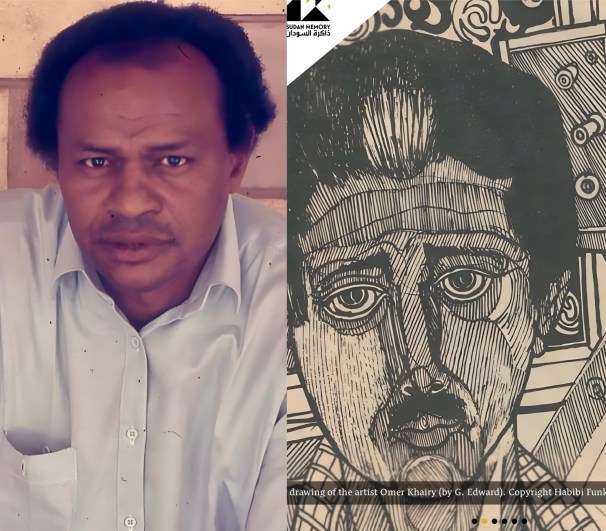
Critics acknowledge Omer Khairy as a key yet often overlooked player in the Sudanese 1946 modern art movement, (See more in Sudan: A Visual Art Narrative), contributing to the Sudanization of modern art. Artist and art historian Rashid Diab (Visual Arts in Sudan) sees in his work an originality, “rich in symbolism, mythical realism and a personal vision of a parallel world.” These parallel worlds are familiar yet strange, unsettling in their dreamlike quality, mysterious and timeless. Everyday scenes became surreal while remaining intensely Sudanese.
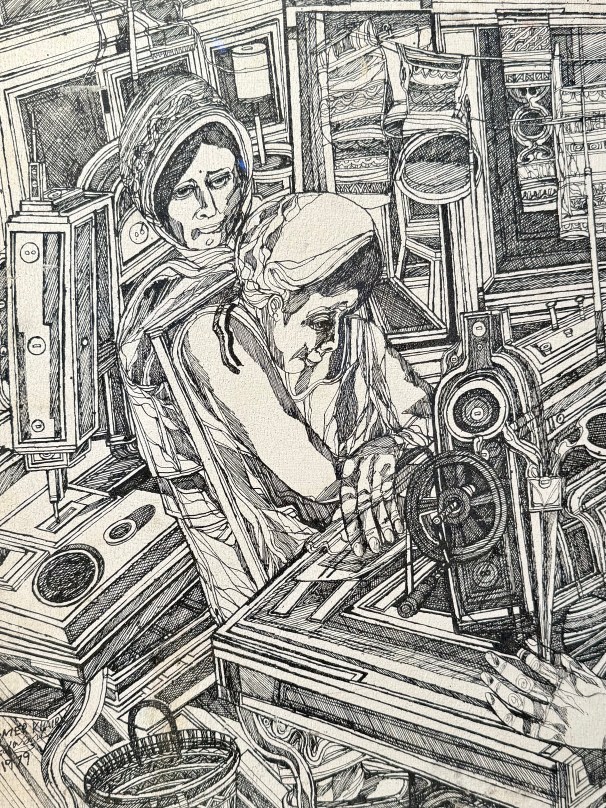
Above right, Mohammad Hassan’s study of Omer Khairy; upper left, photograph and self-portrait of the artist, Wikicommons and Sudan Memory; above left, detail from Omer Khairy’s Sewing Machine, featured below.
See more in Sudan: A Visual Art Narrative

Above, Duet, Sharjah Art Foundation. “The word ‘duet’ is written above a single figure, unifying the concept of the pair and the one. The contrasting composition—dark blue clothing on yellow, a yellow head on blue—may suggest both a complementary relationship and a potential disconnect between body and mind.” (Sharjah Art Foundation)
Brief Biography

Omer Khairy was born in one of Sudan’s cradles for artistic expression, al-Abbasiya, Omdurman in 1939, the last of seven children. The loss of his father while still a child led to an intensification of his relationship with his mother. While at school, Khairy developed his creative and imaginative skills through clay work and drawing people and animals, often depicting charicatures of friends and family – something he would continue to derive pleasure from in later life. He was profoundly influenced in his youth by his older brother, Abdul Aziz, also an artist. See too The Muse Instagram, Meet the Artist.
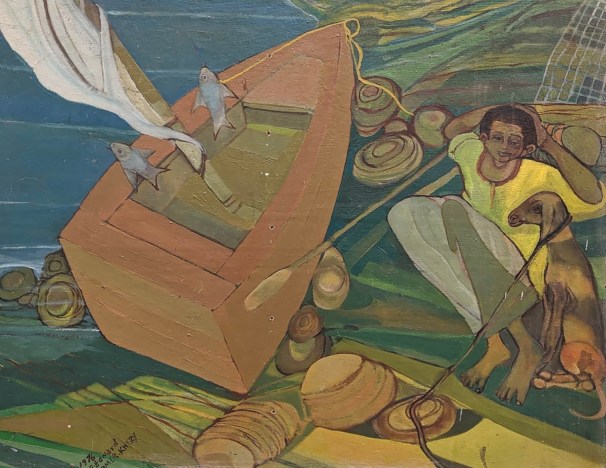
Khairy enrolled in painting at Khartoum’s College of Fine and Applied Arts, only to abandon his studies in 1960 and follow his own path – the same year as his first Khartoum exhibition. Following the death of his mother, in 1963 the artist suffered a nervous breakdown and travelled to Cairo for treatment. From this time on, the artist alternated signing his works as Omer Khairy and the name of his English alter ego, George Edward, writing a memoir of his childhood and youth as the fictional George Edward Scuncucur, The Scuncucur Biography, in 1972.

In 1975 Khairy joined Sudan’s National Council for Arts and Literature, becoming the first full-time artist dedicated to painting and visual arts at that time in Sudan. He also became involved with the Blue Nile Sailing Club, an experience that would have a profound effect on his work.
Omer Khairy,, who received awards from Kuwait and the British Council, produced 750 artworks over his lifetime and enjoyed over 35 solo exhibitions worldwide, many of his works remaining on permanent display at the Sharjah Art Foundation. In addition to his native Arabic, he was fluent in German, French and English. Omer Khairy was also an art critic and poet, with three unpublished poetry collections; If and the Summer Breezes, The Title of Any Number and Taken from Abundance.
Above left, The Fisherman, 1976, Barjeel Art Foundation, Wikicommons; above upper right, Drawing with marker, 1980, black ink on board. Above right, the 2017 documentary, Becoming Omer Khairy. I would be most grateful to anyone who can advise on how to access this work.
The artist died in 1999.
Below, details from Omer Khairy’s Sewing Machine, recently exhibited in Almas Art Foundation, London.


 Women's literacy in Sudan