

Inspired by the Sudanese Looh / lawH / لوح
Sudanese Artists and the Prayer Board / Qur`an Board
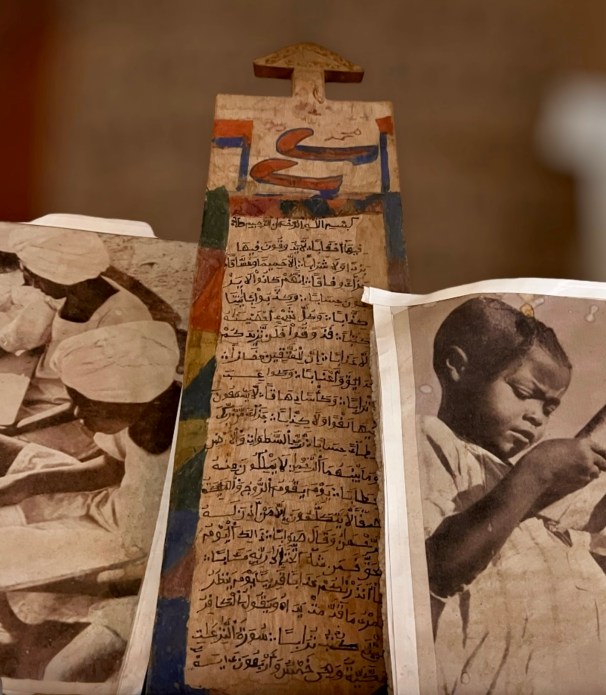
Above, the finely executed calligraphy and vibrant borders of a Sudanese looh / lawH (plural alwaaH) or prayer board, also known as a Qur`an board. It is used by scholars of the khalwa or Qur`an schools to commit to heart verses of sacred scripture and master calligraphy. The looh is also used for the writing of sacred texts with curative powers in Sufi healing rituals, see Unfolding Blessings. It consists of a rectangular slate-like body, often made of acacia or hijliij (desert date tree), topped with an domed “aDaan” handle. The boards shown here were among several beautiful examples featured in Sudan’s Ethnographic Museum in Khartoum pre-war.
See more in Sudan’s Cultural Treasures Looted 1and Ethnographic Museum Khartoum.

More examples, Ethnographic Museum, Khartoum, pre-war. These artifacts, beautiful in their own right, speak also to Sudanese spirituality and aesthetic sensibility and have informed the imagination of many contemporary Sudanese artists.
Inspired by the Looh / lawH – Mo Kordofani, Ibrahim El-Salahi and Dar Al Naim
Rashid Diab, in his Visual Arts in Sudan, speaks of the profound role played by the disciplined and painstaking transcribing of sacred text in forming Sudanese artistic identity. This “spiritual and protective script” was “constructed in the artists’ imagination and subconscious with its mystical dimensions; a “spiritual exercise to gain blessings and memorization”.
For Rashid Diab, this creative artistic response came to be reflected in uniquely Sudanese interpretations of calligraphic art. Its influence can be seen in pioneering Sudanese artistic movements, renowned artists such as Ibrahim El-Salahi, and resonates today in the work of young artists in service of the 2018-19 democratic revolution. Diab notes that the Ash-sharafa ritual in Sufi Quran school is particularly significant. Here the student is honoured for memorizing a Surah of the Quran and during the ceremony, they inscribe their “memorized text on a wooden board and receive celebratory remarks from the teacher.” (Rashid Diab, Visual Arts in Sudan)
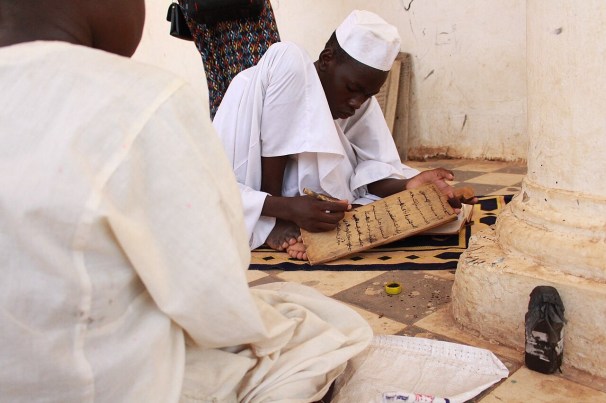
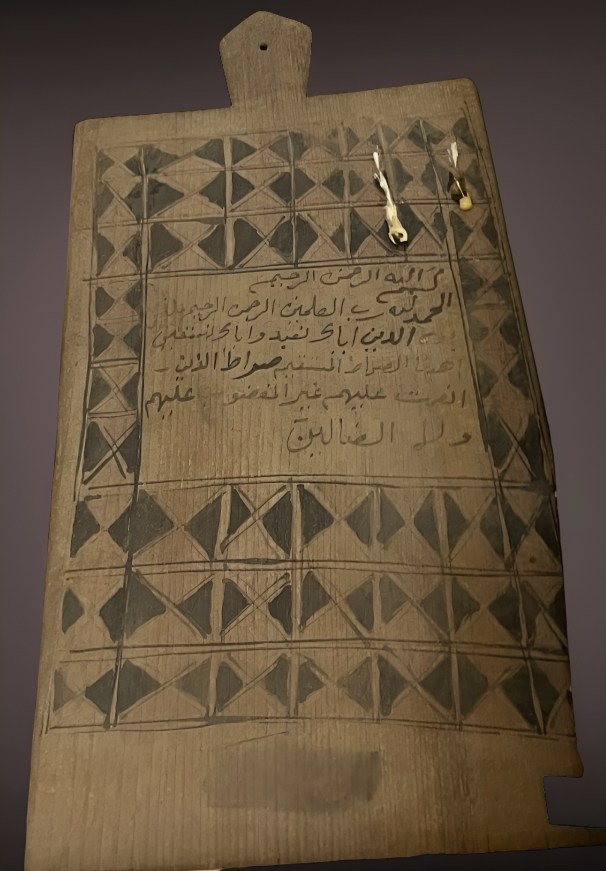
After learning how to draw letters, shapes, and complete words, the student of the khalwa moves on to trace words in the earth with his fingers until he can read and write them. Only then does he graduate to a reed or corn wood pen and wooden board. At this stage, the sheikh may use date stones to draw letters on the board of the student who traces it with their pen and its handcrafted nib; often made by the students themselves. The ink used is known as Al-Amar” and is described below. While some accounts refer to an eraser stone of granite used to smooth clean the board (Wikipedia), in Sudan, the boards are often washed clean, see illustration below from Dr Ahmed Al-Safi’s Traditional Sudanese Medicine. See too يصنع من أشجار لدنة وقوية مثل الهجليج.. الألواح.. كراسة الحيران

*Scroll down to the end of this article for an excerpt from Abdulla ElTayib’s Changing Customs of the Sudan providing a more detailed description of the writing process.
You can watch a a young student mastering the technique in صباح النور│خلاوي السودان .. منارة دينية وعلمية
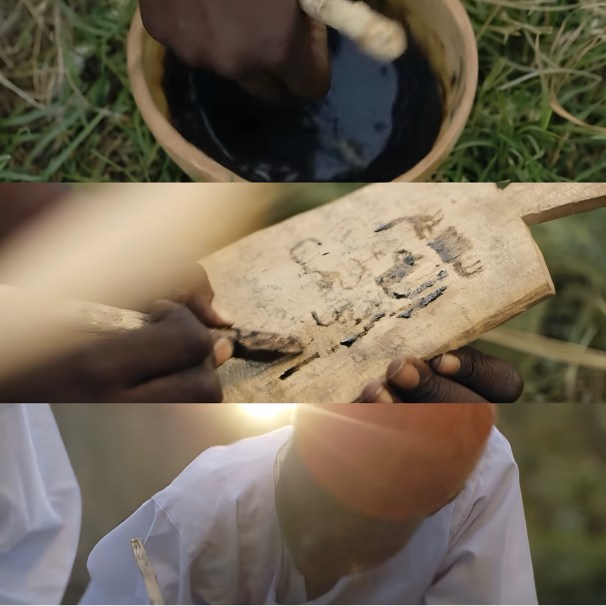
Mo Kordofani, the internationally acclaimed Sudanese director of Goodbye Julia, made his mark as a film maker with the award-winning film, Nyerkuk, in 2016. This lyrically filmed plea for compassion for the poorest in Sudan opens with an overhead shot of a glistening lake of black ink cradled in a gourd bowl. In the early morning light of a village thronging with birdsong, a young boy is scratching out letters on his wooden lawH, while his father watches the sky above warily. Just audible against the birdsong is the faint drone of a warplane. The scene, heavy with symbolism, evokes at once heartbreaking vulnerability and the shattering of peaceful Sufi traditions in Sudanese daily life.
Right, stills from Klozium Studios Nyerkuk. Nyerkuk is an affectionate term for a young boy, used by many southern Sudanese. See too The Making of Nyerkuk and Nyerkuk: The Latest by Kordofani FIlms Ola Diab. See more of the director’s work in The Vulnerable Soul.
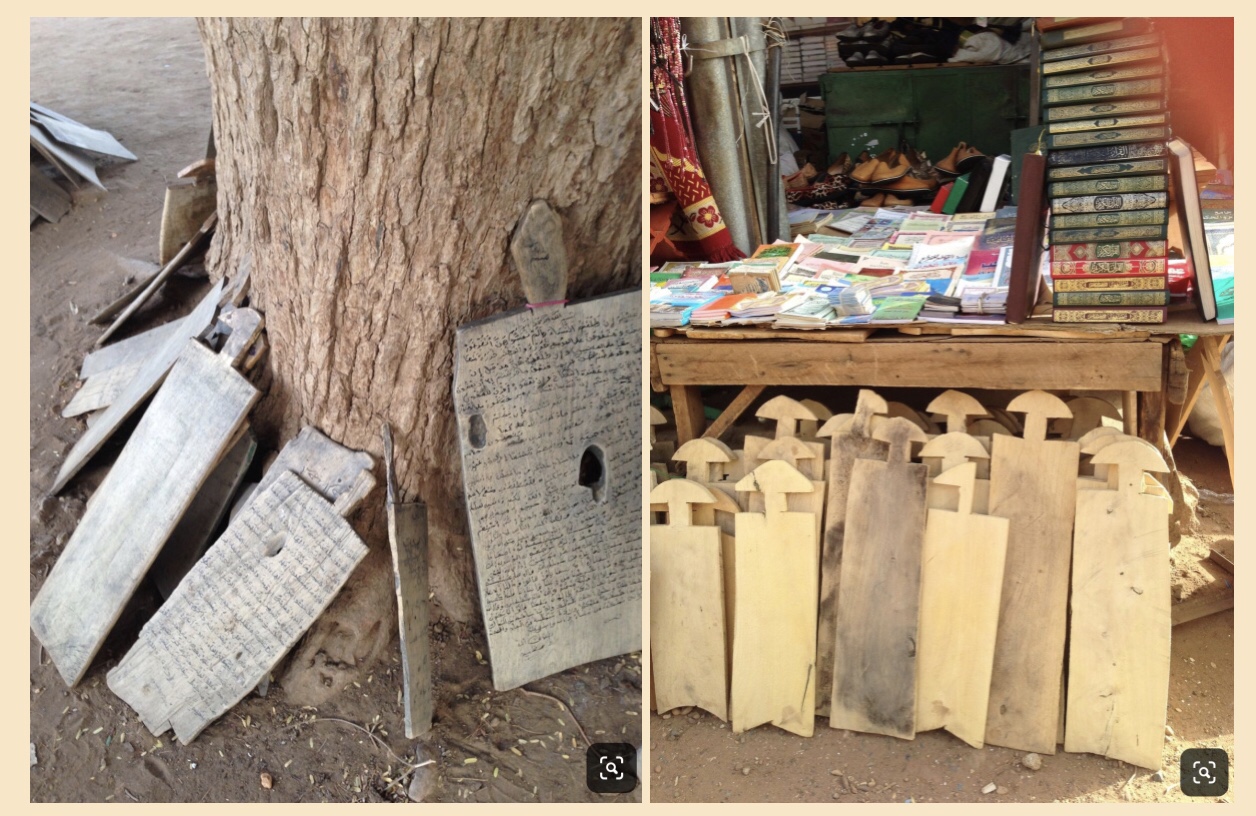
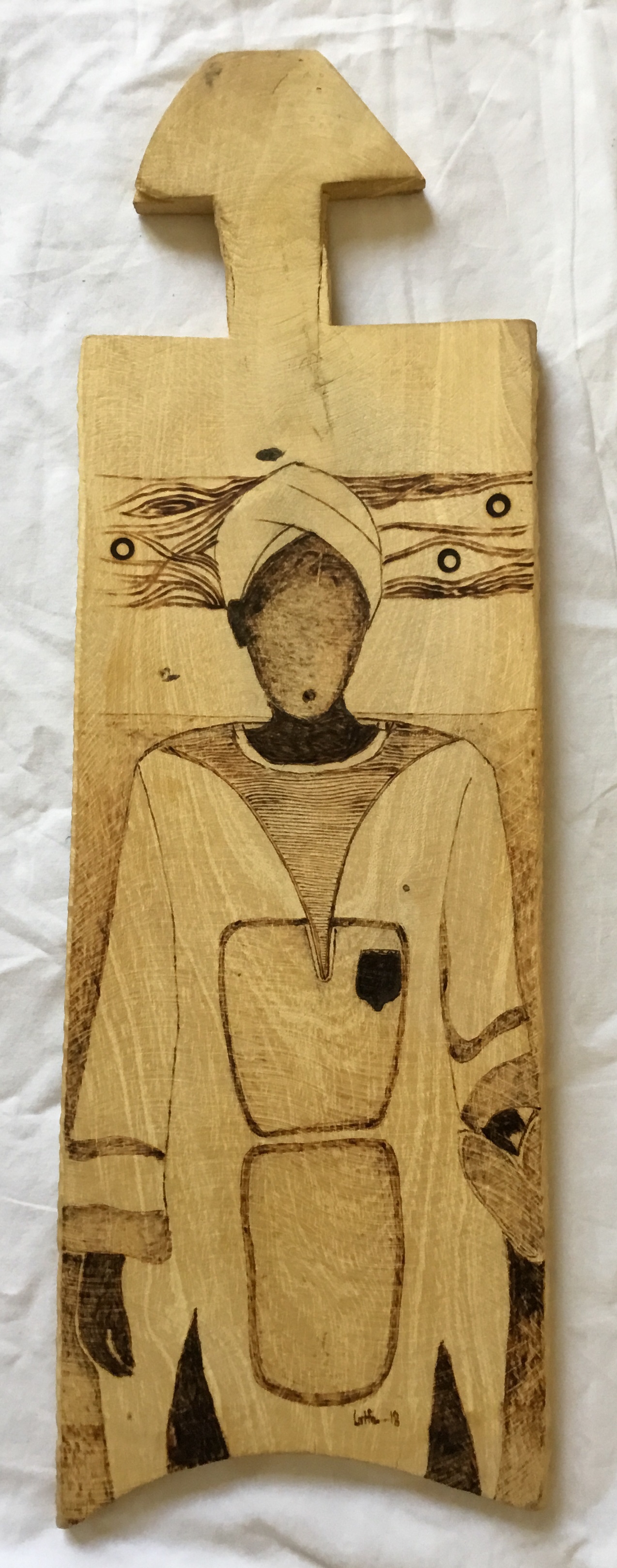
Upper left, Sudanese prayer boards, photos Pinterest posted by Bibi Baloyra; left Sudanese Khalwa scholars, Wikipedia CC, upper right, a piece by Lotte Abdel Fatah Omer, personal collection and below it, another exhibit from The Ethnographic Museum, Khartoum, pre-war.
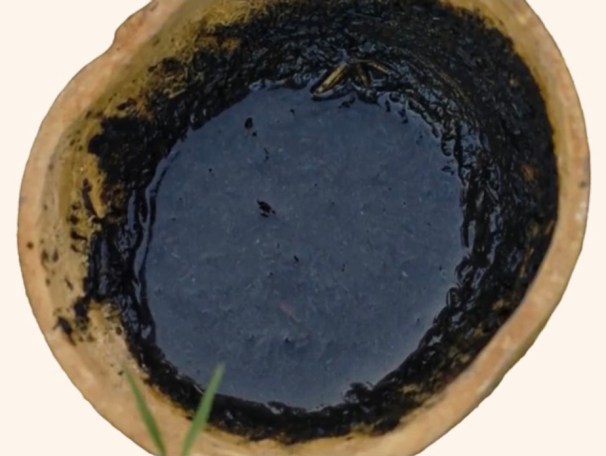
Above, an hollowed out calabash inkwell, or dawaya, in western Sudan. It contains ink made from a mixture of charcoal or soot, gum arabic and water possibly “containing a tuft of hair” (Prof Ahmed El Safi). Dorrit van Dalen, researcher on gum arabic in Sudan recalls one of her informants describing how, as a child, he learned to recite the Quran using traditional wooden boards. When the lawH was covered in verses,“ we rinsed it off with water and then drank it. They say that the spiritual wisdom of the Quran enters your body and protects it that way.” This Amar ink, prepared by fakis is also used in the making of leather bound amulets or hijbaat. (Prof Ahmed El Safi, Traditional Sudanese Medicine) “Melted Amber”; Gum Arabic in Sudan
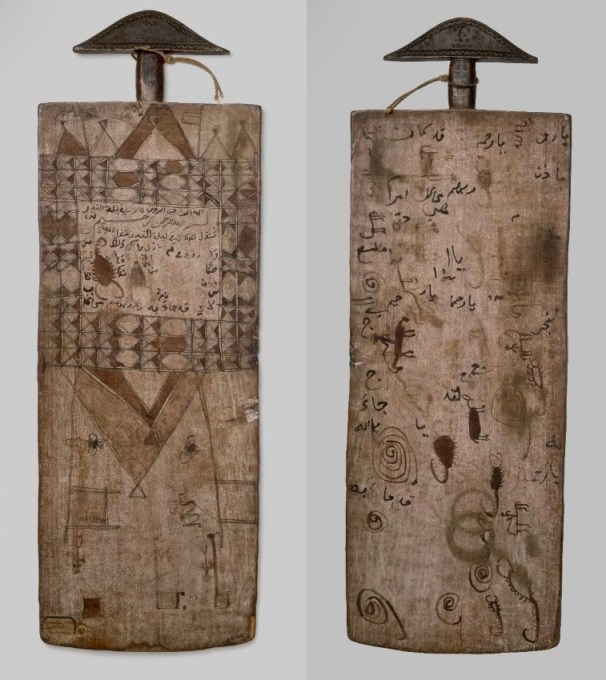
Qur`anic writing board, late 19th or early 20th century, Omdurman, Sudan, Brooklyn Museum,CC.

Ibrahim El-Salahi has often spoken of the profound impact of his childhood enchantment with the flowing forms of Arabic script. Recalling his father transcribing the Holy Qur’an, he notes: “I used to watch him drawing on a whitewashed surface with date palm kernels, some lines faultlessly straight, others fine, interlacing geometric forms …. He taught me to mix amar, the homemade ink used for transcribing – recipe of soot, gum arabic, and water left to ferment until it turned richly dark. He also showed me how to sharpen tumam grass and reeds into pens.” He goes on: “And finally I learnt to design and paint sharafa, tablets used for transcribing verses of the Qur’an. I would ornament my tablet by drawing a frame of intersecting vertical, horizontal, and diagonal lines, making triangles that we usually filled in with contrasting colors. In the centre of this frame we would write the open verses of a chapter of the holy Qur’an that we were to learn by heart.” (The Artist in His Own Words, Ibrahim El-Salahi, Visionary Modernist, p 83).
El-Salahi would go on to see the wooden prayer board as an abstract representation of human body as in his artistic journey he moved ever more towards a modernist “paring back to abstraction” of natural forms, adding “but I am still leaning my back against calligraphy because I find it is something which is very very stable. It’s almost like trees growing….when I see trees growing, you can see the calligraphic shape in them.” Visionary Modernist, p 59
Above left, Ibrahim El-Salahi, from the series By His Will We Teach the Birds How to Fly; see Birds of the Soul -Updated
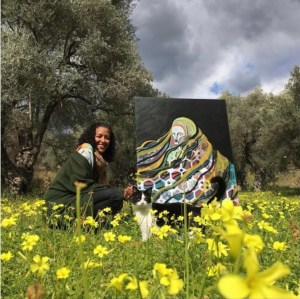
Dar Al Naim, pictured above with her work HerstoryIII.

The socially committed artist, Dar Al Naim until recently based in Spain, has also found inspiration in Sudanese prayer boards. In the collage right, we see forms reminiscent of prayer boards, embossed with patterns echoing traditional Nubian house motifs, tribal facial markings or stamped with tiny, united figures. On the left of the collage, the bands of mask-like faces that bead the edges of cloth whose greens, golds and reds echo the iridescence of Sudanese bridal robes. Here too, the eye, talisman against evil and suitable emblem perhaps, for an artist who seeks “to educate the eye.”
Dar Al Naim’s commitment to “a new international and global dialect” voicing “a message of peace and unity” means her work can also be read as social and political text. Her social media presence and the accessibility of her work; the production of stickers, T-shirts; her sketchbooks dedicated to the Sudanese revolution of 2019, displayed by video on Facebook, “The Revolution will not be Televised”, her public feminism – all inform an art which is at once personal, political and socially committed. “In Sudan, there are those who think women artists can’t have ideas”, she has stated and in addition to bringing Sudanese art to a world public, she hopes to facilitate “ an artistic conversation between men and women creatives.
Learn more about her work in Unmaskings
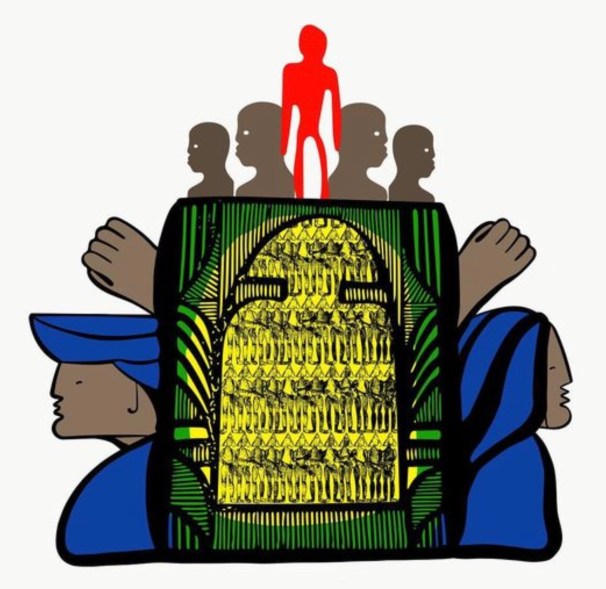
Dar Al Naim; the prayer board as symbol of unity over division.
The artist and educator Sittana Babekir Bedri also incorporated prayer boards into her artistic vision. Her work will be featured in a coming posts.
*Below, The Tablet (loh), extract from Changing Customs of the Sudan.
is now commonly called shini or Indian ink. The ink made from soot and gum is called amar. The pen was often made from a segment of dura cane, but other stronger reeds when available, were also used. When sharpening the end of the cane, great skill is required for making the right inclination – usually anything between an angle 54 and an angle of 30 degrees..
Changing Customs of the Sudan, Abdulla ElTayib pp 67-69.
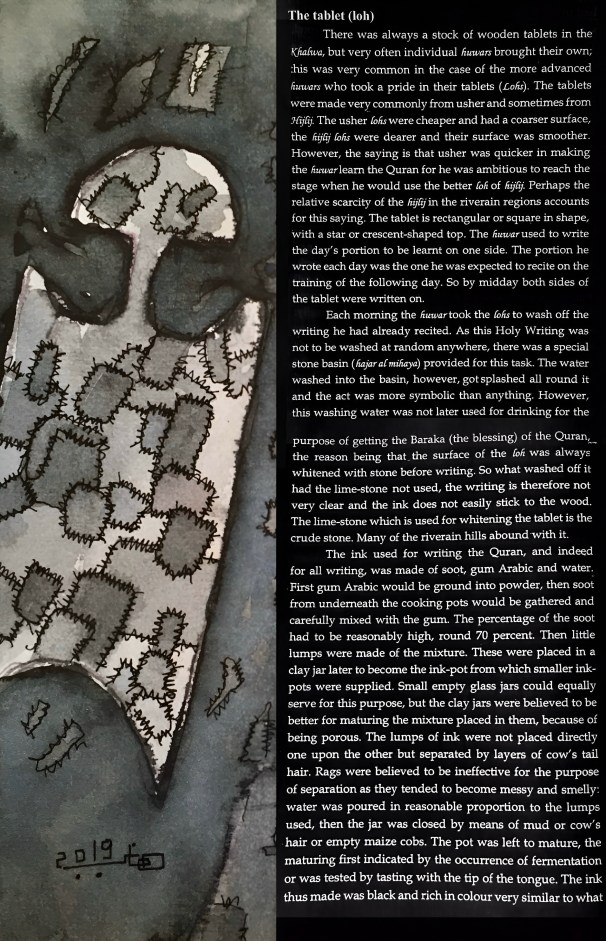
Below, a watercolour from my personal collection, with motifs inspired by the patched robes of Sudanese Sufi mystics.

 Women's literacy in Sudan