

One Man’s Journey Through Sudan’s War
Artist Bakri Moaz’s War Sketchbook
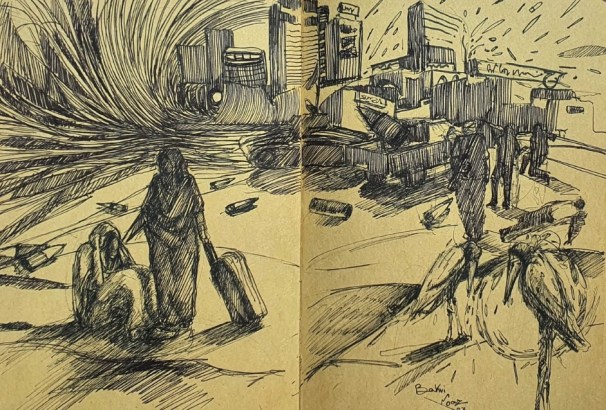
Above, Sudanese civilians fleeing a city ravaged by war; a scene from the sketchbook of Nairobi-based Sudanese artist Abubakr Moaz, widely known as Bakri Moaz. This gifted artist fled Khartoum upon the outbreak of the conflict in 2023. The sketchbook was one of the few possessions he fled with. It became a palimpsest of pen and black ink drawings of scenes witnessed as he made his perilous journey to safety, intricately overlaid with annotations of his thoughts, projects, ideas, even phone number; in short, as he explains in the video below, of everything that mattered to him. The sketchbook was the subject of a special exhibition, Sketches of War, in Germany in October, 2023.
See more of his work in Bakri Moaz Instagram

A once familiar cityscape scarred by bullets, shell casings and tanks. In the midst of chaos, tall, composed women lead their children to safety; another scene from Bakri Moaz’s sketchbook. Commenting on his Sudden Departure series, the artist writes “Many left before they knew how and why they left. Some left early, leaving behind everything except their souls.” Bakri Moaz, Instagram

A Brief Profile of The Artist
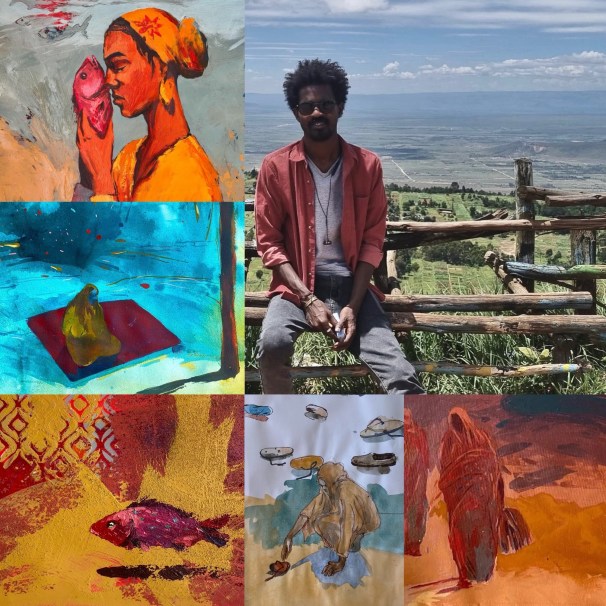
This week’s article is the first of of two posts dedicated to this remarkable young fine artist, muralist and musician. All work featured here is copyright Bakri Moaz and reproduced with his kind permission.
Bakri Moaz, Khartoum 1993, pictured left, worked as a graphic designer and television studio set designer before dedicating himself full time to painting. His work has been exhibited in Sudan, South Africa, Dubai, Kenya and Germany and the artist was finalist and award winner in the pan-Africa Emerging Painting Invitational 2022. See his detailed trajectory in Mojo Gallery’s Bakri Moaz Profile
A graduate in Fine Art from Sudan University of Science and Technology’s College of Fine and Applied Art, Bakri Moaz set up his own flourishing art studio in Khartoum. He speaks of his studio as his second home, often sleeping there among the canvases. He is co-founder of Zan Arts Studio, Nairobi, a collaborative arts hub bringing together and inspiring Sudanese and regional artists. During the 2018-19 revolution, the artist joined other Sudanese artists and activists painting murals in Khartoum. He is a founder member of the musical band Safrajat.
Bakri acknowledges the pivotal role of his mother in forging his identity as an artist: “When visiting friends, my mother would invariably ask me to make some drawings or paintings to take as gifts for them,” Bakri recalls, also fondly recounting how his mother placed on him the responsibility of ensuring”every empty wall in the house had a painting”. He speaks too of the inspiration he draws from sitting in the shade of trees overlooking the Blue Nile and the hustle and bustle of Khartoum streets. Sketches of War: How a Sudanese artist freezes and frames life in a war zone

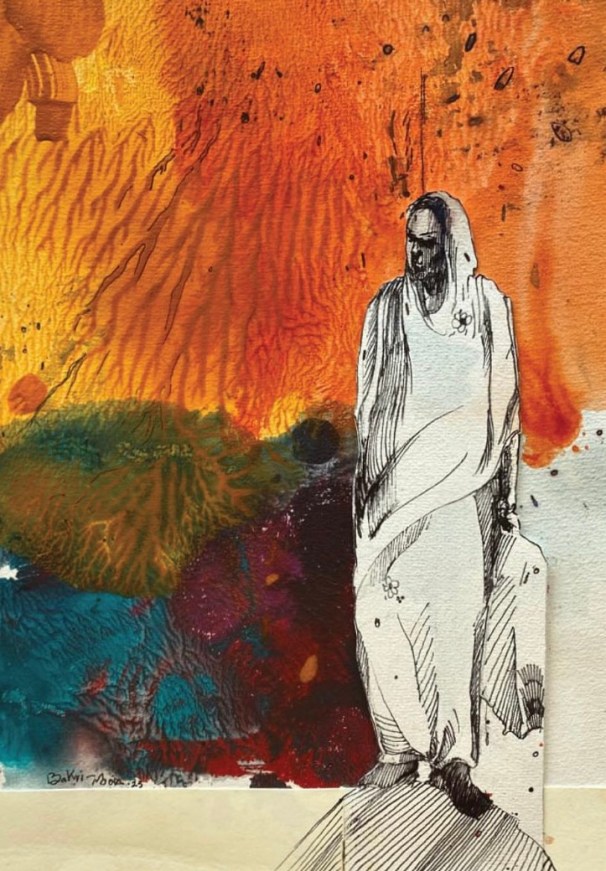
Critics have described the artist’s work as exploring the “relationship between material and spiritual search for truth or the divine “, and the “raw reflection of the search for purpose and the quest for life” Arak Collection / Downtown Gallery. His work is also informed by an intense spirituality whose force is glimpsed in the vast whirling orbits radiating beyond the tall figures of Spirituality and God’s Giving, in Evidence of Things Not Seen, his Behind the Wheel exhibition, embodying his belief in the circularity of the universe, and the “endurance, ritual, and the sacred bookends of each passing day” in Last Light, with its sweeping tree sheltering souls against a radiant sky. Left, untitled, Disturbance in the Nile, Madrid.
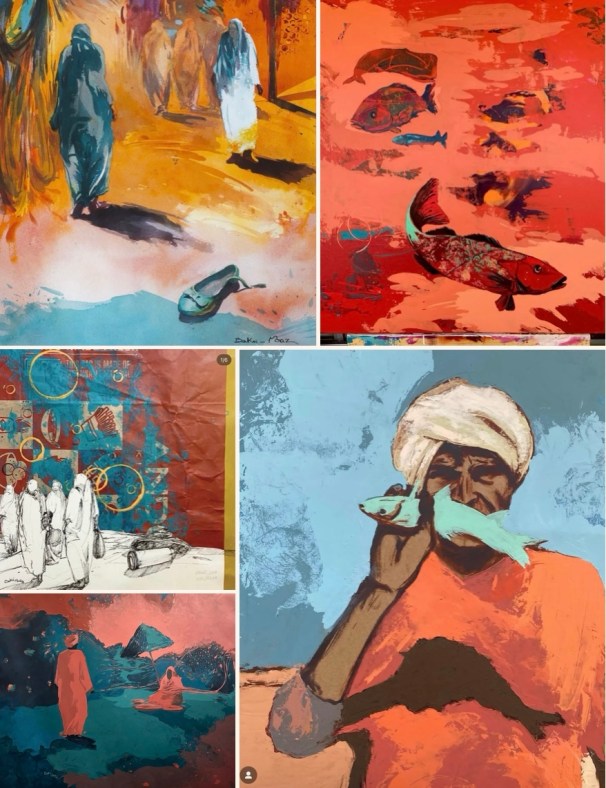
Above, recurring motifs in Bakri’s work; shoals of vibrant fish; complex symbolism of “Sudanese on the move” – “fish have to keep moving, if they stop, they are dead”, “A fish cannot drown in water, A bird does not fall in air”, Bakri explains, fish also depicted scattered and lifeless on the ground; intense aquamarines and carmine reds of vast horizons; shoes lost or abandoned, a strap trailing in the earth; women resolute yet graceful amidst destruciton. Visit Bakri Moaz Instagram to see these works in detail.
Why Bakri’s Sketchbook Matters
“I’ve always believed when you do something honestly it won’t just disappear.” Bakri Moaz, Instagram.

Sudan’s war continues to destroy lives. As I write, thousands of civilians remain trapped in the RSF-besieged city of El-Fasher; at the mercy of paramilitaries accused of numerous atrocities in the region. Although described by The United Nations as the world’s worst humanitarian crisis, Sudan’s ongoing tragedy has largely fallen out of headlines in the West.
Sudan’s war is one forged by deep-rooted internal power struggles, manifested in a 30-year history of state-sponsored mass killings in the country’s peripheries. It is a war fed by regional and international powers. The weapons killing Sudanese civilians come largely, though not exclusively, from Turkey, Iran, Saudi Arabia, The United Arab Emirates, Russia and China.
Read more about recent developments in Grave fears for civilians after Sudanese paramilitary claims capture of El Fasher The mother who could only afford the drugs to save one of her twins Targeting volunteers: lifesavers face cyberwar in Sudan.
Aside from its intrinsic artistic value, Bakri Moaz’s raw, intense work is a plea for the world not to forget Sudan. “It’s not our war”, Bakri stresses, and speaking of the parties to this conflict, urges: “I would like to ask them, ‘Why?’ Nobody will win this. Stop it.” Bakri resolutely continues to draw the world’s attention to the suffering of Sudanese civilians in his work; “the old, the sick, grandmas, babies, relatives, and their daily lives lived in fear of death or loss.” Bakri Moaz, Instagram.
Through the capturing of loss, grief and exile on canvas, Sudanese artists such as Bakri offer a path towards personal and communal healing.
See too Sudanese Artists Work to Heal From Trauma of War and
Sketches of War: How a Sudanese artist freezes and frames life in a war zone

Above, Exit, exhibited in Disturbance in the Nile, Madrid. This is one of several powerful works – see To Nowhere 3 and To Nowhere – where tanks loom against a hectic sky thick with smoke. Lone figures stand sentinel, strong and unbowed amidst a ground vibrating with energy.
The Story of the Sketchbook

Bakri recalled to columnist Mahasin Ismail the sudden sense of foreboding he had on the eve of war and his reluctant decision to leave his Khartoum studio; “I remember taking only my laptop, a sketchbook, and two black pens, which later became my only means of artistic expression. The following morning, I learned of the devastating news on TV and realized that my friends were likely caught in the midst of the conflict zone, unable to leave for the next four days.” The studio would not survive – his artworks destroyed by fire (In the face of overwhelming odds).
For Bakri, the onset of war was the start of a grueling three-week migration. He eventually crossed into Ethiopia on foot, where he obtained a visa to Kenya. A journey where he saw “ground battles, artillery fire and explosions from up close every day”. Throughout his journey, he explains; “I would carry my notebook everywhere. I felt compelled to freeze impressions of the fighting and the destruction it had wrought on us…” (Stories of Sudan’s Migrated Artists)
Despite all that Bakri has witnessed, he remains sure of his country’s strength to rise again: “Sometimes, bad situations come, but they will not stay. Nothing lasts forever. So, Insha’Allah, the good part is coming. Hopefully, we could go back and make Sudan a better place,” Sketches of War: How a Sudanese artist freezes and frames life in a war zone
Watch Bakri’s video of the Sketches of War here:
If you are interested in contemporary Sudanese art, you might enjoy:
 Women's literacy in Sudan