

Art of the Sudanese Revolution 1/4
On the Streets of Khartoum 2019-2022
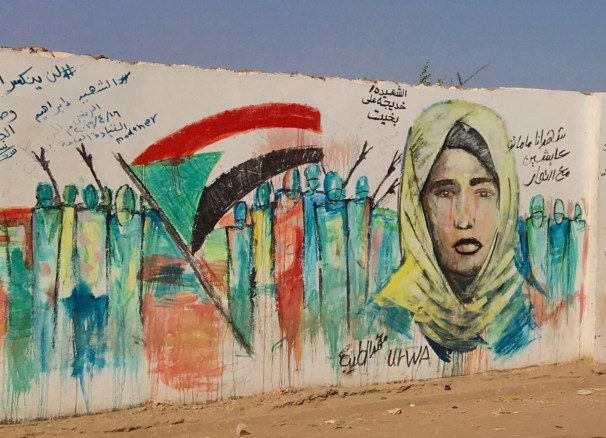
Above, a mural honouring a martyr, or shahiida of the Sudanese revolution of 2018-19, Khadija Ali Bakhiit, by Urwa Ahmed Osman and Mohammad Al-Tayib Bashir Al-Madani. This poignant and powerful work was painted across a sweeping section of wall skirting open terrain in the capital, dwarfing passers-by with its intense, vibrant forms.
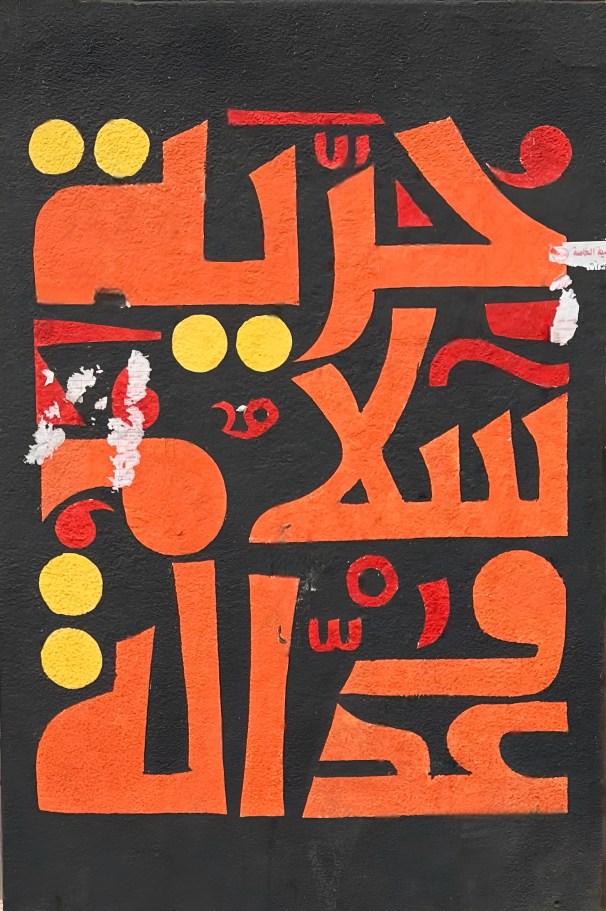
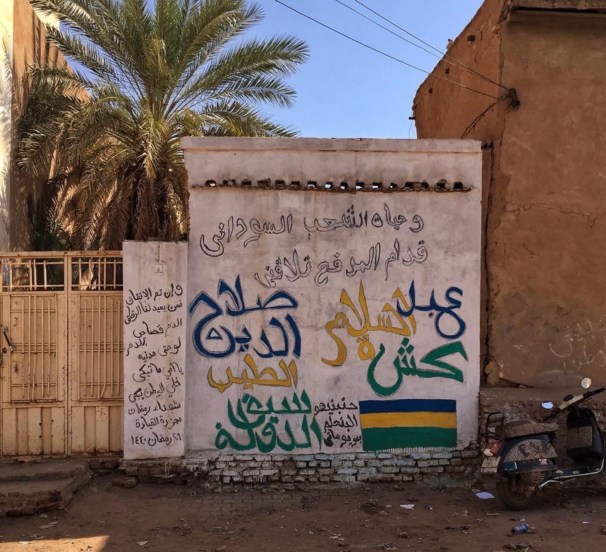
Below, the slogan embodying the ethos of the uprising; “Freedom, Peace and Justice”, which flanked the entrance gate of the Families’ Club, naadii al-usra, Khartoum, also shown below.
All photographs in this post were taken by the author.
Art of the Sudanese Revolution 1/4

There are numerous media and academic studies dedicated to the flowering of community-led public art that played such a pivotal role in the 2018-19 Sudanese revolution. This introductory post seeks only to add to the photographic record of murals in the capital and elsewhere from this fascinating period in Sudan’s recent history. Many of these works will have been destroyed or erased in the brutal ongoing conflict.
The revolution saw an outpouring of artistic energy. Established artists honed their skills and explored new challenges as they lent their voice to the public art of the revolution. Many found themselves the focus of international curiosity and acclaim. Young, lesser known artists cut their creative teeth at this time, forging promising careers. However, the murals of the revolution were above all a collaborative endeavour and for many Sudanese, the revolution offered a unique opportunity joyfully to indulge their interest in drawing and painting. The coming together of communities across generations to spend time painting and supporting the artists as they worked was for many to prove an enriching and empowering experience.
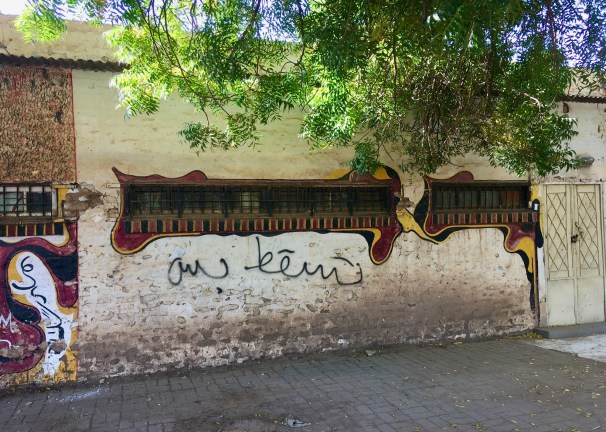
Below the words “tasqo/ut bass” – just go, literally referring to the fall of the Bashir regime and often translated as “Just fall, that’s all” or “You’d better fall”. Researchers into the lexis of the revolution note that this expression appeared to be undocumented before 2018, though similar to expressions used in other uprisings in the Arabic speaking world. They claim the slogan was probably the only one to be translated into Sudan’s other native languages or ruTanaat. The phrase was widely used as a refrain by Sudanese hip-hop singers, (Glossary of the Third Sudanese Revolution).
If you are interested in terms coined during the present conflict, you might enjoy Are You Under the Tree or in the Basement?
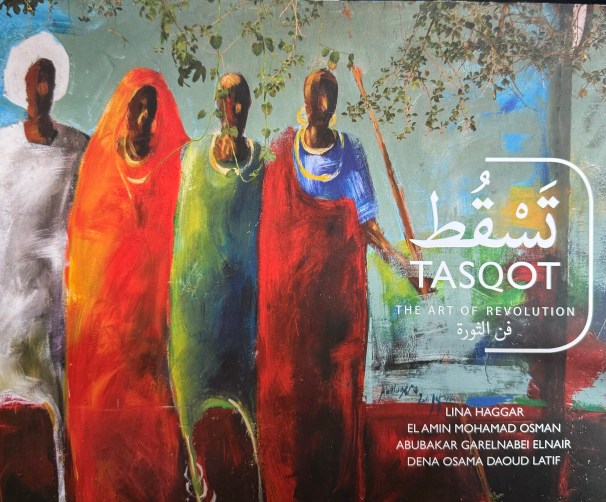
This brief series of posts will explore the themes, passions and slogans behind this artistic burgeoning. It will also focus on the work of some of many artists involved. Tasqot, The Art of the Revolution, pictured right, encompasses the wealth of symbols and motifs which inform the murals – from ancient Nubian queens and warriors, symbols of great Sudanese civilizations of the past, as well as international symbols for peace woven into portraits of revered Sudanese figures such as the socialist poet and humanitarian, Mahjoub Sherif (see Sing, O Khartoum, Sing) and the reformist Islamic thinker Mahmoud Taha. Sudanese women, in all their grace and strength feature heavily in both large scale and more modest compositions. There are also works decrying rape and violence against women and upholding their inherent dignity and honour. As the revolution wore on, murals commemorating those who lost their lives to the cause also emerged.
My next post will discuss the collection of murals documented in Tasqot, The Art of Revolution.
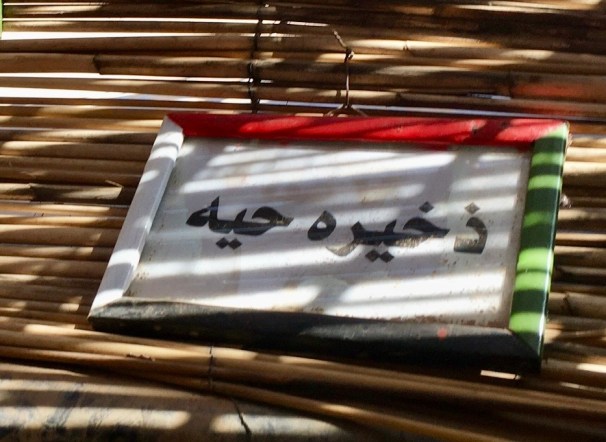
Above, the slogan dakhiira Hayya, literally meaning “Live ammunition!”; a warning to marchers on the numerous mass demonstrations that took place in the capital during this period. The slogan came to embody deadly and disproportionate state-sanctioned violence against peaceful demonstrators.
On the Streets of Khartoum 2019-2022
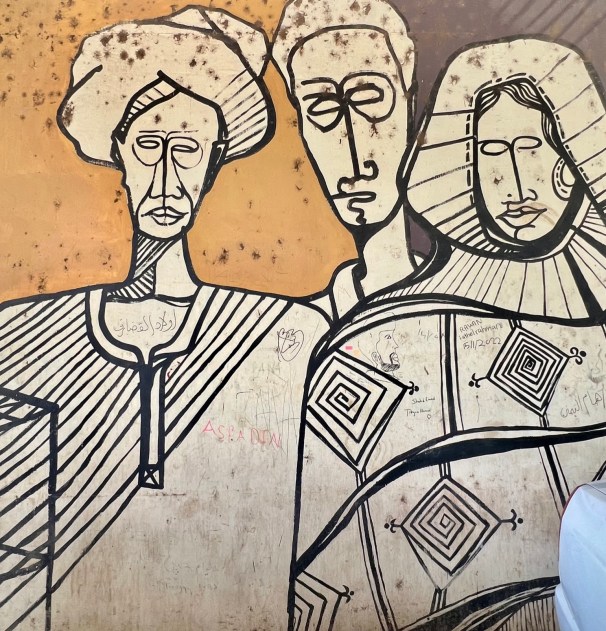
It is difficult to know how many murals from the revolution have survived the ongoing conflict. One that has is by talented young artist Galal Yousif, a detail from which is shown above. Read more about the artist and this striking work in Enduring Witness.
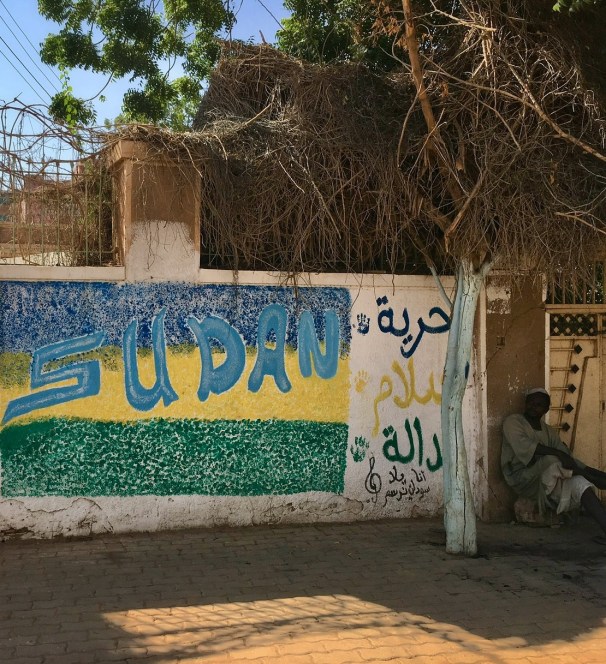
Above, the slogan “Freedom, Peace, Justice” aside a painting of the Sudanese flag adopted from the country’s independence in 1956 until 1970. The flag’s colours symbolize the waters of the Nile, the expanse of the Sahara Desert and green fields of the land’s agricultural wealth. The flag was designed to be ethnically neutral and an expression of unity through diversity in Sudan. The flag was replaced in 1970 by what remains Sudan’s flag today. Based on the pan-Arab liberation flag of the 1952 Egyptian revolution, the current flag is also overlaid with uniquely Sudanese historical, as well as religious symbolism. The flag shown above became associated with a more inclusive vision for Sudan during the revolution and there were even recent formal proposals for its re-adoption. It is a recurrent motif in revolutionary art.
Below, another recurring motif in revolutionary murals; depictions of The Freedom Train, seen on the facade of a car workshop in the capital.
“The dawn has come. Atbara has arrived.”
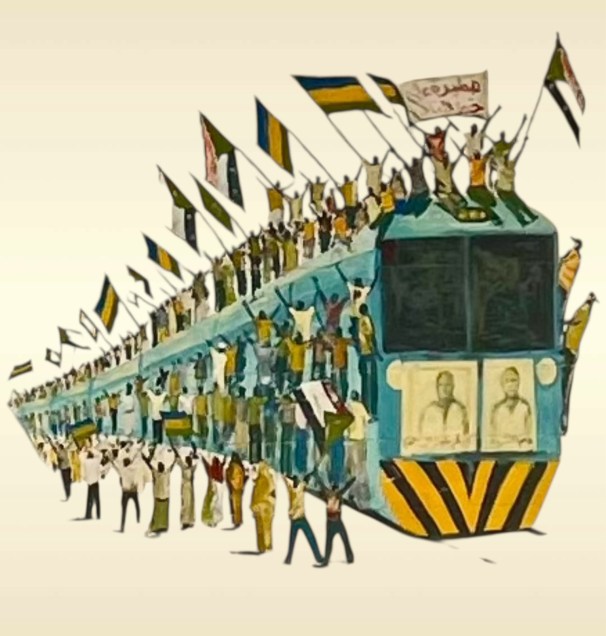
Hundreds of protestors rapturously greeted the arrival of the Atbara train into Khartoum on 23rd April, 2019. The train’s arrival coincided with a mass sit-in at the headquarters of the Armed Forces in the capital and did much to inspire and strengthen the capital’s protest movement’s resolve. The train, photographed below (Wikipedia CC), was overflowing with chanting and flag-waving Atbara supporters of the uprising. Freighted with symbolism, the train originating in the heartland of the country’s labour and trade union movement, evoked memories of the 1964 uprising.
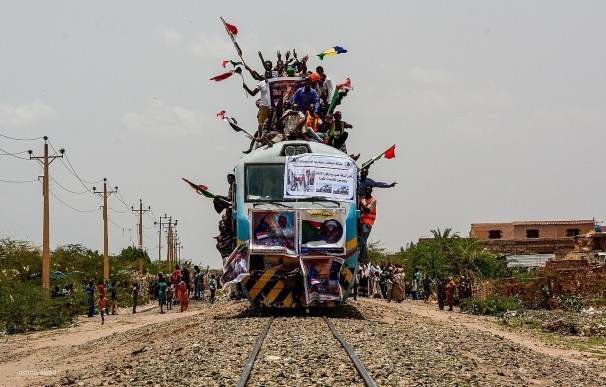
شرقت شرقت عطبرة مرقت
“One of the very first slogans of the third Sudanese revolution. It was shouted in the streets of Atbara from the first protests on 19 December 2018. Atbara, together with Damazin, was one of the first towns to rise up because of its tradition of working class struggles, which had endured since the colonial period. The slogan consists of the repetition of the verb شرقت [šaragat] “it (Atbara) glowed” followed by the sentence عطبرة مرقت [‘aṭbara maragat], which can be translated as “Atbara got out (in protest), Atbara arose”. It makes no political or socioeconomic demands; it is basically just a metaphor likening Atbara’s revolt to a rising sun. After the fall of ‘Omar Al- Bashir, the slogan was also used in Khartoum on 23 April 2019 to welcome the arrival of a huge parade (see موكب) leading thousands of protesters from Atbara to the Sudanese capital. Linguistically, شرقت شرقت عطبرة مرقت presents typical features of Sudanese Arabic, such as the use of the verb مرق [marag] “to go out” with the meaning of “to rise”. The slogan was also the title of a famous revolutionary song.” Glossary of the Third Sudanese Revolution).
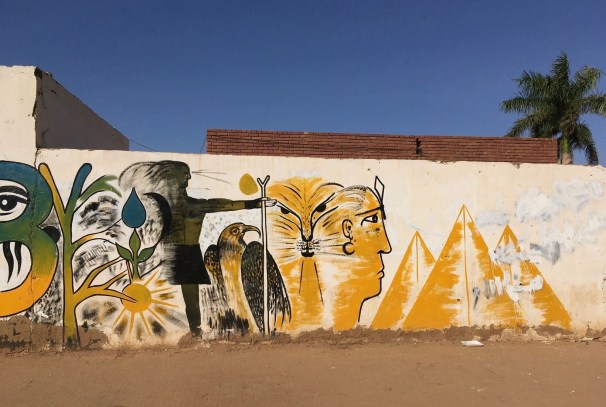
Below, some of the murals I saw from 2019 – 2022.
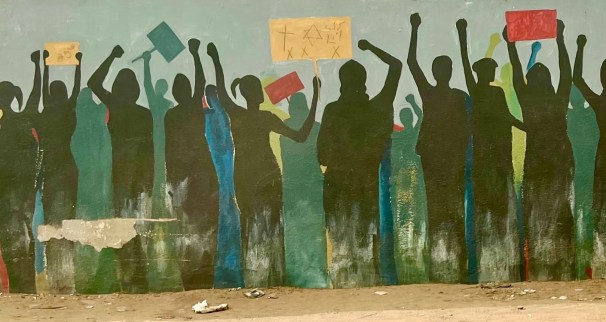
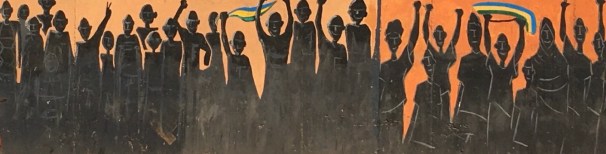
The symbolism, slogans and recurrent motifs in these murals will be discussed in detail in forthcoming articles. Among the most significant aspects of this artistic movement is the celebratory representation of the country’s diverse ethnicity, the re-interpretation of Sudan’s pre-Islamic civilizations in search of historical and cultural archetypes and the portrayal of men and women standing together in the struggle for what some advocates of the revolution saw as a new social order.
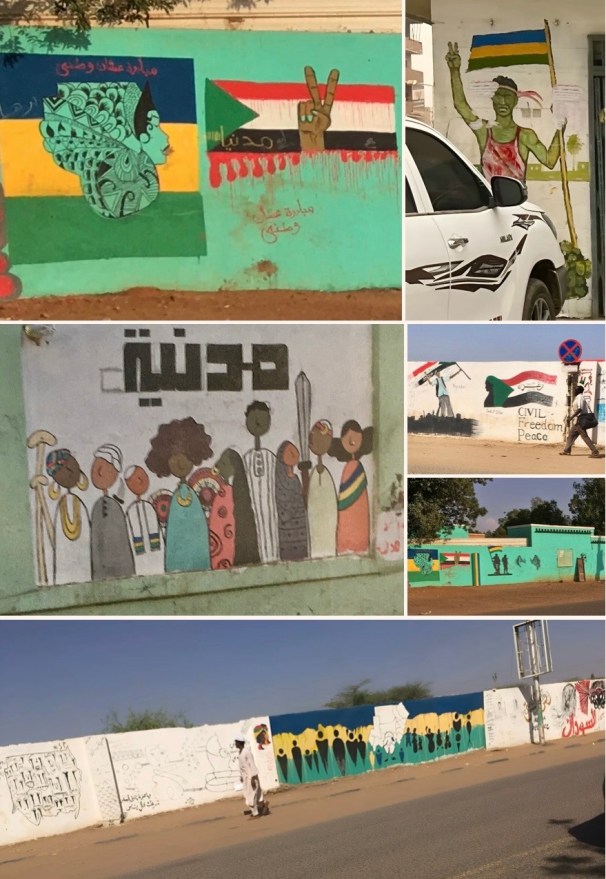
Tasqot (see above) includes a close-up of the black and white mural immediately above. The map of Sudan bristles with elongated, mask-like faces weeping streams of black tears while their mouths are marked with crosses for teeth, giving them a skull-like appearance. This work was created by Sannad Mohammad Sharif Alameen.
Above it left, a mural depicts the many diverse peoples of Sudan under the word madaniyya; civilian rule.
The figure depicted raising aloft a giant flag on the right, second from top, was based on a viral image of a protester wearing a backpack. He towers above the crowds cheering him on. See more of these Burri murals close up in Revolutionary Graffiti in Khartoum.
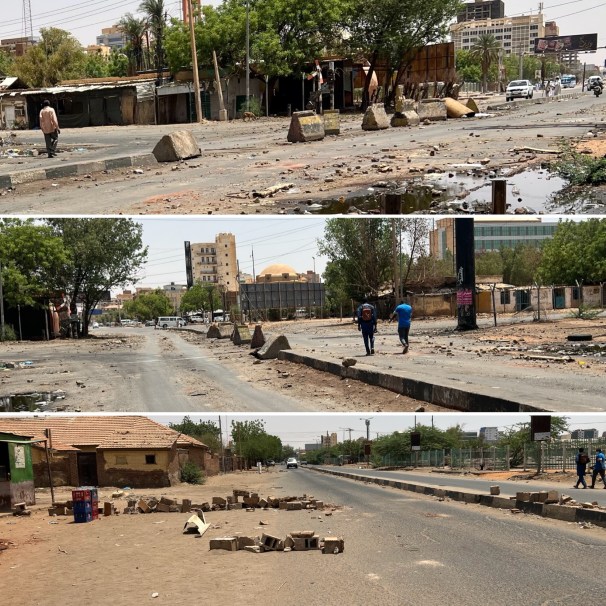
Below, the early morning aftermath of one of the many weekly mass demonstrations in Khartoum in 2022. The air was heavy with the acrid residues of teargas and burning tyres.
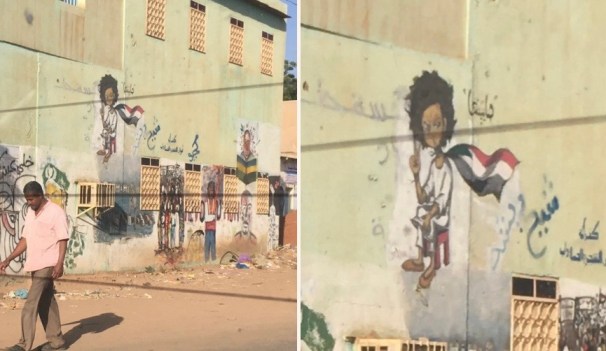
Below, image of the seated figure with Sudanese flag, by artist Amar Alamin Gamaa, and its visual context. It is claimed that the cartoon boy is a direct link to the Black Lives Matter movement, being the Sudanese version of an African American cartoon figure called Huey Freeman, from Aaron McGruder’s cartoon, The Boondocks. Huey is a young black hero figure, symbolizing the struggle for African American rights. The text above him reads Saabinahaa; we will stay cemented here, source: Revolutionary Graffiti in Khartoum. See a clearer and more detailed photo of this work in the link above.
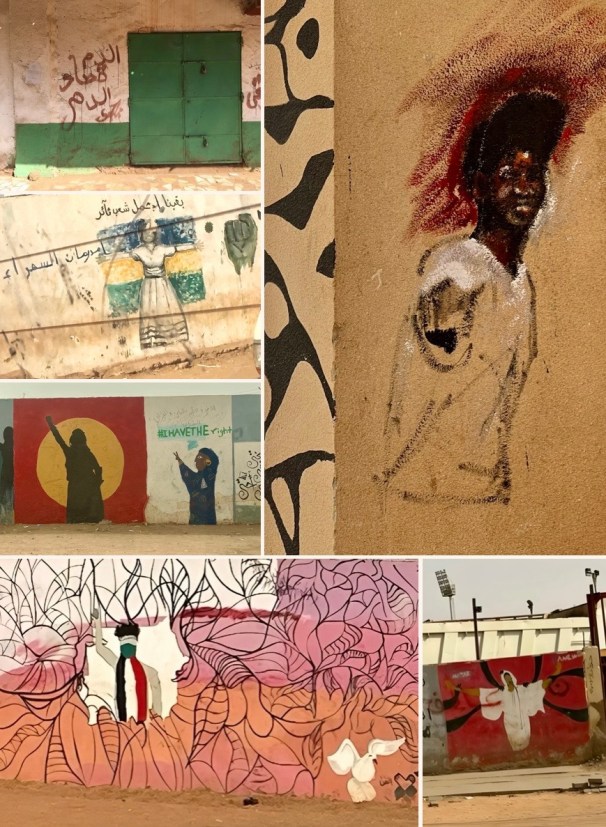
Above, top left, another slogan of the revolution; ad-damm guSaad ad-damm; blood in retribution for blood. This was not always understood as a call for violent revenge, rather a heartfelt roar for legal retribution and justice. This slogan became prevalent after the Khartoum massacre of June 3rd, 2019 and embodied the determination that the blood of the protesters would not be shed in vain and those responsible must be brought to justice. The Glossary of the Third Sudanese Revolution explains that the phrase “Blood for blood. We don’t accept the blood price-ما بنقد الدملدم قصا ا الدية” is “traditionally used in reference to local practices of retaliation or reconciliation following murders. In the context of the revolution, it is interpreted either as a demand for judicial proceedings through the courts independently of Islamic and tribal values (which are both associated with the الدية[diya] “blood price” system) or as the desire to punish murderers with the death penalty.” Below it, the caption reads “We became the most beautiful of revolutionaries, artist unknown. Bottom right, one of many works decrying the abuse and violence against women.
Top right, it has been suggested but I have yet to verify that the young man depicted is Abdel Azim Abubakr, shot in the chest and killed while facing security forces in Omdurman. He became one of the most ironic martyrs of the revolution.
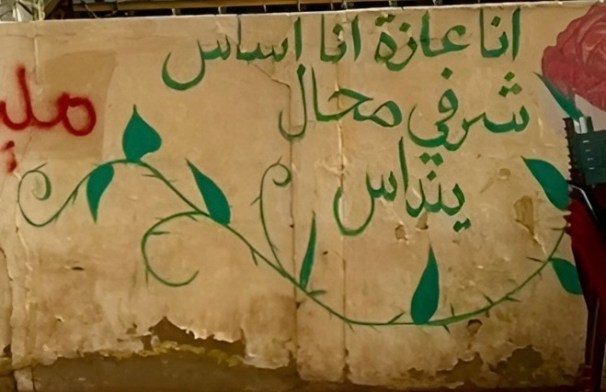
Below, the word `azza refers to Sudan, not as geographical territory but rather a famous Sudanese national symbol embodying the nation; the beloved nation, the homeland. In the popular patriotic song “Azza fi Hawak”by poet Khalil Farah, Azza symbolizes Sudan and she is derived from a real person, Azza Mohammad Abdullah, wife of the hero Ali Abdel Latif, who led national women’s demonstrations in 1970. The slogan reads: I am `azza, the foundation of my honour cannot be trampled on. It may possibly also evoke the unbreakable self-respect and honour of women in general.
Martyrs Remembered
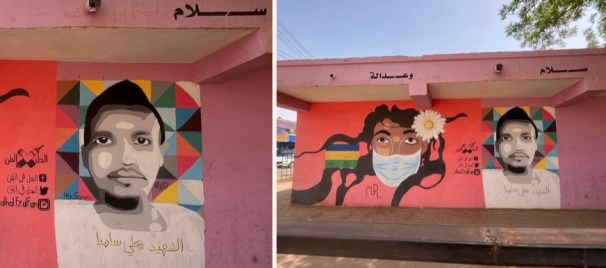
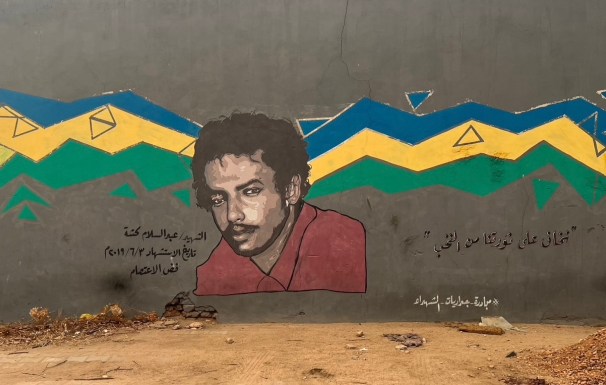
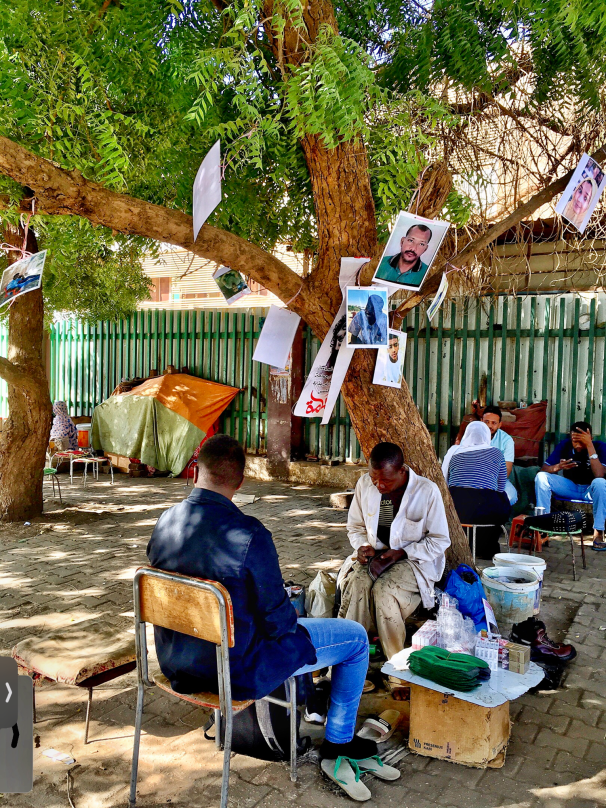
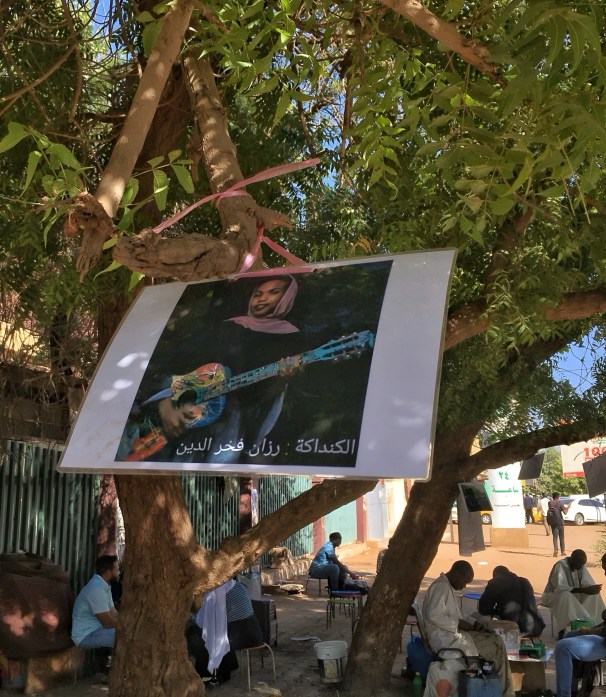
Below, Qasr Al-Nil Street, Khartoum; the martyrs’ tree at a street side cafe, Qasr Al-Nil.
See too Sing, O Khartoum, Sing Khartoum at Peace
 Women's literacy in Sudan