

The Magdarei and Jadla
NUUAR Media’s Tibyan Labiib Explains
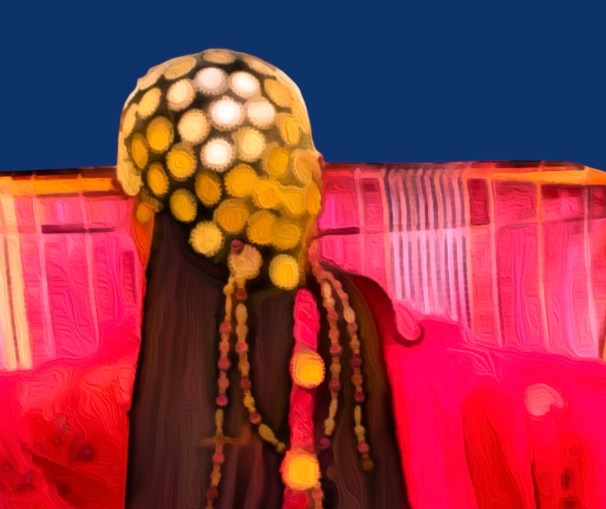
Above, sketch of a Sudanese bride, swathed in her red jirtig wedding toub and wearing her coin-encrusted jadla headdress. She holds up before her the tradition garmasis silk wedding wrap. Learn more about the fascinating customs surrounding northern Sudanese weddings in Anointing in Robes of Red and Gold and Anointing in Red and Gold: Update.
Below, a colonial-era photograph of of young woman in Omdurman performing the Sudanese pigeon dance (personal collection). The braiding and dressing of hair and the celebration of flowing locks in wedding rituals hold deep-rooted cultural and sociological significance. You can read a detailed exploration of these in Hair Braiding in Northern Sudan Part 1 and Hair Braiding in Northern Sudan 2
See too Combs and Ashes

For examples of Beja men’s hair dressing, see The Khulāl.
Below, the beautiful work of ghadamalikk_art.
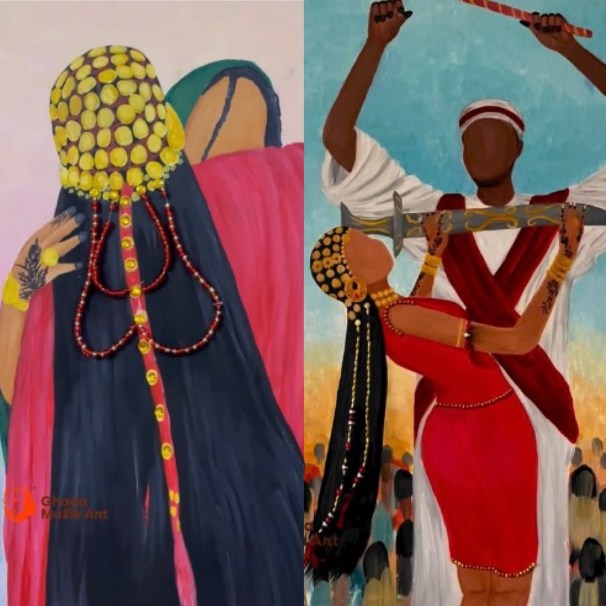
O mother of the bride here we come / Bringing silk for threading the netted ornaments / ; Bridegroom’s “Shayla” song recorded by Abdulla El Tayib in Changing Customs of the Sudan.
The Magdarei and Jadla
In the engaging video embedded left (subtitled in English), NUUAR Media’s culture expert Tibyan Labiib explores the fascinating craft and symbolism of the magdarei and jadla in northern Sudanese jirtig wedding rituals.
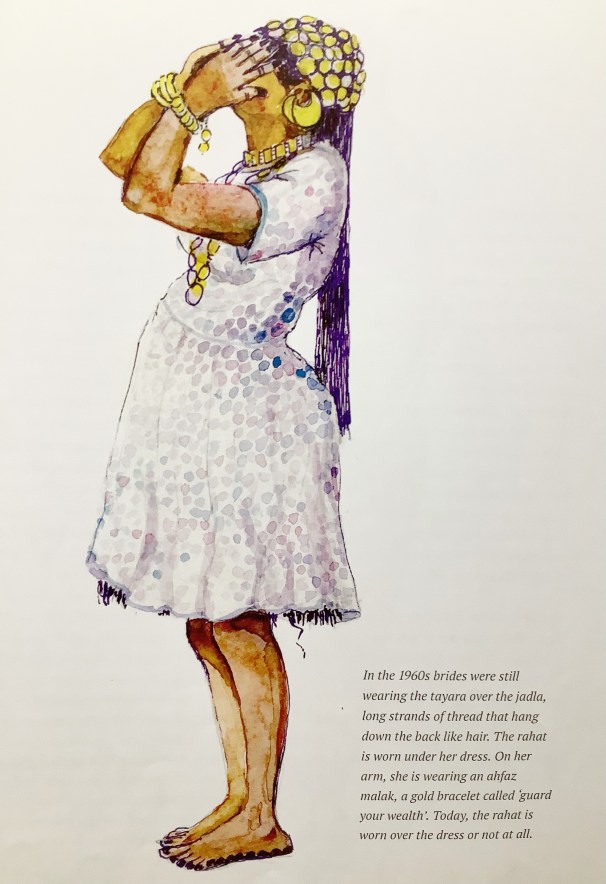
The magdarei are glossy strands of black silk that were once hand-stitched together to create a flowing mane of thick locks that cascade down the bride’s back. The threads are sewn onto a cap of netting and embellished with sparkling coins and golden threads. Griselda El Tayib refers to these as a tayara, from the English word tiara. The headdress and silk hair piece as a whole is sometimes referred as the jadla and offsets the scarlet jirtig toub to stunning effect (see below).
Writing on wedding customs of the Riverain Sudanese, Griselda El Tayib relates that in the 1950s the bride’s hair “was very finely plaited in micro plaits very close to the scalp. At the centre of the back of the head some of these plaits were passed through a gold ring, and strands of black silk were plaited into this bunch and hung down her back as far as her buttocks.” In her accounts she refers to this tassel as the jadla. She goes on: “The rest of her hair reached her shoulders and the last two inches of each plait were teased into the rashsha style.”
“The front of the hair, which was parted in the middle, was covered on each side by a row of four gold coins called rigan al-sharif. The rest of her head was covered by a cap of gold coins joined by black netted silk called the mashabak, or a tagiya cap or the kafiyah. For the occasion the required amount of gold, which in this case was presented by the bridegroom, was taken to the goldsmith and beaten into imitation half sovereigns. From there it was taken to a special craftsman who fashioned it into a close-fitting network of coins. Later one of the bride’s attendants fixed it firmly by needle and black thread to the plaits of the bride’s hair.” (Griselda El Tayib, Regional Folk Costumes of the Sudan, p141).
For more on the coins used see Nisreen Kuku’s Al Gineh
Professor Abdulla El Tayib tells us that among the gifts or “shayla” presented by the bridegroom to his bride, the kafaya or cap of gold was once the most prized, though he acknowledges that it is perhaps a step down from the ostentatious displays by those he deliciously describes as “bourgeois parvenus” of providing the bride with her weight in gold. He also offers a tantalizing hint at the age and origin of the magdarei; referring to an “innovation in hair fashion” in 1930s following the decline of rashsha plaits, “whereby the bride’s plaits were considerably lengthened by addition of Jursaih – artificial black silk threads which hung down straight and heavy well below her hips.” (Professor Abdulla El Tayib, Changing Customs of the Sudan).
Below, Griselda El Tayib’s illustration of a young bride adorned with the jadla.
Below, some stunning modern examples of the jadla, Pinterest, indicating that the tradition is still very much alive.
 Women's literacy in Sudan