

Ivory Adornment in Sudan
An Unholy Marriage – The Ivory and Slave Trades in Sudan
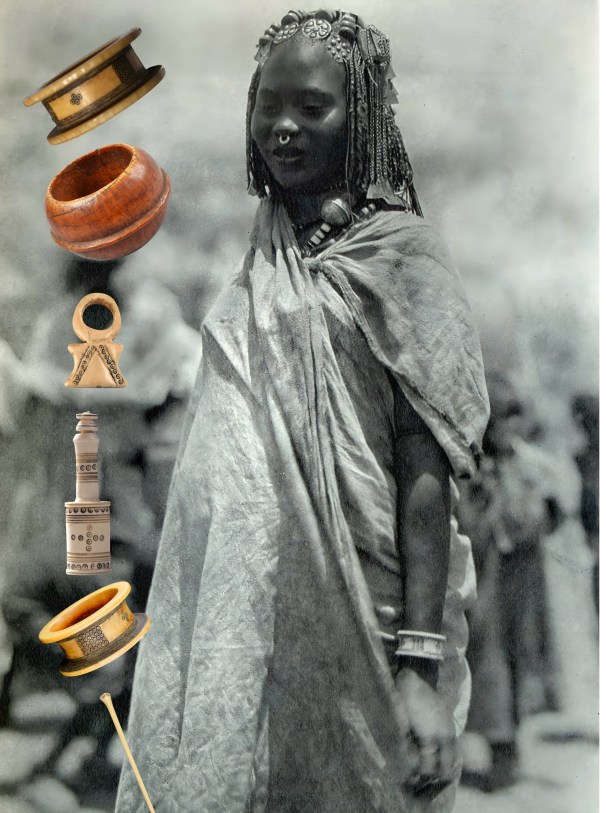
Above, a young woman of the Aulad Hamid people with her stunning tooled ivory cuff, possibly Darfuri in origin (photograph Der Dunkle Erdteil, 1930, personal collection). Insets; top left, a modern bone reproduction of a similar traditional Fur ivory cuff with its emblematic black pigmented motifs. Below it, a British Museum Trustees artifact image (also title illustration); a colonial-era Nilotic-made South Sudan man’s bracelet* with its rich wood-like patina achieved through age and wear, above an ivory ring from southern Sudan (Wikicommons). Traditionally worn as a symbol of status, these were often fashioned from broken bracelets (see more below). An exquisite example of a Darfuri khol container (Sotheby’s) follows, above another, but this time antique, Darfuri ivory cuff. Darfuri bracelets such as these were prized by and often traded among other Sudanese tribes. Another British Museum Trustees’s artifact image; a South Sudanese ornamental hairpin concludes the insets.
*links to more, copyright images.
Setting the Scene – From Ancient Times
The Ivory Carvers of Omdurman – Ivory Adornment in South Sudan
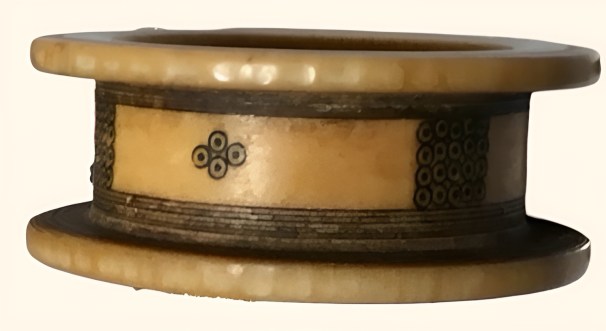
From Ancient Times
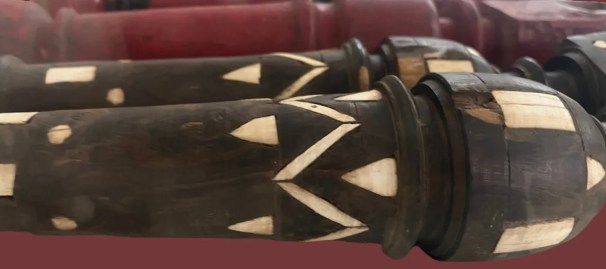
Above, ivory or bone inlaid 19th-early 20th century bed legs (Sudan Ethnographic Museum).

Ivory has long been associated with sacred rites of passage, authority and status among South Sudanese peoples. Across both Sudans, however, it is held to be a precious commodity. Finely crafted in weaponry, furniture and adornments for both men and women, ivory was offered as gifts to both appease and flatter sultans, foreign rulers and colonial adventurers. Passed down through the generations as treasured family heirlooms, it has been sought and crafted for millennia.
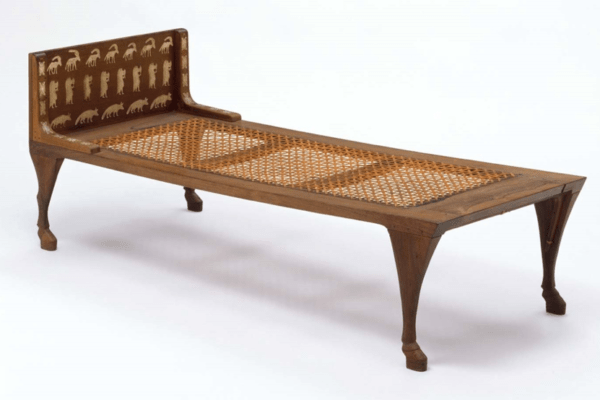
Ancient Sudanese civilizations, including those of Kerma, Napata and Meroe, prized ivory as a material symbol of prestige, power, wealth and divine blessing among their royalty and elites. Jewellery, amulets, daggers and receptacles bearing elephant and hippopotamus ivory have been unearthed from tombs dating from 2400 BC to 300 AD. Ivory inlaid cosmetics boxes and furniture have come to exemplify the immense wealth of Nubian kingdoms and their trading links with Egypt. The earliest known beds in Sudan are believed to come from Kerma and were decorated with ivory inlay in the form of animals and birds, A Short History of the Sudan (Up to A.D. 1500), Sudan Notes and Records.

It is thought that African ivory was long traded via ancient routes to Egypt, Greece and Rome. Ancient Nubian networks are believed to be the primary source of ivory for Southern Levant (1600-600 BC), followed by the trans-Saharan routes (800s AD).

Upper left, fine examples of colonial-era Sudanese `angareeb or traditional rope bed legs, carved and inlaid with ivory or bone, Sudan Ethnographic Museum, Khartoum, Imogen Thurbon; above right, The Kerma Bed, recreated. Learn more in The `Angareeb.
Left, turned ivory kohl pot, post – Meroitic / early medieval, sixth century, found inside a purpose-made leather pouch, complete with an iron spatula (British Museum Trustees images). Above right, the delicate craftsmanship of a late 19th-century Darfuri kohl dispenser in turned ivory (Sotheby’s). Learn more about the symbolism and rituals surrounding kohl in “Who will trace the kohl for our eyes?”
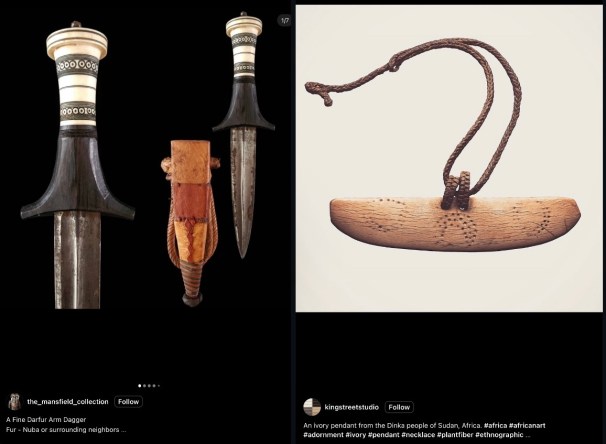
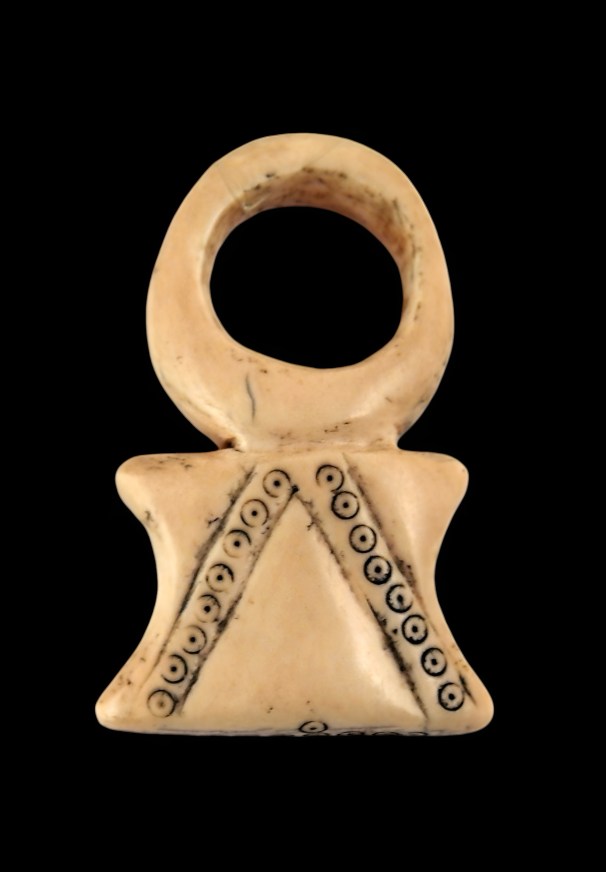
Below, left, a fine Darfuri or Nuba dagger with ivory hilt, The Mansfield Collection, right a Dinka ivory pendant, King Street Studio.
The Ivory Carvers of Omdurman
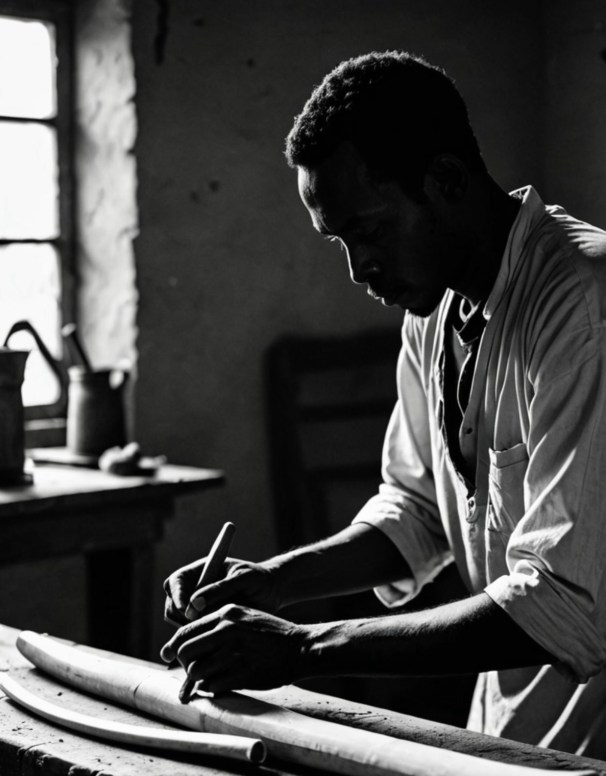
In the 19th and early 20th century the most prized ivory carving skills were those of Coptic craftsmen based in Khartoum and Omdurman, and the Sudanese artisans they mentored. Researcher Lucy Vigne (see below) refers to four main ivory carving families – all Asyuti Egyptian Copts – based in late 19th century Khartoum, creating designs appealing to British and European taste. The Copts have been renowned since pre-Islamic times in Egypt and Sudan for their artistry in ivory craftsmanship. See more on Sudan’s Christian heritage in Sudan’s Christian Heritage Looted.
Khartoum and Omdurman’s status as an ivory carving hub declined after World War II but would see an upsurge in the 1990s with the arrival of Chinese and South Korean workers. In 2017, Lucy Vigne recorded that “there were very few traditional carvers left in Omdurman using hand tools”, going on to explain “In Omdurman souk, one elderly carver demonstrated to me the hand tools for the making of bone and wood items, and another was repairing an old ivory bangle”. Vendors told her that the younger generation had turned away from the time-consuming labour of ivory carving, preferring to “drive cars or work with computers”. One of her informants; a vendor in his 70s, recalled with pride seeing tusks from south “as tall as a person” in his youth and claimed the finest tusks were once to be found in Khartoum, (A tale of two African cities – Ivory trade comparisons in Khartoum / Omdurman and Addis Ababa)
Ivory Adornment Among the Southern Sudanese

In South Sudan, ivory adornment in the form of pendants, earrings, rings, bracelets and armlets symbolize courage, status and beauty. They are viewed as an essential expression of identity among its pastoralist peoples and ivory jewellery would often be offered as wedding gifts and treasured across generations. Sudan Notes and Records (within Sudan Open Archive) provides numerous, fascinating and detailed accounts of adornments worn by southern tribes during the 19th and 20th centuries.
In A Note on Elephants and Elephant Hunting among the Nuer SNR Volume 26, 0 1945, we have a unique insight into the role elephant ivory played in Nuer communities. It was seen as a valuable commodity, fetching high prices in cattle though at the time of writing, the author claimed there had never been much external trade in ivory, with small quantities traded with Arab slave traders. He explains “what is now available is entirely for the manufacture of bracelets”, which were highly prized. The article provides a fascinating account of the rituals, spear-throwing skills and sheer courage involved in Nuer elephant hunting, the customs surrounding the burial of tusks and the distribution of ivory among community members.
Below, a Nuer hunter with his spear and striking upper armlet known as a cot (image Der Dunkle Erdteil, 1930, personal collection).
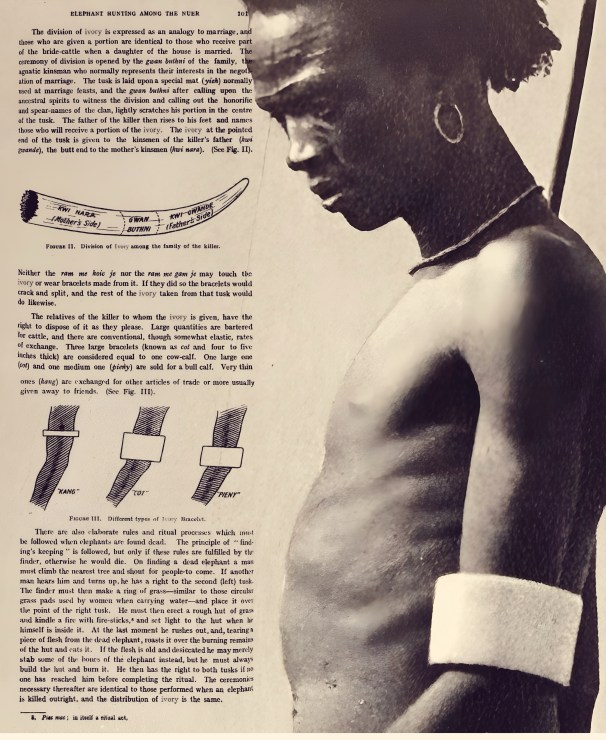
Insets, illustrations and text from A Note on Elephants and Elephant Hunting among the Nuer, outlining customs surrounding the disposal of the elephant and distribution of ivory.
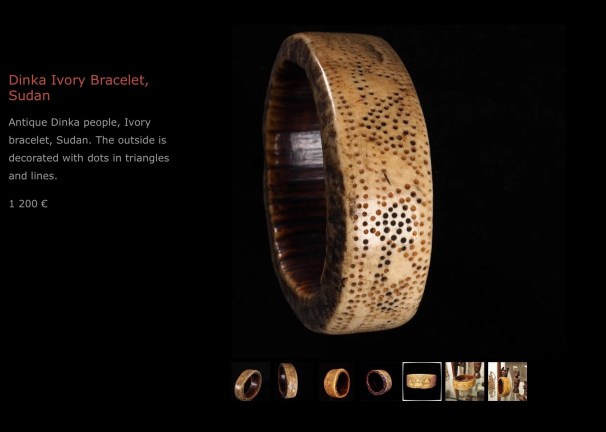
The Dinka people also have a rich heritage in carving ivory bracelets. Worn by herders and others as a symbol of courage and status, they were also worn by girls to show eligibility for marriage. Married Dinka women, it has been reported, would wear ivory earrings representing cow horns.
In The Raik Dinka of Bahr El Ghazal Province, SNR Volume 10, 0 1927, we have detailed descriptions of adornments such as ivory pendants, beading and bangles worn at the time, including this excerpt: “On his upper arm he will wear two big ivory bracelets which, with their wax lining to keep them in position, stand out two inches or so. These are occassionaly seen of wood or hippo hide. An Ivory pair is worth a medium-sized bull.” The account continues: “two more ivory armlets may be worn just above the elbow, or a light bangle or two of brass…” The account also makes mention of ivory rings.
Above left, a Dinka bracelet with dot and triangle motifs, Karlsson and Wickman.
Below, a stunning ivory trumpet, possibly the symbol of a clan chief, carved from a whole tusk, South Sudan, mid-1800s. From the Pitt River Museum, Southern Sudan Collection; see details here. A similar one is referenced in The Suri Tribe, SNR Volume 28, 0 1947
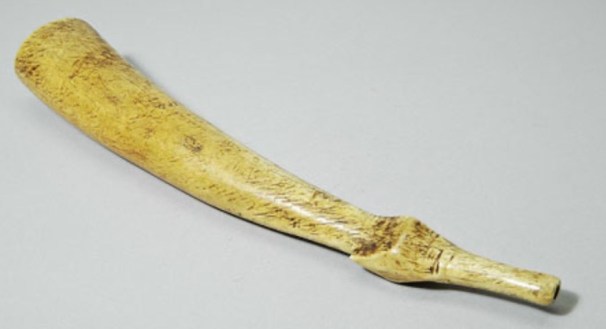
Ivory Adornment in Sudan
An Unholy Marriage – The Ivory and Slave Trades Then and Now
“The night formerly discordant with the creaking of sagia wheels was silent as death, and there was not a dog to howl for his lost master.” (SNR as below)
By the late 19th and early 20th centuries, Khartoum had evolved into a booming hub for what came to be a darkly symbiotic trade in two “products”; ivory and human beings. The sheer scale of the ivory trade in Sudan at that time was hinted at in Sudan Notes And Records article, The Story of Khartoum (SNR Volume 18, 0 1935): “There was scarcely a man in the place who was not interested in the traffic. Anybody who had money enough to equip a party, or the funds to furnish a station, could get into the ivory business, with such results that in 1862, 186,000 and in 1866, 180,000 kilogrammes of ivory were drawn from the Upper Nile region”.
The ivory trade’s unholy marriage to the slave trade, the latter’s crude practicalities and decimating cultural and economic impact – raids accomplished “with the greatest cruelty and wanton destruction”, is outlined in chilling form in the extract from the same article below.
Sudan Notes and Records, with over 300 references and detailed descriptions of the ivory trade in Sudan, is an uniquely valuable resource, reflecting the practices and attitudes of the time.
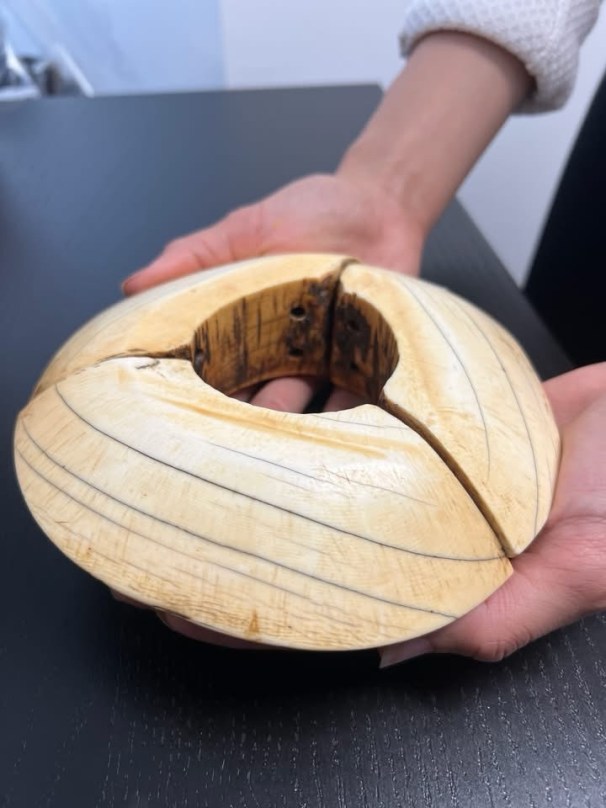
Right, a widely reproduced Facebook image from Ethnic Jewels Community, showing a 882g ivory Dinka bracelet from the early 1900s. Made up of three segments joined with plant fibre, this imposing piece would be worn upon the wrist, forearm or upper arm, depending on the wearer’s rank, age or ceremonial status.
Below, excerpt from The Story of Khartoum (as above)
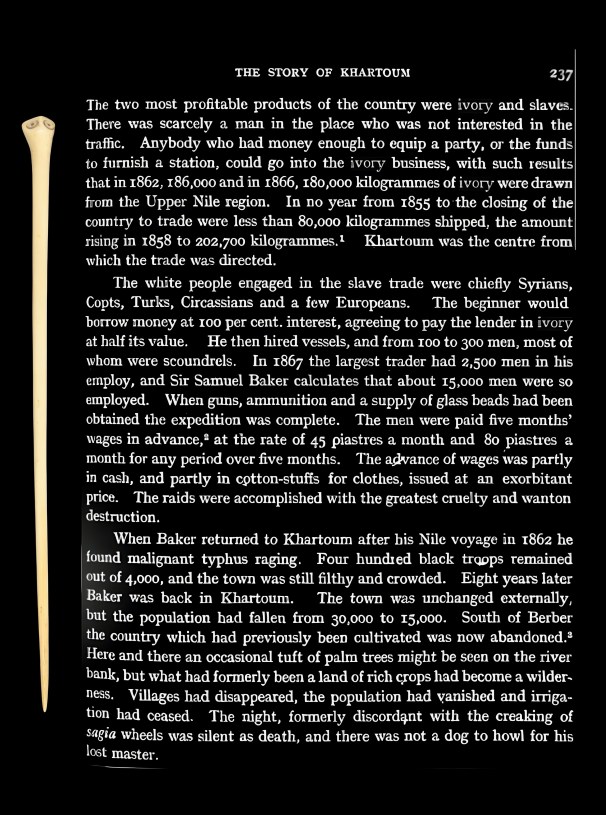
Illustration to the text below, from British Museum Trustees Collection; an ivory hair pin with black pigmented patterning from South Sudan.
Writing in 2017, Lucy Vigne offers a fascinating contemporary snapshot of the ivory trade in Khartoum and Omdurman, in her comparative analysis of regulatory policies adopted by the Sudanese and Ethiopian authorities (A tale of two African cities – Ivory trade comparisons in Khartoum / Omdurman and Addis Ababa). In 1976, vast herds of elephants – an estimated 133,000, still roamed Southern Sudan at a time when the boom in ivory exports led to extensive poaching. By 1992, herd numbers had shrunk to 40,000 (Lucy Vigne) and recent surveys (Wikipedia) suggest their current population to be no more than 2,500. Vigne noted that at the time she was researching, most elephant poaching was taking place in The Central African Republic. From there, The Republic of Congo and northern Gabon, the tusks would be smuggled often by armed Janjaweed militia forces into Sudan. Routed through Darfur, the ivory would end up in the black market hubs of Khartoum and Omdurman. She also observes that ivory was a resource leveraged by the military to “fund insurgencies”.
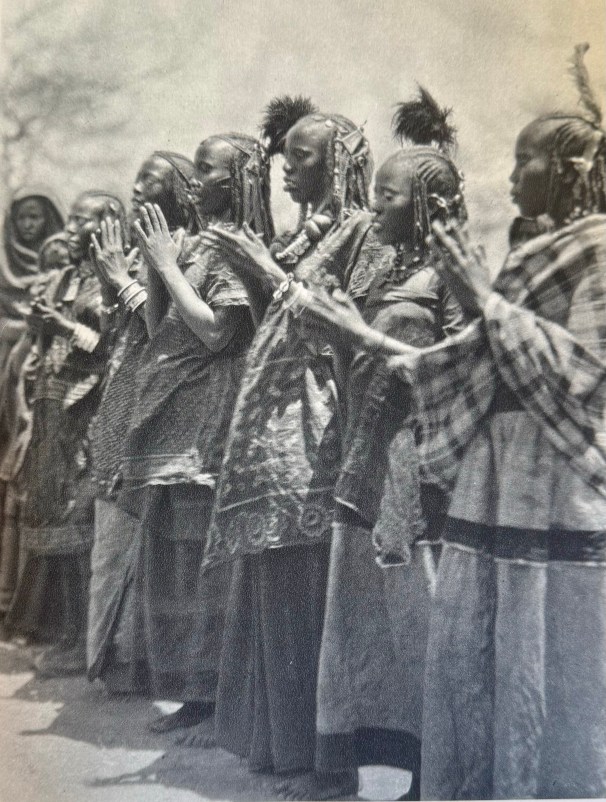
Right, Aulad Hamis women clapping time at a dance, wearing ivory cuffs, Der Dunkle Erdteil, 1930.
In 2017, Vigne documented the wholesale price for raw ivory as 279 US dollars for a 1-3 kg tusk, and referenced 36 souvenir shops displaying over 7000 items of ivory for sale, the vast majority being modern, rather than antique items, typically chopsticks, pendants and bangles aimed at Chinese customers; a market that declined substantially with the departure of Chinese workers following secession in 2011. One vendor she interviewed claimed the demand for chopsticks had decimated the elephant populations of the south, having led to the killing of calves.
Since the 1990 CITES ban on elephant ivory, the trade has declined, though poaching is tragically still rife. Camel bone, often from Darfur, is now the main substitute for carvings and items such as walking sticks.
Brief Historical Background
By the 1850s, Sudan Notes and Records reported, 130 tonnes of ivory were being exporting annually from Sudan. What had been a relatively decentralized and often locally consumed trade, especially among the Southern Sudanese, expanded to one of industrial scale exploitation as European demand for luxury goods such as ivory billiard balls and piano keys soared. By 1905, the chief exports of Darfur, for example, were ostrich feathers, ivory, pepper, rhino horn, tobacco, camels and cattle. Ivory and feathers alone commanded a royalty of 20% (A Darfur Compendium, A Review of the Geographical, Historical and Economic Background to Development in the Region, (2005 edition, 0 1985 Edition 02, Sudan Open Archive). Sudan Notes and Records, reviewing the history of Suakin, gives us an insight into the export process: “ivory used to be sent from Darfur and Kordofan to Suakin where it was received by Englishmen or their Indian agents”. The article goes on to explain for the greater part, no customs duties were levied and the ivory was “taken out by small vessels and then to larger ships to India”, though it was also traded to Egypt and Europe. Ivory from Khartoum was shipped to London and arrived within six weeks, to be sold six months before ivory sent at the same time through the considerably cheaper Egypt / Suakin route, (SNR Volume 20, 0 1937 The Story of Suakin).
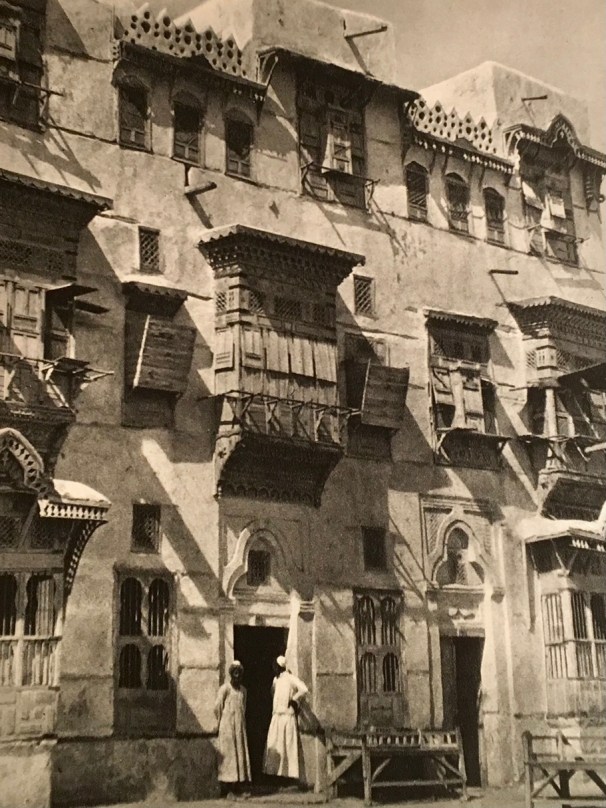
Above, Suakin scenes from Der Dunkle Erdteil, Atlantis Verlag Berlin, 1930. See more historical sketches in Historical Sketches – People and Places and Sketches from Sudan.
Most sources agree that thirst for ivory incentivized the long-existing slave trade in the region as the logistical demands inherent in the trade – the need to transport heavy tusks long distance to the coast for export, led to the enslaving of local populations in what has been called “cost-free porterage”. Several SNR correspondents note the destruction of societies the ivory trade brought in its wake in loss of cattle alone; citing the example of Slatin and his men who, in sending a thousand loads of ivory to Khartoum per year at one point, were consuming upwards of 5000 head of cattle in the same period. The harrowing account from The Story of Khartoum reproduced above is but one of many.
As elephant herds declined in the wake of a brutal hunting free-for-all, ivory traders increasingly turned to or expanded their existing participation in the slave trade as a lucrative substitute, weaponizing tribal rivalries in the pursuit of ivory and cattle to devastating effect in the process. Although European industrial-scale demand fueled both the ivory and slave trades, it was the expeditions of Muhammad Ali and the Turko-Egyptian invasion of 1820 that paved the way for waves of subsequent ivory traders and adventurers. Mohammad Ali’s conquest of Sudan, motivated primarily to exact taxes on the gold, slaves and ivory extracted there to fund his government, would have a devastating impact on the communities of the Bahr el Ghazal region in particular.
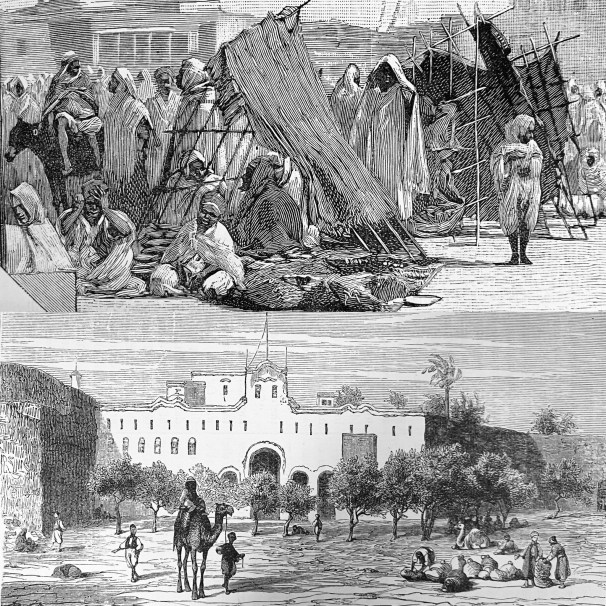
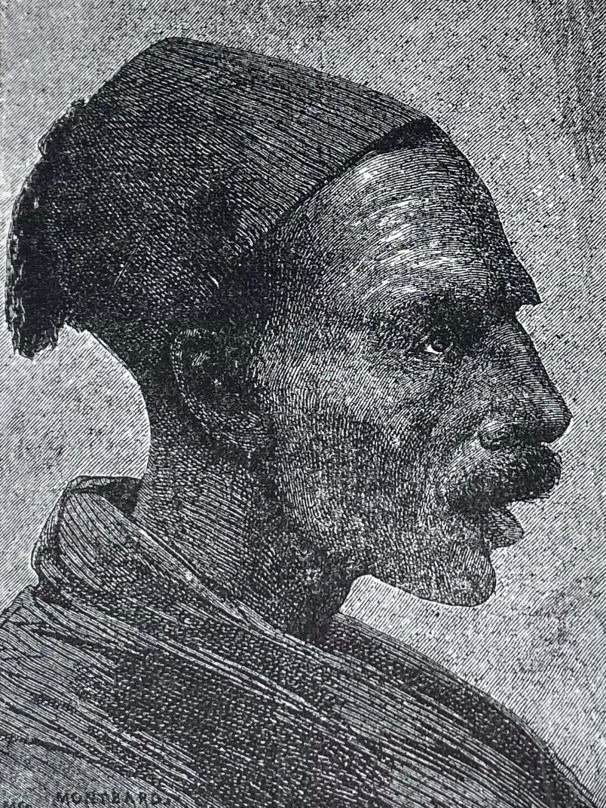
Above right, Khartoum scenes from The English in Egypt with the Life of General Gordon, 1898, below left, a sketch of Zubayr Pasha, same source.
The “zariba” system of fortified encampments, developed initially as bases for elephant hunting and the storage of tusks, rapidly doubled as bases for the violent capture, imprisonment and brutal execution of slaves as elephant herds declined. European, Turkish, Egyptian but also Sudanese slaver merchants and public dignitaries such as Zubayr Rahma Mansur built private empires in Bahr el Ghazal where the trade in ivory and people became indistinguishable. In addition to enslaving women and children, slavers would loot cattle, grain and ivory.
Perhaps the most compelling and tragic commentary on the fusion of the ivory and slave trades is that found in Travels in the Sudan in the Sixties: Letters from TH.V. Heuglin to Dr. Petermann (July, 1862-3) SNR Volume 24, 0 1941:
“When natives tired of glass beads a cheaper expedient to gain ivory was discovered.” Because of disputes, escorts increased and are now used in expeditions against some of the smaller tribes. “A caravan of such plunderers, often over 100 men strong, will surprise a village, cut down all those who attempt defence, and then transport both the humans and cattle they have taken to the next tribe, where they exchange them for elephant tusks”. These would “fetch such a high price that often 60 oxen are given for 50 to 60 lbs. of ivory. The large number of prisoners they make cannot be taken into Khartoum, for there the government and consuls are trying to put a stop to the “ivory” trade, but the traders have their ways and means; they dispose of their booty, before the slaver on its return journey has reached Turkish territory…”
 Women's literacy in Sudan
