

Birds of the Soul
Ibrahim El-Salahi – Pain Relief, held at the Saatchi Gallery, London, 2019
Setting the Scene
Bird of my soul, / be patient of thy cage / This body, lo! / how fast it wastes with age, Sultan Cem, 15th century.

Above, self portrait 2019, from the series Pain Relief at the Saatchi Gallery, London, 2019, (photographs taken with curators’ permission). Below, details from the Pain Relief series.


This is a cultural post for Women’s Education Partnership
Learn more about our literacy work in Community Literacy and About

If you are interested in Sudanese art, you might enjoy Forests and Spirits and Inscriptions on Rosewater

Above, more works from Pain Relief. Used envelopes, postmarks and braille from medicine packets are all incorporated into El-Salahi’s creative processes. The 88-year old artist suffers from chronic sciatica and back pain.
“The medicine packets are on the back of the of the images, so can’t be seen. This is just how the works came to be. I am not asking people to consider my suffering or endurance, just the imagery that comes out of it.” Interview with El-Salahi on Pain Relief
Birds of the Soul
The Bones of Letters – Letter, Prayer and Line
From Particle to Whole – Healing and Pain Relief, The Return of the Particle to the Whole
Birds of the Soul
Bird Symbology in El Salahi’s Work; Some Iconic Images

Detail from Self-Portrait above from the series Pain Relief, Saatchi Gallery, London, 2019.
“Freedom, justice, the conscience of the artist and his alter ego”*. El-Salahi returns again and again to the symbolism of birds in his work. As they gently alight on the huddled shoulders of the caged prisoner, they speak to the fractured soul, trailing with them echos of the miraculous, divine compassion, revelation and intelligence.
*source: interview with the artist by Salah M Hassan and Prison Notebook, A Visual Memoir by Salah M Hassan, A Visionary Modernist, p 93.
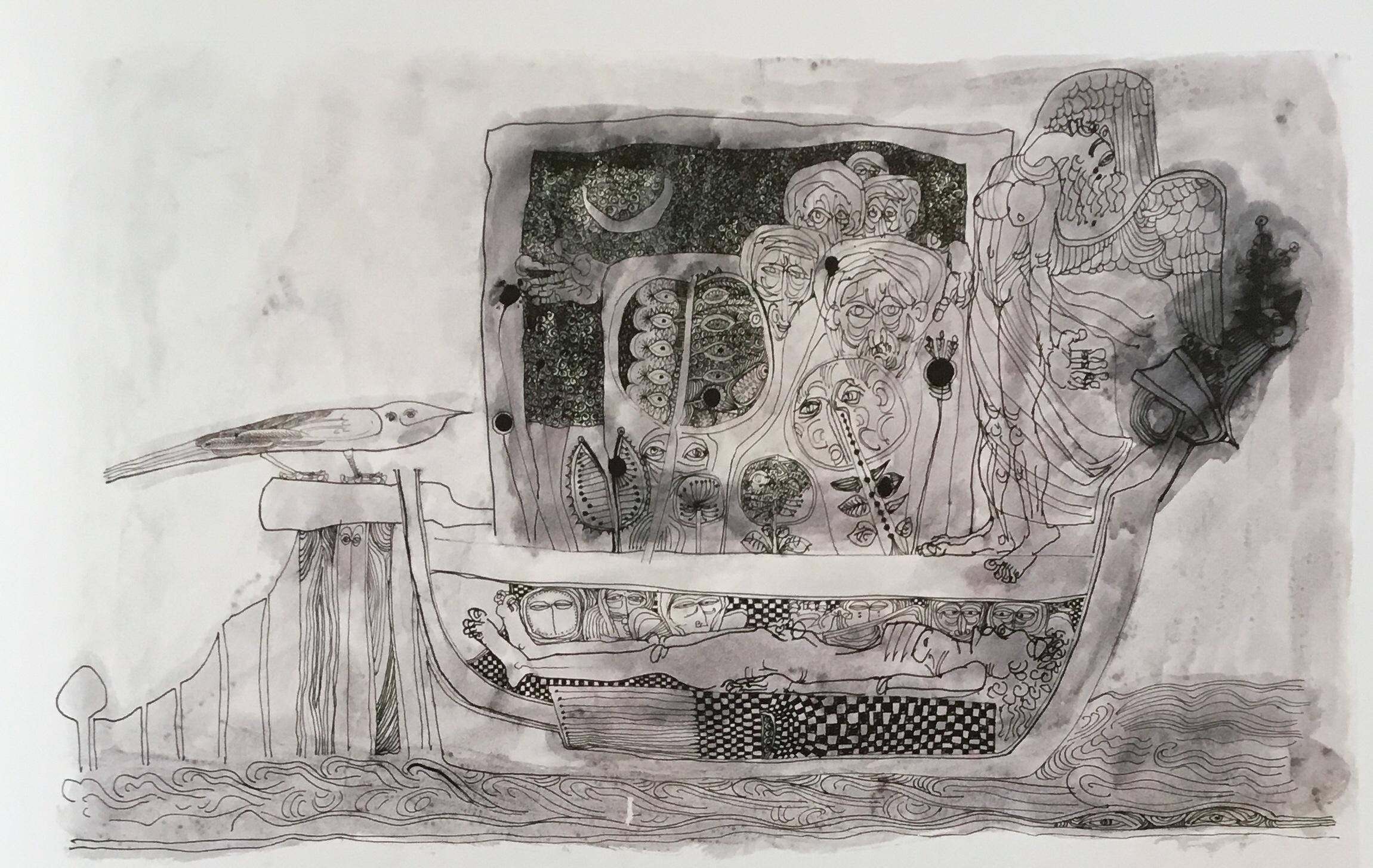
Above, from the series By His Will, We Teach Birds How to Fly,1969, artist’s collection, Vigo Gallery. Note the intent, sharp-eyed bird; witness, omen or blessing.
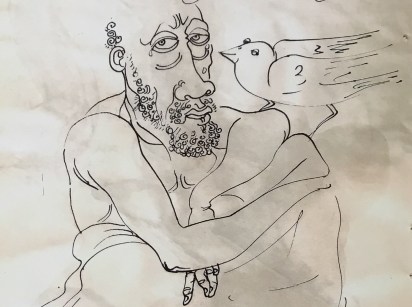
Above, detail from Self Portrait, Prison Notebook, capturing the hooded, tear-filled eyes of the caged prisoner. Islamic tradition condemns unnecessary caging of birds, making this scene perhaps even more poignant.
El-Salahi’s devout Sufi father had the habit of ” praying with his index fingers pointing outwards from his entwined hands, forming a shape that resembled the beak of the bird prevalent in his dreams” – Salah M Hasan in A Visual Memoir by Salah M Hassan, A Visionary Modernist.

From Pain Relief, Saatchi Gallery, London. Small drawing “nucleus” image later expanded to large scale silkscreen canvas. El-Salahi defines the nucleus as “a founding image of sorts, …… a kernel image”
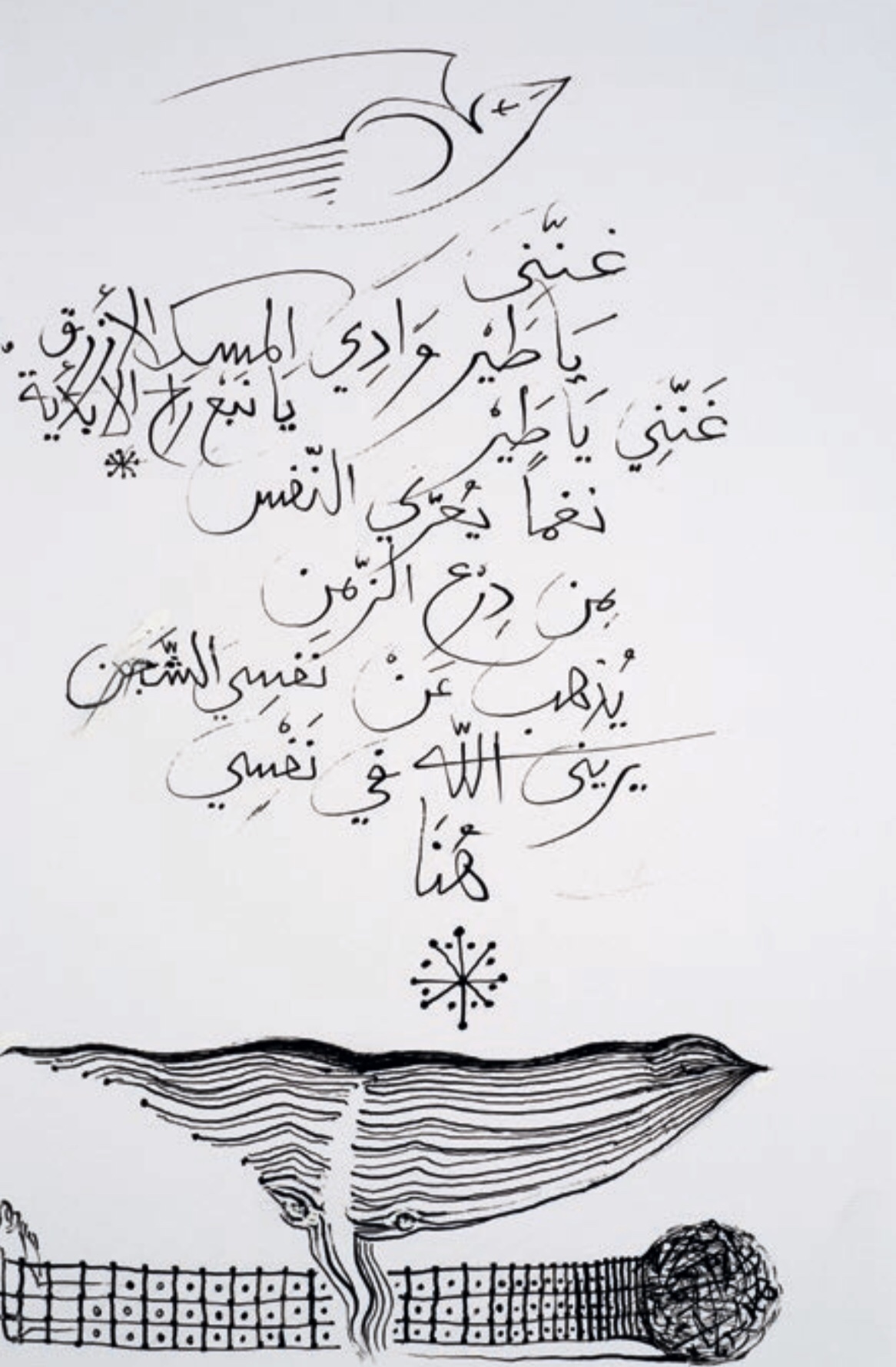
El-Salahi’s work explores the long tradition of zoomorphic Arabic calligraphy
From the series By His Will, We Teach Birds How to Fly 1969, Collection of Artist, reproduced in Vigo Gallery’s Ibrahim El-Salahi in Black and White.
Learn more on his black and white works in this short Youtube video.
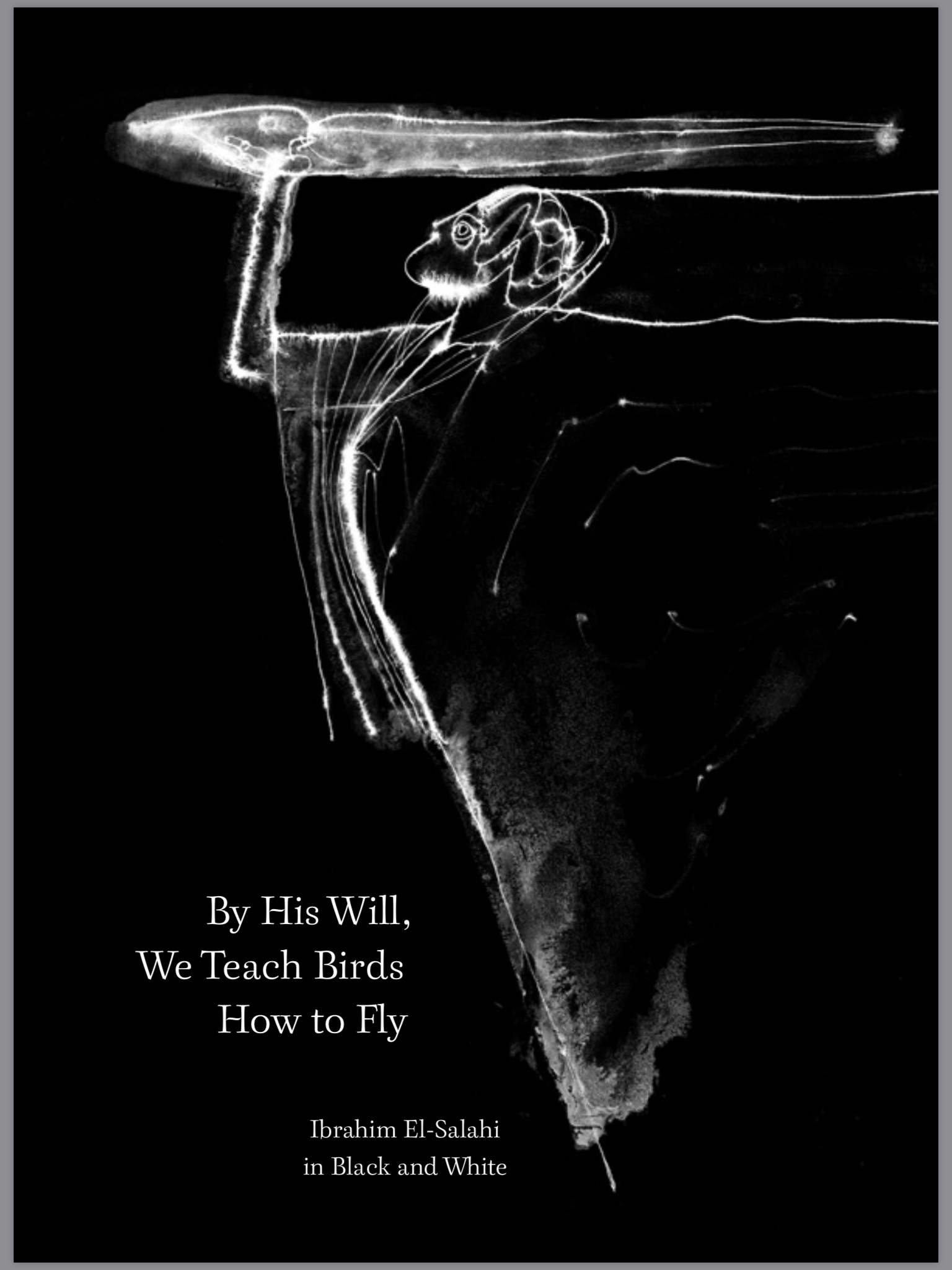
Seest thou not that Allah is He, Whom do glorify all those who are in heaven and the earth, and the birds with wings outspread? Each one knows its prayer and its glorification. And Allah is Knower of what they do” Holy Qur’an Chapter 24, verse 41

Holy Qur’an Chapter 16 Surat al-Nahl (The Bees), Verse 79 Translation Yusif Ali, a verse central to El-Salahi’s Sufi understanding of his faith and which he frequently quotes.

Dovecote near El Kurru, south of Karima, Sudan, Wikipedia
The Bones of Letters – Letter, Prayer and Line
“I limited my color scheme to sober tones ….In the next step I wrote letters and words that did not mean a thing. Then came a time when I felt I had to break down the bone of the letter, observing the space within a letter and the space between a letter and the other on the line. I wanted to see what was there and find out their basic components and origins.” (Referenced below)
Letter – In El-Salahi’s Words

The shape and textures of medicine packets with their braille inscriptions evoked the prayer boards of his childhood, El-Salahi, when interviewed about the exhibition.

From series By His Will We Teach the Birds How to Fly (see above)
Below, El-Salahi recalling his father transcribing the Holy Qur’an:
“I used to watch him drawing on a whitewashed surface with date palm kernels, some lines faultlessly straight, others fine, interlacing geometric forms …….He taught me to mix amar, the homemade ink used for transcribing – recipe of soot, gum arabic, and water left to ferment until it turned richly dark. He also showed me how to sharpen tumam grass and reeds into pens.
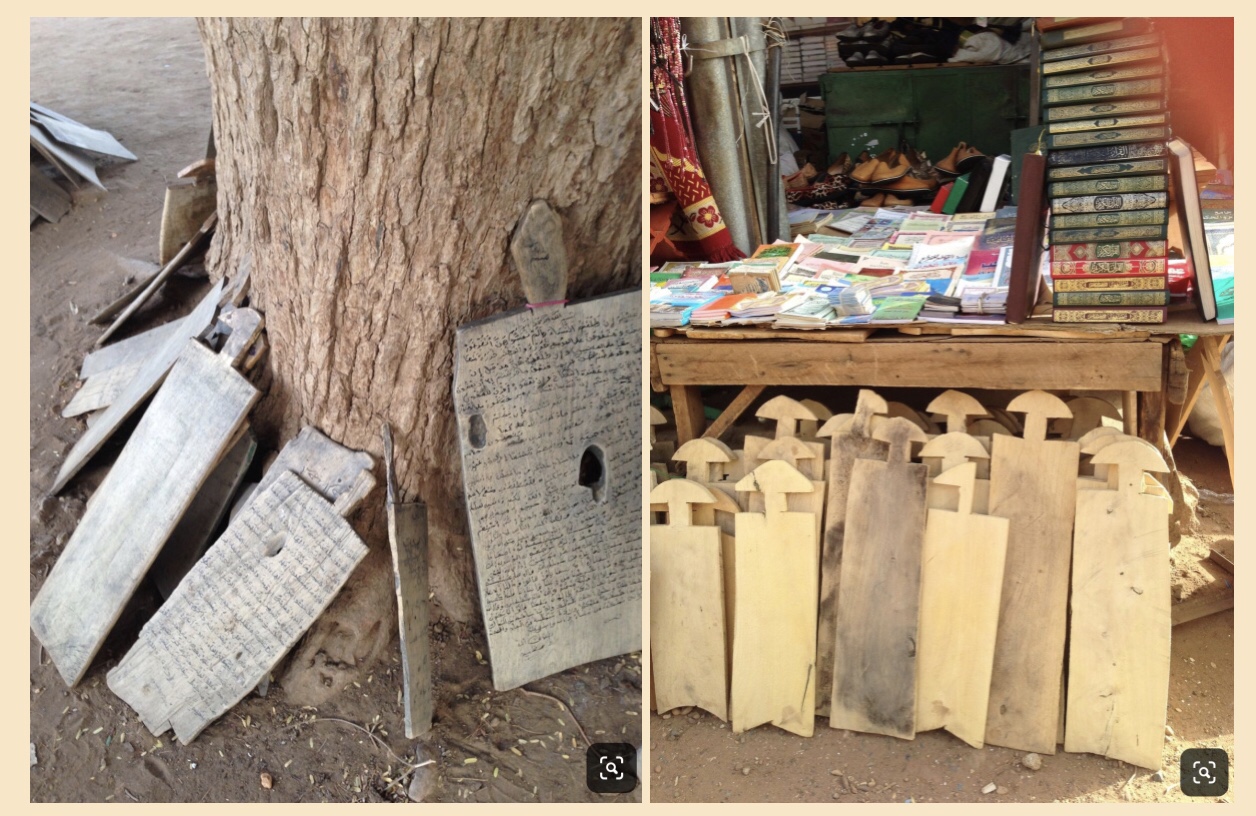
Sudanese prayer boards, photos Pinterest posted by Bibi Baloyra
“And finally I learnt to design and paint sharafa, tablets used for transcribing verses of the Qur’an. I would ornament my tablet by drawing a frame of intersecting vertical, horizontal, and diagonal lines, making triangles that we usually filled in with contrasting colors. In the centre of this frame we would write the open verses of a chapter of the holy Qur’an that we were to learn by heart.” The Artist in His Own Words, Ibrahim El-Salahi, Visionary Modernist, p 83
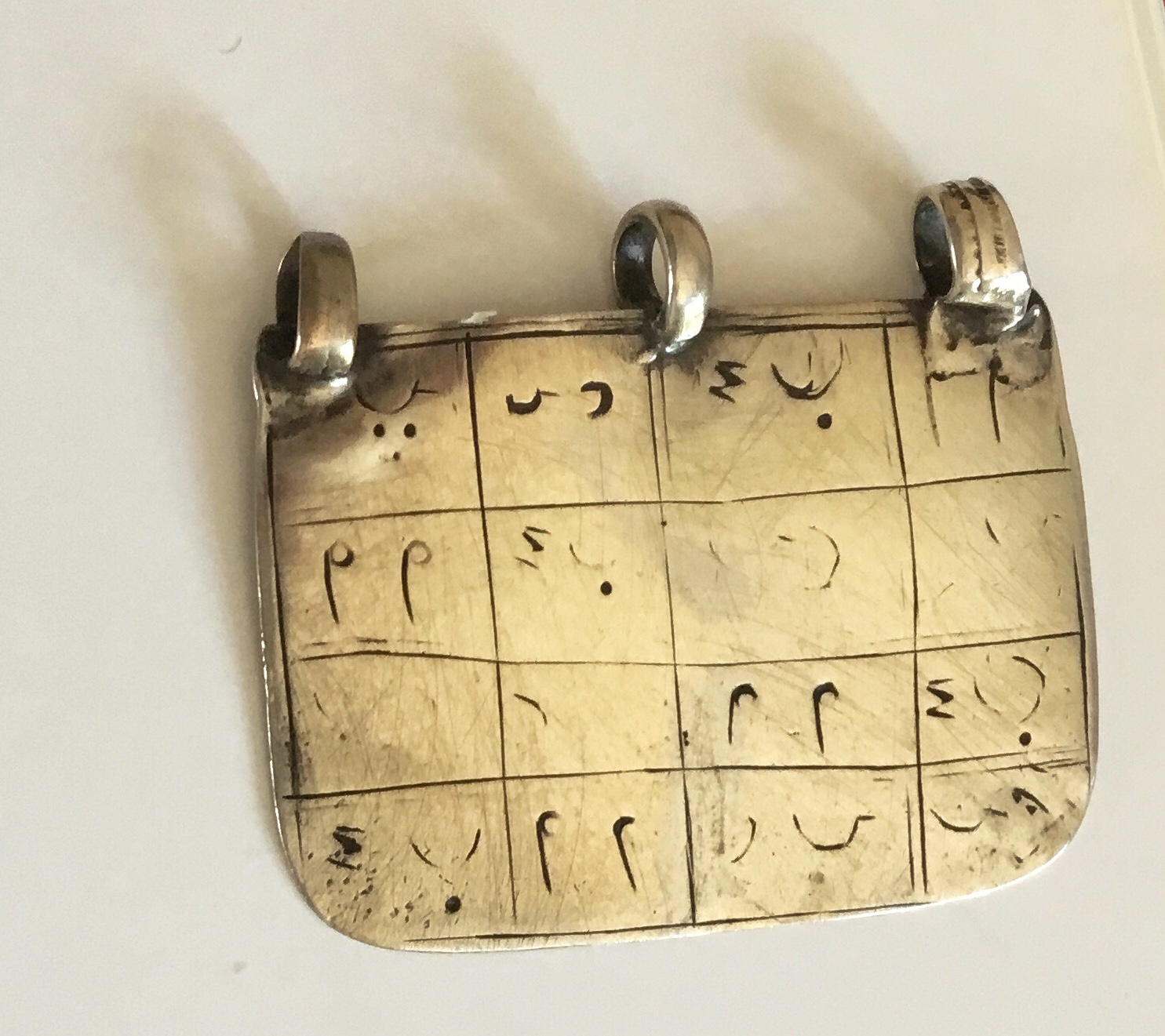
Above, talismanic pendent from Omdurman, 1980’s. Personal collection

Talismanic Qur’an Board, Omdurman, Khartoum, c.1922, Brooklyn Museum, CC.
El-Salahi’s rediscovery of Sudanese calligraphy after returning from studying abroad came as part of a quest to reconnect with Sudanese artistic sensibilities and reclaim the validity of Sudanese indigenous art and crafts and its creatures and landscapes as sources of artistic and spiritual inspiration.
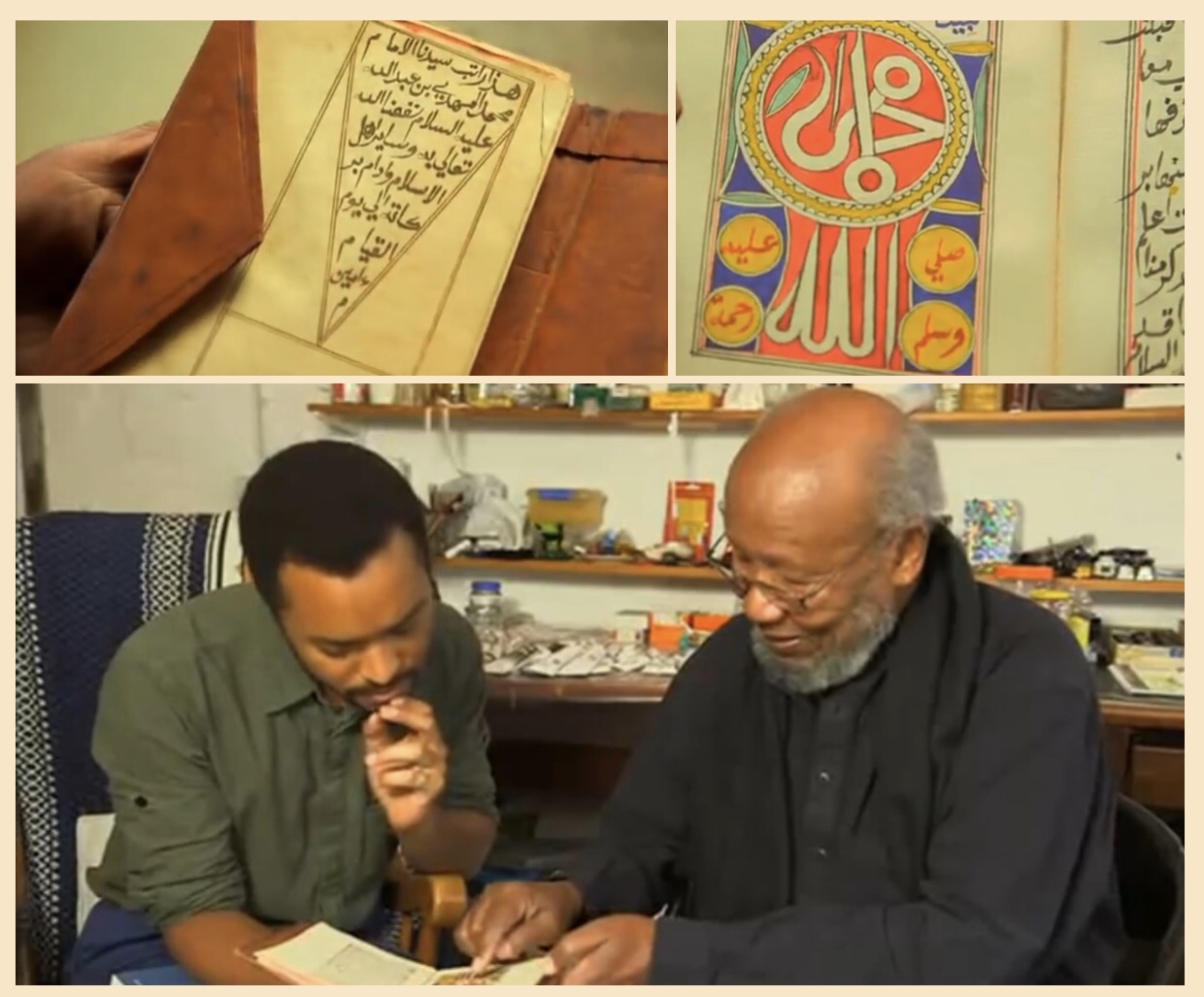
Screenshots from The Culture Show – Who Are You Calling an African Artist? showing the artist’s treasured Mahdist prayerbook. Sadly this video is no longer available.
“I limited my color scheme to sober tones ….In the next step I wrote letters and words that did not mean a thing. Then came a time when I felt I had to break down the bone of the letter, observing the space within a letter and the space between a letter and the other on the line. I wanted to see what was there and find out their basic components and origins.”
Ibrahim El-Salahi and Calligraphic Modernism in a Comparative Perspective, Ibrahim El-Salahi, Visionary Modernist, p 45
“It then became the beginning of of a new pictoral idiom…..abstract reference to animated forms, each with their own subjectivities, the voices of calligraphy.” In My Garment There is Nothing but God, Sarah Adams, Visionary Modernist, p 59

Above, one of El-Salahi’s early works, kept in storage in El-Salahi’s studio, screenshot from The Culture Show – Who are You Calling an African Artist? “For heaven’s sake, treat us as artists or leave us alone.” – El-Salahi rejecting simplistic “ethnicity” pigeonholing of African artists “We have been left out in the cold.” El-Salahi, speaking on African artists on the western-dominated international art stage
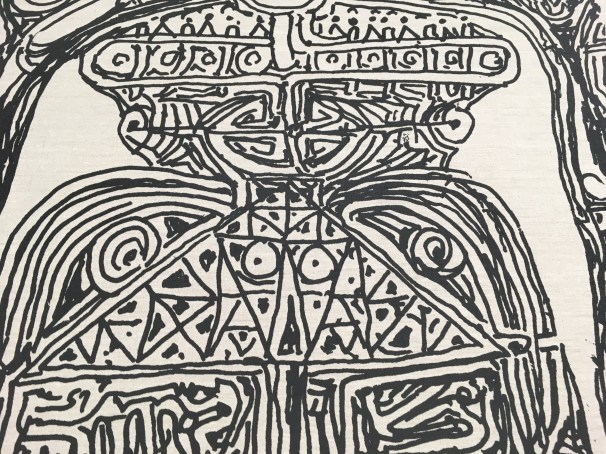
Detail from Pain Relief series, Saatchi Gallery
“There the Pandora’s box opened up wide before my eyes …….in place of those broken up letters I discovered animal and plant forms, sounds, human images, and what looked like skeletons with masked faces.” Ibrahim El-Salahi and Calligraphic Modernism in a Comparative Perspective, Visionary Modernist, p45
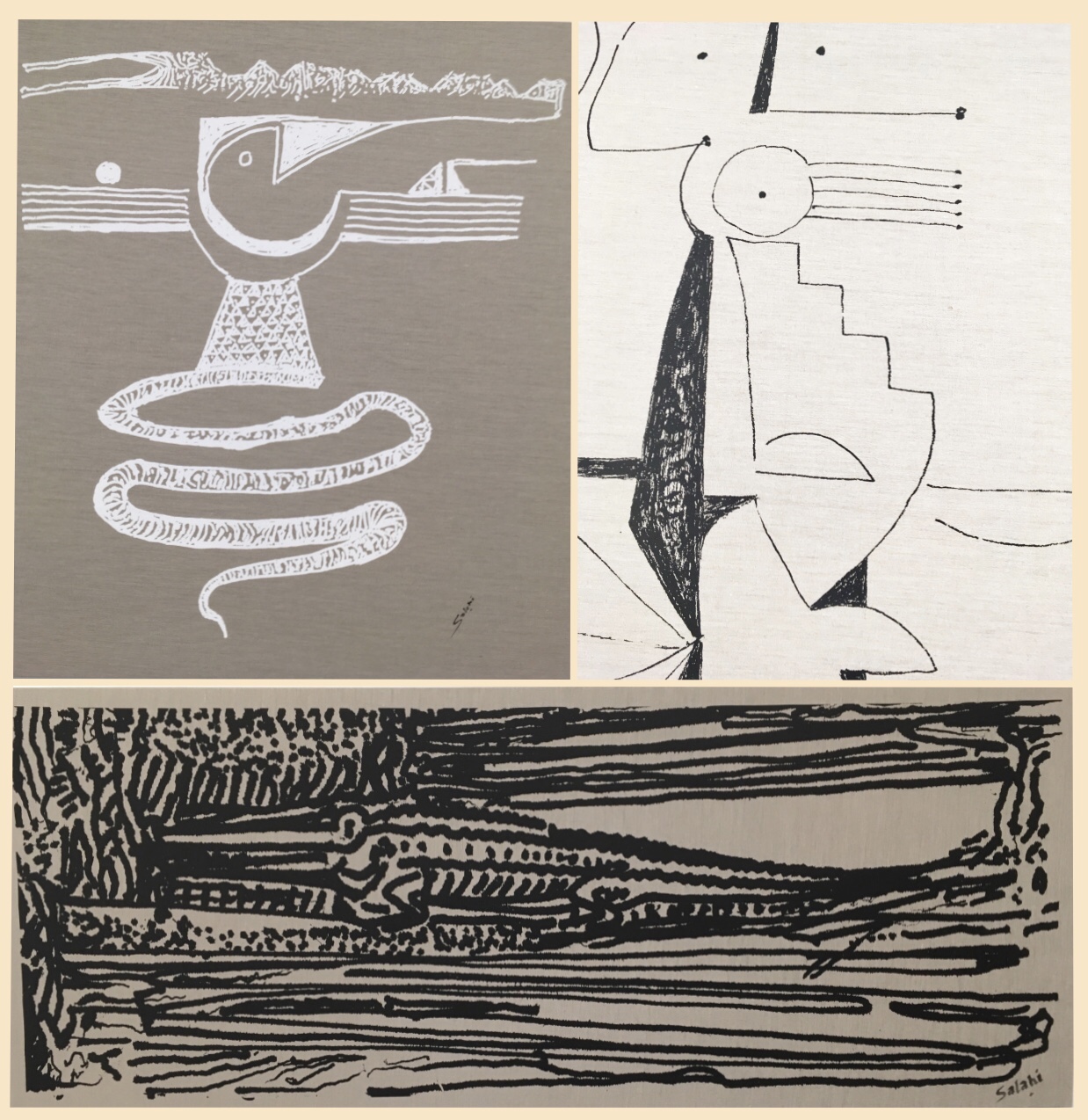

From the series Pain Relief, Saatchi Gallery, London
“The archaic imagery, hidden, coming through you from the unknown, and allowing you to glimpse it briefly, has to be wedded to the things you have learned, the things that you see and feel.” Ibrahim El-Salahi, Visionary Modernist, p 111
In Sudan “there is such glare that you have to half close your eyes – only at certain times of the year can you open your eyes fully. So in Sudan your impressions are almost half-seen, but I feel them through another eye; I know it by experience of another kind.” Ibrahim El-Salahi Interviewed by Ulli Beier, Visionary Modernist, p 105

Funeral and the Crescent, 1963
“Alternatively these elongated, black-eyed, glittering facial shapes might represent the veils our mothers and grandmothers used to wear in public, or the faces of the drummers and tambourine players I had seen circle wildly during funeral ceremonies…or maybe they evoked the reciters of the holy Qur’an, invoking Allah and chanting the Sufi poems of El Burag, again during the funeral ceremonies, once the dead had been entombed, in the vain hope of making him sit up and listen.” Visionary Modernist, p 84
In England my eyes are fully open; it is a gray world, old houses, dark, sooty. The appearance of things is rather haunting. I took it all in, but never did anything about it in London. It surfaced later on; it’s almost like regurgitating. Visionary Modernist, p 105
Ibrahim El-Salahi Interviewed by Ulli Beier, Ibrahim El-Salahi, Visionary Modernist, p 108
The Bones of Letters – Letter, Prayer and Line
Prayer
El-Salahi’s profound faith is central to his understanding of artistic creativity and the rituals, discipline and meditative power of prayer in achieving the negation of self and body inform all his work. See Sarah Adams, In My Garment There is Nothing but God, Ibrahim El-Salahi, Visionary Modernist.
“It is that moment in prayer / In silence we feel / We were there / Where things begin in his name / To make real sense / No more no less” – Ibrahim El-Salahi, 2016, quoted by Vigo Gallery (link unavailable).
“I find that when I come to paint I do exactly the same. I always wash. I have to come clean outside which leads to cleanliness within. And then I work. So for me, and for us as Muslims, any action we do is supposed to be in the name of Allah.”

“Many times I have said this to people – I realize the work comes through me. And I am not the originator. It is originated by someone else – which is Allah, which is my God. And I have little bits. Sometimes the window opens and I can see things. I can follow them if I can clean, if I am not the window is closed and I don’t see it” Ibrahim El-Salahi A Visionary Modernist, p 57
“I know that I draw on an unwavering spiritual origin in which I resolutely believe. I rely on and submit to the metaphysical and the invisible as ways to gain access to the hidden chambers of my innermost self.”
The Bones of Letters – Letter, Prayer and Line
Line
El-Salahi sees the acacia wood prayer board as an abstract representation of human body and in his artistic journey has moved ever more towards a modernist “paring back to abstraction” of natural forms. This is powerfully expressed in his haraz tree series below:
“but I am still leaning my back against calligraphy because I find it is something which is very very stable. It’s almost like trees growing. (Looks outside the window to the tree in the garden) – when I see trees growing, you can see the calligraphic shape in them.” Visionary Modernist, p 59
“I don’t know if it has to do with my age…….it just became vertical lines, lines as if joining the roots of earth and the branches of heaven, just between the two. I find it very restful because it it goes along with my idea of meditation.” Visionary Modernist, p 63
Below, from the Pain Relief series, Saatchi Gallery, London

From Particle to Whole – Healing and Pain Relief, The Return of the Particle to the Whole
Healing
“I was often quite ill in those days. I used to feel dizzy, I vomited quite often, I had headaches. I decided I would try and cure myself just by looking inside and telling myself that what was aching would stop aching. I really did cure myself just by sitting there very quietly.” El-Salahi recalling meditating in the desert in the 1960’s, Interviewed by Ulli Beier, Visionary Modernist, p 105
Meditation flowing through artistic creativity allows El-Salahi to lose himself as he works, seeking spiritual unity and glimpses of other, non-rational worlds:
“I often incorporate images from suffering past and present, personal or general, but these works are not, for the most part, literal. It’s about the act of drawing offering respite, not drawings about pain.”
Read more here: Interview with-Salahi on Pain Relief by Anna McNay

From Pain Relief series, Saatchi Gallery
“I often had these enticing glimpses of alien worlds when I was a child, and I still have them as an adult, when I left behind the rational pulse of the conscious mind. At these fleeting moments, I felt liberated from the shackles of the body. The past faded with the present, and I could see things that my rational mind had failed to fathom.” Ibrahim El-Salahi, A Visionary Modernist, Salah M. Hassan, 2012
“For a fleeting, irresolute moment, that essence flickers like lightning in one’s mind, where visual images intermingle with visions and dreams from whose components one creates a composite, a visual drama that gives vent to one’s passions ..”

The dissected rawness of pain in every sinew and vessel – From Pain Relief series. El-Salahi finds relief from chronic pain through his work.
From Particle to Whole
El-Salahi recalling his British tutor at Gordon Memorial College’s School of Design:
“I have never forgotten him finding me alone in a studio one day: he took a handful of sand, sprinkled it in a dusty heap on the bench next to me, and told me “draw that!” I broodingly sat there all day, examining the particles of sand and gravel and the bits of dry grass mixed in with them. it was a revelation, showing me what in the visual world had until then passed me by.” The Artist in His Own Words, Visionary Modernist, p 83
When falsely imprisoned in the mid-seventies, El-Salahi secretly drew on scraps of paper from food wrappings, which he later buried in the sand, never to be retrieved. These miniature works formed a creative process he was to adopt in later works and which can be seen in the Pain Relief exhibition –
“The nucleus, or the heart, which locates agency and and selfhood in the heart, not the head, tells him if there is more to be added on the top, left, sides and so forth. In short the nucleus-as-heart presages the rest of the work – it directs the construction of its own body.”In My Garment There is Nothing but God: The Work of Ibrahim El-Salahi, Visionary Modernist, p 55
This approach led to what Salah M Hassan defines as El-Salahi’s “organic growth” theory of his work:
“The work unfolds like a fetus growing in some unfathomable womb. Its ultimate shape is impossible to grasp or imagine at the process’s start.” Ibrahim El-Salahi, Visonary Modernist, p 89
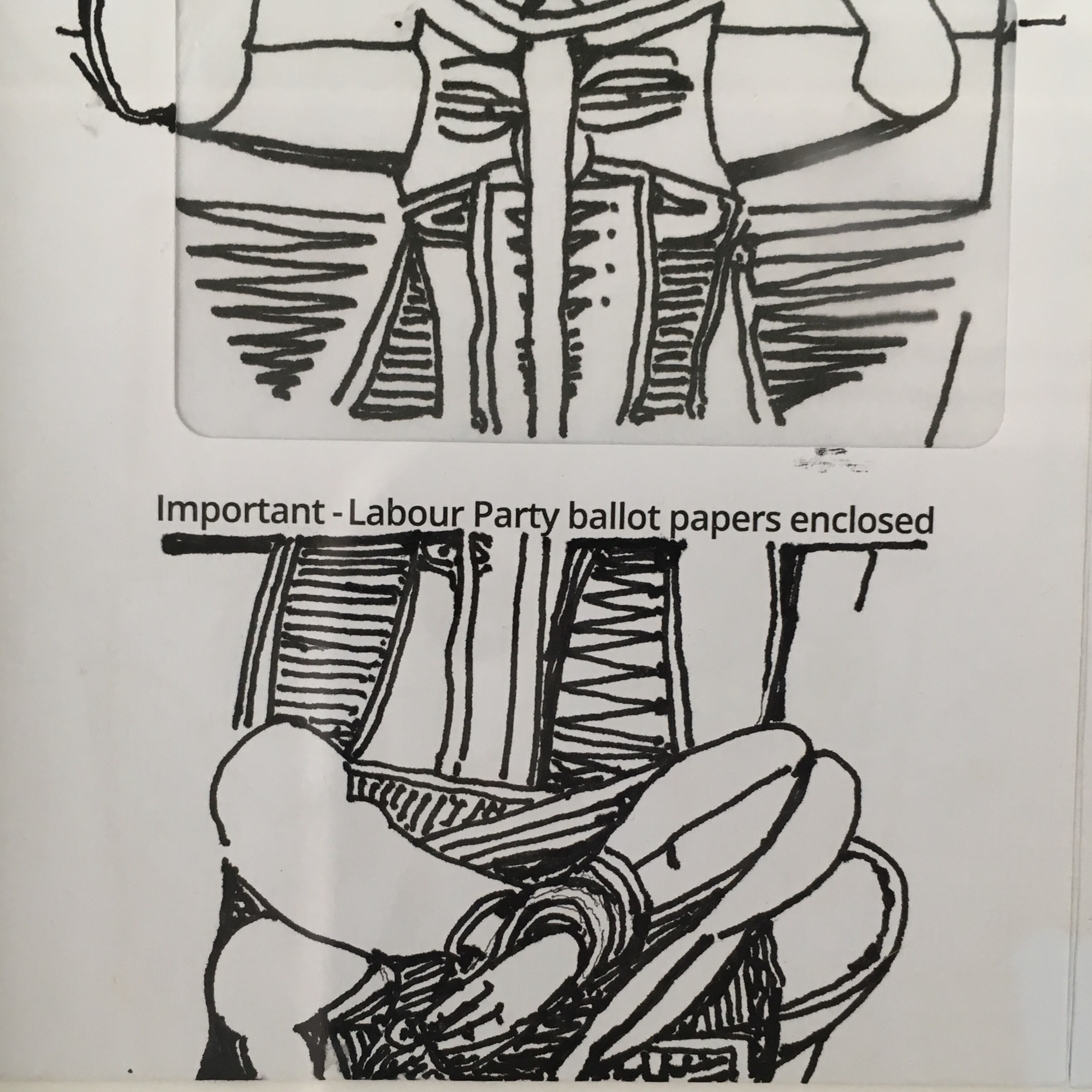
“El-Salahi feels compelled to frame the individual sections when they are completed in order to silence and control them, to quiet their demanding voices”, Visionary Modernist, p 58

Above, the process of converting kernel images to large scale works from Interview with-Salahi on Pain Relief by Anna McNay.
 Women's literacy in Sudan