

In Conversation with Nisreen Kuku
Sudanese Jewelry Designer and Expert Conservator
Conserving Sudan’s Timeless Treasures Part 2

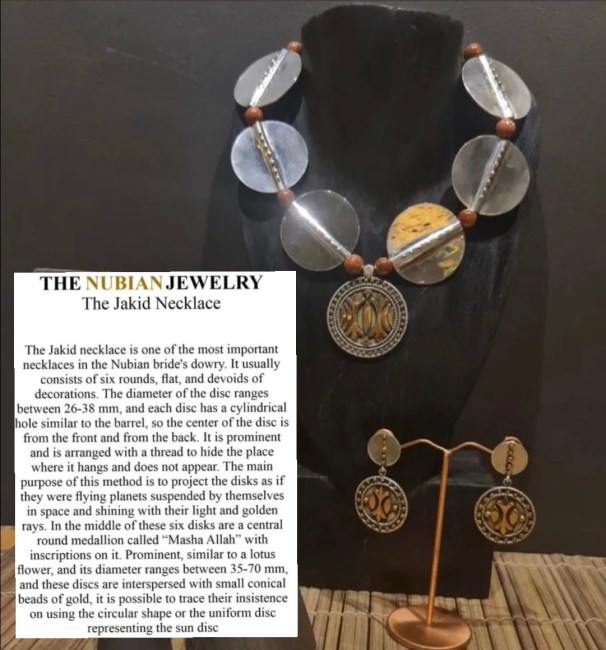
Above, Nisreen modelling stunning pieces inspired by the Nubian jewelry heritage of northern Sudan, such as the Jakid necklace, below.
All photographs in this article are copyright Nisreen Kuku and are used here with her kind permission. They may not be reproduced without her written permission.
For background to her career and more, striking examples of Nisreen’s work, see
Conserving Sudan’s Timeless Treasures Part 1
In Conversation with Nisreen Kuku
Nisreen Kuku’s many collections and exhibitions have expertly celebrated the regional and tribal jewelry heritage of Sudan. Nisreen is a designer whose inspiration flows from her work as researcher and conservator of Sudanese jewelry traditions and her commitment to conservatorship takes on a special urgency at this tragic time. Nisreen is a mine of detailed and specialist information on tribal jewelry in a field sadly lacking in the documentation of works of consummate skill and elegance.
The Arabic original of this interview is available on request and will also published in a special Arabic edition post shortly.
Imogen: Nisreen, thank you so much for your kindness in talking with me today, especially in the light of the tragedy besetting Sudan. I know our readers wish all Sudanese a swift resolution to this brutal conflict. Can you tell us how the war has impacted Sudan’s jewelry heritage?
Nisreen: I don’t think we can really feel the sheer extent of what has been lost just yet. That’s because the Sudanese don’t see jewelry just as objects of adornment for women but rather as tangible cultural heritage flowing from an ancient civilization that goes back over seven thousand years. These objects have been handed down by mothers from generation to generation. In this war, so many mothers have lost their jewelry and with it that generational continuity. So few families, too, have been able to flee Sudan with these precious family heirlooms and post-war, I fear harsh economic circumstances will probably mean many more will have to sell their jewelry. So, the ultimate scale of the loss will be great.

Above, examples of Nisreen’s ebony and gold, Beja and Bedouin, and Nubian collections.
Imogen: you have spent so many years fighting to conserve Sudan’s vanishing jewelry heritage. What has happened to your gallery and museum and how do you see the future for your work? How can Sudan’s jewelry heritage best be preserved?
Nisreen: I have tried to safeguard everything I can in the same way that people have always done in wartime but what I would like people to understand is all this goes back five years. In late 2018 I opened my gallery exhibition and my Kuku Museum of Sudanese tribal jewelry. I had been funding and undertaking my own conservation work alone but even then I sensed very strongly that there was a growing threat to our jewelry heritage. Friends advised me to look for non-profit sector support in preserving this heritage but I felt it was better for me to carry on under my own steam rather than spend time trying to convince those who were aware of the existence and scale of the threat due to many other factors. The war will make my work as conservator more complicated and there are sadly very few specialist studies on Sudanese tribal jewelry available. What I did find was research that didn’t set out jewelry conservation and display in a way that was readily accessible or which drew heavily on early texts. I call upon all those bodies who specialize in preserving our cultural heritage to join in preserving what is left of a heritage which goes back over 5000 years.

Above, the Nugar Necklace, with its exquisite signature earrings.
Nisreen: Sudanese heritage is deep-rooted, embracing the cultures of more than 570 tribes. It remains shielded in the family and the customs and traditions our mothers and grandmothers practised in their daily lives, so it isn’t easy for it to be lost. However, it’s even more important now, given what’s happening, for researchers and universities to work for its preservation.
Imogen: Can you tell us a little about a piece of jewelry in your youth or a family piece that made a lasting impression on you?

Nisreen: What I most remember is a necklace known as the Farjallah*, (pictured left). I couldn’t have been more than fifteen years old and I would always go with my mother when a relative got married to see the traditional bridal dance. Whenever there was a family celebration like this, my grandmother would prepare the gold for the bridal dance and the farjallah, of course, weeks beforehand. I was fascinated and followed all of this with great interest.
I remember that when my grandmother passed away, the necklace became part of the family inheritance to be divided among her descendants in accordance with shariah law. I asked my family if I might have permission to keep the stones set in the centre of the gold filigree flowers because they were considered to be such a fine and distinctive feature of the necklace, with their delicate rose red colour. So I kept the stones and when I grew up, I was able to recreate the necklace using a similar silver soumit necklace which I gold-plated, owing to the high cost of gold. It is satisfyingly heavy and I have treasured it to this day.

The farjallah necklace above, from Facebook Page of
Jewelry from Ancient Nubian Heritage
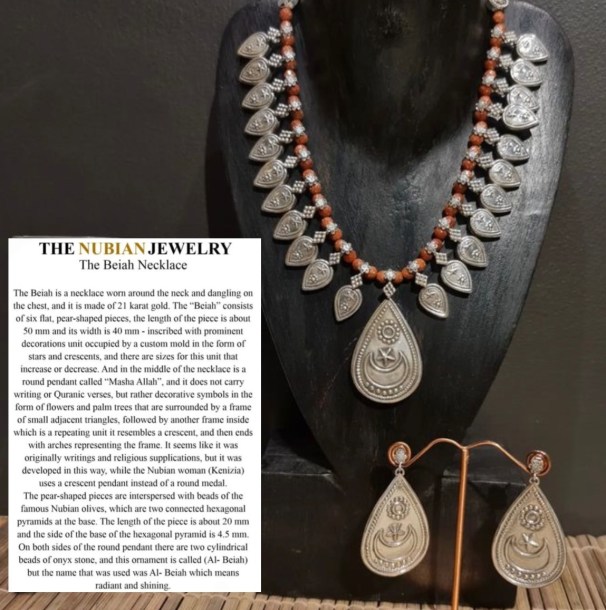
Above, the striking Beiah Necklace, Nubian Collection.
Above left and right, the farjallah necklace. *Farjallah; this term is part of the formulaic Islamic appeal to God’s mercy,”God’s help is near and he who asks his help will not be disappointed.” Faraj has the idea of relief from or the solution of a grave situation of difficulty.

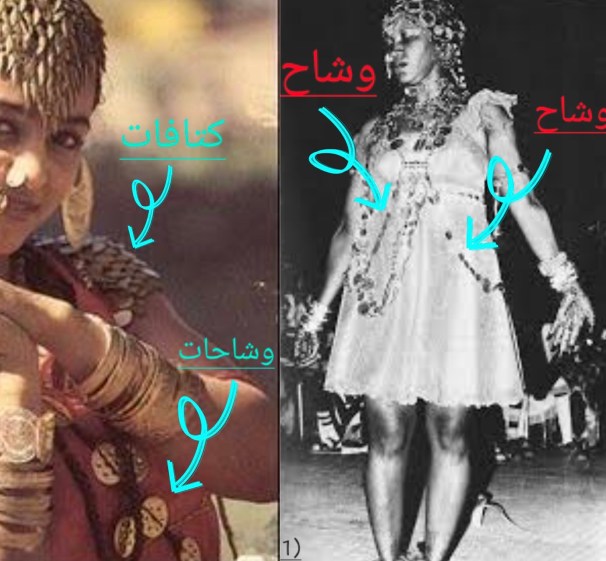
Nisreen: The Farjallah is one of many treasured heritage pieces which is still used in the Sudanese wedding ritual of the jertig and the accompanying bridal dance. Among other pieces worn at this time are the “al-laba/luba” necklace, and wishaaHaat, or bridal sashes of stamped gold chains and coloured threads, worn across the body (see below**), as well as pieces all made from English coins, such as the George V sovereign. The farjallah necklace is gold and typically made up of either six “farjallah” coins and eight filigree flowers or vice versa. In the centre of each filigree flower is a rose red ruby, skillfully set by goldsmiths. The centre piece of the necklace is a fine cylindrical Yemeni agate bead known as soumit, encased in gold at both ends and attached to the necklace chain. Sometimes, two soumit beads may be added to the necklace.
See more on traditional Sudanese filigree work in
“A Necklace of Shells from Distant Seas…”

Above, from Nisreen’s Nubian Collection; exquisite examples of bridal jertig jewelry. Learn more about the jertig wedding rituals of northern Sudan in Anointing in Robes of Red and Gold
“It was considered an inviolable form of family savings because to attack and rob a woman was very cowardly. For the unmarried girl it was an important status symbol of her father’s ability to provide, and for the married woman of her husband’s ability to maintain it and if possible increase it. It was lent and borrowed between female family members of a family on wedding occasions and often the bride would display the total gold resources of their mother and aunts.”
Griselda El Tayib, on the central role of gold jewelry in Sudanese riverain culture, in Regional Folk Costumes of the Sudan.
More on Sudanese jewelry in
“A Necklace of Shells from Distant Seas…”
**Below, wishaaHaat.
Imogen: How did your family react to your career plans when you were young and what are some of the challenges you have faced?
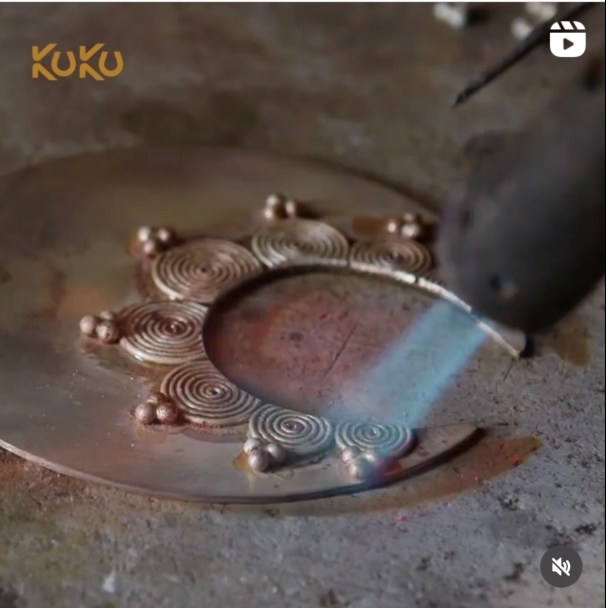
Nisreen: I grew up in my grandmother’s home in the old, historic quarter of Omdurman city. My grandfather, Arafat Mohammad Abdullah, was one of the major figures of his day in the anti-colonial struggle for independence and owner of the influential Al-Fajr magazine. It is a house steeped in history and tradition and it had a great influence on how I developed creatively. From a very young age I was interested in Sudan’s diverse artisan and crafts heritage.
As a teenager, I spent hours learning more about both crafts and craftsmanship in the old market of Omdurman, which at that time was full of craftsmen and merchants trading goods from all corners of the country. It all started when I graduated from Omdurman girls’ secondary school. The school included lectures in arts and needlecraft in its academic programme. Then came the waiting and applying to universities, which in those days took a whole year. So I asked my mother to go with me to the market to buy beads and tools so I could make some pieces just for my own use. I came home and although I appreciated what my mother had done, I wasn’t happy with the quantity she had bought for me, even though it wasn’t what you’d call modest. So I started thinking, “How can I go to the market again and buy even more?”

It was 1996 and I decided to collect all my textbooks that I had used for the secondary school certificate – and it turned out to be a lot. I took them to a book seller near the post office in Omdurman and I was lucky enough to sell all of them for 600 Sudanese pounds; somewhere around 1300 dollars in those days. With that, I was able to buy a substantial quantity of materials – enough to make a large number of necklaces, bracelets and earrings that year. I also sought my grandmother’s family’s opinion on what I had produced with my limited means at that time. To my amazement, everyone was impressed and they put forward the idea that I should market them, although they knew I really hadn’t designed and made them for this purpose.
My family have played a big part in my success. Their support has meant that I have been able to participate in exhibitions both here in Sudan and abroad. This has enabled me to promote my work in events such as the Dubai Festival, as well as having the honour of representing Sudan at the Sudanese Embassy in London, The Jordanian Embassy and others.
Below, fine examples of Rashaida jewelry and silvery lead-beaded face veils.

Imogen: Rashaida women are skilled in jewelry making. Can you tell us a little about their roles as artists and craftswomen?
Nisreen: The Rashaida woman undertakes all the work required by her nomadic life and pastoral environment, from the weaving of the family tent, to making all the leather utensils of the home such as water skins, as well as pillows. She sews her own dresses and adorns them with coloured and silvery lead beads and threads. She sews not only her wedding dress but that of her daughters and her skill and talent is particularly evident in the way she coordinates the colours she uses, reflecting and complementing the tones of desert life. She makes Rashaida jewelry in silver, reviving the work of Jewish goldsmiths who had lived in Yemen for thousands of years and who trained their Arab counterparts who strove to carry on the legacy.
See more on Rashaida esthetics in
Rashaida Dress and Adornment Part 1 Rashaida Dress and Adornment Part 2
Imogen: How do you see the role of traditional and contemporary women jewelry designers?
Nisreen: I see it as becoming as informed as possible about Sudanese jewelry traditions and researching into the jewelry cultures of Sudanese tribes. In this way we can preserve and spread knowledge of Sudan’s jewelry heritage, as well as producing work inspired by it for coming generations so their continuity and presence will endure into the future – something which is especially important at this time.
Imogen: Do you have a favourite regional Sudanese jewelry esthetic? Which regional designs and styles would you hope to explore more?
Nisreen: I would answer Nubian women’s jewelry to both questions, just because of the values – values still practised today, and meanings and beautiful stories associated with it.
I would like to close by thanking all my family; my mother, who stayed up late at night with me so I could finish my work and who has tirelessly accompanied me to every exhibition, and my late father, may he rest in peace, who insisted I join the College of Interior Design because he saw that a bright future lay in the arts for me, even though he had already approved my entry into Ahfad University’s faculty of Business Administration.
Imogen: Nisreen, thank you once again for your kindness today and for giving us a fascinating insight into your work.
Below, Rashaida women’s embroidered face veils from Nisreen’s personal collection.


 Women's literacy in Sudan