

The Baobabs of Sudan
Colonial Encounters
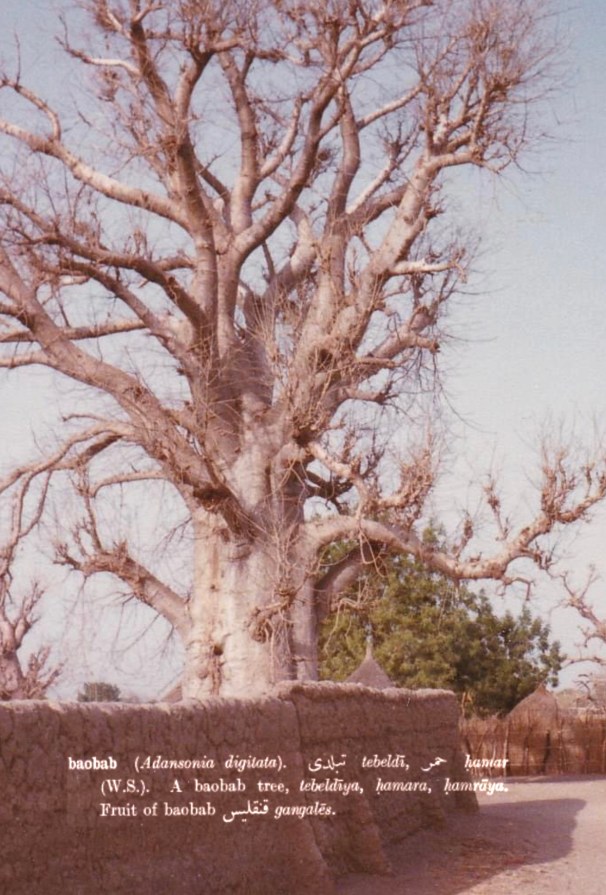
The English name,”baobab” is thought to derive from the Arabic “father of many seeds”. In Sudanese Arabic the individual baobab or tebeldi tree is a tebeldīya or less commonly Hamara. Colonial observers of the 1920s noted that throughout central Sudan the tebeldi was also known as “kuka“, a name they believed resonated with words used for the residence or thrones of departed kings and the hauntings of ancestral spirits. These sentinels of Sudan’s savannas, wadis, sun-seared rocky outcrops and mountain foothills have been known to live for centuries, and in the case of Sudan’s oldest specimens, more than two millenia. Dying, they collapse in on themselves, gaunt, husky shells that dissolve into dust. Today these giants among succulents are facing extinction throughout the world, as over-exploitation and climate change take their toll.
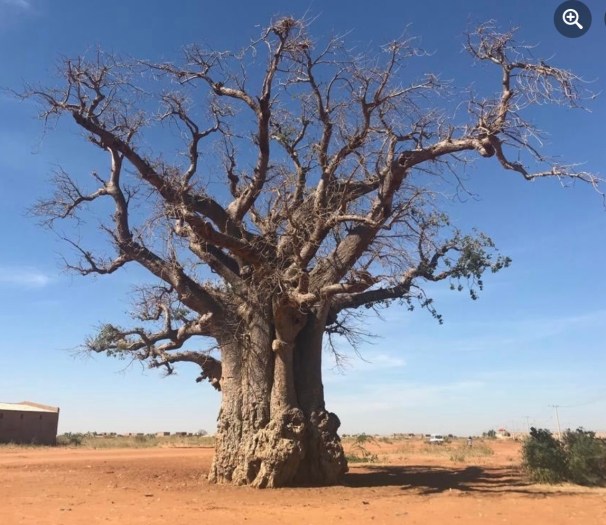
The imposing tree pictured above was photographed in1984 in Damazin by English teacher, Geoff Holden. My thanks to Geoff, and other followers of Sudan English Teachers and Do You Remember Sudan Facebook Groups for this and other photos included in this series of posts. The Arabic glossary entry above is taken from Sudan Arabic: An English-Arabic Vocabulary, Sudan Notes and Records, 1925.

Setting the Scene
The Baobab as Landmark and The Baobab as Water Cistern
The Baobab; Folklore, Sweet Water, Food in Famine and Flowers
Colonial Encounters with the Sudanese Baobab; The Baobab’s Military Significance The Naming of Trees
Colonial Understanding of the Tebeldi Water Cistern
Setting the Scene
The Baobab as Landmark
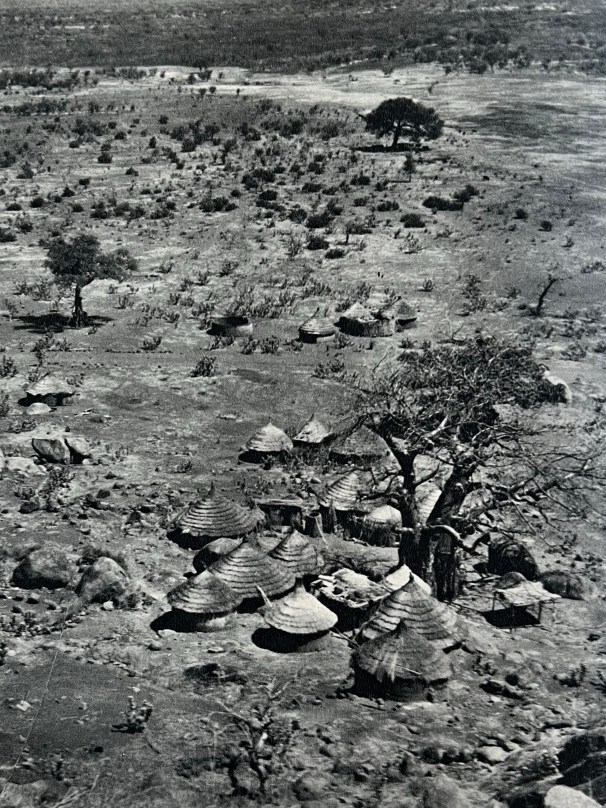
Above, a clutch of Nuba village huts encircle their life-sustaining tebeldīya, against a scrub-studded plain, (photo Der Dunkle Erteil, 1930). Colonial and post-colonial observers noted that the visibility and distinctiveness of the baobab made them vital landmarks for those toiling through featureless and inhospitable terrain. Individual trees were carefully plotted on early maps, serving as boundary markers, province frontiers and the living sources around which new villages could be established, Africa’s wooden elephant: the baobab tree in Sudan and Kenya
“No boundary can be demarcated, no site of a new village established, no transfer of individuals be considered without reference to it in Western Kordofan” , Sudan Notes and Records, 1923.
The baobab’s relevance as natural border posts persists to this day, with the 2005 Abyei Boundaries Commission referencing the establishing of borders between the Ngok and Misseriya by colonial powers decades before, and noting the British saw the tebeldi trees that flanked the local border resthouse as more reassuringly permanent than the resthouse itself.
The Baobab as Water Cistern

Getting Water from a Baobab Tree, The Kababish, Sudan Open Archive
Below, stills from Sky News Arabiya, showing jerrycans of sweet water drawn from a baobab cistern in the early 2000s. A trapdoor is cut into the tree by the family owner but all water stored in its hollow trunk is shared among the community.


A transcription of this two-minute report will be available shortly in Sudanese Arabic Documentary Transcripts and Translations
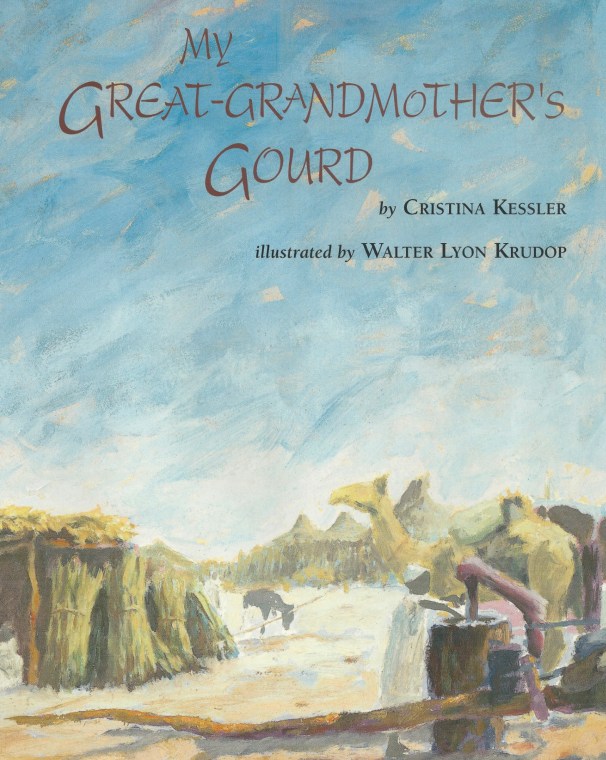
In the magically illustrated My Great-Grandmother’s Gourd, a little girl learns just how important her great-grandmother’s skills in tending and filling the village baobab every autumn are when the local water pump suddenly fails. Set in The Thirst Triangle of North Kordofan, where the hard red clay of the region and low rainfall mean little water is absorbed into the ground, this charming cautionary tale warns against over-reliance on pumps and wells, while bringing alive the ancient techniques used for water collection and storage. The illustration below shows the trough or necklace dug around the tebeldi to collect rain water. In the past, leather buckets were used to haul the water up into its tree cistern. The branches of trees used as cisterns were often pruned, researchers note, to improve the tree’s stability in stormy weather or shaped to facilitate the natural funneling of rainwater into the tree.

From My Great-Grandmother’s Gourd
The Baobab; Folklore, Sweet Water, Food in Famine and Flowers

This week’s post is the first of two articles on the Sudanese baobab, Adansonia digitata L, a variety common to Sudan, Kenya and small areas of Eastern Chad. It is believed by some researchers to also be the source of the baobab found today across the Indian subcontinent. In this article I explore colonial encounters with the great baobabs of Sudan. Next month, I focus on the tree’s nutritional and medicinal properties.
Myths, folklore and fable surround the tree wherever it grows and the Sudanese baobab is no different. Often occurring as solitary individuals, when two are found aside, according to Darfuri folklore, they are known as “twins” and the space between them will throng with dancing and singing djinn at night. Two or more growing together may become the ghostly abode of Father of the Lamp, Abu Lamba, the lamp-bearing, tree-dwelling spirit who lures passers-by from their paths at night, causing them to lose their way, (Voices of Darfur, August 2010). In the Nuba spiritual panoply, the Urkar spirit of the dead dwells in the vicinity of tebeldi trees. Invisible and howling like the wind or dogs, the spirit causes “men and animals to flee in terror at its approach and death is often the consequence of such a meeting.” (Sudan Notes and Records, Volume 15, 1932.)
“Imagine, two millennia in one spot? Human generations are calculated in twenty-five-year intervals, so such baobabs would have witnessed eighty generations of humans crying as infants, crawling, growing, living, exploring, farming, building, warring, loving, and dying.” The Eternal Tree


The baobab is revered for its prodigious age – the bark of the most ancient specimens still bearing centuries old inscriptions – and its service as a vast natural water cistern. Its natural or artificially excavated trunk cavities can store up to 10,000 litres of water which remains fresh for several years; a life-sustaining force in lands without wells and sparse rainfall. Even today, fieldworkers note, herdsmen will still fix mirrors, soap, towels and toothbrushes “in the wrinkled bark of a stand-alone baobab” for fellow nomads, who wash under its welcome shade, (Africa’s wooden elephant: the baobab tree (Adansonia digitata L.) in Sudan and Kenya: a review). Its vast hollow trunks or more accurately stems, have also served as storerooms, stables, shelters and prisons over the centuries. In Kordofan and Darfur, the baobab’s unifying and enduring presence places it at the heart of the village parliaments and rituals that are held under its protective boughs. So important is it that individual trees are given names.
Left, the leaves, flowers and fruit of the baobab. Photos, copyright, dreamtime.com.

The baobab’s knotty canopy of stubby, root-like branches, Its leaves, flowers and elephant hide, fire-resistant bark nurture delicate ecosystems of insects, reptiles, birds, bats and other mammals. Its tart and tangy fruit and spinach-like, vitamin-rich leaves have sustained the Sudanese and their livestock in times of famine and drought, providing a measure of food security for families and a local income for women and children. It sheds its leaves in the dry season, enriching the soil, and remains leafless for eight months of the year See too Note on the Baobab, Kordofan, Sudan and Journal of the North for Basic And Applied Sciences, Vol (3) Issue (2) Northern Border University (2018/ 1440 H) Its bark is made into cloth and rope, cut into shingles for roofs and used to treat fevers.
Upper left, my thanks to Peter Moszynski for this photo of a tebeldi tree. Above, right, nuggets of dried tebeldi fruit pulp in a Khartoum market stall. Above left, chewing on baobab leaves in times of food shortages, 2014, The New Humanitarian

abshir be t-tabaldi lamman al `ushar yaldi. Enjoy the tebeldi fruit until the ushar (Caloropis procera) yields its fruit; make do with what is within your reach until you find a better alternative. More on the baobab fruit in Part 2.
My thanks to Muna Zaki for this proverb.

Long before European accounts of the baobab and its habitat gained currency, the fourteenth century Arab scholar and explorer Ibn Battuta told of weavers setting up their workshops under its generous shade, and marveled at its vast hollow trunk, home both to sweet water and honey bees. The numerous medicinal properties of the tree’s fruit, known in Sudan as gongoleez, have provided generations of Sudanese with cheap, accessible and effective remedies for common conditions.
The baobab’s pendulous, night-blooming, heavy-scented flowers are pollinated by bats. At dawn the tree is alive with birdsong and in the day, baboons feed on the velvet-husked fruit that can endure three years of drought upon the tree and whose shape hanging from the branches has led many to call the baobab “the dead rat tree”. Below, verses from Arif Gamal’s The Baobab.

Arif Gamal says his early journeys through Kordofan accompanying his uncle charged with mapping sites for potential water wells and rainwater waterholes were nothing less than life changing as he experienced the unstinting kindness and quiet self-sufficiency of the Kordofanis in a harsh and waterless land. Read his account of this time in Poetry Society of America New America Poets Arif Gamal
Colonial Encounters with the Sudanese Baobab
The Baobab’s Military Significance The Naming of Trees The History of The Tebeldi Water Cistern
The documents compiled in the British colonial administration’s Sudan Notes and Records speak volumes on the fascination, uncertainty and even rancorous academic rivalry surrounding data gathering, fieldwork and theorizing on the baobab.
Contributors were far from in agreement, at a time before carbon dating, on the maximum age of the baobabs they observed. They differed too on whether the trunk water cisterns were entirely natural cavities or had been artificially pared away, and debated over when and how the species was first used for water storage in Sudan. Uncertainty even surrounded the etymology of the word “tebeldi”, with some contributors claiming it to be of Berber origin. These early twentieth century correspondents nevertheless provide an invaluable and often meticulous record of baobab size, distribution and range in western Sudan and offer fascinating hints into their history. They also offer unique accounts of ceremonies and rituals held under or close to the auspicious heart of village life:
“Under the shade of a tebeldi tree standing near the house a party collected for the big dance which they call kanga. Music was provided by a drum and five trumpeters, the trumpet being made of long cylindrical gourd…” SNR Volume 5, 1923, relating funeral rituals. Another account runs; “On the eve of the feast one of the official attendants of the kujur prepares the first bread from the new grain under a certain tebeldi tree; it is then offered up as a sacrifice in the hut of the aro.” Sudan Notes and Records Volume 6, 1923, on harvest rites. They also provide details of festival attire made from tebeldi bark; “The village community and visitors including women now collect on the dance ground, drums are beaten and dancing takes place, the women wearing a special waist fringe called soli made from the bark of the tebeldi tree…” Sudan Notes and Records Volume 22, 1939. Photo above right, British Council Older Persons in our Communities
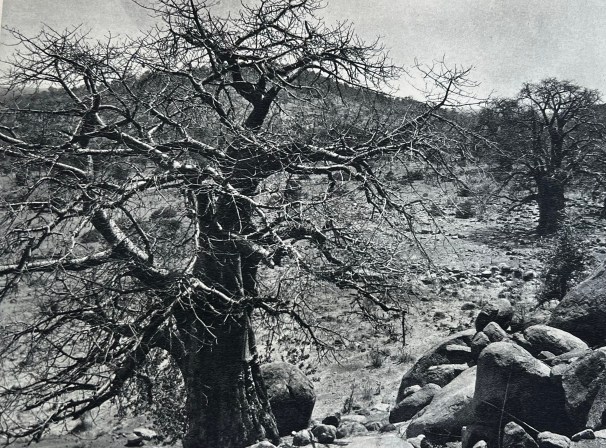
Photo left above, Nuba tebeldi, Der Dunkle Erteil, 1930.
Extracts quoted from SNR documents in this article are available to all at Sudan Open Archive
The Baobab’s Military Significance
Writing for SNR in 1923, Blunt documented 30,000 water-bearing tebeldi in Western Kordofan and claimed “a third of those in use were hollow in and before the Turkiya”. When Blunt and his contemporaries were data-gathering, the siting of ninety percent of Hamar villages was determined by the location of tebeldi, with several entirely dependent on the tree for their water supply and others deserted after the tree had been emptied of water. He estimated the total annual storage in the region to be 7.5 million gallons. The prodigious water-bearing capacity in a land with few wells made them a key military target during the Mahdiya, when many were destroyed, and Blunt cites the western tribes’ overrunning of the Dar Hamar and Emir Mahmoud’s historic 1868 march, “when every patch of corn was burnt or cut, and many fine Tebeldi pierced at their bases so as to be incapable of holding water again.” Fears of widespread strategic destruction of tebeldi were to resurface among Sudan’s British rulers in 1915 when they feared the forces of Sultan Ali Dinar would raid Kordofan, destroying the trees in their wake.
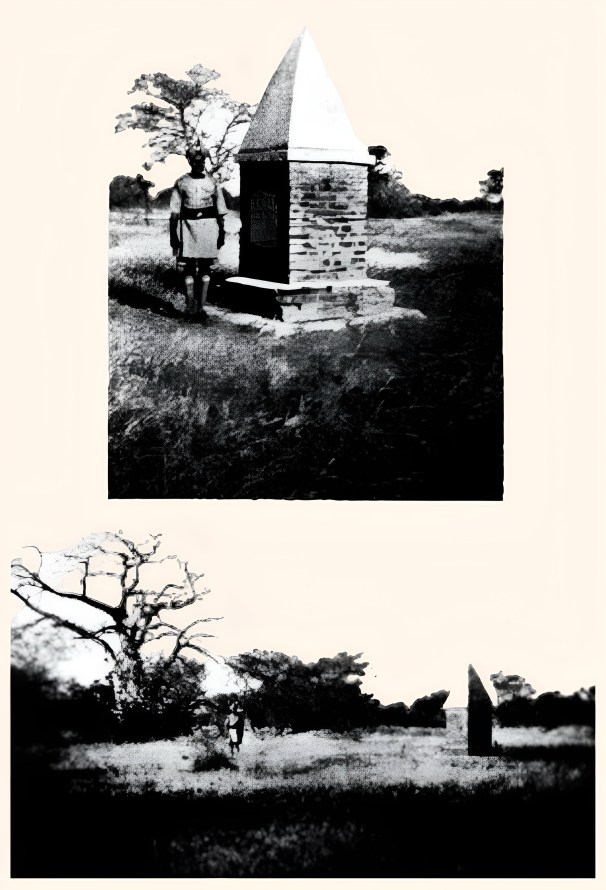
For British and Egyptian colonialists, the tebeldi was to take on darker resonances, as this account of the death of Hicks Pasha at the Battle of Shaykan and accompanying photographs reveal:
“The tebeldi is known as Bugler’s Tree owing to the story that Hicks sent his bugler up to the topmost branches to spy out the land. When the bugler saw nothing all round but Dervishes waiting to attack, his report was so dismal that Hicks Pasha ordered him to be shot where he was in order that the morale of his troops might not be damaged still further. It is said that the bugler’s skeleton remained stuck in the branches for many years… It was early on Monday morning when Hicks Pasha moved. Then at last the Mahdi attacked and the army of Hicks was overwhelmed. Hicks Pasha himself died fighting bravely by the Tebeldi tree and I myself was there to see it. The slaughter was terrible and to this day you can see the bones of those that lay in heaps.” Sudan Notes and Records Volume 20, 1937
The Naming of Trees
Colonial sources noted that tebeldis could be family owned and were sometimes let or sold. Though rarely planted on purpose, they explained, the trees were protected by local households. Western observers also learnt that when well watered, the tree would grow quickly, as evidenced in those of the Palace and Sudan Club in Khartoum. El Obeid was celebrated for its tebeldi-lined avenues, market places and urban gardens graced with tebeldi trees.
Blunt (Blunt, H.S 1923 Tebeldia SNR Vol 6 (1) 115-6) relates that individual trees were named and formally registered and in Western Kordofan, these names were feminine. Among the more colourful were “Um Khiban; to store provender in times of want, “Um Asal”, mother / home of honey, “Um Tiyur”, home of birds, and “Um Fakha Khir”, mother of glories. Others bore the names of “The flowing / The Tearful”, “The Bald” and “Um Lagat”, the latter for trees whose configuration of upper branches led the tree to be self filling.
Colonial Understanding of the Tebeldi Water Cistern
The vexed issue of when the tebeldi was first used for water storage among the Sudanese exercised the colonial mind for several years. While the Hamar of Kordofan had insisted that the first to hollow out a tebeldi for water storage was Mekki Hajj Mun’im in the mid-nineteenth century, others claimed the trees had only been used for water storage for sixty years at most in western Kordofan. While some believed the tebeldi trunk had to be hollowed out, basing their opinion on informant accounts that it took three weeks to hollow out a normal tree to a satisfactory degree, others viewed the hollowing out “more in the nature of finishing off what nature had begun, with the extraction of the soft core and the paring of the inside walls, (SNR, Volume 7 1924). “Um laqai” was the term given to a tree hollowed out by itself. See too SNR Volume 12 1929
Although the advent of carbon dating, and advances in botanical and ecological sciences have given us greater and more accurate insights into the baobab and its ecosystems, many questions remain unanswered. The most pressing; how this wonderful species, which so many Sudanese depend on for life and livelihood, might be saved for future generations.
 Women's literacy in Sudan
Hi ImogenLooks an interesting post
LikeLike