

Cowries in Sudan; Divination and Adornment
Part 2 Adornment
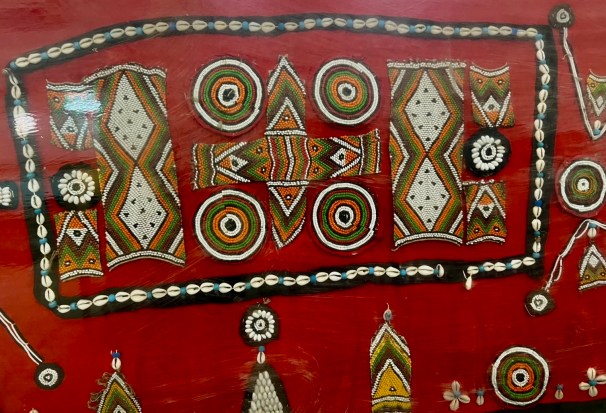
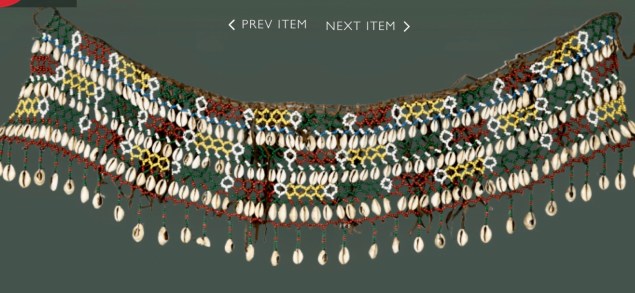
Above and title image, detail of a stunning “Bridal Mat of the Beni Amer of Tokar” with its rich geometric beading and cowrie-edged motifs. Such mats were often handed down from generation to generation by the women of the family. An exhibit from Sudan Ethnographic Museum, Khartoum, photo Imogen Thurbon.

Colonial observers were to document the striking red cloth and cowrie wall hangings adorning the Beni Amer homes they visited in the 1940s.

Above, finely worked ceremonial camel trappings from western Sudan, displayed at the Burri Botanical Gardens Festival, Khartoum, 2019.
Part 2 of Cowries in Sudan explores the use of cowries in jewelry, garments and the bull trappings of nomadic tribes. It also discusses the intriguing role of cowries in Sudanese initiation and fertility ceremonies and explores how the cowrie’s tragic link with slavery is subverted and reworked in zār spiritual healing rituals.
Below, western Sudanese camel trapping. See more in Al-Hawdaj.

For the use of cowries in divination, see Cowries in Sudan Part 1.
This post features photographs of exhibits at Sudan Ethnographic Museum. In 2022 I was lucky enough to see its remarkable collection for the first – and I hope not the last, time. One of the many tragedies of the conflict engulfing Sudan is the irreparable loss of the country’s heritage, the looting and destruction of her archives, museums, libraries and universities.

Above, netted cowrie shell gourd rattle, Sudan, personal collection.
Cowries in Sudan, Part 2
Adornment Ritual Slavery and Zar

Adornment

Above, cowrie-encrusted bull trappings of the Baggara people, western Sudan, Sudan Ethnographic Museum. Inset, a 1933 colonial account of Southern Darfuri bull trappings from Sudan Notes and Records, Volume 16. Below, side view of the bull laden with finely worked leather side panels, baskets and gourds, Sudan Ethnographic Museum. Cowries are also used to embellish the baskets and hide and woven food holders by many Sudanese peoples.
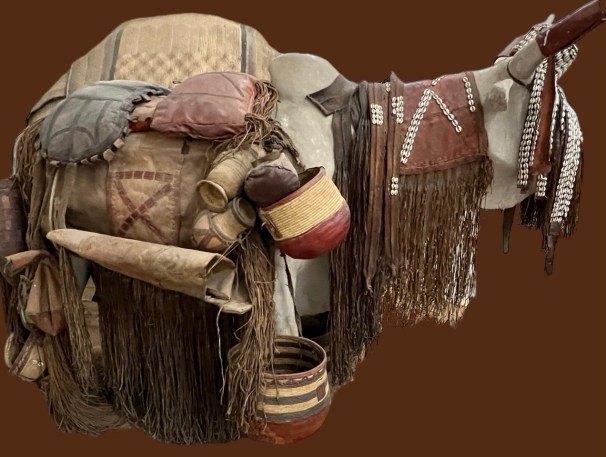
For details of cowrie-decorated camel trappings, see Al-Hawdaj.

Cowries were laid as bright unclosing eyes upon the eyes of the ancient Egyptian dead to ensure sight in the afterlife. They decorated the hair and garments worn by the dead in their tombs. Their representation in gold and silver has adorned the Nubian queens of antiquity and cowries have been found in Faras and the Meroitic graves of the first and second centuries AD. For more on ancient jewelry of Nubia, ..on the traces of Nubian goldsmithing. Still imbued with status today, they continue to adorn the robes and accoutrements of tribal leaders in Sudan and South Sudan.
Left, gold, fused glass shield ring of Nubian Queen Amanishakheto, believed to represent the guardian god, Sebiumeker, with udjat eye and what appear to be cowrie pendants, Amanishakheto jewels, photo, Pinterest.
The fascination for cowries as adornments possessing propitious powers has endured to the present day and can be seen in the headdresses, jewelry, ornamental veils, and tasseled garment fringes of numerous Sudanese tribes. Contemporary jewelry designers, such as Nisreen Kuku, still incorporate the cowrie into their signature pieces. See Cowries in Sudan Part 1.
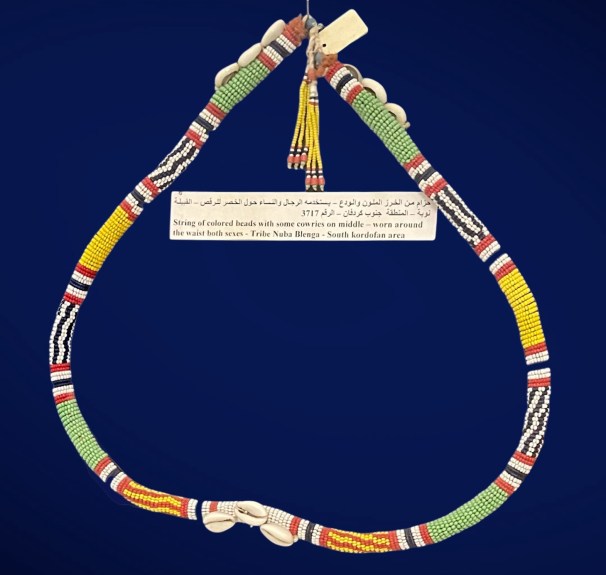
Although cowries have been prized as decorative additions to the clothing of rich and poor alike across numerous cultures, the popularity of cowry fringing on western garments, recognized as a growing trend as far back as the 1990s, (New York Times 1993) raises complex questions relating to the vexed issue of cultural appropriation; see for example, Fashion Meets Archeology: Safeguarding the Heritage of Sudan Countering Cultural Appropriation. A Conversation with Ahmed H.A.Adam. Above right, Nuba waist band with cowry decoration, Sudan Ethnographic Museum.
For more on Sudanese jewelry, see “A Necklace of Shells from Distant Seas…”

J.Theodore Bent, writing in the late nineteenth century of his travels in northern Sudan noted the Bisharin women of the encampments he visited had “glass beads and cowries tied to their matted locks, and brass and silver rings of considerable size fastened to their noses”. Their small children wore “waistbands of leather straps, on which were strung long agate and carnelian beads, with cowrie danglements hanging down in front.” (A Visit to the Northern Sudan, The Geographical Journal, Vol. 8, No 4, 1896). Colonial observers of the early 1900s describe the Sudanese rahat, the thickly tasseled leather skirt worn by unmarried girls as “decorated as a rule with cowries”, Sudan Notes and Records, Vol.5, 1922.

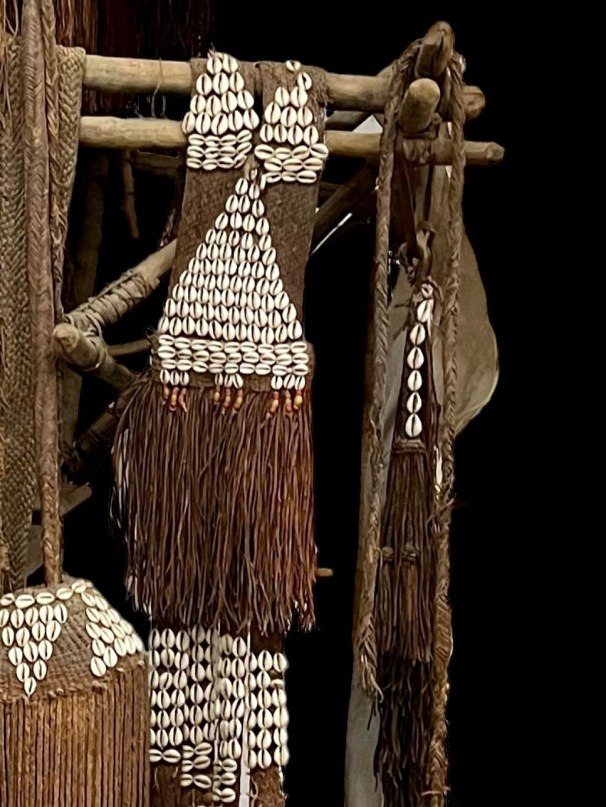
Cowrie shells have embellished the camel and bull trappings of nomadic tribes throughout Sudan and when not in use, adorn the walls of their dwellings. The Bishari homes Bent visited in the 1890s were draped in the “paraphernalia for weddings and camel-travelling”, “all elaborately decorated with cowrie and other shells”. Even their food hangers, he noted, were adorned with cowries. The “most remarkable of all” for Bent was the tall, conical hats with long streamers used for dances at weddings, entirely covered with cowrie shells in pretty patterns”.
Above photos, details of trappings from Sudanese camel litters or hawdaj, Sudan Ethnographic Museum.
Below a Nubian Beadwork and Cowrie Apron, Bisharin, 19th Century. Website commentary, marcusonandhall.com. notes the apparent parallels to ancient Nubian collars and the possible “remarkable continuity of design over 2000 years”.

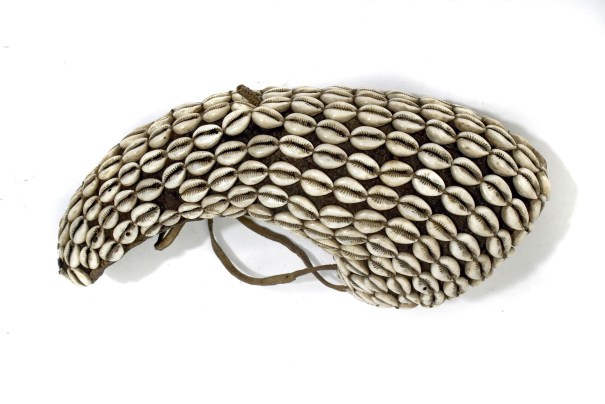
Below, head-dress made of human hair with base structure of rush, stitched with rows of cowries and two leather thongs attached; Shilluk tribe, South Sudan,1867, British Museum collection, CC. Colonial accounts describe initiation ceremonies among the Shilluk involving casting cowrie shells on the ground as well as child healing rites involving cowrie shells, Sudan Notes and Records, Volume 27, 1946.
The Ritual Power of Cowries

Early Islamic historians reference the widespread use of the cowry as talisman and charm among both pre-Islamic or al-Jahilīya and Islamic societies, where it served to guard against the evil eye and even “the pangs of despised love” (Materials relating to the cowry currency of the Western Sudan II, M-Hiskett, SOAS, 1966). The cowrie has long been invested with spiritual, mystical or superstitious powers, the latter often held to be of questionable or even heretical nature in Arab and Afro-Arab cultures. See Cowries in Sudan Part 1 for their use in divination and as adornments to the robes of Sufi mystics.

Many colonial observers recorded the use of cowries as talismans among Nuba communities in male circumcision, age grade and cicatrization ceremonies. Dr Ahmed al-Safi, citing colonial records in his descriptions of ritual scarring among the Nuba noted expert women officiants were paid “in seven cowries” and the newly scarred presented with necklaces of cowrie shells and horsehair fly switches. Those awaiting circumcision among Southern Kordofan Nuba were “anointed as it were with four cowrie shells sprinkled over him” (SNR,Vol.15, 1932).
Parallel rites celebrating young Nuba girls’ transition into womanhood were also documented, with girls given girdles of cowrie beads upon puberty or marriage. A 1945 SNR account of a Nuba age grade initiation “Shield” ceremony near Talodi notes rituals featured ” a long broad belt of leather, completely covered on one side with small white cowrie shells” and “objects handed down from the ancestors”. Significantly, perhaps, the author notes that the cowries were unstitched and returned to their women owners after the ceremony.

Above, sketch of a cowrie shell and bead strand, encircling the waist of a Kordofan baby. Based on a photo from Sand in my Eyes, Enikö Nagy
Although the cowrie is worn by men and as we have seen, exercises powerful symbolism in male coming of age ceremonies, it is perhaps most associated with women, as hinted at above and in particular with women’s sexual and reproductive potential, its form recalling, some researchers have suggested, the pregnant belly. In many cultures, including Sudan, the cowrie is deeply resonant of femininity, its talismanic powers evoked to secure conception, safe birth and infant health. Talismans of cowries are worn by pregnant women and their newborns. Below, a fascinating colonial account of The Ceremony of the Rob; undertaken between the seventh and ninth month of pregnancy in the northern Sudan of the late 1940s.
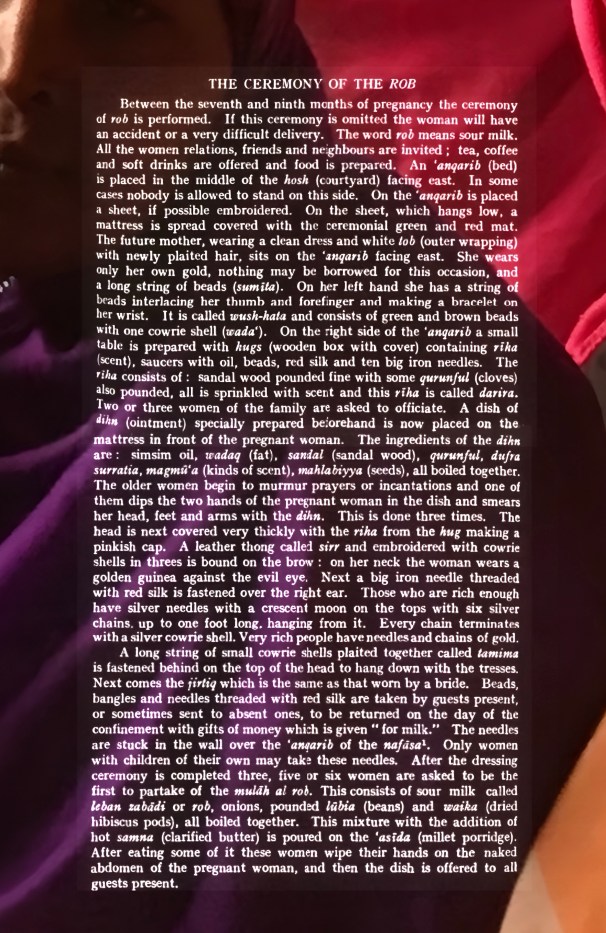
Customs of the Women of Omdurman Part II, S. Zenkovsky, Married Life and Pregnancy, Sudan Notes and Records, Volume 30, 1949, Sudan Open Archive.
See too The Lancet Egyptian cowrie necklace
Zar, Slavery and The Cowrie
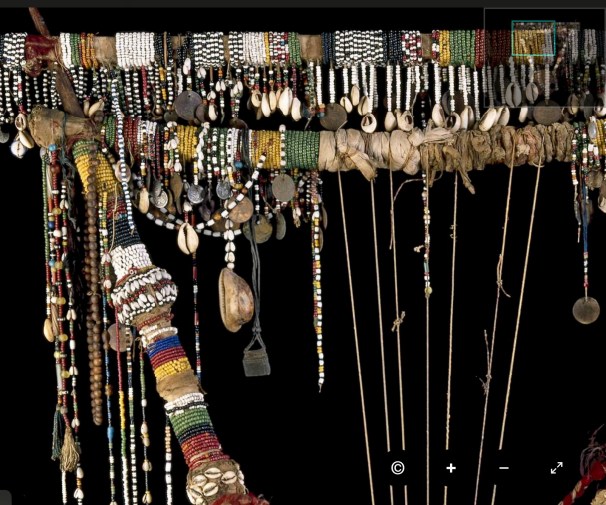
Above, a Sudanese tambour, bedecked with cowries, beads, leather-bound hijab and coins. Learn more about this exquisite instrument and its role in the zar and tambura, Sudanese women’s spiritual healing rites in The Sudanese Tambour
You can find more on zār in Incense (بخور bakhūr) in Sudan
“There is a big belt, a piece of leather 20 inches wide with strings on the corners and embroidered on the top with cowrie shells in the form of crosses – four together, At the bottom edge are about a hundred goat’s hooves. The belt is called al Mangur worn by man or woman from the staff of the Tambura to help the performance, and is tied to the hips so that rhythmical twisting produces a sharp rattling sound. This performance is called la’ab (playing) and they say: ‘ma fi la’ab, ma fi rih’ (when there is no playing, there is no spirit wind) when the entity delays manifesting itself.”
Zar and Tambura as Practised by Women of Omdurman. S.Zenkovsky, Sudan Notes and Records, Volume 31, 1950

Above, the Sudanese artist Kamala Ishag’s mysterious and disquieting evocations of zār healing rituals in which women are the protagonists, often taking on male persona. Photos, Imogen Thurbon. See more in Forests and Spirits
In the tambura witnessed by Zenkovsky, a ritual where spirits are summoned, embodied and propitiated through the lighting of incense, animal sacrifice, ritual movement, drum and tambour music, among the entities “of all the world and Adam and Eve” called upon was Sitt al Ragash. This particular spirit required ” a band with cowrie shell embroidery on the brow”.

In her masterful Spirits and Slaves in Central Sudan, The Red Wind of Sennar, anthropologist Susan Kenyon describes how cowries are used to summon and placate often wayward and wilful spirits, especially those she defines as black, Sudani spirits- many of them embodiments of former slaves, now wielding power.
“For the most part Sudani are generic representations of warrior spirits, distinguished by their bold demeanor, physically threatening movements, daunting expressions, and startling costumes, which often include beads or cowrie shells…”
As part of the healing ritual, women who believed themselves to be possessed wore “with pride”, “explicitly and publicly” headbands, rings and caps made of stretched ram’s intestine or stomach with carefully sewn borders of cowries.
For Kenyon, “the deliberate use of cowries, the currency of slavery* in much of Africa…” is a further reminder of the link between slave spirits and the people who brought zar to the area.” This “costly” tribute to the slave spirits, in Kenyon’s view, was further testimony to the age and “cosmopolitanism of zār”.
See too The Way the Cowries Fall on Candomblé and other religions derived from African slaves in Brazil in Brazilian poetry.
*The export of slaves across the Sahara for centuries formed an important part of trans-Saharan trade and brought with it the importation of cowries on massive scale. The 18th century was to see the peak of the slave trade and record levels of cowrie imports. European domination of the trade, first by the Portuguese, would ultimately lead to the destruction of the cowrie as currency.
 Women's literacy in Sudan