

Prayers from Mouths of Mothers
Selected Poems of Enas Suleiman
“P- Prayers from mouths of mothers / depart to the skies / looking for angels to carry them / to the Most High / O- Or is your weapon mightier? / Mightier than a thousand prayers, thunderous cries / and unanswered whys?”
From Enas Suleiman’s acrostic poem, Weapon, puncturing the hubris of men who would play God with guns.
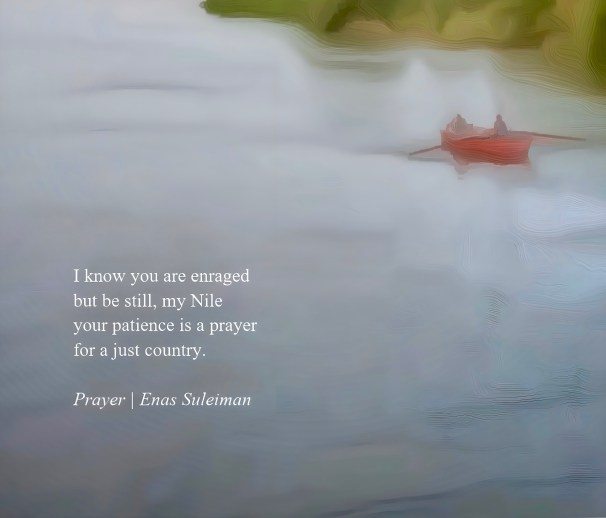
Above, Prayer, by Enas Suleiman. The Nile flows through so many of the verses of this gifted Sudanese poet, a witness at once consoling and unforgiving to the violence and violations of recent years.

Setting the Scene
Water, War and Justice
Grief; Within these sudden sullen walls
Setting the Scene
This week’s article is a very brief celebration of the work of the remarkable UAE-based poet, performer and writer, Enas Suleiman. At this time of great tragedy for Sudan, Enas looks into the soul of her homeland and disarms with her honesty, anger and searing clarity of vision. She speaks with a woman’s courage and a sense of justice anchored in her understanding of a compassionate faith betrayed. Hers is also the voice of the emigré’s wistful yearning. It gives expression to the anguished preoccupation of so many Sudanese who find themselves scrolling social media, praying “I beg I don’t see a familiar face”. Her work is tender, raw and intimate.
Join us next month when Enas has very kindly agreed to talk about her work and her sources of inspiration.

Above, writer and poet, Enas Suleiman, author of Tidal Waves.
“Tonight, I unpeg words / from the universe / lay them out / to rearrange them / for my last complete poem.” From Complete
Enas Suleiman’s warm evocations of Sudanese life, its customs and rituals are joyful affirmations of a culture’s resilience. Below, Jirtig, a wedding ritual unique to Sudan.
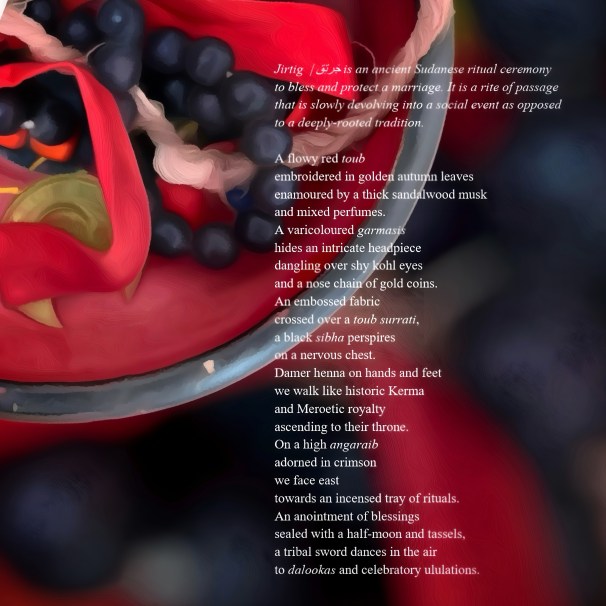
Learn more about the jirtig in Anointing in Robes of Red and Gold
The poet’s nostalgia for her homeland is palpable but always tempered with a realism that registers the power outages and burnt-out candle stubs of a capital in crisis; “A summer of a coal iron / pressing flowery bedsheets like swords, / broken mirrors hung in bathrooms / and the mystery of unclaimed toothbrushes / tucked behind pipes.”

Water, War and Justice
Do you wake up in a sweat, / bathe in sacred water / to wash off the blood of martyrs / from your slaughterous hands? / Who told you the Nile forgives?
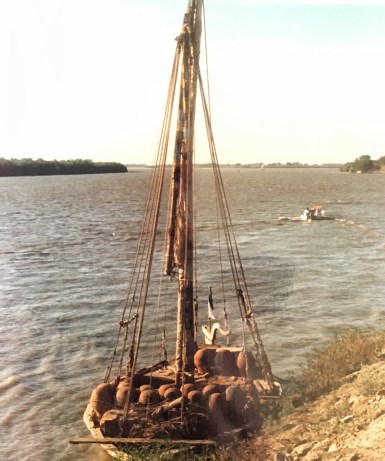
Many of the most moving verses by Enas Suleiman evoke the Nile as witness and silent guardian of truths; “I tell the Nile my secrets / so they’ll surge to you / where they’ll be safe / and protected”. Recalling the massacre of peaceful demonstrators in the heady days of Sudan’s democratic revolution, many of whom were drowned and their bodies never recovered from the Khartoum waters of the Nile, Suleiman writes of Sudan’s long trajectory of injustice; “How are the murdered washed / with the same water / y(t)ear after y(t)ear / with no accountability?”
The cleansing waters of the Nile and those used in pre-prayer ablution and purification are polluted by betrayal in equal measure; “How can you then / cleanse your body / and pray to the same God / m(others) call to in mourning?”, Four. Yet, amidst the pain, the poet refuses to lose sight of the humanity and even vulnerability of the young men responsible for such suffering; “What made you use a gun / instead of picking wild flowers along Nile / Street / or drink spiced tea / with the view of the river as your friend?, Weapon
“I think of the captured men / lined up, shirtless / shot point blank / tell me, what is the point of shouting / “God is the Greatest” / when you think you are greater?”, Worthy

Colonial-era postcard, northern Sudanese women welcoming the rising of the Nile.
From the waters of the Nile, Enas’s compassionate gaze radiates outwards, embracing the seas that bear desperate migrants to foreign shores and reminding us “if the sea can s p l i t for Moses”, it is not the sea but human indifference that is cruel. “Where does a mother / lay down flowers / if the vast ocean / is a unmarked graveyard?”, Migrant. And water becomes intimately personal, resonant of loss and all its residues; “The water comes in / and I am a memory / soaked in salt, / hung on your lungs to dry.” Laundry.
For more on the Nile in Sudan, see Angels of The Nile The River of Life The Drowning
An acute sensitivity to the existence of cruelty permeates Enas’s work. She skewers the casual cruelty of tradition in “What are we celebrating?”, a chilling dissection of the damage wrought by FGM, where “Little girls” are “baited / into taking trips to see an auntie” and in Other Kitchen, she is the tender observer of the sadness of a wife upon her husband taking a second spouse. Elsewhere she peels back the layers of other forms of violence women are subject to; that of the home and the state-sanctioned violence against Sudanese women activists; “while you are arguing what to call me / /kandaka, african, arab, zift*”
*zift; when used in colloquial Arabic, this word has a derogatory meaning akin to “rubbish, trash” .
Grief; ” Within these sudden sullen walls”
Tidal Waves is Enas’s voyage into grief, written upon the loss of her father. It is a raw inhabiting of grief and immensely resonant for anyone who has lost a loved one. In speaking to the uninvited, unwelcome guest of grief, she grasps “We need to learn / how to breathe together / so we don’t turn into ash .”, Mourning. In evoking bodily loss and physical void, Enas captures the essence of a soul; “My father’s skin was a blanket for strangers, / His backbone was a crane that lifted diving souls”, his “hands a welcoming nest, / with fingers closely webbed to trap tears”. There is warmth and hope too in this collection, dedicated to the man who brought ” warm fool from the shop, with the green broken door.”
“I count your prayer beads 99 times / between my fingers, / to hear your encrypted murmurs to God/ when I can’t find peace”, Beads.
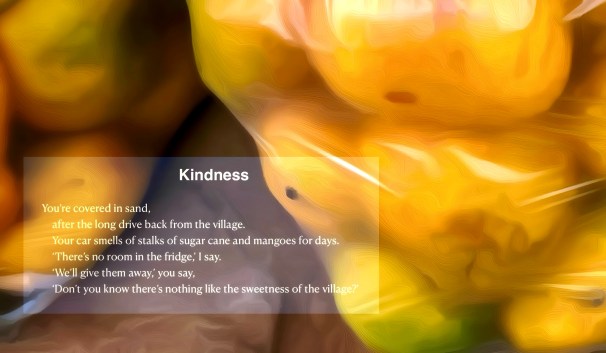
Above, Kindness, from Tidal Waves.
Join us next month to get to know Enas and read more of her work.
 Women's literacy in Sudan