

Architecture and The Soul of a City
Khalid Abdel Rahman’s Lost Khartoum
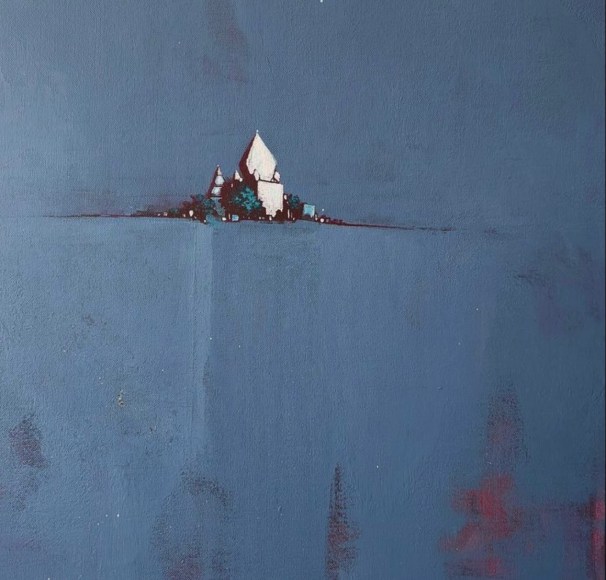
Above Khalid Abdel Rahman’s Memories of Khartoum, Shrine of Hamid Al-Nil, Omdurman. See more of this remarkable Sudanese artist’s work in Khalid Abdel Rahman Instagram and Artsy

Setting the Scene: Landscapes of the Soul
The Destruction of a City: The Capital’s Architectural Heritage Lost
Khalid Abdel Rahman’s Cityscapes; Maps of Loss
Selected Works
Setting the Scene: Landscapes of the Soul
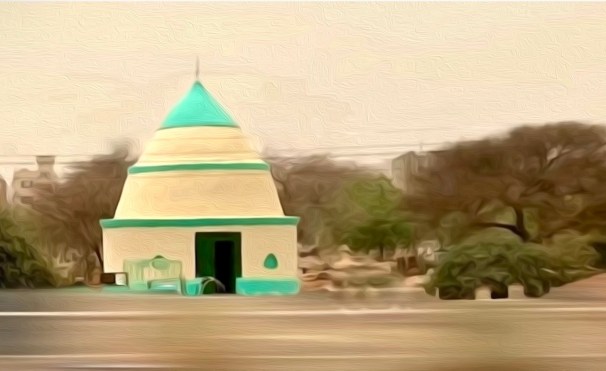
Sufi shrines are recurring motifs in this gifted Cairo-based artist’s work. Their domed moonlit surfaces stand etched against the immensity of the Sudanese night sky or glint blue-black on vast sunbaked plains. Since fleeing his homeland last year, Abdel Rahman has painted ever more iterations of the Gubba, DariiH or Sufi holy man’s tomb and shrine. Perhaps, amidst the destruction of war, the shrine’s enduring sentinel-like presence offers some sense of consolation.

Khalid Abdel Rahman’s vibrantly coloured landscapes and cityscapes (more on the latter below) have been interpreted as deeply personal, emotional and spiritual responses to beauty, memory, loss and absence; landscapes of the heart and soul mapped out among the streets of a city he walked in as a child. They depict scenes indelibly shaped by human presence pared down to dense plains of colour and surfaces bordering on the abstract. Devoid of human forms, their absence becomes poignant and palpable. As with Miska Mohammed, Abdel Rahman has been credited with re-invigorating landscape painting in Sudan, The Muse Multi Studios Above left, one of the many Sufi shrines that dot the capital’s cemeteries. Right, and title illustration, shrine, Khalid Abdel Rahman, Instagram.

“I always think of my artwork as an extension of the old local Sufi poetic tradition that values the eye of contentment or the good eye that sees beauty in everything, with this concept in my mind I take daily walks to look at my surroundings and take photos and sketches and then I go back to the studio to produce the final result, usually a simple drawing with soft and oil pastels on paper. My goal in this body of work is to celebrate the local and the ordinary and hopefully to inspire those who look at my art to take a careful look at things around them.” Artsper

Above, shrine in a yellow field.

Khalid Abdel Rahman, 1978, Khartoum, is a self taught artist who has dedicated himself to art full time since 2011. He has exhibited solo in Sudan and New Orleans (see below) and has featured in group exhibitions in South Africa, Kenya, Uganda and Germany. Working from photographs and memory, the artist’s visual lexicon has been likened to magical realism and surreal dream states. In April last year, Khalid was forced to flee Sudan and now lives in Cairo, where he continues to pursue his art, while striving to keep the artistic heritage of his homeland alive in these tragic times.
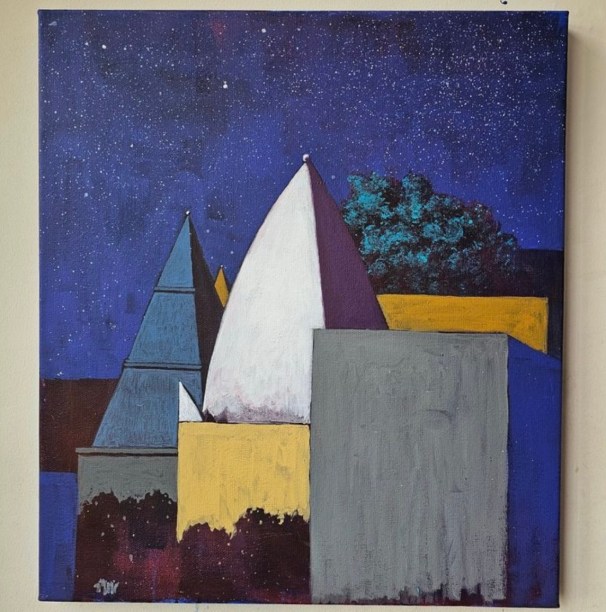
Sometimes, as in the work below, Khalid Abdel Rahman’s moonlit shrines inform his urban nocturnes.
The Destruction of a City: The capital’s Architectural Heritage Lost
“The destruction of my home town has caused me to reflect on its construction. What is being lost is much more than just buildings. It is also people’s hope for a future they had invested heavily in.” Architect Amira Osman, reflecting on the rich architectural heritage of capital and its tragic loss in Khartoum: the creation and the destruction of a modern African city
Footage from the early days of the war, showing the scale of destruction in Khartoum. See too New York Times A Proud City and Scenes of Sudan’s gutted capital Khartoum
The war in Sudan continues to exact a devastating toll on its civilians. It has also ripped through the fabric of urban life in the capital as key buildings and the infrastructures they served are gutted by shelling or fire (see Satellite images show devastation in Sudan 1 year since conflict began). Hospitals, schools, university and government buildings; banks, markets, power stations, bridges, mosques and churches have all been destroyed.

The three cities that make up the capital; Khartoum, Omdurman and Bahri, are home to numerous, distinctive indigenous, foreign and hybrid architectural traditions – Ottoman Turkish, Greek, Egyptian and British colonial, and more recently, the confident, wealth-based architectural esthetics of The Gulf States.

Historic landmarks such as the Republican Palace Museum, Sudan’s National Museum and the Presidential Palace have seen severe damage and with it the loss of irreplaceable archives and treasures they once housed. Modern Sudan Collective, dedicated to documenting and preserving Sudan’s distinguished modernist and Tropical Modernist heritage has set about tracking the damage and loss of key buildings in the capital.
Above left, the distinctive forms of 19th century vernacular architecture, Omdurman. Right, the recently restored 14th century Turkish Sultans’ tombs, central Khartoum. Below, scenes of Khartoum, pre-war.

Learn more about the architecture of Khartoum in Modern Architecture in Khartoum 1950-1990, ResearchGate, Architecture in Sudan 1900-2014; An Endeavor Against the Odds, ResearchGate, and 10 Sudanese Structures That Showcase Africa’s Rich Architectural Heritage

Looking out onto a Khartoum 2 street, pre-war.

Some of the first areas of the capital to be bombed were residential zones that lay close to strategic military targets. The architect Amira Osman recalls that, a “narrow part of the city, about 20km across, between the Blue and White Nile rivers, is where the airport and military headquarters are located. Around them are dense residential neighbourhoods. People have had to evacuate their homes as this narrow strip was one of the first invaded. The rest of Khartoum is now equally destroyed at a massive scale.” Khartoum 2, a fashionable middle class district, is now shell-pocked and deserted; its galleries and offices looted, its inhabitants forced to flee. Whole swathes of Omdurman, together with its historic markets, lie in ruins.
Amira Osman relates how In the late 1980s and 1990s, “many educated Sudanese left the country due to political instability, high unemployment rates and the general difficulty of day-to-day life. Yet, like many Africans in the diaspora, they never lost contact with the home country.
During this time, building guidelines changed and Khartoum densified. Plots that previously had a single-storey family home now became three- or four-storey apartment blocks, and the city expanded vertically. Property dynamics adapted to receive the newcomers – as well as the massive cash injections from Sudanese abroad.” Citing her father, the distinguished architect Omer Siddig, she explains “The model that evolved was adopted and replicated widely; it allowed for the family to occupy the ground floor section while the upper levels comprised apartments for use by the children of the family as they married. This system replicated the model of homes of extended families in the rural areas from where most of Khartoum’s residents originated …”.

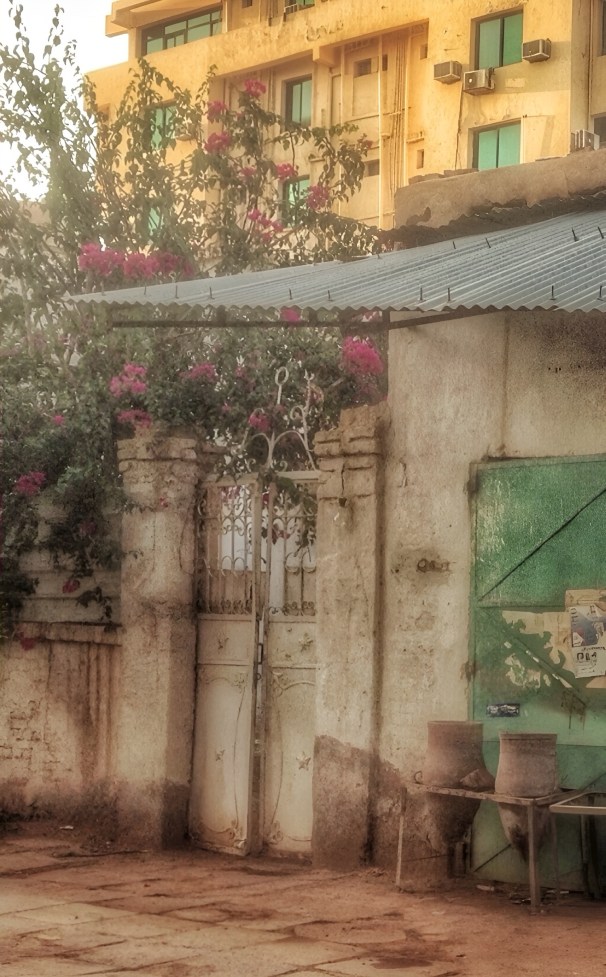
Above left, Khalid Abdel Rahman’s borgainvillea. Upper left, scenes of Babekir Badri Street, central Khartoum, a Tutti Island square, and a Khartoum 2 side street. Above right, residential buildings, central Khartoum and view from a Khartoum 2 window.
Below, a vibrant and strangely poignant cityscape, Khalid Abdel Rahman, Instagram. The artist’s cityscapes capture “the tonal colours, stark structures imbued with sturdy strength and presents a layered and multi-dimensional façade of the Sudanese contemporary landscape.” eclectica contemporary
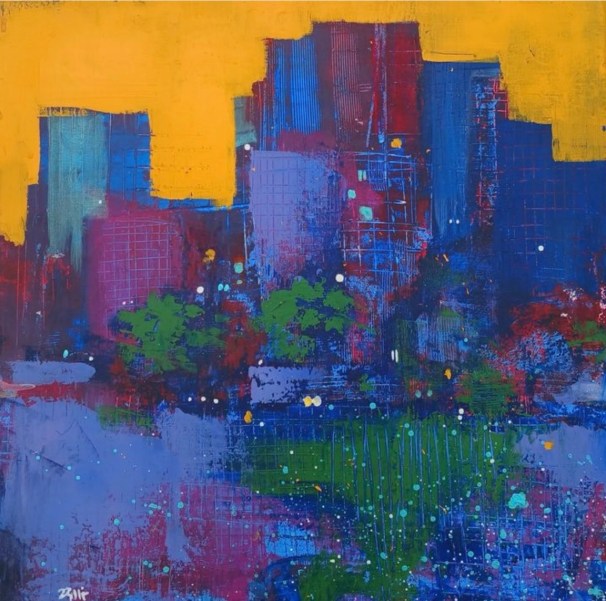
Khalid Abdel Rahman’s Cityscapes; Maps of Loss
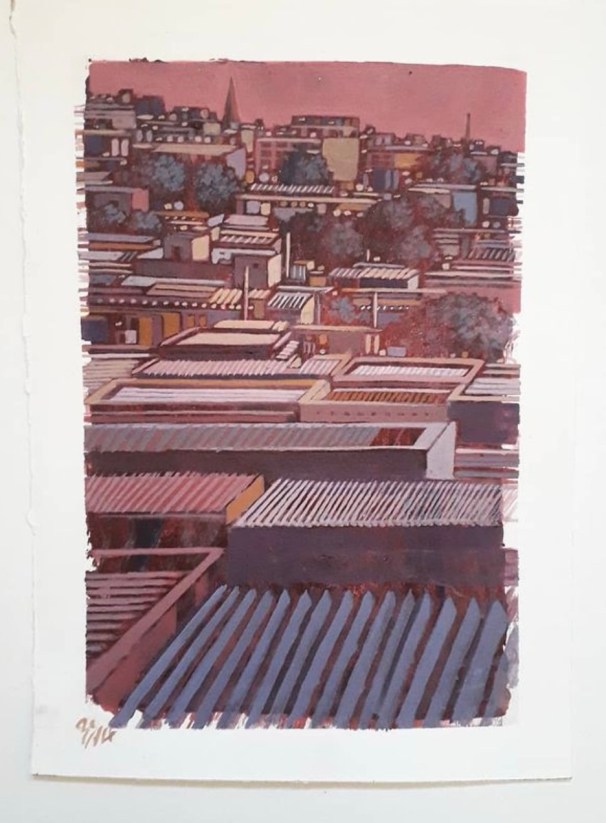
Amira Osman tells of physical destruction of residential areas wrought by the on-going conflict. Khalid Abdel Rahman’s cityscapes evoke the hollowing out and abandonment of these neighbourhoods and the scattering of their communities long before the outbreak of war. They speak of a thirty-year attrition of the Sudanese middle class in the capital. A middle class that fled the government or was absorbed into it, was ground down by economic instability or forced to emigrate for work. Khalid explains that these people became lost to him. “The brightly sad coloring of these empty neighborhoods reflects the reality of their disappearance” eclectica contemporary. For other critics his works make us feel “as if the spectator was a type of archaeologist. Sometimes the barren city scenes are like a nostalgic memory of a future time.” Khalid Abdelrahman Dara Art Gallery

In 2022 while walking through central Khartoum I met a Darfuri woman who journeyed in every morning from the outskirts of the metropolis to the Souq Al-Arabi where she sold prayer caps to support her family. She had fled Darfur in the wake of a twenty-year campaign of violence against her people. She told me of the tragic loss of her son who had drowned off the Italian coast trying to reach Europe. The present war has pushed millions of Sudanese into forced migration and countless Sudanese men, women and children have perished in the attempt.
In 2017 the Arts Council of New Orleans featured the work of Khalid Abdel Rahman in A Disappearance, an exhibition curated by Kristina Kay Robinson and Sudanese cartoonist Khalid Al-Baih, exploring the ethical implications and human toll of forced displacement and migration. See The Installation of Tragedy and The Ideology of Open Space and A Disappearance
Never before have the issues explored in A Disappearance taken on such painful relevance for the peoples of Sudan. Khalid Abdel Rahman’s work is a testimony to the beauty of a country and the exquisite sublimation of loss through art.
See more scenes of pre-war Khartoum in
Another Khartoum Another Khartoum Part 2 Memories of Omdurman
Selected Works

“Where I live and my relationship with it is the main subject I work on. It began naturally as I was making works about surroundings, and later on it became a deliberate choice to narrow my subject so I can have more room for experimentation in mediums and styles under one unifying theme. Sometimes the focus is on my relationship to the place and the emotions it produces upon me, that’s when the work leans towards abstraction and is more interested in pure shapes and colours, and sometimes I just illustrate what I actually see and that is when it goes to the opposite direction, but most of the I attempt to take the middle way, and combine both in individual pieces, aiming at achieving a very personal expression that I can effectively communicate to people. Speaking of people, their total absence is another unifying aspect present in all these different works” The Muse Multi Studios

Khalid ditched realistic values and showed the colours he wanted to show and not the ones you see in nature. Colours no longer had a representational purpose. The Muse Multi Studios
Nocturnes

 Women's literacy in Sudan

This is a lovely muse on Sudan. I particularly liked the early comment “the old local Sufi poetic tradition that values the eye of contentment or the good eye that sees beauty in everything,“. Sudan has fallen so far from that driven by two power and money hungry war lords. No eye of contentment with them. Little beauty to be seen in destruction, and death due to malnutrition and famine.
LikeLike
John, thank you so so much for this. Heartbreaking.
LikeLike
wow!! 105Khartoum Streets
LikeLike