

The Nugulti – The Sudanese Shoe Repairer
A Brief Photographic Tribute
Setting the Scene: The Nugulti and the Shoe Shine The Nugulti in Poetry
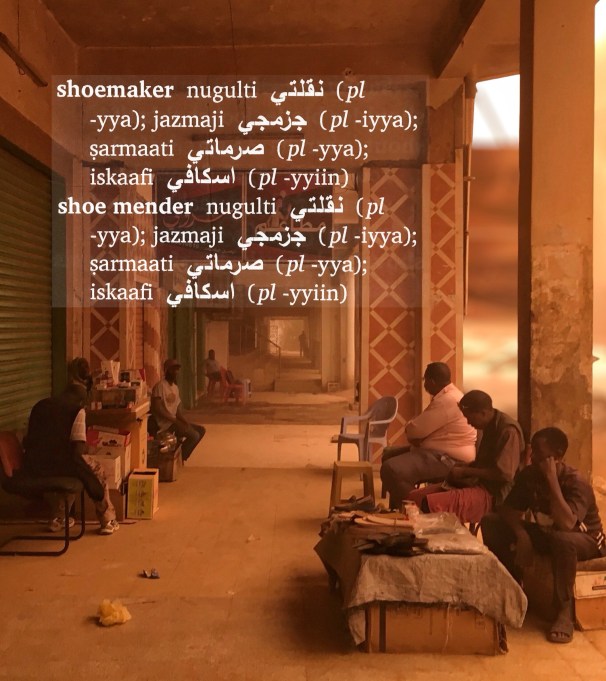
Below, the nugulti or shoe repairer bends over his work at his neatly laid out stall as ochre dust descends on a storm-hushed colonnade off Zubeir Pasha Street, central Khartoum. A few hours earlier a fierce sandstorm or habuub had grounded flights and blinded the capital in gritty orange haze. The definitions below come from Rianne Tamis and Janet Persson’s Concise Dictionary of Sudanese Arabic. As the lexicographers note, the term nugulti may be used for both a shoemaker and shoe repairer.
While popular etymology among shoe repairers holds that “nugulti” comes from the root verb “naggala” in the sense of to transfer / replace, as in for example, a worn sole, Dr Sharif Gasim, in his Dictionary of Colloquial Sudanese Arabic, explains the verb in Sudanese colloquial is actually used to refer to the act of repairing through patching, as in raqa`a, of cloth or leather. My thanks to Muna Zaki for this.
The word “nugulti” carries a potent social and poetic charge in Sudanese culture, invoking the stoicism and dignity of the poor and a yearning for social justice, captured in the iconic verse of Sudan’s beloved “people’s poets” such as Himmaid (quoted below) and Muhammad Al-Mahdi Al-Magzoub / Majdhub.
This week’s brief post is a tribute to the Sudanese shoe repairers I was lucky enough to meet and spend a little time with every morning while staying in Khartoum. I hope they and their families have been spared the worst of the sufferings of war and are safe. This article draws on a lyrical homage to the nugulti published by Ali Al-Sheikh Al-Hanin in Sudanyat; بتاع الاورنيش و النقلتي, Al-Raboka’s portrait of nugulti Ibrahim Abdullah by Mahasin Ahmed Abdullah in النقلتي) ابراهيم عبد الله : خريجو الجامعات بقوا (ينافسونا) في مهنتنا and Sudaress; «النقلتي» .. مائة عام من «المباصرة.
Scroll down to the end of this article to watch an interview with Musa Othman, a nugulti who worked in Soug ash-sha`abi, Khartoum for many years. A summary in English is available on request.

Above, the ubiquitous Bee and Flower polish, fine brushes and cloths of the nugulti’s toolbox, also used by the SaaHib al-warniish or shoe shine (see Sudan Memory’s 1993 photo Three Shoe Shiners from Shendi).
The Nugulti and the Shoe Shine

There is often a touch of rivalry and light-hearted distain among shoe menders for the nomadic shoe shine; a caste bereft of a designated perch who must roam the city for trade, their Pepsi bottle top bells and their calls of “kishshsh kishshsh” ringing out. Their repair work is, the nugulti sometimes claims,”second rate”. For others, such as Ali Al-Sheikh, the shoe shine is one of the many visual artists of the city. Like the nugulti, he embellishes the urban landscape by his work, eyes always expertly scanning the ground – and other people’s shoes.

While NGO “rags to riches” stories abound of the shoe shine who graduates from university to thrive in business, so many shoe shine boys, tragically, will still never get to school. Now, even university students, desperate to fund their studies in precarious times, are working as shoe shines; unwelcome competition for the professional nugulti like Ibrahim Abdullah.
Above left, a pair of well worn markub and their owner taking a well earned rest. Above right, the dapper snake and lizard skin markub referenced in lyrics sung by the great Mohammad Wardi and discussed in “Sirwal wa Markub”. If you are interested in the making of traditional Sudanese shoes, such as the markub pictured above right, then you might also enjoy A Day in the Life of a Darfuri Markub Maker.
The Nugulti in Poetry
Below, iconic and oft-quoted lines from Himmaid’s humanist hymn to the poor, Uncle Abdur-Raheem; “ghash(h)in an-nugulti wa-t-tarzi al-gariib“: drop them off at the cobbler’s and the tailor nearby. Adil Babikir’s translation of this excerpt from the poem in Modern Arabic Poetry reads:
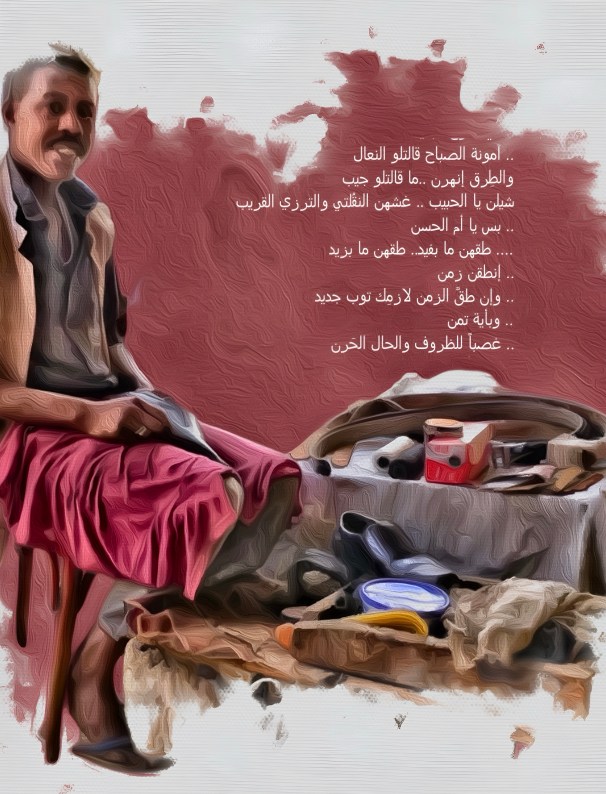
That morning, Ammoona finally spoke out: / “The shoes and the tobe are worn out.” / She didn’t demand money, though. / “Don’t worry, sweetheart. Just drop them, / to the nearby cobbler and tailor.” “How come – Om al-Hassan?” / “They won’t stand a single stitch! / Only worse they can get! / You’ve got to have a new tobe – / at any cost, / no matter what.
To hear a beautiful recitation of this work in English, dramatized by Moheim Ibrahim, see Uncle Abdur-Raheem. You can also find a line by line working translation in Uncle Abdur-Raheem (Sudanese Arabic Transcriptions).
The Nugulti or Sudanese Shoe Repairer: A Brief Photographic Tribute

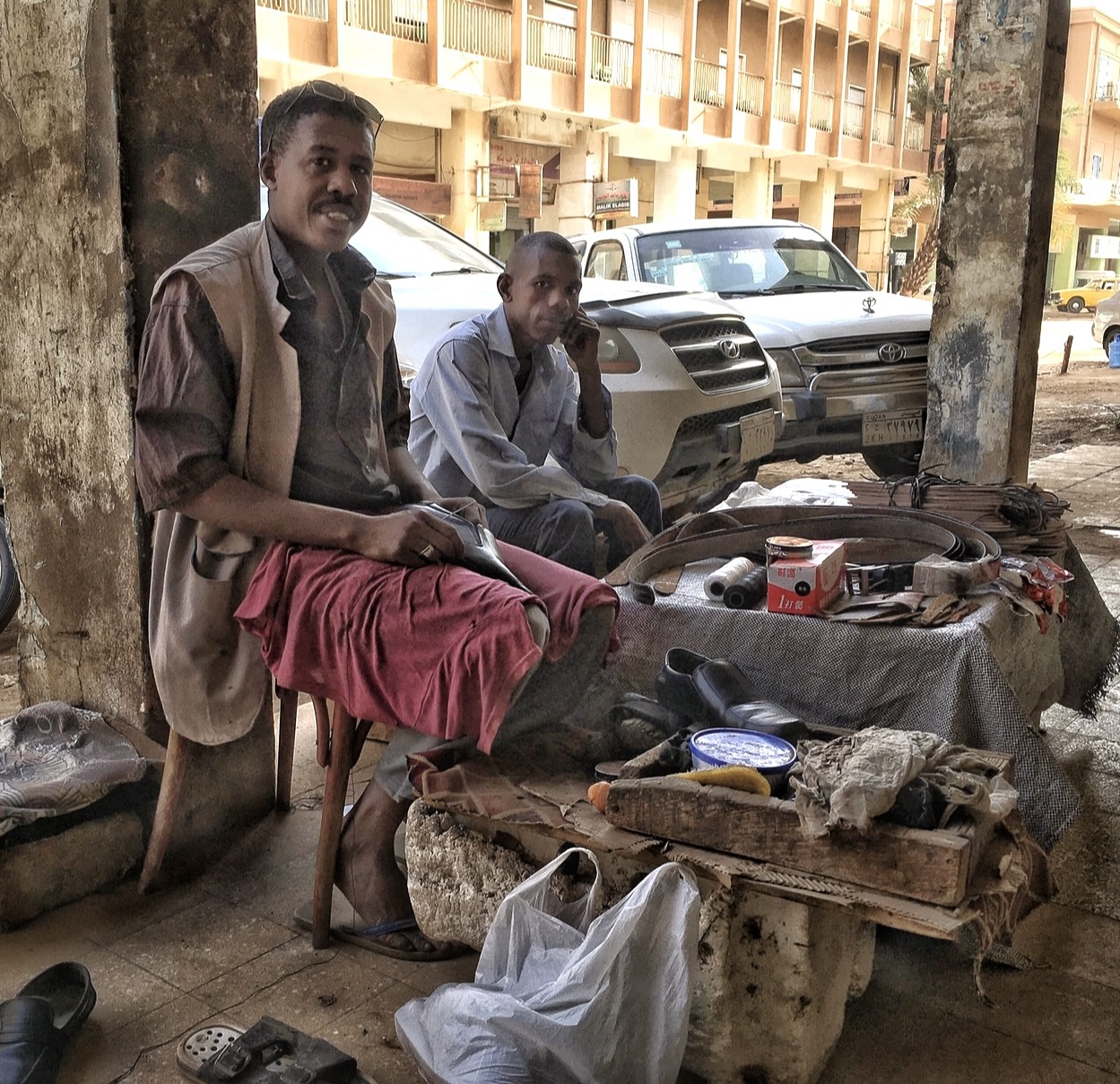

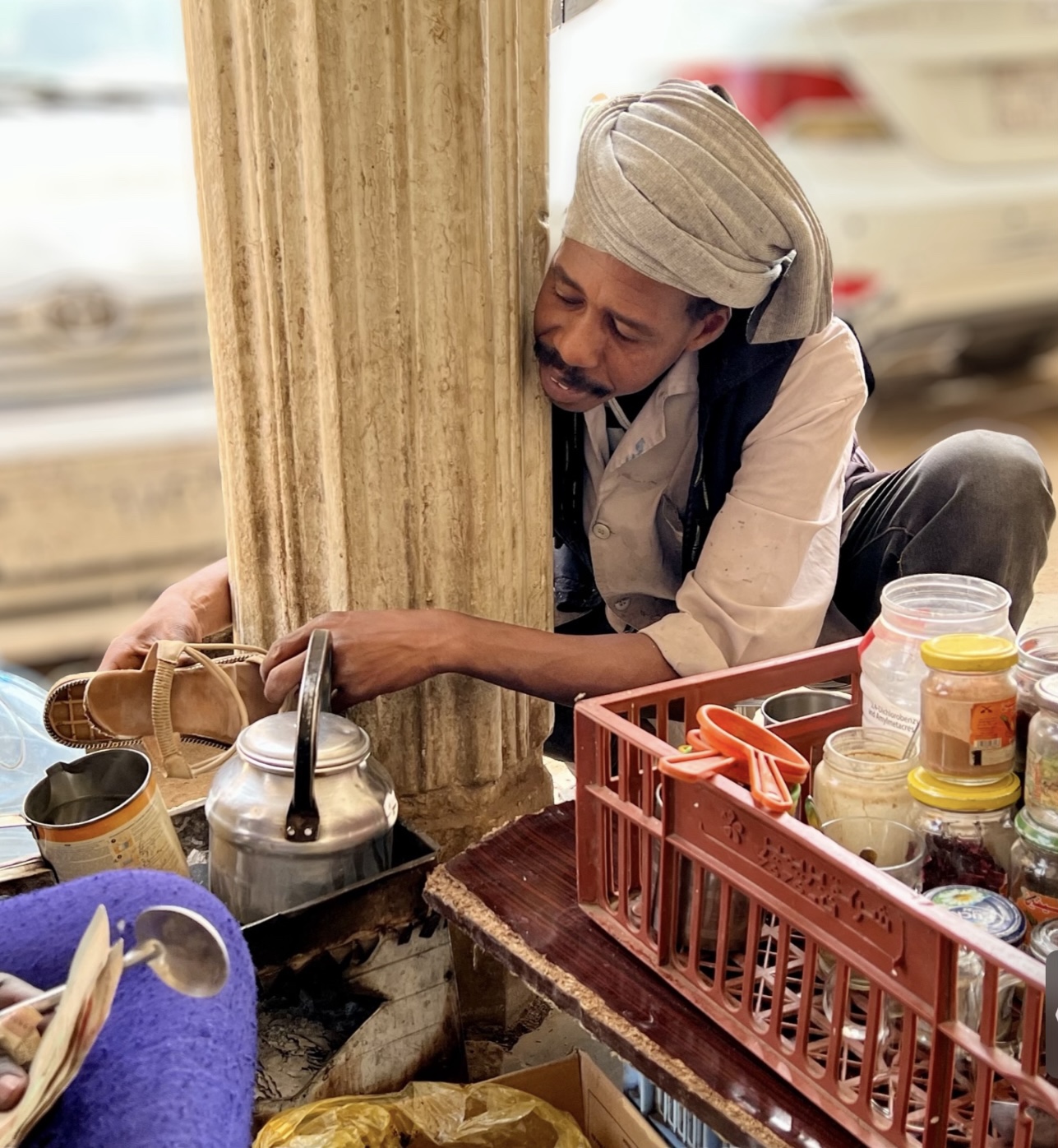

Above, morning scenes off Zubeir Pasha Street, pre-war. Among the warm community of the colonnades were the tea and coffee ladies, the cigarette and newspaper sellers and the nugulti.
“I remember there was a young man who used to come to me every week to sew up the same shoe in the same spot until I finally got fed up. The last time I couldn’t even find a place to put the needle in because the shoe was too worn out so I got up and threw the shoe in the rubbish and then took off one of mine, that was new, and gave it to him – to please God. He was so happy and he left me and never came back.” Ibrahim speaking to Mahasin Ahmed Abdullah, Al-Rakoba, as above.

My shoes were always a sorry affair while I was in Sudan. Scuffed, dust-caked or mud-stained within a few minutes of leaving home. I would marvel at how Sudanese women’s shoes maintained an immaculate sheen, seeming to glide unblemished over potholes, puddles and broken pavements. The Sudanese take great pride in their shoes and the care of them, believing, as sayings go, that the choice of shoe speaks volumes on the wearer’s innate elegance.

Before the war, the colonnades opposite the Acropole Hotel were home to a community of coffee and tea ladies who rose at dawn to trek into the city in time for the morning rush hour. Coaxing their charcoal braziers into life, they would share hot coals and incense with the fuul shopkeepers and cigarette sellers next door. Passing businessmen and civil servants would pause a while to have their shoes polished or restitched. The nugulti would offer them a sandal to slip on and as they waited, they sipped coffee, read the paper or told their prayer beads. Then would come the delicate closing dance – a point of pride for the craftsman, as he awaited the customer’s “response to the mastery of his work.” (Ali Al-Sheikh).
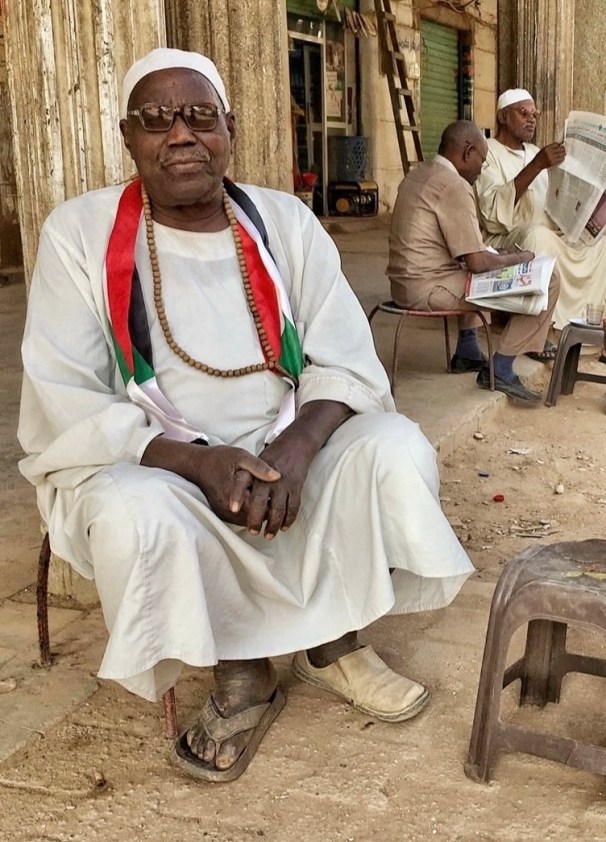

In Ali Al-Sheikh Al-Hanin’s lyrical homage, the nugulti is nothing less than a plastic surgeon, his scalpels, fine needles and surgical thread at the ready; his expert hands making incisions, excising and suturing wounds. As he adds beauty to the world, he binds up the homeland with his thread. For others, the nugulti is a skilled diagnostician of human gait, seeing telltale signs of bad posture in worn down heels. Left, telling prayer beads while waiting on the nugulti’s skills.
In recent years, in such economically precarious times, the nugulti’s skills, once in decline, are in demand again. Ever more shoes are resoled, reheeled and seams re-sewn under the nugulti’s skilled hands and even new shoes are brought in to be double-sewn to extend their lives. The same Ibrahim who offered his foot-weary customer his own shoe above has a face etched with “weariness, hardship and fatigue”, Al-Rakoba recalls. While he survives on his work, he barely makes a living. Let’s hope life gets easier for all Sudan’s shoemakers, shoe repairers and shoe shines.
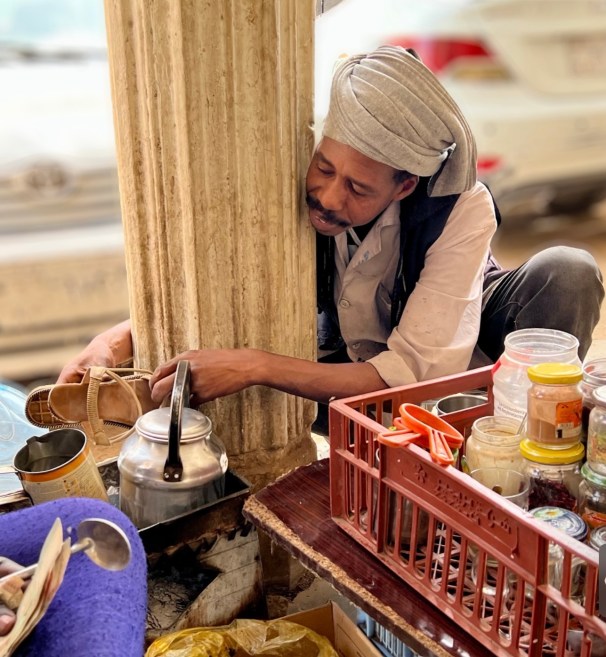
Above, sharing the warmth of the tea lady’s kanuun or brazier to fix cobbler’s glue.
You might also enjoy Khartoum in May and Working Hands
Below, interview with nugulti Musa Othman.
صباحات طيبة | تعرف على تجربة العم موسى” النقلتي” أنامل تصنع الابداع
 Women's literacy in Sudan