

An Ancient Art – The Wooden Door Locks of Nubia
A Brief Tribute to Their Craftsmen

Setting the Scene
Above and title photograph, the wooden lock securing gates to the ancient mud-brick temple known as the Western Deffufa, in the city of Kerma, northern Sudan, (photo Alamy, used under licence). The wooden pin and tumbler lock mechanism within its pared down patterned casing pictured here has been used for millennia, with experts agreeing early Egyptian and Babylonian cultures to be among the first to perfect this form of locking mechanism. Until recently, such locks were commonplace throughout the villages of northern Sudan, their craftsmanship especially associated with Sudanese and Egyptians settled in the Halfa region before mass displacement of these communities in the early 1960s.

Above, the Western Deffufa, Kerma, photo Wikicommons. Below, details of Nubian locks, sometimes known by the Nubian terms qaaluuda or Dabba, with their striking carved and painted geometric decorations and their flat, toothbrush-like as well as angled keys, known as at-tiirii or qaliid. The bolt is known as ash-sheruu. Doors in Northern Sudan were often made of sunut or scented pod acacia. Photos, Facebook.

An Ancient Art – The Wooden Door Locks of Nubia
A Dying Art The Copts of Khartoum and Their Keys Colonial Account of Two Locking Mechanisms
W.Merrill’s Research into the Wooden Locks of the Halfa Region
Video: The Language of the Locks

A Dying Art
As a young contract English teacher in Northern Province during the 1980s, I was delighted every time I came across a wooden gate or door lock as I wandered through villages along the Nile. Even then, most doors and gates were secured with thick metal bars and Chinese padlocks and wooden doors were being replaced by metal ones. Rather than forbidding and hostile to the passerby – a fierce “Keep Out!”, these carved wooden locks, crafted to integrate into the aesthetic of the home, invited the passerby to pause, enjoy them and wonder about the family within.
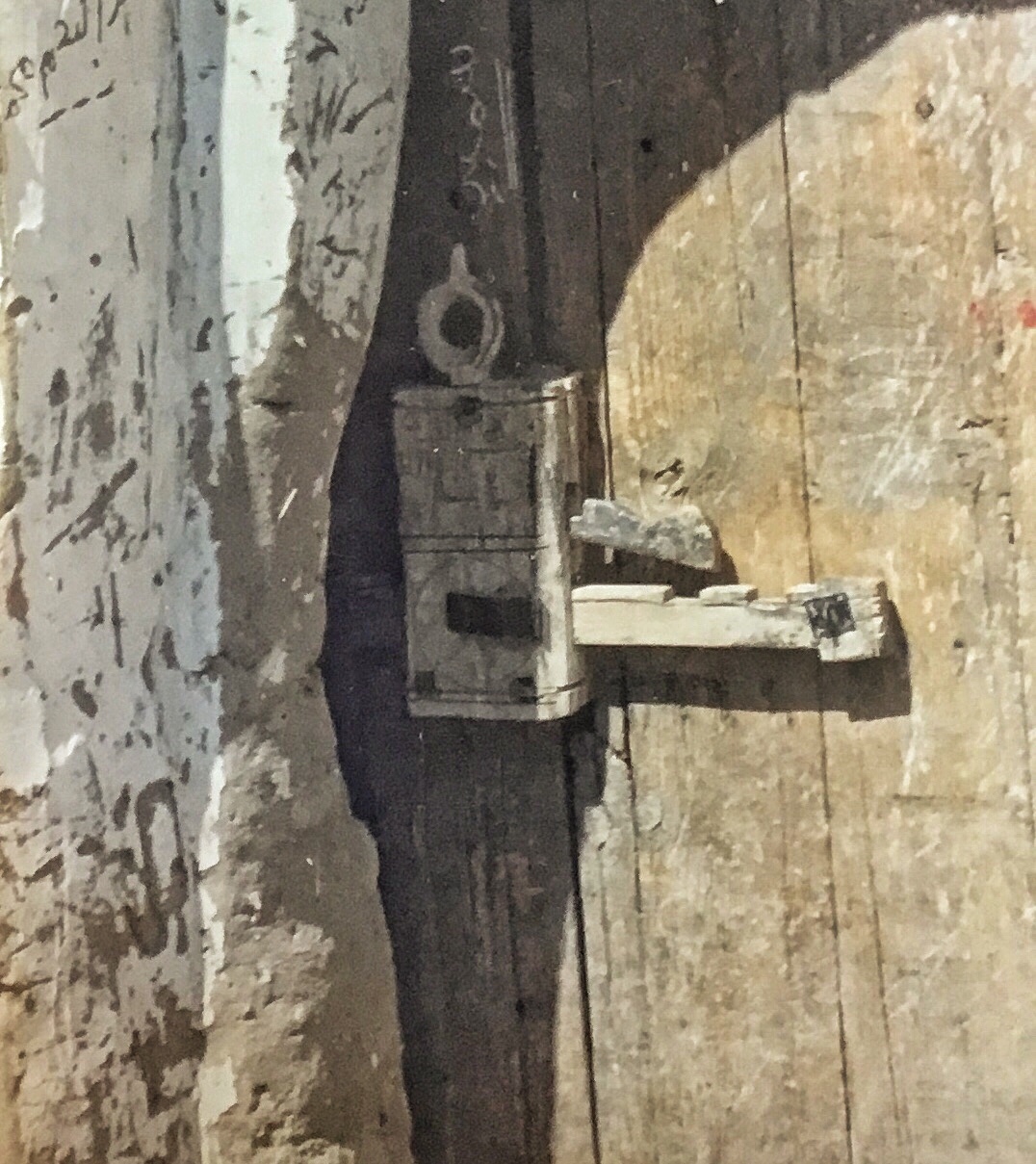

This week I draw on accounts published in Sudan Notes and Records between the 1940s to the mid 1960s documenting locks and lock-making in Sudan. One article in particular, The Wooden Locks of the Halfa Region, W. Merrill, Sudan Notes and Records, 1964, Vol. 45, pp. 29-34, provides fascinating insights into the artistry of Nubian locks and the culture of lock making as researchers conducted interviews with local craftsmen while they went about their work.

When Merrill was undertaking his research, traditional wooden lock making was sadly already becoming a lost art and with many villages abandoned, he struggled to gather detailed information on the origin of unusual designs. With the construction of the Aswan High Dam, roughly 50,000 Sudanese Nubians, many from the Wadi Halfa region, were displaced from their ancestral lands along the Nile and resettled by the government elsewhere. Many experienced this as a tragic uprooting from their cultural traditions. During his research, Merrill interviewed Abdullah Kheir, the last maker of locks on the Sudanese side of Wadi Halfa and who I believe is shown in the remarkable photograph below. Scroll down for a brief summary of this interview.

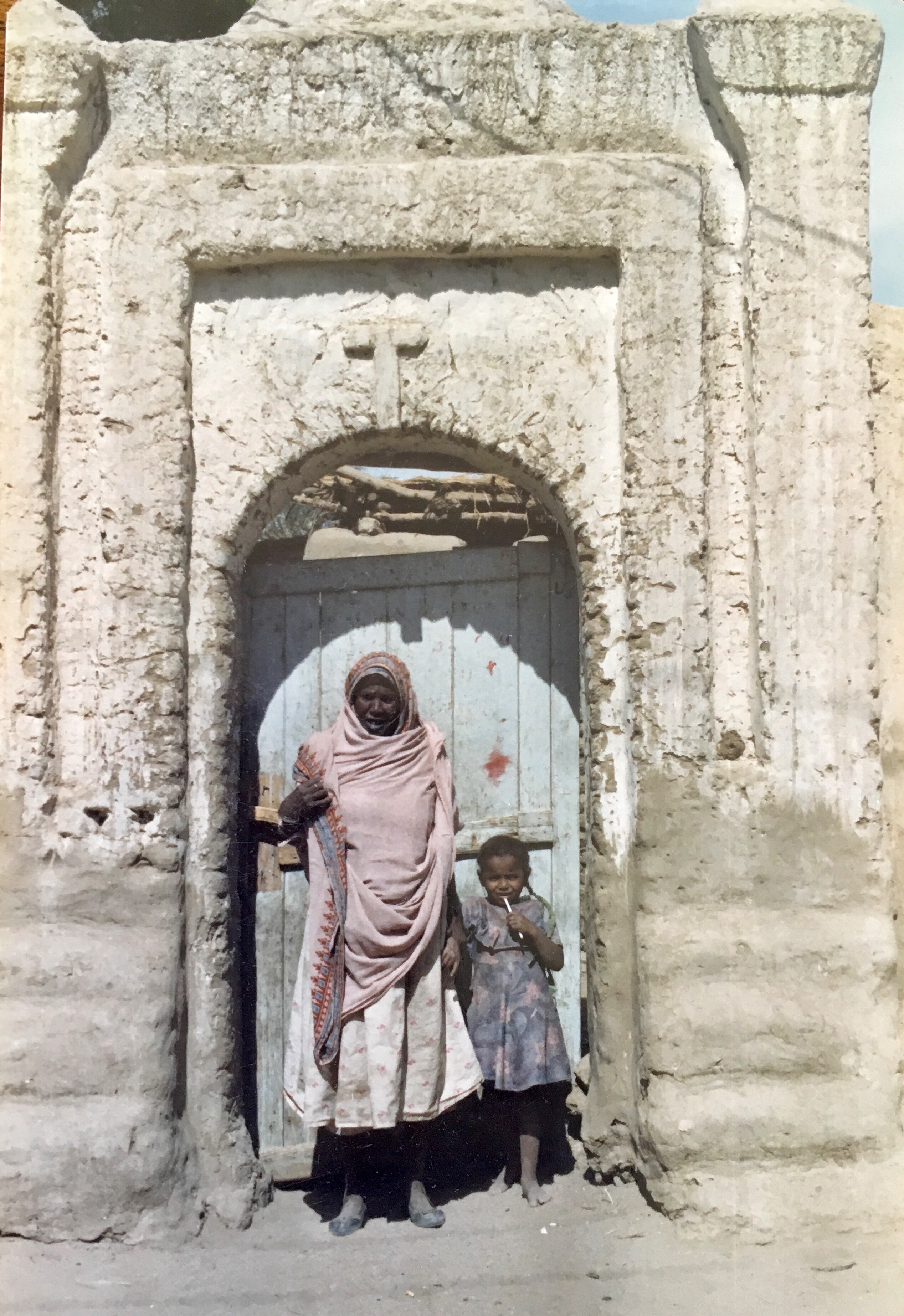
Upper right, a Nubian village door lock seen north of Dongola, early 1980s with its unusual dome-like finial. Next to it, diagram of the mechanism of the pin and tumbler lock; see a demonstration of the mechanism here and also here. Upper right, still from arD as-sumur documentary on Nubian vernacular architecture, transcribed in Nubian Architecture Part 2. Above left, a woman and child outside their imposing doorway, the lock just visible behind them, near Kerma, Northern Province, 1980s. Right, screenshot from the video featured below, revealing the fascinating semiotics of lock positions – at least on the Egyptian Nubian side of Wadi Halfa.
Below, the craftsman Abdullah Khair / Kheir at work. According to Konoz Yadaweya, posting on X, 2019, “Baqri Ashkeet asked him to make the last model before the displacement to Khashm Al-Qirbah.”
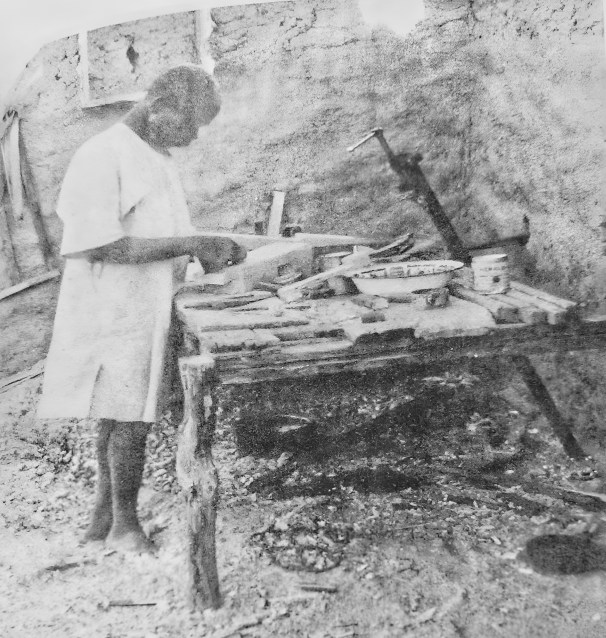
“Abdullah Kheir Al-Sid of Ashkeit showed us his workshop which was in a corner of the courtyard of his home. Using a simple plane, he smoothed off a block of sunt or tamarisk wood, cut from the local trees. A saw and a large chisel were used to cut out the holes for the bolt and tumblers and then he began to make the decoration. All measuring was done by eye, but he used an angle iron and the back of a saw for making straight lines. A tea glass and a halawah Tahineh can were used for obtaining the circles. With a saw, he cut the dividers and straight lines across the face. A small chisel was used to cut out the circles, half circles, and zigzags.”
The Wooden Locks of the Halfa Region, W. Merrill, Sudan Notes and Records, 1964, Vol. 45, pp. 29-34
Below, sketch by artist Margaret Potter of a 1950s Nubian doorway with its elegant lock complementing the traditional decorations and motifs of the home, taken from Everything is Possible. For more on Nubian architecture and the role of women artists in their decoration, see Inscriptions on Rosewater.
See too The Nubian Gate – is it seclusion or repose of heritage

The Copts of Khartoum and Their Keys
Below, a fascinating excerpt from a 1935 account of the history of Khartoum, referencing observations by Ferdinand Werne writing in the 1830s. The excerpt comes from C.E.J.Walkley’s The Story of Khartoum, Sudan Notes and Records, Volume 18, 0 1935. It offers possible insight on the expression “under lock and key”, hints at the dark side of secure enclosure and entertains with accounts of practical jokes of the era.
“Copts of this period, who were for the greater part clerks and the like, took great pains to safeguard their families. When they left their houses in the morning they locked their doors, and carried with them the large wooden keys with iron pins. All inside were safely locked in for the day as the master seldom returned home until the evening. Iron keys and locks were as yet unknown in the Sudan, and the local wooden lock consisted for a hollow square block of wood, which was firmly nailed to the door, and through which ran a slide or bolt. A square piece of wood which passed into a hole in the door post was movable in the block. This wooden bolt was hollowed or notched on one side, so a large square-sided key fitted into it. The locks could only be opened from the outside, and at night they remained unshot, the door being fastened by a cross-bar on the inside. It was a common trick on the part of certain wags to lock all the doors at night from the outside, so the owner of the house could only get out by throwing the key into the streets for a passer-by to unlock the door. Similar locks are still available in Omdurman.”
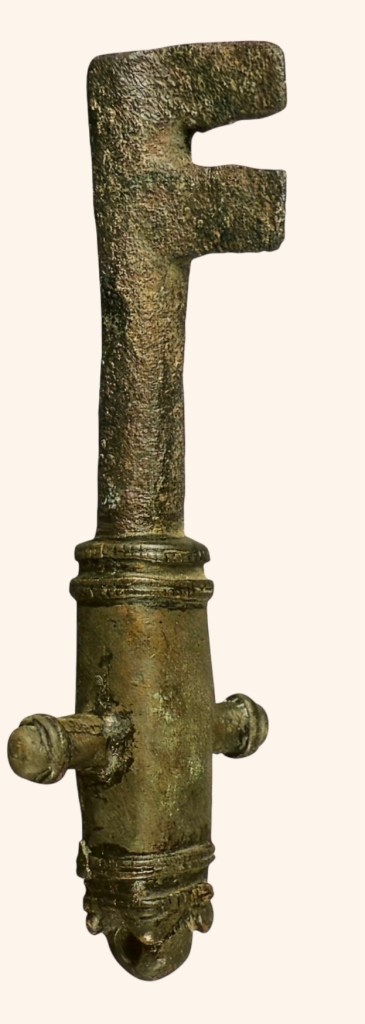
Illustration above left, a finely wrought, wax-cast 11th century or earlier copper alloy iron key from the Monastery of the Holy Trinity, Old Dongola, found in a cellar, indicating perhaps that “several places or containers within the monastery were accessible to a privileged few”, British Museum. Contrary to the account above, metal keys clearly had been known in Sudan’s earlier history.
Colonial Account of Two Locking Mechanisms
Below, description of locking mechanisms as observed by G.W. Titherington in Sudan Notes and Records, Volume 23, 0, 1940.

W.Merrill’s Research into the Wooden Locks of the Halfa Region
The Wooden Locks of the Halfa Region, W. Merrill, Sudan Notes and Records, 1964, Vol. 45, pp. 29-34

Writing in the mid 1960s, Merrill noted that while not all houses in the Halfa area were decorated, all had a “Dabba”, a Nubian term used to refer to a door lock in general and the main body that supports the bolt or sherū, and encloses the mechanism. He explains that each Dabba was made differently, with some incorporating two sets of tumblers, its angled receptor for the key making the lock harder to pick. According to Abdullah Kheir Al-Sid, the carpenter and lock maker from the village of Ashkeit referenced above, the ideas for the motifs that embellish the locks sometimes came from women’s jewellery, “decorating the otherwise plain door”. See the article for detailed copyright illustrations of these designs.

Merrill observed that few locks had decorations or finials protruding from the top as the one I saw in the 1980s and shown above, but some had a dome or double dome shape, crescents and or zigzags. In the area of Sara West he recorded an unusual finial of three or four pyramid steps topped by a diamond shape; a 3-dimensional decoration possibly the work of one man. For Merrill these designs were “strangely reminiscent of decorations on top of Koranic inscription tablets” although craftsmen denied they had any symbolic meaning. He noted that no two “Dabbas” were alike, citing X-shaped or hourglass scorings as the most common, followed by circle and half circle motifs accompanied by triangles, as well as rosettes, diamonds and chevrons. He also recorded an ornate design with domes, flags and crescents, thought to represent a mihrab, mosque of a holy man or his tomb and noted that designs sometimes bore carved inscriptions of Islamic blessings such as “In the name of God” and “Enter in Peace”. Sometimes delicate side elements were incorporated; stars, water jugs, birds or automobiles, though the researcher’s informants emphasized that “pictorial elements were rare and the ‘work of young people.'”

The decoration on the face of main body of the lock is often repeated scaled down on bolt. Abdullah Kheir explained that the cost depended on the size of the lock, not its decoration, that locks on internal doors were smaller and that he rarely worked on requests, rather creating designs that “took his fancy.” As all locks in a village were usually made by the same man, their designs would all bear his signature motifs, although one village boasted notably varied designs supposedly all made by the same carpenter.
Most locks were made by professional carpenters, the craftsmen learning their skills from their fathers or grandfathers. Merrill was told of one who had gained his training at carpentry classes held at the village school. Abdullah Kheir told him that he always wanted to make his locks “as pretty and different as possible” so they would sell more.
The craftsmen Merrill met also told him of their understanding of the history of wooden locks. They claimed the earliest locks were found in Dongola and Omdurman where the key would slide into the main body of the lock, believing the angled key to be a later addition. Earlier locks were not decorated and doors were smaller and also undecorated. With the advent of larger doors and their decoration, locks came to be decorated too. Earlier locks were rounded “like a log” and Merrill relates that the oldest such Dabba in his survey had come from a house washed out by floods forty or fifty years before.
Among the most interesting insights provided to Merrill was that the shape of the lock was symbolic in that when closed it formed a cross or an X – the sign for nobody to enter and even possibly represented a relic of Sudan’s Christian past, echoing the cross of Christ.
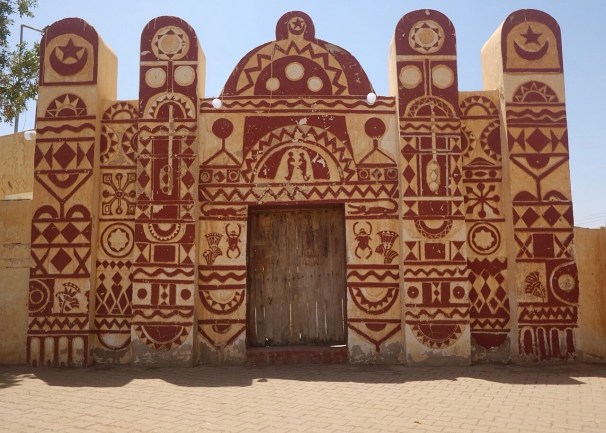
Upper left, a Nubian doorway in the Wadi Halfa area, photo Alamy, used under licence. Below it, illustration by Margaret Potter of a particularly ornate lock from Everything is Possible. Upper right, a woman stands at the doorway of her Nubian home, photo Alamy, used under licence. Above right, The Nubian Club, Khartoum, Wikicommons. Above left, exhibit at the Sudan Ethnographic Museum, Khartoum, pre-war.
Below, an Egyptian Nubian reveals the secrets of lock positions in his region.
 Women's literacy in Sudan