

The Clever Sheikh of the Butana and Other Stories
Sudanese Folk Tales Retold by Ali Lutfi Abdallah
A Tribute

Above, Scenes inspired by folk tales of the collection The Clever Sheikh of The Butana.
Sudanese Folk Tales as Cultural Artifacts The Context to The Clever Sheikh of The Butana
Magic, Adventure and Lessons Learned

Setting the Scene

This is a world where wise sheikhs temper justice with compassion, sinners are given a second chance, heroines outwit malevolent forces with quiet grace and mothers impart wisdom to their sons by allowing them to learn from their own mistakes. Young men embark on daring adventures too and in doing so learn the true measure of courage and steadfastness.

Set in “times long, long ago when all things talked the same language”, these are tales of buried treasure, enchanted trees, evil spirits, magic pots and satisfying comeuppances. Often reminiscent of Aesop’s Fables – see for example The Fox Learns How to Divide, and classic hero’s quest narratives of western myth; see The Nabaga of Life, these twenty-six tales are also uniquely Sudanese in setting, the musicality of their verse, and in the cultural messages they give voice to. Woven into the fabric of these tales too are the landscapes of the regions these tales come from; north, east and central Sudan, and in particular, the Ruf`aa and Dueim of the author’s birth and childhood.

Ali Lutfi, (Ruf`aa White Nile, died 2014) the reteller of these tales, received his formal education under the British, and after completing his school studies in English, became a primary school teacher. He would go on to become school inspector in Al-Gazira and to teach in Saudi Arabia, Sudan and The United States. Throughout his life, the author strove to extend educational opportunities in Sudan and to make the richness of Sudanese literature and culture available to non Sudanese audiences.
Above, cover of the 1999 Interlink Books, New York edition. It is beautifully illustrated by artist Elnour Hamad, “driven into exile for his role in a progressive Muslim reform movement”, as the forward to this edition reads, referring to The Republican Brotherhood.
Below, how I imagine the scene in Plant Well, Cultivate Well, when a young woman, having learnt how kindness can tame even the fiercest opponent – and her husband, succeeds in plucking a whisker from a lion. Folk tales often provide magical backstories to popular proverbs and sayings, as here; “one who is kind can pull a lion’s whisker.” They also flesh out aphorisms such as “bravery is only patience”, in What Bravery Is in powerful and memorable ways.

“A time came when all caravans and travelers left the road and went to Attay’s village, and it became the most important station on the road. When they were there, they were hosted in the best manner. They were given their rooms, the place where they slept, and anything else they needed. For all this, of course, they paid no money. In return Attay would accept nothing. There are still people who live this way in the Sudan.”
A poignant excerpt from the tale Generosity Bends the Road, cautioning against the loss of Sudanese values of selfless generosity to the stranger. A generosity I experienced as a guest to Northern Province in the 1980s and for which I am profoundly grateful.
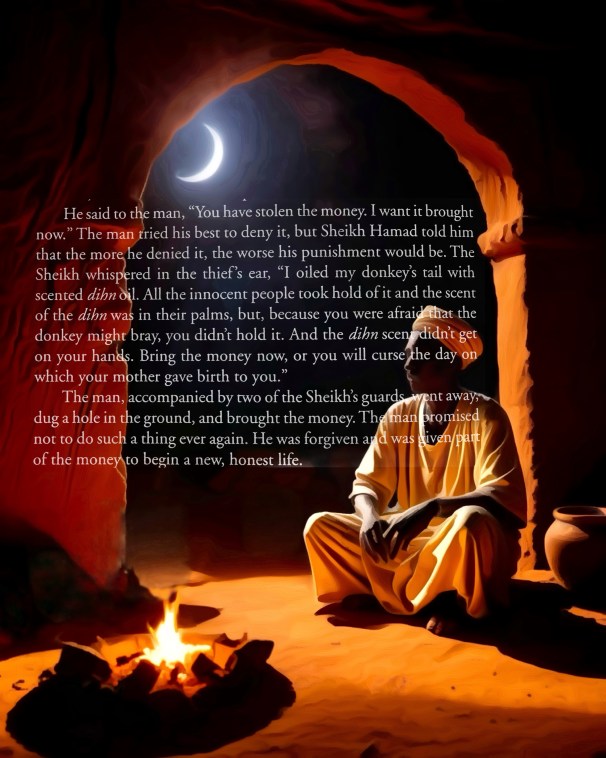
Below, a uniquely Sudanese test of honesty: the close of the title tale, The Clever Sheikh of the Butana.
Sudanese Folk Tales as Artifacts


Folktales have proved powerful vehicles of cultural identity and poetic wisdom in Sudan. In our women’s literacy programme, now sadly suspended, the retelling and critical analysis of folktales proved a dynamic and engaging literacy teaching aid. Sudanese folktales have been recruited in the service of social and political movements both in Sudan and among the Sudanese diaspora, all of which see in them the version of Sudanese identity they wish to claim as most authentic. A feminist vision of feisty heroines, an expression of traditional, God-fearing values, a celebration of the Sudanese poetic and proverbial voice, rich in aphorisms; a well of almost spiritual inspiration to be drawn on in the midst of oppressive xenophobia for those Sudanese who live in Trump’s America. They can also be seen as a subtle reclaiming of the voice of the poor and marginalized; in the Face is a Dagger, for example, a poor man with nothing to lose kills a lion nobody else has the courage to face and is rewarded with the means to be self-sufficient.


None of these sociological readings tell the whole story and none are unproblematic. Some English-language published Sudanese folktales – not, I stress The Clever Sheikh of the Butana, contain slurs against women, non-Muslims, “slaves”, and one I have read is profoundly anti-semitic. They are of course the product of their time and must be understood as such. Through a certain lens, the line “all the girls were beautiful and all the boys were smart, strong and generous” may well now seem grating. The death of the all too beautiful yet impeccably virtuous Tajouj (The Fatal Beauty of Tajouj) who just can’t win is a case in point. Perhaps though, these elements make the discussion of Sudanese folktales even more informative and valuable when approached with an open mind.
Upper left and right, the way I imagine the Clever Sheikh and a scene from the collection, and lower right, a Sudanese lyre or tambour, often featured in the tales. See more in The Sudanese Tambour. Above left, the way I imagine the many cruel sultans and kings that people these tales, destined to learn the lessons of good governance the hard way.
The Context to The Clever Sheikh of The Butana

Stepping into these tales, we step into the “story listening days” of the author’s childhood. Stories told to him by grandmothers, serving women and the descendants of slaves. In his Introduction to the tales, W.Stephen Howard reminds us that the Ruf`aa and Dueim of Ali Lutfi Abdullah’s youth “were yet to be electrified. The nights were moonlit or starlit and children were calmed down” before bedtime or during major events by stories told by family matriarchs – women who came into their own when weaving tales of beautiful yet plucky girls and wicked brothers undone. “Old women were the lending libraries for these stories, remembering and embellishing as their energy permitted or as the children’s restlessness demanded”.

Setting the scene, Howard goes on; “Before she begins her tales, the old woman moves slowly to the zir, the clay water jar, for a cup of cool water. She keeps it at her side and sips from it” as she tells her tale. Sometimes tales were told over comforting “bowls of sorghum or millet porridge” or skillfully dramatized to backdrops of sand storms or gales outside.
Politicians, Howard suggests, learnt their oratory devices from these story telling grandmothers. The tales are also full of poetic – “the white eagle of dawn beating the crow of night”, lyrical and musical refrains woven into the rhythms of the everyday lives of their protagonists as they struggle to support their families.
Learn more about grandmothers and their key role in literacy and the negotiating of cultural identity in Grandmother’s School and “Muslim Like My Grandmother”. Above right, my wonderful neighbour and teller of tales in 1980s Dongola, Northern Province. Above left, one of the dazzling heroines of the tales as I see her.
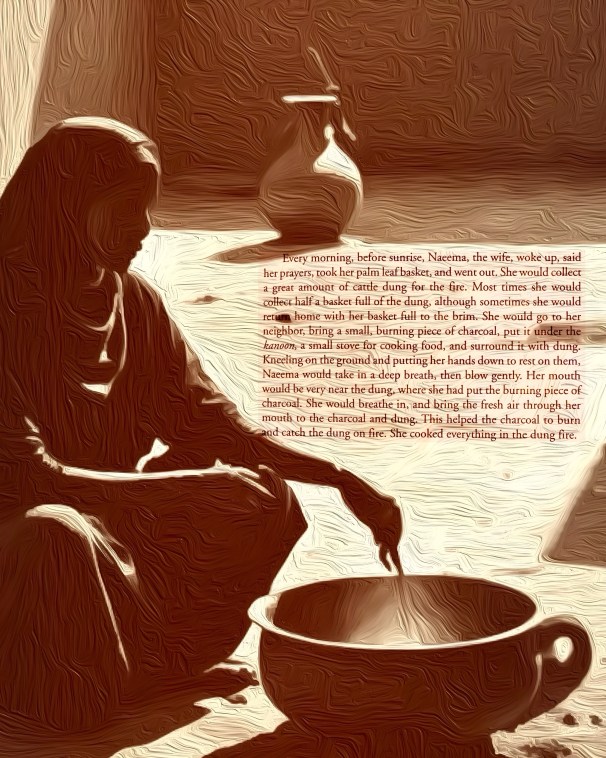
Below, from Plant Well, Cultivate Well. Folk tales mirror moments of arduous daily life for rural Sudanese.
Magic, Adventures and Lessons Learned
Selected Excerpts from the Tales

In the tale, In Unity There is Strength, a dying father gathers his sons around him and asks each of them to bring a stick. He then instructs them to break the stick, which they swiftly do. When asked to place the sticks in a bundle, however, they find they cannot break them. “O my sons! You are like these sticks. If each of you stands alone, by himself, and doesn’t pay attention to the others, he will be as easy for an enemy to break as a single stick. But if you band together, and be as the fingers of a hand, you will be unbreakable..” In similar vein, in Where the Treasure is Hidden, a son learns that his father’s dying references to buried treasure on his land were but metaphors for the enduring treasure earned through honest labour and perseverance.

In The Good Excuse, a poor fisherman enters a brutal king’s court, only to outwit him and teach him, at the risk of his own life, to cast aside his impulsive cruelty and embrace kindness and reflection. The tale closes with “The king never gave an order, except after thinking it over several times.” The issue of good governance explored here is taken up in other tales too.
Many tales explore themes of betrayal and reconciliation. In The Magic Ring the prodigal son is welcomed back with love into the bosom of his family by his pious father after consorting with gamblers and “shameless women”. In The Story of Al Giseima, many recurrent themes emerge: betrayal by friends who are later forgiven, families reunited, the outwitting of ugly evil spirits or roole / ghool, sinister bodily transformations, skins shed and beautiful maidens restored; all at a breathtaking pace.
If you enjoy Sudanese folk tales, you might find these articles interesting:
Bringing Sudanese Folktales to Life

 Women's literacy in Sudan