

A New Year’s Mystery – An Omdurman Amulet
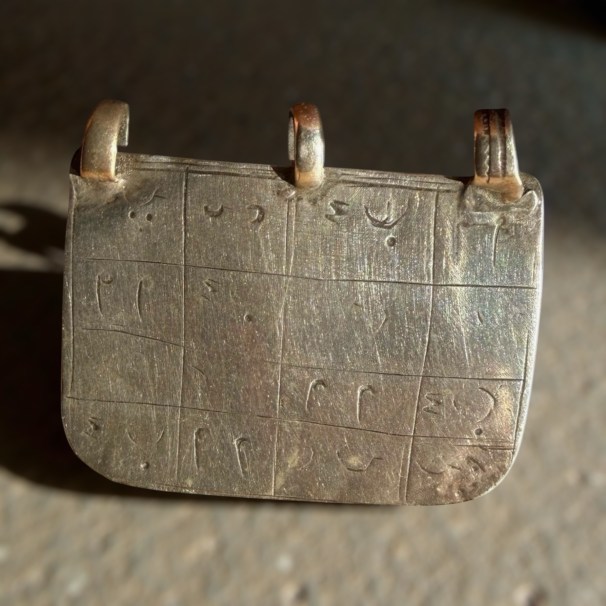
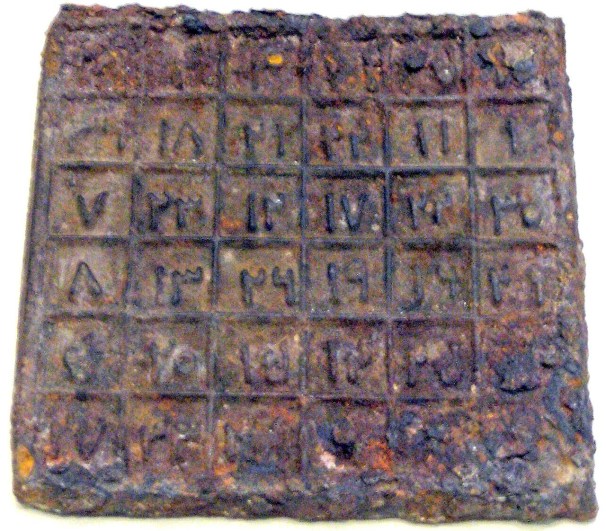
Above, the face of an amulet I acquired in Omdurman in the early 1980s. Possibly made of silver, it bears a four-square grid roughly scored with numbers and Arabic letters which themselves bear numerical values. Its soft silver-grey sheen and deeply worn surface have always fascinated me. I like to imagine that for someone – perhaps long ago – this was a treasured object; the coolness of its silver surface worn hidden against warm skin. Suspended from thick cord passed through its metal loops, it would have been worn around the neck or across the chest, the central loop possibly serving to hold a smaller additional leather amulet. The piece appears to take the form of what we know in English as a 4X4 magic square.
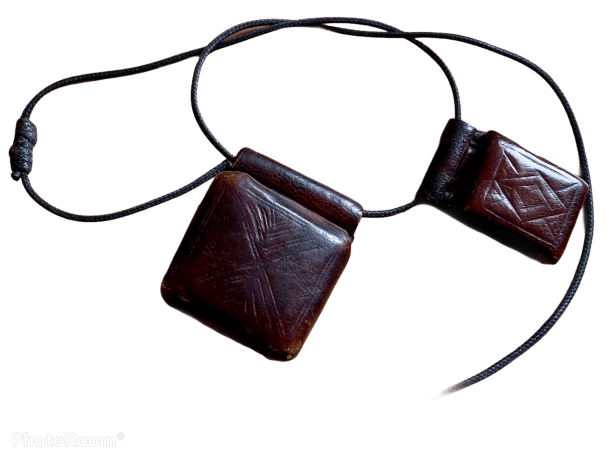
Above, examples of Sudanese leather amulets enclosing sacred script and known as hijābs, personal collection.
This week’s brief post is a footnote to my long read article on Sudanese Sufi amulets or Hijãb (plural Hijbāt); Unfolding Blessings. It explores the role of magic squares in Sudanese esoteric traditions. It would be wonderful if anyone reading this post could unlock something of the mystery surrounding this beautiful object. In this post, I draw on the work of jewellery expert, Dr. Sigrid van Roode of Bedouin Silver, Professor Saiyad NIzamuddin Ahmad, Department of Arabic and Islamic Civilizations, American University of Cairo and Dr. Ahmed Al-Safi of Sudanese Traditional Medicine.
Setting the Scene
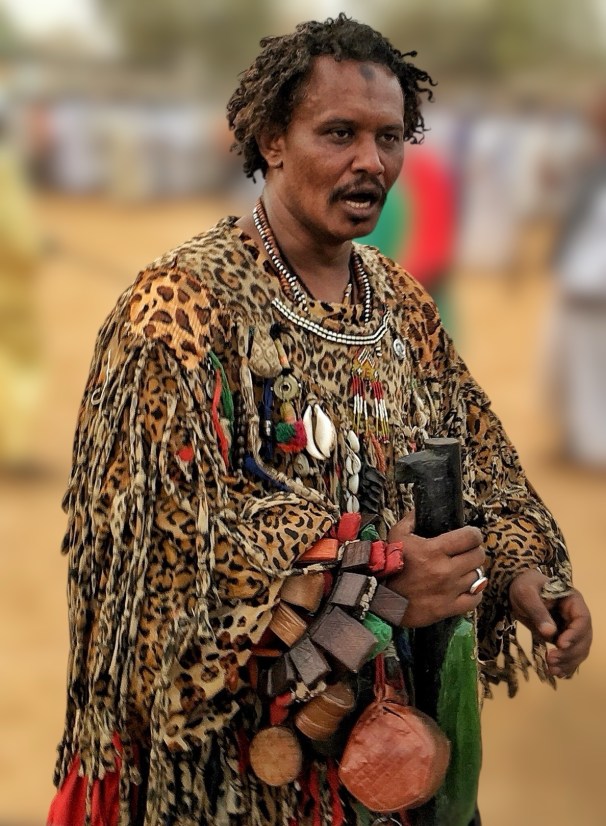
Above, a Sufi worshipper acknowledging a fellow devotee during a zikr celebration at Hamid Al-Nil, Omdurman. Bands of richly tooled, leather-bound Hijāb drape his arm. See more in The Eternal Dance – Updated, Sudanese Moments and Memories of Omdurman.
Believed to be pre-Islamic, possibly Babylonian or Syrian in origin, these amulets often encase holy writings, full or abbreviated names of God, or the archangels, propitious numbers, magical squares and astrological symbols. They are still sought out and worn proudly by many Sudanese today; “prescribed to grant safe passage through life’s changes” (Dr Ahmed Al Safi).
Interwoven within rituals that draw on rural and herbal medicine; mysticism, and folklore, they embody one of many expressions of Baraka, or benediction; blessings given by God and found in the person of holy figures, certain acts and “any phrase from an Islamic ceremony or prayer devotion which is believed to be infused with baraka and highly efficacious when retained on one’s person, either in the form of a memorized formula or an amulet…“ (Sanneh 1979:208), as quoted by Osman El-Tom, Berti Qur’anic Amulets by A.Osman El-Tom University of Gezira, Sudan, Journal of Religion in Africa, XVII, 3. They may be invoked to guard against malevolent forces, as well as the jealously or anger of others.
Speculations and Musings
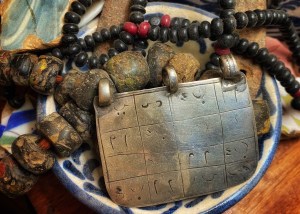
Google Gemini tantalizes with tales of a Mahdist warrior commissioning the amulet that has fallen into my hands so he might ride into battle impermeable to colonial bullets. AI even suggests that its silver was pressed from melted down Austrian-minted Maria Theresia Thaler coins, once the hard currency of Sudan, and often used in jewellery and adornments because of their high silver content. This origin story is enchanting but I fear sadly fanciful.
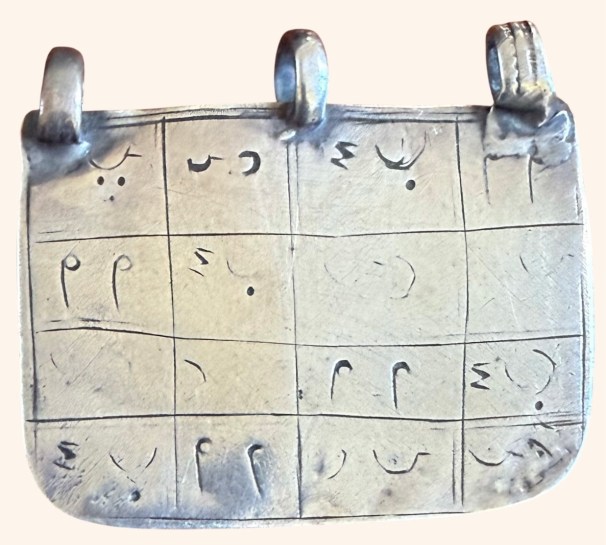
A kind respondent on Facebook told me she’d shown the picture of the amulet to an elderly Sudanese friend who said it reminded her of the kind of “spell” used by wives to curtail the powers of mother-in-laws to interfere in their sons’ affairs, thereby securing complete control over their husbands. Delightfully mischievous, this story speaks volumes on age-old negotiations of marital rivalries but again, I fear, is improbable. Perhaps though, it is a hair more likely than Gemini’s account.
Dr. Ahmed Al-Safi has emphasized the Hijāb is personal to its bearer, commissioned from a Sufi holy man believed expert in esoteric sciences and in many ways bespoke and unique; “Indeed, while making the hijāb, the faki notes the nature or tabii’a of the client or that of the person to be charmed” and “that it is customarily worn by the person for whom it is prescribed if its purpose is protective, and hidden if it is required to bewitch someone.” (Al-Safi, Traditional Sudanese Medicine).
Researchers writing in the 1980s – around the time I acquired mine – note that “impersonal Hijabs” are now sold in markets, a practice condemned by many fakis.” I have to admit, then, that mine may well be one of these garden-variety hijābs, destined for the market. The numbers and letters plotted across its grid – apparently with such deliberation – might be entirely meaningless but there is just a faint chance they are pseudo-script, engraved to thwart malevolent spirits from divining their true meaning, as Dr Al-Safi has also documented. I doubt I will ever know and perhaps that is the way it should be.
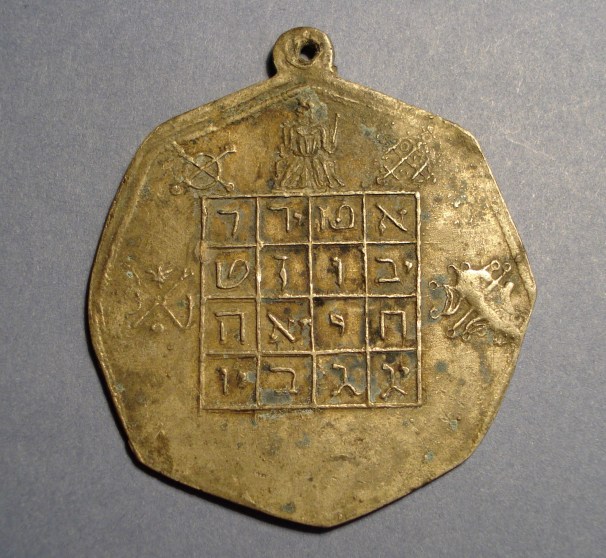
Above right, an octagonal amulet with a magical square of Jupiter in Hebrew letters, 16th-18th century European, Trustees of the British Museum, CC. The 4×4 magic square is often associated with Jupiter, with attributes of justice and wisdom, health and prosperity. AI has suggested that may just be the case with my amulet.
Magic Squares
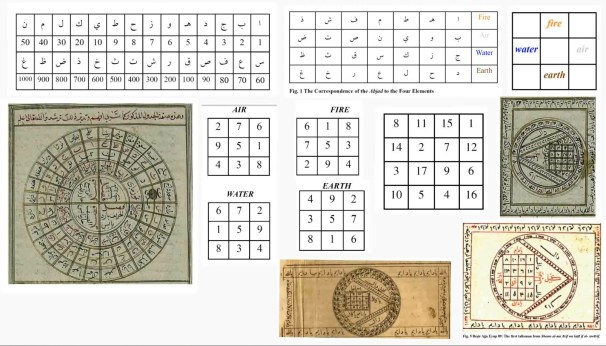
Screenshot from Professor Saiyad NIzamuddin Ahmad’s exploration of Islamic esoteric technologies, Magic and the Occult in Islam: Ahmad B. `Ali Al-Buni (D. 622H / 1225CE?) Shams Al-Ma`arif. Top left, the numerical values often attributed to Arabic letters, centre, letters associated with the four elements and below them examples of 3×3 and 4×4 magic squares.
See too Wikipedia: Magic Squares
In Arabic, the term “magic square”, Professor Saiyad Nizamuddin Ahmad is quick to stress, does not exist. We understand the term to refer to square grids composed of smaller squares containing numbers that add up to the same total, whether calculated vertically, horizontally or diagonally. This sum is known as the “magic constant”. In Arabic these squares are known as awqaaf, sing. wifq, a nuanced term evoking numerical or mathematical harmony and balance, or the harmonious disposition of numbers. It does not embrace the term “magic”, which in Arabic is often associated with taboo and doctrinally unacceptable practices. Watch the professor’s introductory video, The Basics of “Magic” Squares: The 3×3 Square.
Magic squares are believed to be at least 2000 years old, originating in China and brought to the Arab world via the silk road. Dr Sigrid van Roode reminds us that they are common to Islamic, Jewish and Christian traditions and were associated in the ninth and tenth centuries with the easing of childbirth (Dr SIgrid van Roode, Bedouin Silver publication, Magic Squares). They have been studied in the Islamic world since medieval times, contemporaneous with the introduction of chess there. The magic square gradually took on esoteric and talismanic properties, linked to the courses and attributes of the heavenly bodies, astrology and the elements.
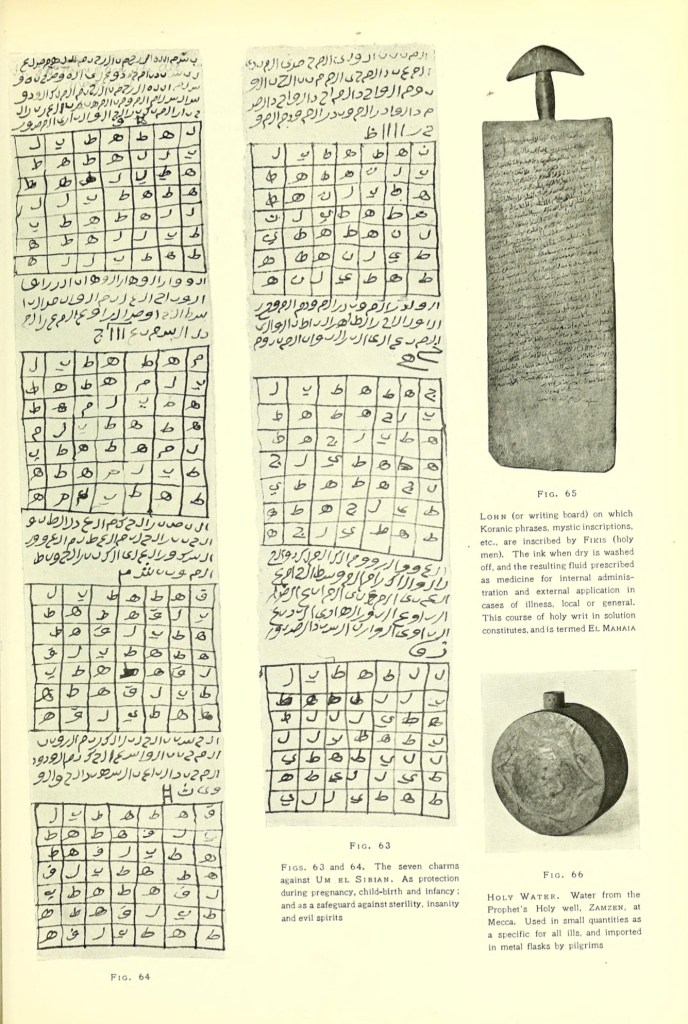
Left, an extract from R G Anderson’s Medical Practices and Superstitions amongst the People of Kordofan. See more on these fascinating examples of talismans and their chronicler in Unfolding Blessings.
In Sudan, magic squares were known under the misnomer muthallath (triangle) or khatim (seal) of al-Ghazali (Dr. Ahmad Al-Safi). Drawing on the work of Professor Tigani Al-Mahi’s investigation of Sudanese amulets and charms in An Introduction to the History of Arabian Medicine, Dr Al-Safi explains that the symbols used in Sudanese amulets are similar to those of Babylonian languages and the names invoked appear to be corruptions of Babylonian deities. He believes magic squares, one of many elements constituting the ancient `ilm al-`adad or the science of numbers or numerology, to be Syriac in origin and the numerical patterns, such as the sexagesimal as Sumerian. “Almost every medieval Arabic medical book that is available to the Sudanese traditional healer” Dr. Al-Safi continues, “is rich in magical seals, numerical squares, and numbers reminiscent of Babylonian origins.
Above right, iron plate with Arabic numbers forming a magic square adding up to 111, Yuan Dynasty 1206-1368, Wikipedia CC.
In his exploration of esoteric technologies, Professor Saiyid NIzamuddin Ahmad describes the Arabic `ìlm al jafr; the science of the symbolism of letters in all their dimensions – visual, phonetic, arithmetic as “the pith and harrow” of what he has coined Quranic theogy, often based on the divine names of Sufi practice. Also known as `ilm al-Huruuf, the science of Arabic letters, Dr Al-Safi claims, was introduced to Sudan by Arab missionaries, who brought with them their popular medieval science books. The practice of numerology was confined to Sufi experts, fakiis and faqirs, with the layman knowing only of so-called auspicious numbers, such as 3, 5 and 7. In Sudan awqaaf might be written, along with holy verses, seals and astrological formulae, on sheets of white paper known as bakhra (see Incense (بخور bakhūr) in Sudan). The sheets are folded, given to the patient or set aside to be burnt in an incense burner alone or with frankincense or ambergris. The patient, enveloped in a toub, inhales the fumes, (Dr. Ahmad Al-Safi).
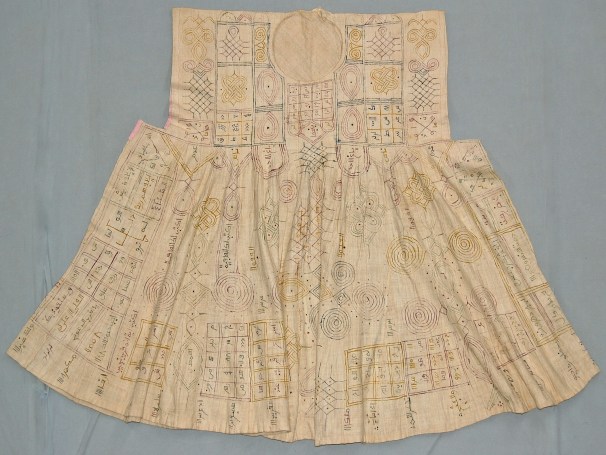
Above left, a tunic elaborately painted with Qu’ranic texts and magic squares, made by the Hausa people in the 1970s, Trustees of the British Museum, CC. See more stunning examples of talismanic robes here.
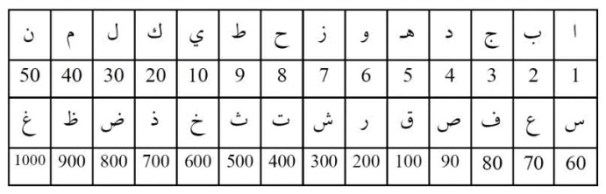
In her Magic Squares and Numerology in jewellery Dr. van Roode explains that for many, the magic square is a mirror of the divine order of the universe, a trap for evil spirits and a vessel for divine blessing. In a pseudo magic square, the shape of the square alone is regarded as beneficial. She explains that “the most widely used square is the ‘buduh’-square: an arrangement of the numbers 1 through 9 with 5 in the middle, that reads 15 in all directions. This square gets its name from the four letters on the corners of the square when noted down in the Abjad letter-numerals shown above: b-d-w-h. Its powers were believed to be so strong that the name ‘buduh’ itself was enough to invoke that power.”
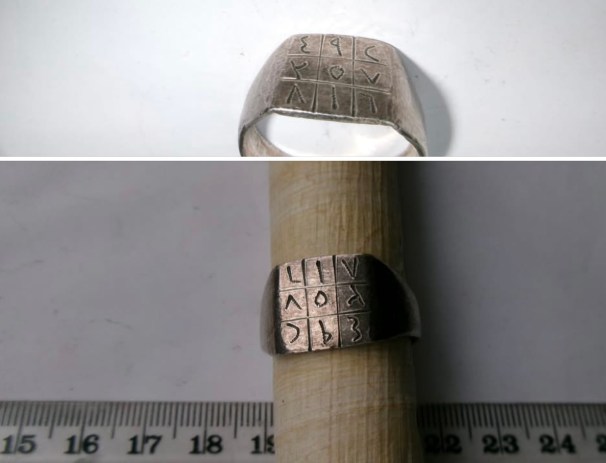
“The placement of the number five in the centre is also an indication of the universe, in symbolizing humankind in the middle of the four cardinal points. Elaborating on this idea, the central number in any magic square is often considered to represent God in the centre of His creation. Some amulets leave this middle field blank out of respect for God, or simply write Allah or one of the 99 Names of God. The magic square in this way becomes a symbol of God, holding the universe in order and controlling creation.” (Dr. Sigrid van Roode).
Above left, a ring found by River Thames Mudlarkers in London, The River Thames Mudlarking Finds, Facebook. Note the central 5 in this classic 3×3 magic square.
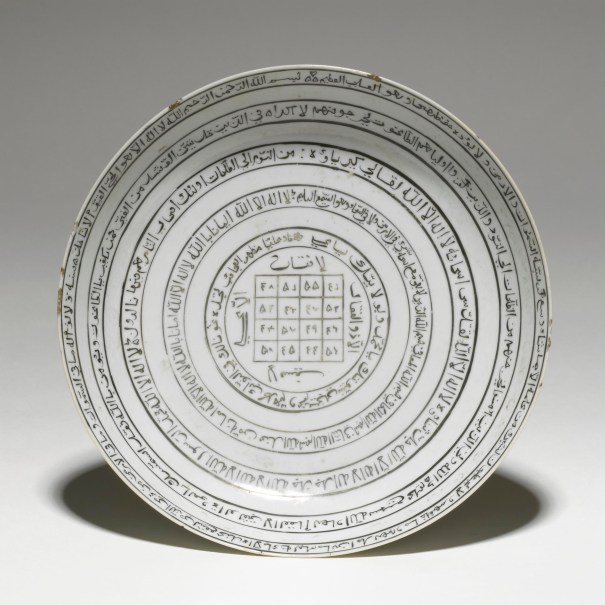
Above right, enamelled porcelain dish with a 4×4 magic square in the centre and Arabic inscriptions including the ayat el kursi, The Throne Verse,, Qing Dynasty, 1786, China, Trustees of the British Museum, CC.
I would like to think that the forms traced within the bounds of my amulet might also echo ancient understandings of humanity’s place in the vastness of the universe in these troubled times. The amulet, I hope, will one day return to a homeland at peace. It will soon be in safe Sudanese hands.
 Women's literacy in Sudan