

Freedom, Peace and Justice
Watchwords and Slogans of Sudan’s Peaceful 2018-19 Revolution Part 1
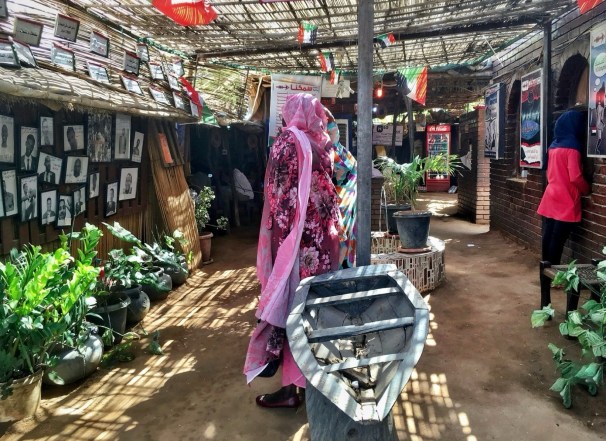
Sudan’s peaceful revolution of 2018-2019 saw an outpouring of artistic, musical and poetic creativity. Its energy is also evident in the pithy and defiant watchwords and slogans it coined. Slogans sung, chanted, shouted and roared by thousands in the streets of Khartoum and elsewhere. In 2019 I was lucky enough to come across a tribute to the slogans of the revolution when I visited Khartoum’s Samaknaa restaurant. There, photos of some of the many young men and women who tragically lost their lives during mass demonstrations and sit-ins across Sudan were displayed, along with framed collections of some of the most popular slogans of this heady and dangerous time.
Above, the dappled entrance hall to the restaurant. To the left, photographs honouring the martyrs of the revolution and above them, some of the framed slogans that this article explores.
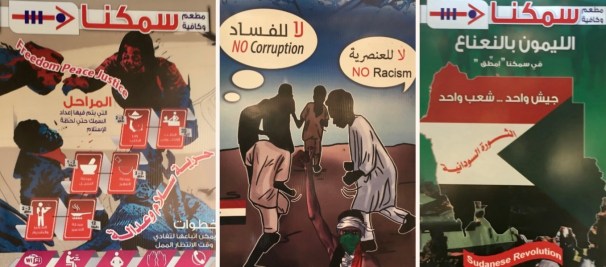
Above, posters displayed at the restaurant in support of the uprising; right the slogans emblazoning the map of Sudan read, “One Army, One People” and “The Sudanese Revolution”.
Setting the Scene
The watchwords and slogans of the Sudanese Revolution embody in punchy shorthand unyielding principles of a movement seeking democratic reform and a return to civilian-based systems of government in Sudan. They also emerged in an organic and spontaneous way as the revolution unfolded in response to verbal provocations and physical violence by those in power. Though many took their inspiration from expressions coined in the Arab Spring of Egypt and Libya, others have their roots in the spirit of the Sudan’s 1964 Revolution and 1985 uprisings, drawing on uniquely Sudanese poetic imagery and anthems of those times; see for example October Al-Akhdar by Mohammad El-Mekki. The revolution saw the reprising of the poetry of such cultural giants as humanitarian Hummaid, communist Mahjoub Sherif and Azhari Mohammad Ali (see Part 2), through their powerful musical renditions by the likes of Mohammad Wardi; as in the stirring anthem Sing O Khartoum Sing.
The slogans of the revolution expressed values common to Sudanese Sufism, grassroots community activism and socialism. They sought to reflect too Sudan’s political and cultural pluralism and aimed at messages of unity and non discrimination. Women; the Kandake heroines and martyrs of the movement, played a key role in both the creation and popularization of slogans and inherited slogans from past movements were sometimes modified to reflect the inclusive values of the uprising. See too Mothers of the Revolution New Internationalist. The ideals of “unity through diversity” of the revolution were rigourously applied in the mass 2019 sit-in outside military headquarters in Khartoum.
The slogans are also, of course, a powerful linguistic document of the times. A blend of Sudanese colloquial, slang and classical Arabic, they are fascinating source material for any student of Sudanese Arabic and culture. Perhaps more importantly, their creativity and wit served to “fix” fluid events of historic importance. It is intriguing to ponder how many of those phrases coined in 2018-19 will one day be rediscovered and repurposed by another generation of Sudanese and how many will fall into oblivion.
See terms coined in the ongoing war in Are You Under the Tree or in the Basement?
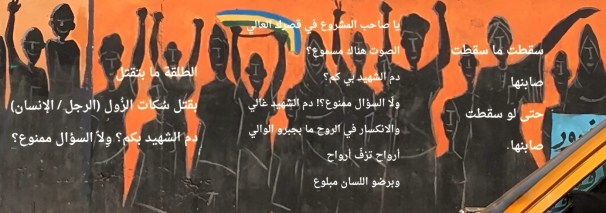
Above, excerpts from three of the most famous chants, poems and anthems of the uprising. They will be transliterated, translated and contextualized in Part 2.
…جيشنا معانا… الجيش ما جيش كيزانا
Sometimes slogans sought to integrate the armed forces into the cause of the uprising, with refrains such as “The Army is with us” chanted at the lines of young soldiers facing the crowds, or as above “The Army is with Us…The Army Doesn’t Belong to the Kayzaan (derogatory reference to the Islamist regime)”. At others, they responded with defiance to veiled threats of violence, as in regime spokesman Ali Osman Mohammd Taha’s references to the “Shadow Batallions”, quasi military forces that he claimed could be called upon to defend the regime at all times. لا بنكل و لا بنمل و لا بنهاب كتايب الظل : la binkill wala binmill wala binhaab kataayib aZ-Zill – “We won’t falter, we won’t tire, and we won’t fear the shadow batallions” was the cry that emerged in response. Other slogans and refrains actively disparaged the Islamist regime power base, as in كيزان يا سقطت سقطت; “O Kayzaan! Fall already, won’t you!” (the use of Kooz / Kayzaan will be discussed in Part 2).
Slogans made scathing reference to the corruption. of prominent political figures. They levelled humourous digs at the wealthy wives of regime leaders and made clear that the people would not be fooled by political sleights of hand, as in شالوا كديسة و جابوا فطيسة و عملوا الحركة الما دسيسة, shaala kadiisa w jaabu faTiisa w `amalu l-Haraka al-maa dissiisa; “They took away the cat only to bring out a carcass”; an ironic reference to the ouster of Omar Bashir being succeeded by the appointment of another unwanted, interim military leader, General Ibn Auf. Listen here to chants with similar messages.
Some slogans repurposed Khartoum University students’ football chants and military drill refrains in the service of the revolution. Many were chanted by thousands using compelling, rhythmical call and response modes, as in the video below. Some served practical and logistic purposes; reassuring those passing through check points who needed to be searched, encouraging the building of barricades and the collecting and distribution of food, water and medical supplies.
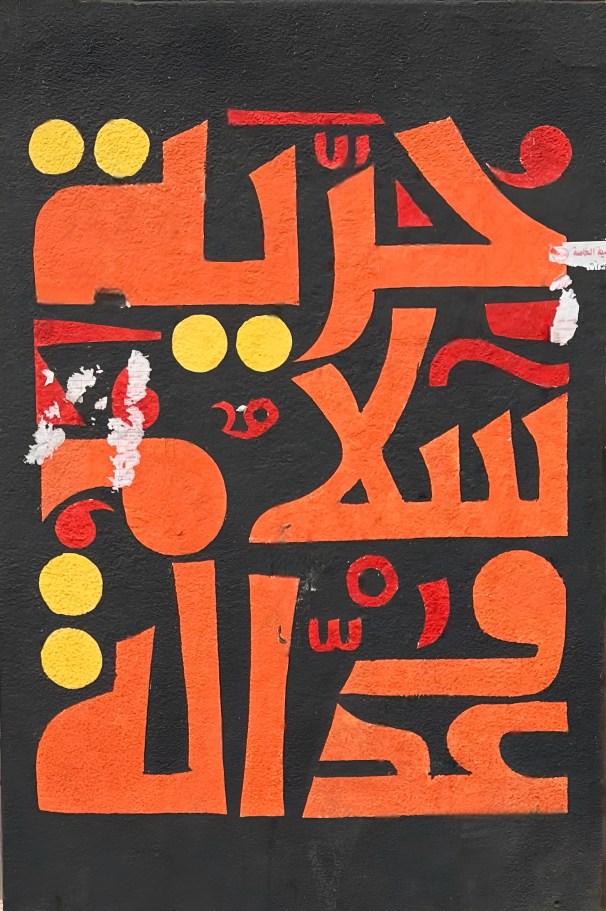
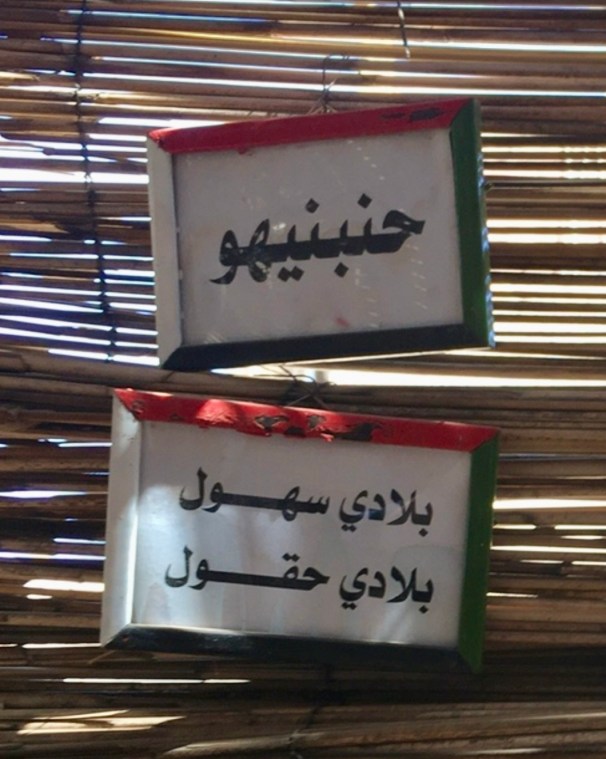
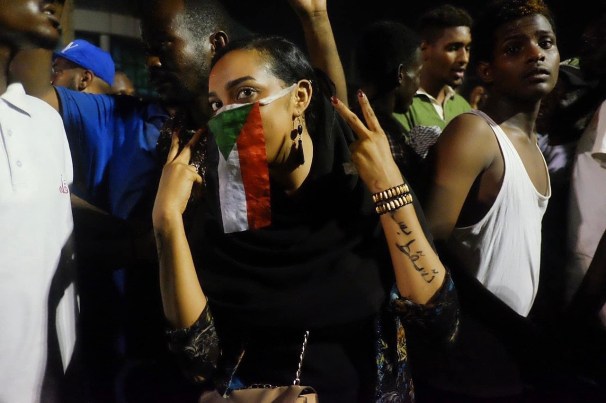
Above top left, the watchword of the revolution, Freedom, Peace and Justice, whose origin is explained below. Above left, Hanabnii-huu; “We will build it (a new Sudan)” and balaadii suhuul, balaadii Haguul; my country is the (fertile) plains, my country is the fields – from the patriotic anthem, Sudan Al-Khayr, lyrics written by Idris Jamma` around the time of Sudanese independence. Composed at a time of growing national consciousness, the song is a hymn to Sudan’s diverse, rich and fertile land. Above right, a young Sudanese supporter of the revolution, Wikipedia CC.
Above, one of the most powerful call and response chants of the revolution, featured in the film Gidam.
For more on the revolution see Armed with October: Thawra and Poetry from Khartoum to Toronto, Art of the Sudanese Revolution Part 1/4, The Power of Non Violence: Silmiya & The Sudanese Revolution, “All visible rays of light” The White Toub and From White Teyab to Pink Kandakat: Gender and the 2018-2019 Sudanese Revolution
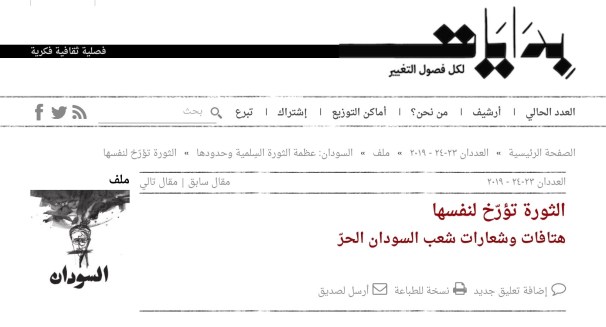
A wide-ranging analysis in Arabic of Sudanese revolutionary slogans, which I have drawn on here, can be found in this article:
Selected Slogans
Freedom, Peace, Justice
Hurriyya, salaam wa `adaala”.

This enduring slogan of the 2018-19 revolution is often claimed to have originated upon the funeral in 2012 of Secretary General of the Sudanese Communist Party, Mohammad Ibrahim Nugud. It may also echo similar phrases chanted in Egyptian and Tunisian uprisings, such as “Bread, freedom, Social Justice”. It was to prove a signature slogan of the 2013 Sudan uprising. It has been understood as a call for a complete end to conflict and the establishment of an independent and equitable judiciary. The reference to peace has been interpreted as a deliberate rebuke to the politicized use of the word by the Bashir regime, when it took on Islamist connotations of the pacification of elements opposed to its rule, under which the word was used in the renaming of rebel areas and displaced persons’ camps. As the revolution evolved, it was also referenced in the context of negotiations between civilian authorities and transitional military powers, to emphasize there could be no negotiations without an end of conflict. The term justice referred at the outset to the restoration of rights to the marginalized and those discriminated against. It would later be extended to incorporate demands for justice to be applied, in terms of direct legal action, against Omar Bashir following his fall from power. After the massacre of civilians on 3rd June 2019, the word took on powerful resonances of demands for accountability for all those implicated in the bloodshed and the need for real judicial reform. (Sources: Glossary of the Third Sudanese Revolution and The Power of Non Violence: Silmiya & The Sudanese Revolution).
The phrase is often seen as the first of a two-part slogan; the second being “The revolution is the choice of the people.” – further emphasizing the validity of the protesters’ mandate.
Peacefully, peacefully Against the Thieves! / Non Violent Resistance against the Corrupt!
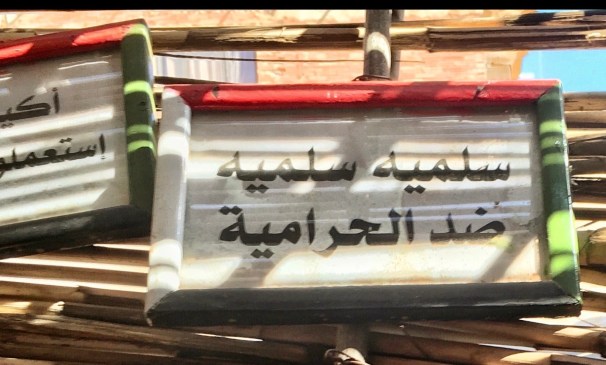
Silmiyya silmiyya Didd al-Haraamiyya.
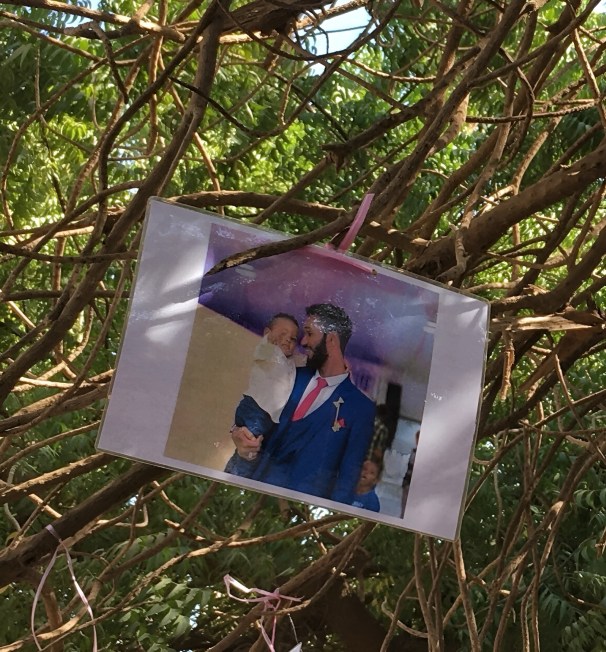
This slogan in many ways exemplifies the ethos of the revolution and lent its name to revolutionary anthems. It is multilayered in its resonances. Reported to have been used during the 2016 general strike, the saying was also used in the Syrian revolution of 2011. For researchers, the Sudanese understood the call for non violence as a complex “game, a weapon, a voice, all imbued within an atmosphere of love.” Non violence was a means of frustrating the regime’s expectations, ” a game of hide and seek”, debunking regime claims that Sudan would devolve into “another Syria or Libya” if protests continued. It was also a defining principle in itself for many Sudanese revolutionaries who wished to conduct the uprising on their own terms. It helped secure support from a cautious international community and meant criminal counter measures would have less credibility. The thieves of the slogan refer to those engaged in government corruption and exploitative economic policies. Variants on this slogan emerged, such as “Ya Khaatuum tawri tawri lan yaHkimna luSuS kaafuurii; “Hey Khartoum the Revolutionary! The thieves from Kafuuri will not govern us”; a chant making direct reference to the well-heeled Kaafuuri district on the banks of the Blue Nile, home to wealthy elites and others associated with the regime. (Source The Power of Non Violence: Silmiya & The Sudanese Revolution, Glossary of the Third Sudanese Revolution and Bidayat as above). Above left, a photo of a young man holding his child hangs from a neen tree in Gasr Al-Nil Street, 2019 to commemorate a fallen protester.
You Arrogant Racist, We Are All Darfur / The Whole Country is Darfur!
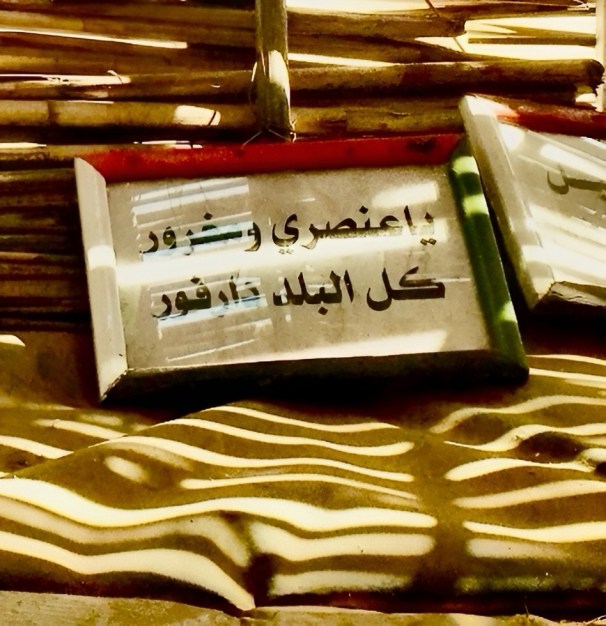
“Ya ‘unṣurii wa maghruur, kull-l-balad daarfuur.”
A watchword of the uprising, this slogan epitomizes a central tenet of the revolution; an end to state sanctioned racism and the targeting of ethnic minorities. Researchers note the slogan “emerged in the early days of the protests in response to the regime’s attempt to split the revolutionary movement along local ethnic lines. On 29 December 2018, 32 Darfuri students who had allegedly taken part in the demonstrations were arrested, tortured and forced to publicly confess their membership of the Sudan Liberation Movement / Army. Following these events, the slogan started to be used extensively by demonstrators throughout Sudan “to express their solidarity with the detainees, while stressing the supra-ethnic and anti-racist nature of the revolutionary movement.”
The slogan produced other variants encouraging inclusivity such as البلد كل جبان يا العنصري يانسوان] yā ‘unsūri ya al-jabbān kulli al-balad niswān; “Hey, your cowardly bigot, We are All Women!” (Source: Glossary of the Third Sudanese Revolution)
Teargas and A New Sudan – More Slogans

Top right, law `ind-ak khut, maa `ind-ak shiil; “If you have the means, give. If you don’t, take what you need.” This slogan expresses the ethos of Sudanese solidarity that underpinned the revolution. It is perhaps most associated with the vast sit-in outside Khartoum’s military headquarters, where stations for food, water and other supplies were sourced and manned by volunteers.
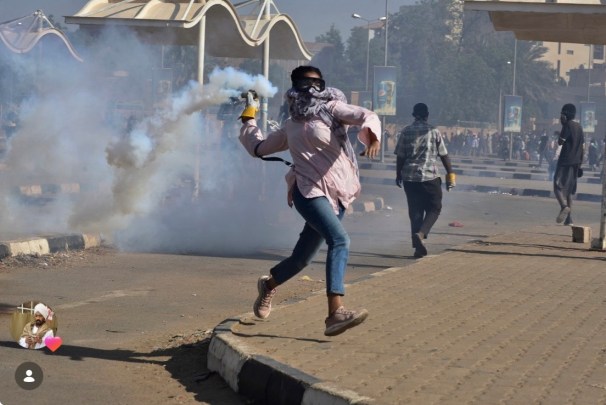
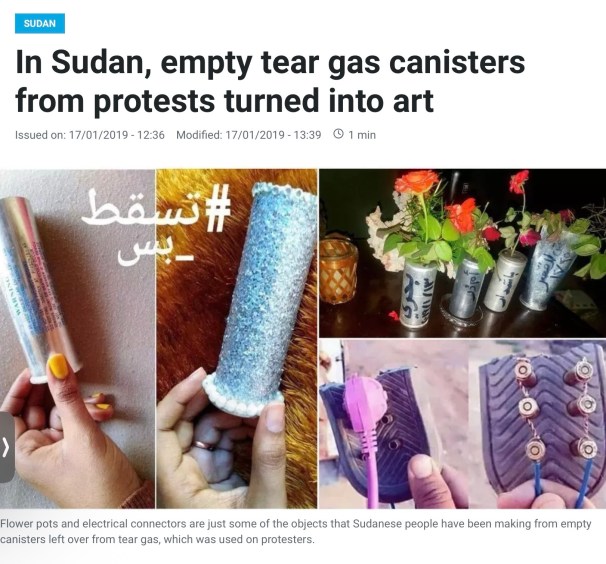
Top centre, “al-buumbaan!”; “Teargas!”, a warning shouted to fellow protesters. Demonstrators faced a near constant barrage of teargas canisters hurled by security forces during protests, and contrived homemade remedies against their effects. Determined to show security forces they remained unintimidated and unbowed, spent canisters were often collected and repurposed; made into surprisingly elegant coffee cups, and even electrical outlets (see below). Some were used in works of art. Protesters, such as the iconic young woman shown left (WIkipedia CC), became known as teargas hunters; fearlessly catching and hurling live canisters back at security forces, often sustaining burns to their bare hands.
Top left the slogan reads “A New Sudan”. Lower right, the slogan “NiHnaa maragnaa Didd an-naas as-saraguu `aragnaa!”; literally “We went out against those who stole our sweat!”; a clear socialist or trade unionist inspired reference to unjust treatment and poor living conditions of the Sudanese working class.
Centre; “` awaaliig nakhliihaa!”; literally “We leave the trash behind! or “We won’t let the useless ones stay!”; expressing the movement’s refusal to accept government reforms amounting to half measures that enabled some figures to retain their positions. This defiant phrase uses the Sudanese colloquial for people considered corrupt or incompetent and like the term faluul, refers also the remnants of the regime.
Perhaps the most poignant among the slogans is the last one, lower right, reading “Laa raa`uu lil-ummahaat, laa ummii, laa ummak”; often translated as “They showed no mercy to mothers, not mine, not yours. The killing of mothers – whether while demonstrating, feeding the crowds or treating the injured, manning support stations, or all those working as what Sudanese affectionately call their “tealadies”, whose bodies were thrown into the Nile, was seen as an egregious violation of Sudanese values. The killing of mothers was felt as a communal loss and chants such as “The blood of the martyr is my blood, the mother of the martyr is my mother.” reflect the profound impact of these events. (Source for the above: Glossary of the Third Sudanese Revolution, among others)
Above right, from The Observers, France 24 In Sudan, empty tear gas canisters from protests turned into art.
In my next post, I look at some of the most famous slogans and poems of the revolution.
 Women's literacy in Sudan