

Wedding Jewelry
Two Colonial Accounts from Northern Sudan, with Illustrated Commentary
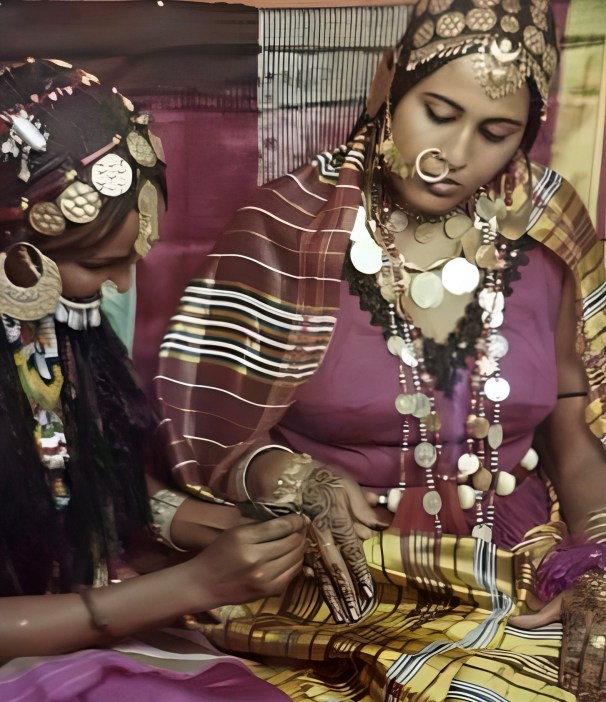
Above, a widely reproduced photograph (circa 1950 -1970s) of a Sudanese bride decked in her wedding finery and draped in her silky red and gold garmasis stole. She watches intently as her companion traces intricate, lacy motifs in henna on her hand. She wears a small gold nose ring or zumām, which when worn attached to a gold chain often studded with small discs or tiny glinting pendants is known as zumām abu rashma. Sudanese costume expert Griselda El Tayib notes that the zumām would later fall out of fashion, often being replaced by a gold stud in the shape of a flower bearing a stone centre piece.
The bride wears layers of teela necklaces; strands of cylindrical agate beads here interspersed with gold sovereigns, half sovereigns or imitation stamped gold coins traditionally bearing the image of British monarchs such as George V. Sometimes brides would also wear an elaborate display of gold chains cascading across the chest. Framing and illuminating her face is a necklace of gold conical shayir beads, studded with dazzling, sun-like gold tokens.
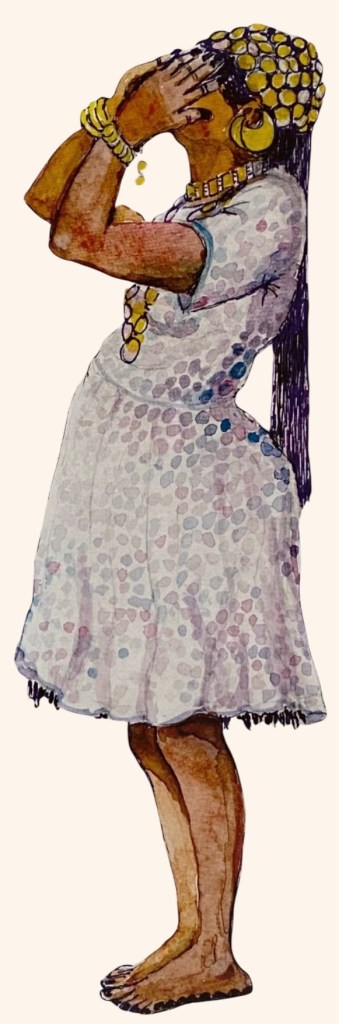
As well as her many bracelets, the bride wears round her wrist the purple silk threads of the wedding jirtig ceremony (see below and Anointing in Red and Gold: Update). Around her waist she appears to be wearing a belt of Hagoo beads. Her elaborate cap of netted coins or tayara, as Griselda El Tayib references it, with additional thick locks of black silk tresses is known as the jadla or The Magdarei
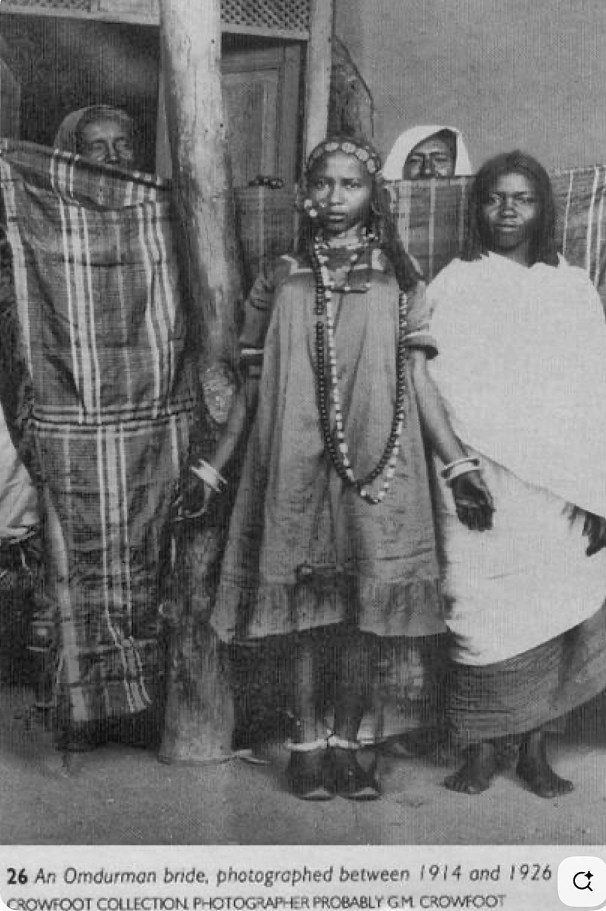
Above, a life-changing moment of tenderness and vulnerability captured; an Omdurman bride on her wedding day, 1914-1926, Pinterest, photograph attributed to G.M Crowfoot. The young girl holds open her hands to display her freshly hennaed palms and sin fil ivory cuff bracelets (more on these in coming posts). Her ankles are adorned with silver hijil anklets, described below. For more period portraits of Sudanese brides and grooms, see the work of pioneer Sudanese photographer Rashid Mahdi, and for example his Sudanese bride, wife of Malik Al Sheikh Mohammad Saeed.
Setting the Scene

Above, shimmering, bejewelled and delicate; the Sudanese bridal dance. Plate from Women of Omdurman, Anne Cloudsley, p55. For more articles on Sudanese dress and adornment, see Beads and Silverwork, Red, Gold – and Blue “A Necklace of Shells from Distant Seas…” The Rahat Hair Braiding in Northern Sudan Part 1 Rashaida Dress and Adornment Part 1
Setting the Scene
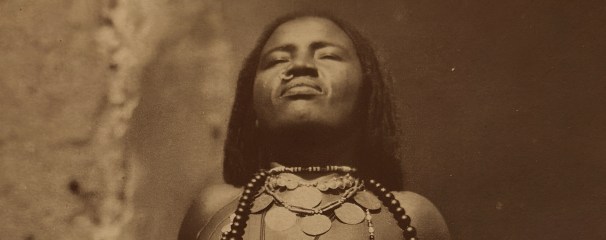
Detail from a photograph of a Sudanese dancer, reproduced by Hugo Adolf Bernatzik in Der Dunkle Erdteil, 1930, personal collection.
This week’s article reproduces two open access colonial-era accounts of wedding rituals in northern Sudan published in Sudan Notes and Records in 1922 and 1945. Inevitably, the authors bring to their accounts their own cultural and colonial biases and we must assume the texts contain misperceptions, inaccuracies and omissions. Yet they remain a fascinating, detailed and often carefully observed record of rites of passage imbued with profound dramatic symbolism. They offer too a magical glimpse into key moments in the lives of Sudanese men and women a century ago.
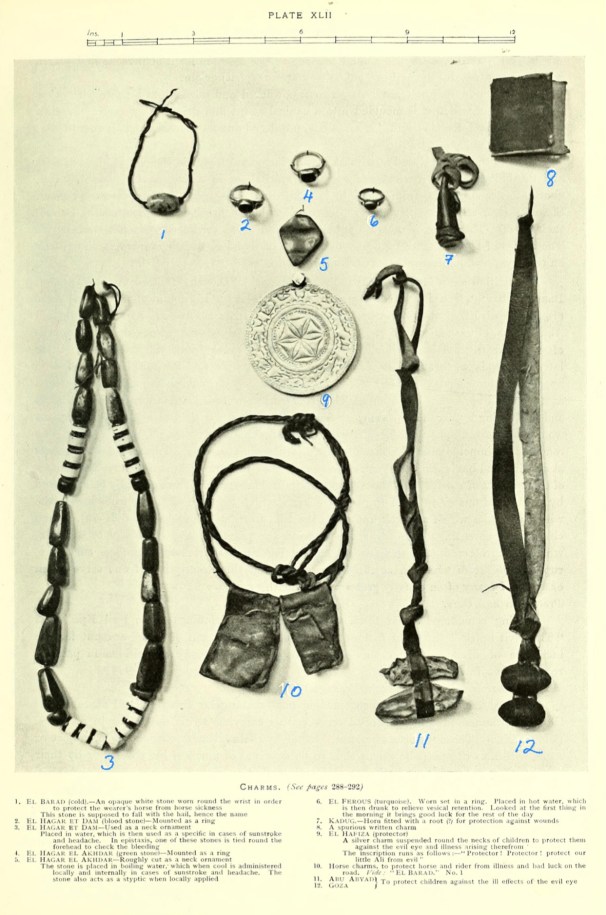
What makes these accounts compelling is what they tell us about the central role played by jewelry in these life-affirming events – its sheer ritualistic, talismanic and celebratory power. Since ancient times in Sudan, precious metals and stones have been held to possess healing and protective qualities; silver is believed to be cooling and protective; coral, amber and agate are intimately linked with the propitiatory and fertility – related aspects of jirtig rites. Professor Abdullah El Tayib in his Changing Customs of the Sudan references, for example, the hajar ad-damm, ” a small round stone of amber colour”, widely believed to have the power to stop hemorrhage. The placing of individual pieces of jewelry upon the bride and groom by family members during wedding ceremonies is both solemn and joyful and is akin to a form of anointing, as the accounts below reveal. Religious invocations, recorded below, are made as the pieces are placed around necks and wrists. Later in the wedding ceremony, jewelry is used in light-hearted games allowing the young women attending to have public interaction with male guests and possibly a future husband, and for gifts of money to be collected to defray wedding costs.
The bride arrayed in all her wedding jewelry – especially gold, offered to the world a dazzling public statement of status and family wealth. As Griselda El Tayib noted, gold represented an “inviolable form of family savings”, with brides often displaying the “total gold resources of her mother and aunts”. Pieces of jewelry were often lent and borrowed among family members for the occasion. As a form of currency whose intrinsic value was guaranteed, El Tayib reminds us, gold “was always moving between goldsmiths and clients and in order to stimulate this movement the goldsmiths had a vested interest in inventing new styles”. Pieces would be brought in to be melted down and beaten into new styles (Griselda El Tayib in Regional Folk Costumes of the Sudan). For El Tayib, this practice explains the relative scarcity of antique jewelry in Sudan. While the jewelry worn by the unmarried girl reflected the status of her father and his ability to provide for his daughter, that of the bride speaks to her husband’s ability at very least to maintain, if not enhance her social standing.
In addition to colonial-era photographs, I have illustrated the texts below with examples of contemporary iterations of classic pieces by the jewelry expert, curator and creator, Nisreen Kuku. The instagram links from her account embedded below provide more information on the pieces, their symbolism and history.
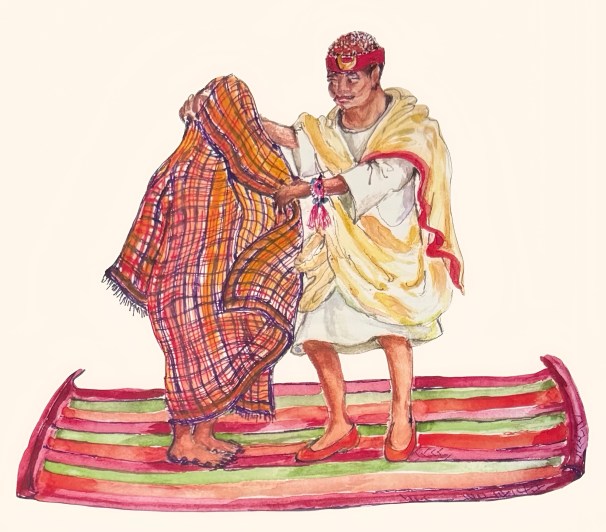
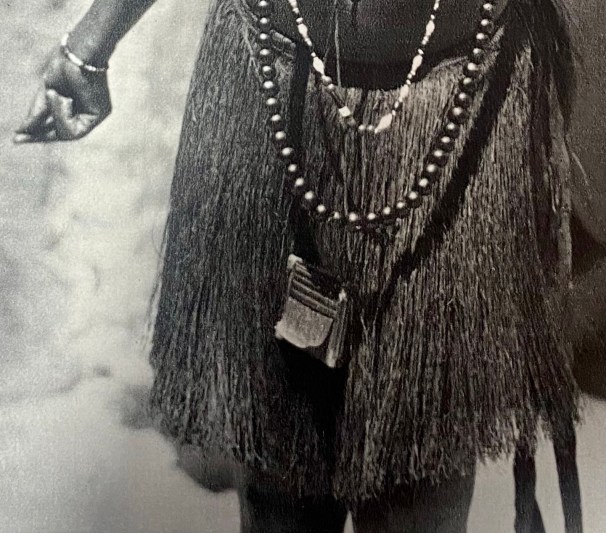
Upper left, an illustration by Griselda El Tayib depicting the bride swathed in her garmasis about to be uncovered by the groom. They are standing on the purple and red wedding rush mat referenced below. Upper right, another illustration by Griselda El Tayib, this time showing a young bride in her gold netted headdress. Above left, a plate from R G Anderson’s article, Medical Practices and Superstitions in Kordofan (open access Welcome Foundation), showing examples of Kordofani charms and amulets. Red and blue stones in particular were often held to have talismanic properties. See more in Unfolding Blessings. Above right, a young Sudanese girl with her agate beads, black wood prayer beads and leather purse draping her rahat skirt.
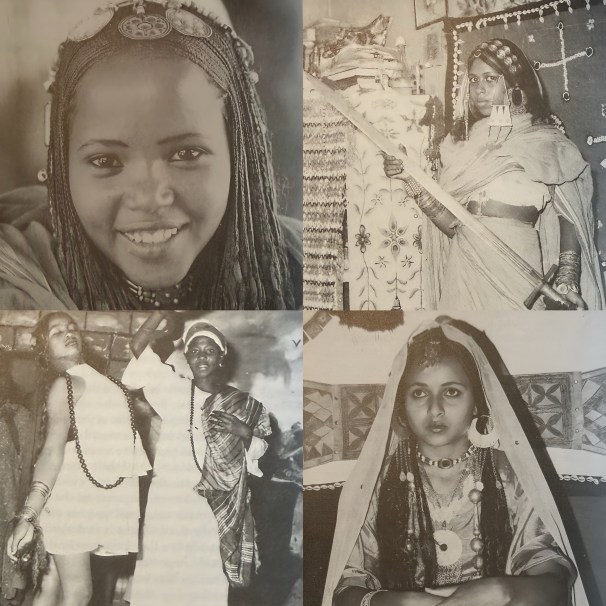
Above, top left, a Hadendowa bride, Kassala Province, top right, a Beja bride; bottom left, typical Sudanese weddng dance and bottom right, Nubian bride in tradtional wedding costume. Photographs and captions from Sisters under the Sun, The story of Sudanese Women, Marjorie Hall and Bakhita Amin Ismail.
Excerpt 1 – Ceremony
Marriage Customs in Omdurman Sudan Notes and Records Volume 26, 0 1945 Sudan Open Archive
Sophie Zenkovsky writes:
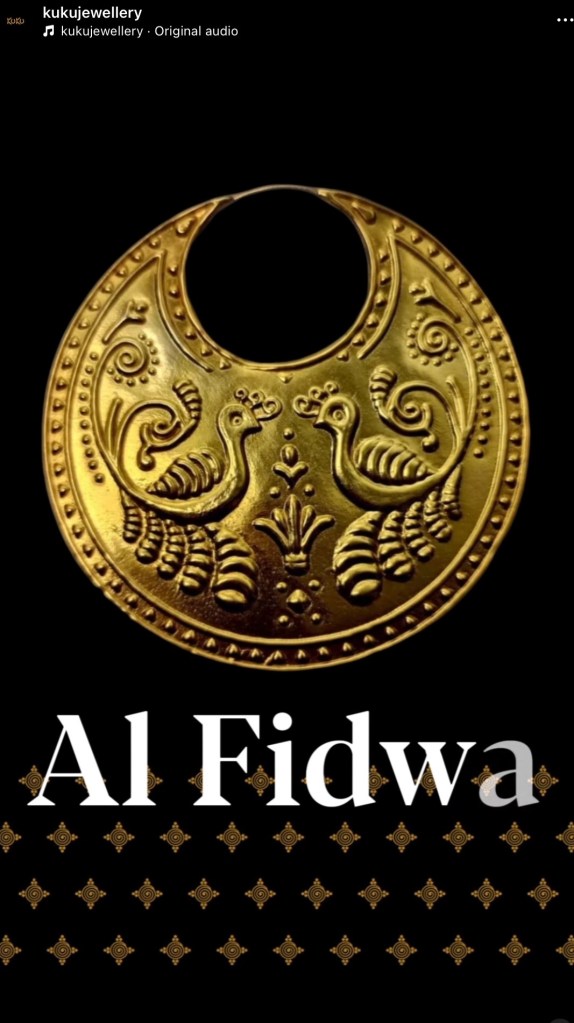
“A big hosh is chosen, sometimes that of a neighbour, if the bride’s premises are not large. Benches,`angareebs, chairs, or mats with cushions or mattresses on them, are put in a circle, leaving the centre free. In it a special mat is placed, the red-mauve one, for the bride to stand on. Usually the ceremony is performed in the afternoon, as soon as all the guests have arrived and the bride has put on all the ornaments and charms required. Whilst the bride is being dressed the guests are offered refreshments and sometimes food.” (Far right, Al Fidwa, Nisreen Kuku).
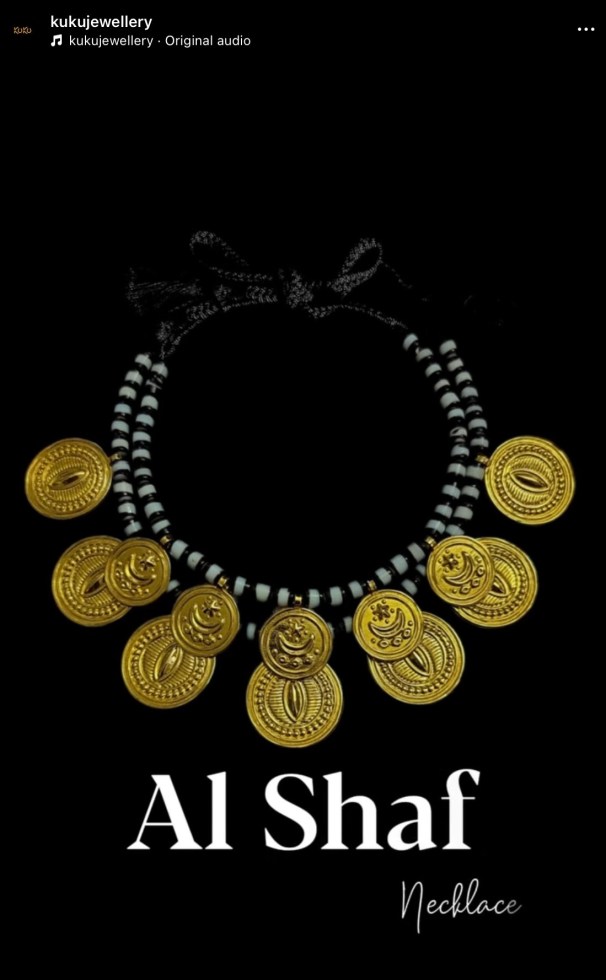
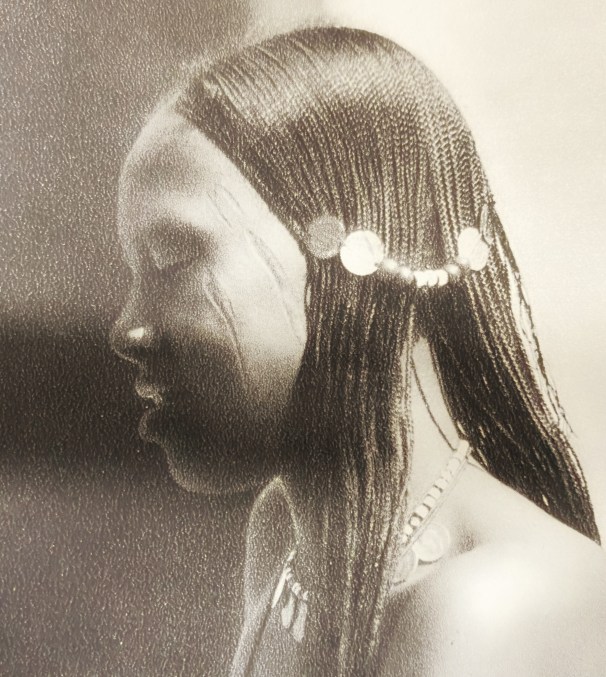
“The bride’s room is packed with women; there is no question of privacy; all must see and give advice. The best knickers and petticoat are put on, and the rahat is fastened over the knickers. Over all the best of all the bridegroom’s gift dresses is put on. Much time is taken up with putting on the ornaments, for this is the pivot of the ceremony. A kind of net composed of three or more rows of gold discs (bunduqī) with a string of smaller gold discs hanging down behind is put across the head from ear to ear. This is called the sharīfa. It is sewn with threads to the hair, so that it shall not fall off during the dancing. In the ears are placed the large earrings called khurus (this term in other texts refers to the netted headdress itself) and the small ones called fidwa, as many are there are openings in the ear-ridge. The wedding ring (zumām) is put in the nose and joined to the head-dress over the ear by a chain of small gold discs in a double row (rashma).” (Far left, Al Shaf, Nisreen Kuku).

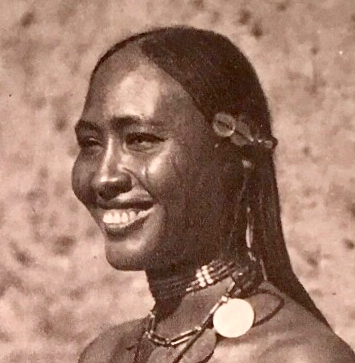
Left, a pair of stamped metal fadayat adorn the upper part of a young woman’s earlobe in a widely reproduced Pinterest image. Griselda El Tayib noted that the fidayat would often be complemented by a heavier, gold mugtal, worn at the base of the earlobe. She notes that in 1960s, the fidayat’s popularity waned and many were beaten down into ghuwaishat bracelets. See too The Gamar Boba Part 1. Above left, a colonial – era photograph of a young woman wearing a necklace of conical gold shayir beads interspersed with gold coins or tokens. Above right, a young woman is adorned with an agate teela necklace, both photographs from Der Dunkle Erdteil as above).
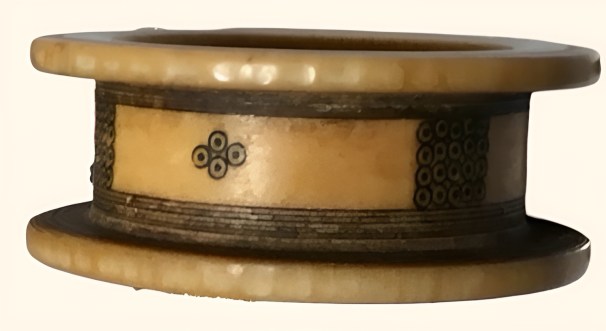
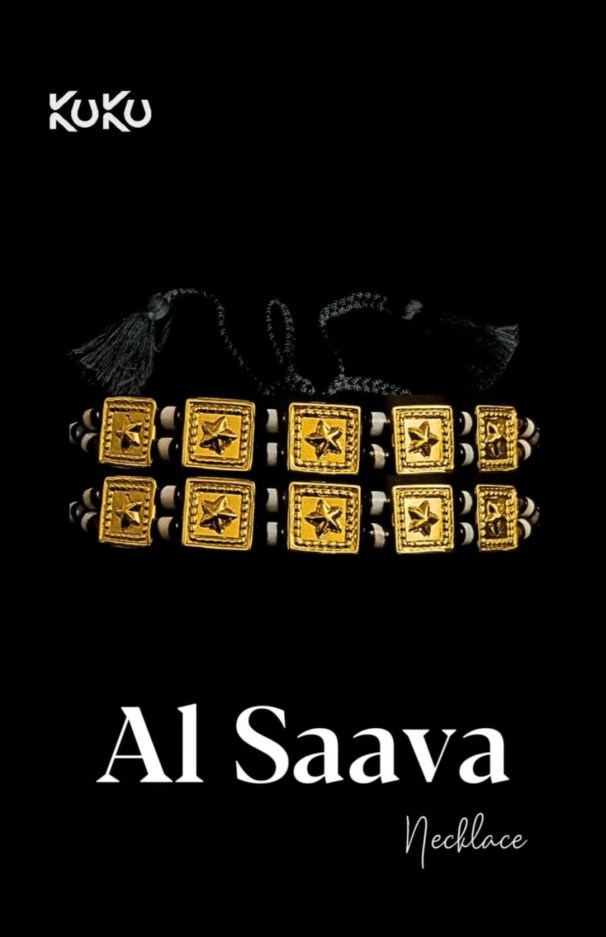
Right, Al Saava, Nisreen Kuku; Nisreen explains the small square compartments “are believed to represent miniature Qurans. Sudanese women often wear it with the belief that it brings blessings and spiritual protection.”
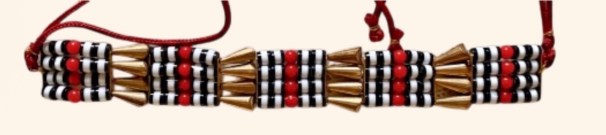
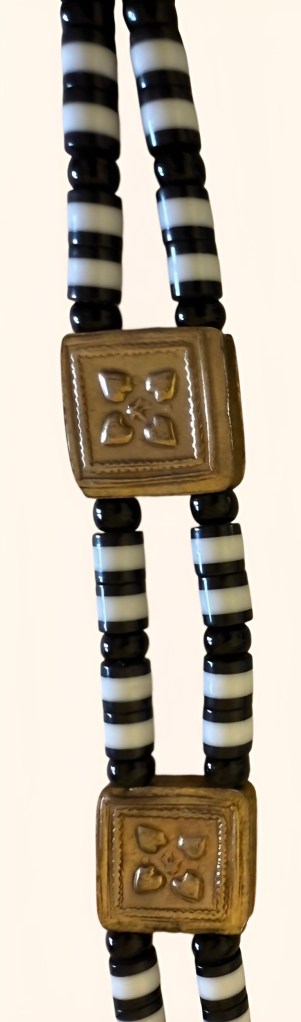
Above, a modern matarig or agate bead high choker necklace. The matarig was typically composed of four parallel rows of cylindrical agate beads alternating with long barrel-shaped gold beads called shayir, little bars of gold called rakaiz or conical beads known as jitti* (Source Griselda El Tayib). It might also feature flat square hollow beads of beaten gold, known as jakkid, threaded onto two parallel black cords.
*Colonial observers, speculating on the origin of the word jitti have quoted derivations from jonti, related to child bearing or jurti, meaning sunt seeds, used for tanning, the smoke of which “is still thought to ward off the evil eye.”
The account continues:

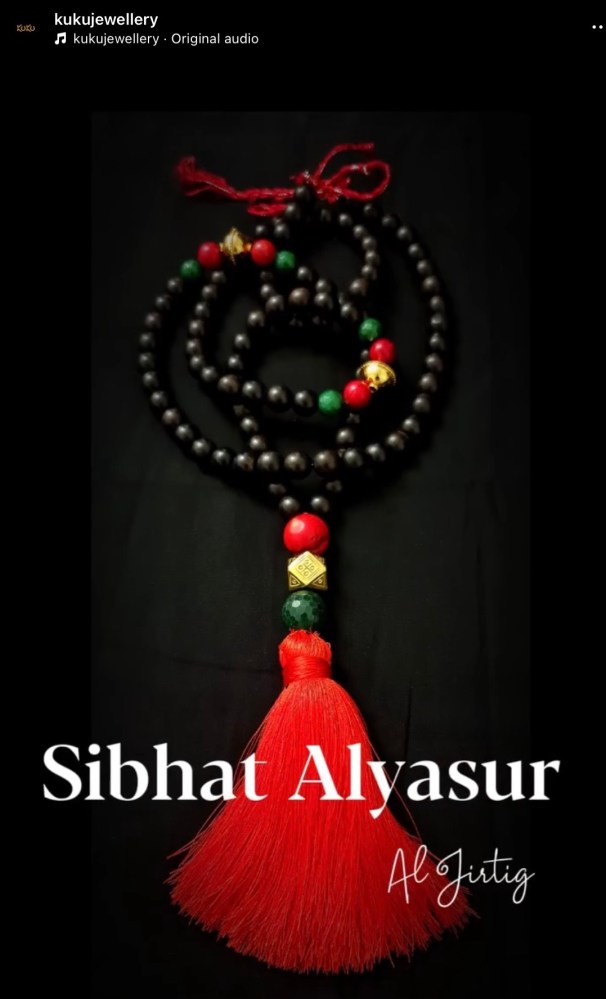
“Round the throat is put first a necklace of three strings of small gold beads held together with agate spacers (matārig); then a necklace of gold sovereigns and agate beads (somīt), known as tīla el ginehat; then a necklace of gold half-sovereigns and agate beads, called tīlat al ansās; then a string of gold discs called fatīl (each of these gold discs is known as a faragallah) – then the rosary (sibhat el yasūr) consisting of 99 large black beads with eight red ones at intervals; then the `iqd somīt, a very long string of agate beads and gold beads; and finally the charms (hijab), which are absolutely essential – a bride may be so poor that she can wear no gold, but she will never dispense with these charms. In new leather covers, one cylindrical and one square, they are worn on the neck, and two other square interlaced boxes are suspended one on each hip. A tiny hijab box is fastened on the upper arm. Large silver anklets (hijil) are put on each ankle. The ornaments do not necessarily all belong to the bride, for she wears the wealth of all her family. and even the poorest will borrow thing for this ceremony.” Right, a modern teela.

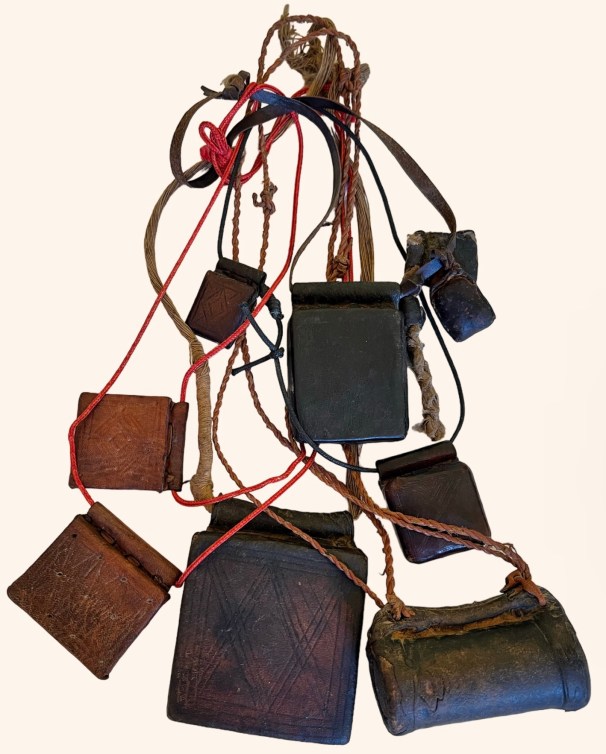
Above and left, silver Hujuul or hollow anklets with Rashaida embellishment, (personal collection). Traditionally, the Hijil was often worn by young girls before marriage to seek protection from the evil eye (Muna Zaki). Researcher William Young’s Rashaida informants explained that Hujuul came from the Arabic root for to “hop on one foot” and “muHajjal” could mean both a woman wearing Hujuul and a horse with white feet or ankles. For Young, male mastery of camels and other livestock through their hobbling and laborious breaking in bore symbolic and lexical parallels in the adornments such as anklets and nose rings worn by Rashaida women. See more in Rashaida Dress and Adornment Part 2 and Rashaida Dress and Adornment Part 3. Above right, examples of hijab amulets; see more in Unfolding Blessings.
The account goes on describe how incense is lit and the bride performs her last rehearsal of the wedding dance while family and friends offered criticism and advice. Finally, when all is ready “the woman attending the bride smoothes her dress, puts her rosary, necklaces and ornaments in their correct position and draws down the bride’s hands. Her eyes are tightly close. The bridegroom steps forward, takes hold of the bride’s charms and guides her forward …”
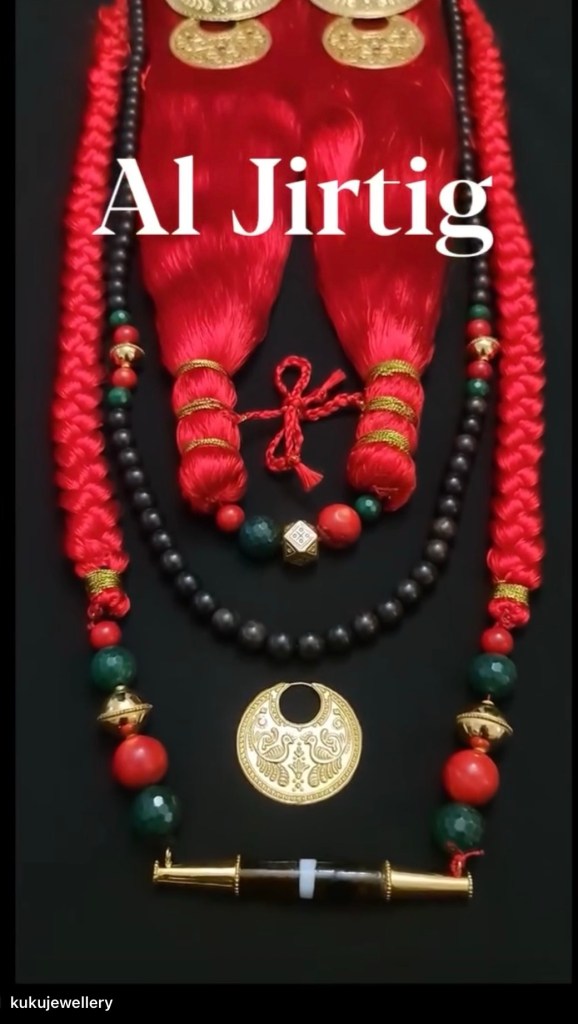
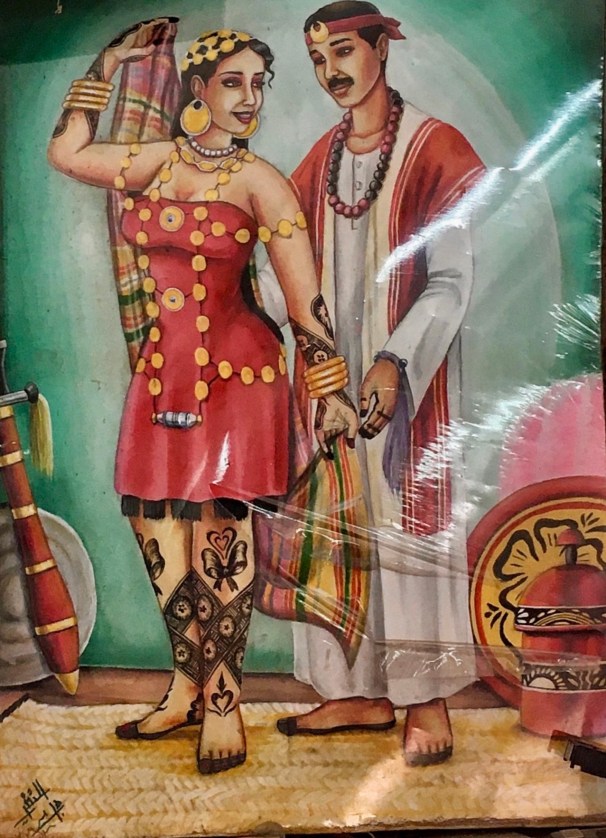
Describing jirtig adornments, Zenkovsky writes “the jirtig is a bunch of reddish-purple silk threads with a tassel dependent from it. On the silk are threaded the following always in the same order:- (1) A very large green bead, (2) a fish vertebra (killi), (3) a small white bead (raheimi), and (4) a medium-sized pale green bead (suluk). The jirtig is worn by both the bride and the bridegroom on the right forearm. The bride also wears on her right wrist a string of red beads called damarāt, and the bridegroom wears on his right wrist a silver bracelet (suwār) of the same size and shape as the bride’s anklet. The jirtig is worn by the man for nine days – a week is considered sufficient for government employees – and by the woman for a month.” Above left, a Sudanese wedding scene; a painting for sale in Khartoum.
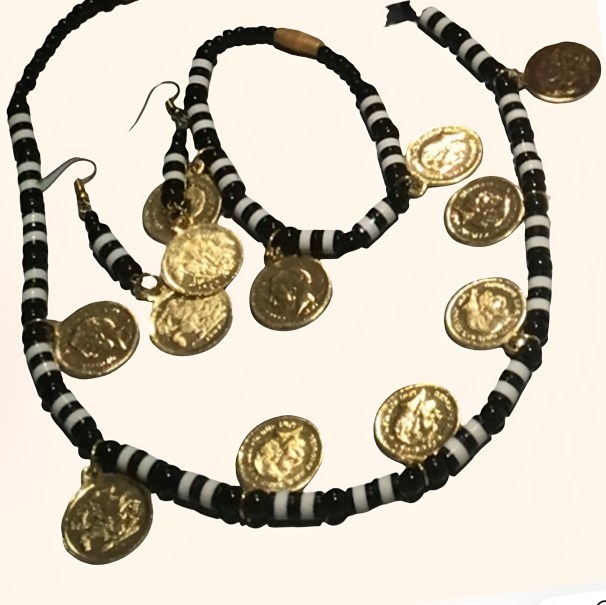
Below, a contemporary strand of hagoo beads with fish vertebra.
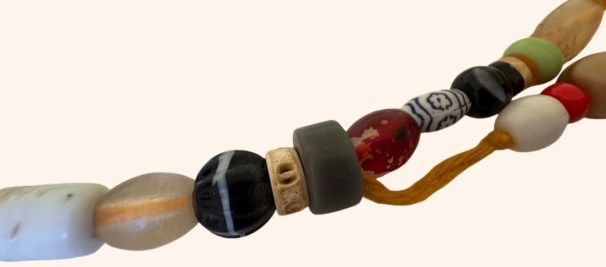
Colonial accounts also speculate on the origin of the jirtig, venturing to suggest that it recalled the “necklaces that bedecked the dead in ancient days.” They also explored regional differences in the custom, noting for example seeing on one occasion a small ostrich feather being stuck through the bead; a “rare addition in Khartoum but common in the Nuba Mountains.” They reference too the protective gold crescent moon Hafaz medallion “suspended on a string of red or blue material hung on the brow of the bridegroom.” Right, Nisreen Kuku Jirtig, showing gold tipped “somit” agate bead pendant. See too Nisreen Kuku EL Haryra.
Learn more about a rite unique to Sudan in Anointing in Red and Gold: Update and Anointing in Robes of Red and Gold
Excerpt 2 – Symbolism and Games
Wedding Customs in the Northern Sudan Sudan Notes and Records Volume 5, 0 1922
J.W.Crowfoot writes:
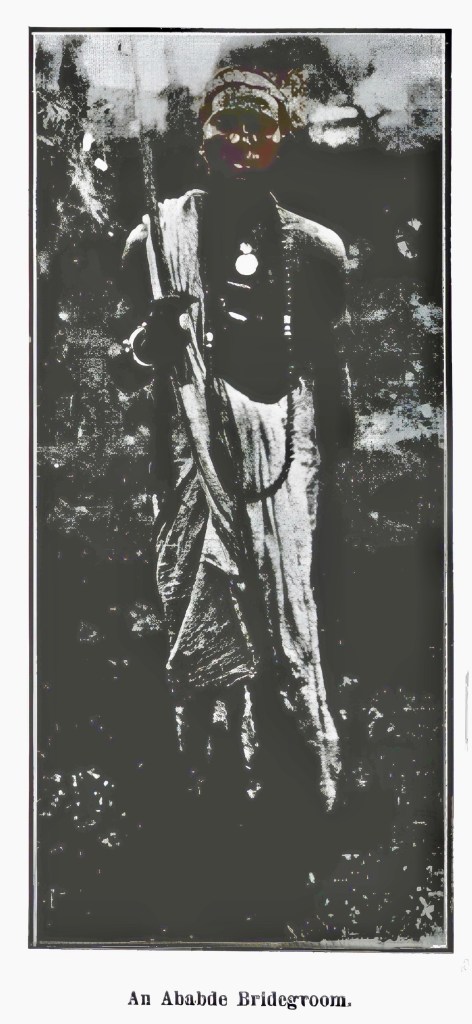
“On the ring finger of his right hand a silver ring with a large red stone in it. Round his neck four necklaces one of black and white beads (somīt) and gold beads, a second of red silk with large tokens called fragallahs and a small one called a bunduki, a third also of red silk with a slip from a palm branch tied to it – another rare addition, and a fourth of the usual rosary type. Round his temples a handkerchief to prevent the unguents with which his head has been anointed from trickling down his face. A whip in his right hand and the unsewn tōb, dress-length, complete the attire of this particular bridegroom, but he should properly be carrying a sword and the wedding garment of the well-to-do is of fine silk with borders such as only women usually wear.”
The various ornaments “are prepared beforehand by the womenfolk of the bridegroom: part of the preparation consists in dipping the beads first in milk ‘to bring bright days’ and then in zirri`a, dura soaked in water until it begins to germinate, to ‘make the marriage fruitful’. Only women are present at the actual robing or investiture which is performed by an old woman called the bakhita, a bringer of good luck. As she puts the necklaces and bracelets on the bridegroom she repeats some such phrases as the following: ‘Bism-Illahi’ (In the name of God), ‘bil-mahla wa sa`ada’ (Wishing ease and happiness), ‘wa bil māl wa -l `ayāl’ (Money and many offspring!), ‘wal matmūr el kabir wal rakūba el dalīla’ (A full granary and a shady rakūba!), and the women present sing and trill”…
In Dongola, the author observed “gaid” or chains; a game played by girls at the expense of the men. “The girls go about with necklaces, bracelets and anklets, and try to slip one of them round the head or wrist or foot of any man they see: the man thus captured has to redeem himself by paying a forfeit which may be in money or in kind, and a rich man often on these terms supplies all the food necessary for a day’s entertainment in the bride’s house.”
In a variation of this game, women are described as processing; one holding a bowl filled with necklaces, bracelets and anklets, another a bowl of water, while others carry perfumes and candles. “Then a girl takes the necklaces and other ornaments out of the bowl and puts them round the necks, wrists or ankles of the men, and they have to pay a forfeit into the bowl of water before they can take their “chains” off.” The forfeit would be in the form of small sums of money – divided between the girls for covering trays of dishes served at communal events such as weddings.” Right, the 99-bead rosary, Nisreen Kuku Sibhat Alyasur.
 Women's literacy in Sudan