

The Music of the Saqia / Sagyia
The Sudanese Waterwheel
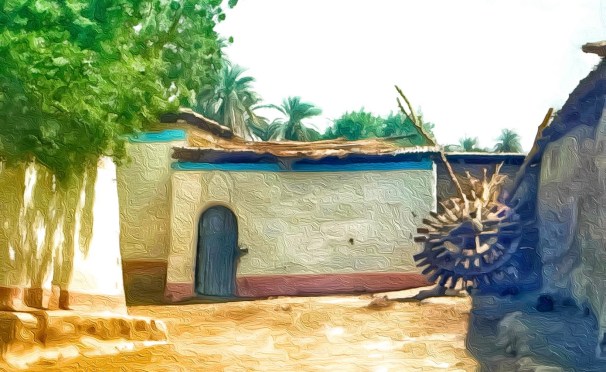
Above, sketch based on a photograph taken in a quiet corner of a Nubian village near Dongola in the mid-1980s. To the right, the pleasing geometry of the cogs of a wooden waterwheel or saqia. Below, a waterwheel in use, plate from My Sudan Year, 1924, personal collection. The caption to the photo reads: “This method of getting water from the Nile has been in use for countless ages. The machine is made of wood which creaks continually as the wheels go round and enables the employer to know whether the driver is keeping at work.
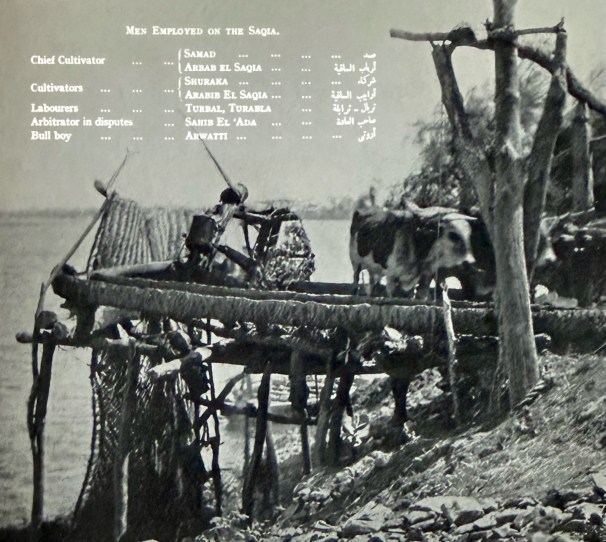
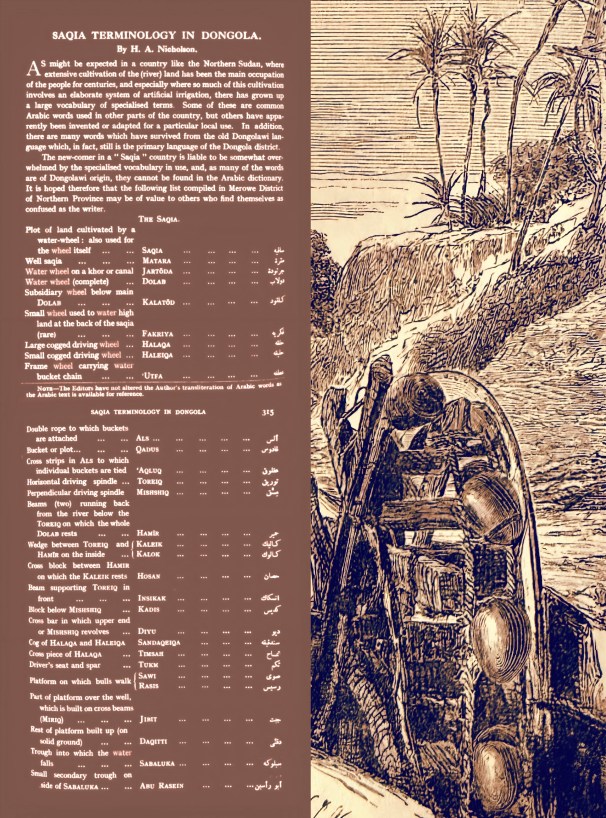
Inset above, excerpt from the fascinating glossary of waterwheel terms: Saqia Terminology in Dongola, H.A. Nicholson, Sudan Notes and Records, Volume 18, 0 1935. The term “awwatti”, or bull boy also appears in the prose excerpt below.
This week’s brief post reproduces an edited excerpt from the writings of medical officer Allan Worsley, in his Land of the Blue Veil, published in 1940. Worsley served as gynaecological surgeon over several years for the Church Missionary Service in Omdurman, publishing research on “Infibulation and Female Circumcision” and “Fear and Depression”. In addition to affectionate memories and anecdotes of his time in Sudan, Worsley wrote studies of Sudanese grammar and proverbs. The piece below captures something of the timelessness and beauty of an ancient and highly effective system of irrigation and its unique metronomic qualities. When I lived in Northern Province in the mid to late 1980s, these beautiful structures were already being replaced by pumps, and with them, cadences as old as Sudan herself were lost.
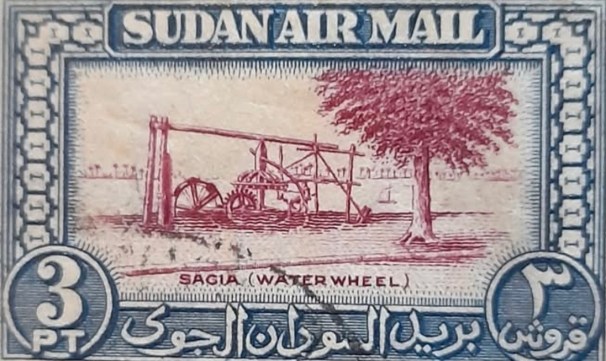
The saqia in Sudan is rich with musical, artistic and poetic resonances. Sayyid Hurreiz writes: “The sagia was the subject matter and source of inspiration for traditional performing arts and literary folk genres eg. folk songs, proverbs, folk dances and traditional popular narratives. As an example of such proverbs, we refer to “Juha’s sagia which draws water from the river and pours it back into the same river” which is used in folk wisdom to refer to futile action. Narratives about Nile mermaids are often told and disseminated by sagia workers operating night shifts. Folk songs echo and stress socio-economic values related to sagia community eg. “the squeaking sound of the numerous sagias of the beloved’s father awakens those who were fast asleep”. The second video embedded at the close of this post celebrates the musicality of the waterwheel – viewers commenting that they played the sound of the turning waterwheel to their children to soothe them to sleep.
The saqia symbolizes a deep connection with the land and The Nile and for many bears a spiritual as well as folkloric significance. Researchers have noted the ancient practice of burying a newborn’s afterbirth under the wheels of the sagia. (Source: Al Sagia: A Masterpiece of Technological & Socio-economic Development, Sayyid H. Hurreiz)
See too The Lost Waterwheel and Medieval Sai Project, the latter including fascinating medieval Christian sources to the saqia.
The inclusion of this excerpt should not be understood as support for imperialism of any form.
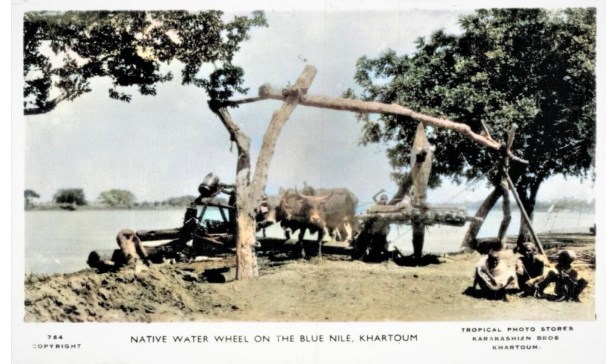
Above, colonial-era postcard depicting a Khartoum waterwheel.
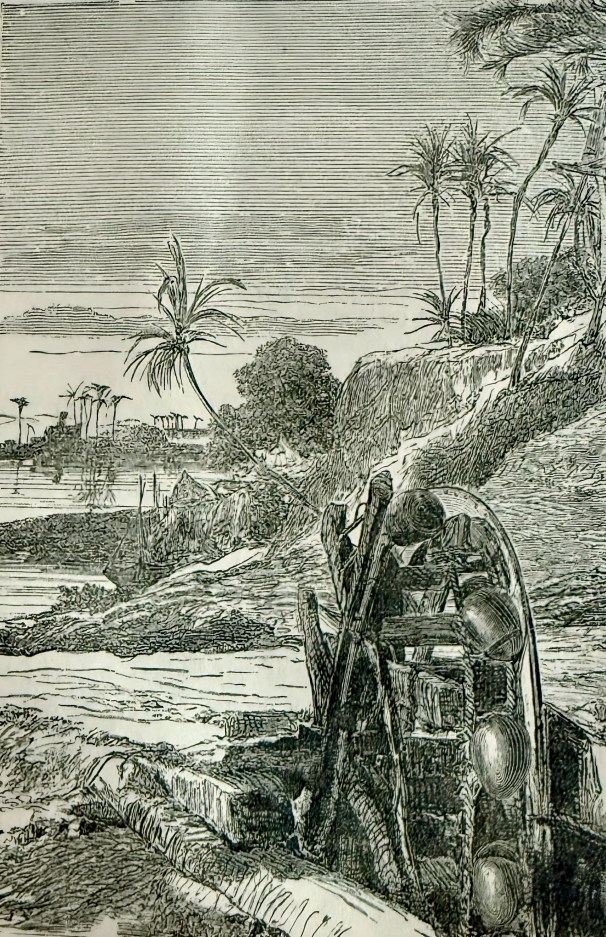
The sagyia / saqia has been used for centuries to raise water to irrigate land. A vertical wheel is set above a pit dug down to the water table. Looped around it are ropes to which pots are fastened. A draught animal attached to the vertical shaft of the gearing causes the wheel to turn and the water-filled pots to empty at a higher level. The saqia was eventually replaced by motorized pumps feeding water through large pipes direct from the river.
See a saqia in action in Sudan Layout’s short video embedded below.
The Sagyia Wheel – Allan Worsley, From The Land of the Blue Veil, Cornish Brothers Ltd, p 197-8.
There is a Sudanese saying: “Three things there are that cause sorrow to flee; the smile of a woman, a river, a tree.” In the original, however, the word is rather “greenery” than “tree”. How truly is the spirit of this saying embodied in the Sagyia! I know of no greenery more restful to the soul than a Sagyia garden; of no music more soothing to the mind than Sagyia music, for it always brings ease to a troubled heart. (In another section, Worsley refers to the saqia gardens consisting chiefly of lemon groves, recalling the “silence that reigned in this haven of diaphanous greenery”.)
Sagyia music would always help me to unravel the knottiest problem, to work out the most complicated schemes.
Round the endless circle pace two patient oxen, while behind them, perched on the driving-beam, sits the naked arawatti, a diminuitive youngster. He sings to himself, or perhaps to his oxen, in a sing-song nasal dirge; but what he sings is unintelligible. I doubt whether he, himself, could frame the actual words. But whatever it is, he takes his measure from the sagyia, and sings in harmony with its rising and falling cadences.
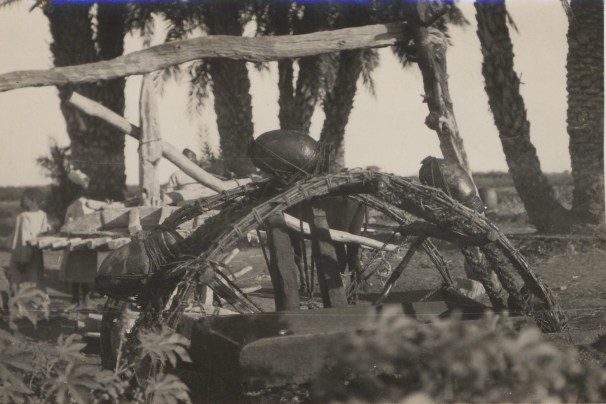
As the rough unhewn wooden cogs of the horizontal wheel press against those of the vertical, they slowly move the latter with a long drawn-out, quavering, protesting whine.
How can I describe that sagyia music? There is no other like it in the world. It is slow and long-sustained, yet ever varying. For no three seconds is the sound the same. Each note softly shades into the next one. Slowly the music rises, then slowly it falls again, then merges sideways into a minor key. It continues its song in descant, then back again, as the oxen complete the circuit, into the first refrain.
A strange, unearthly quality of sound that lies somewhere between a bagpipes’ lament and the joyous singing of bees in a cottage garden.
As the big paddle-wheel revolves, it lifts a chain of earthen jars that are roped to its cross-poles. Like the buckets of a Dart dredger, they dip down into the river, so Prussian blue that there seems some living quality to its colour. It comes as something almost unexpected to see it poured out a transparent liquid, after all, into the trough that feeds the lemon grove. The sunlight flashes on its outpouring as the jars empty themselves, and pass downwards again, inverted. How cool, how fragrant, how refreshing, against the quivering sun-parched background is this “strip of herbage strown, that just divides the desert from the sown.” You never learn the true value of green till you have experienced the desert, just as we do not learn the meaning of ease till we have suffered pain.
It is only in the noonday heat that the sagyias are silent. Day in, day out, and even at night in some cases, you can hear their sleeping groaning blending with the high-pitched songs of their arawattis.
To the Arab sagyia-gardener there’s a practical meaning in the music. It tells him, as he works on the far side of the cultivated patch, that the arawatti is keeping the oxen on the move.
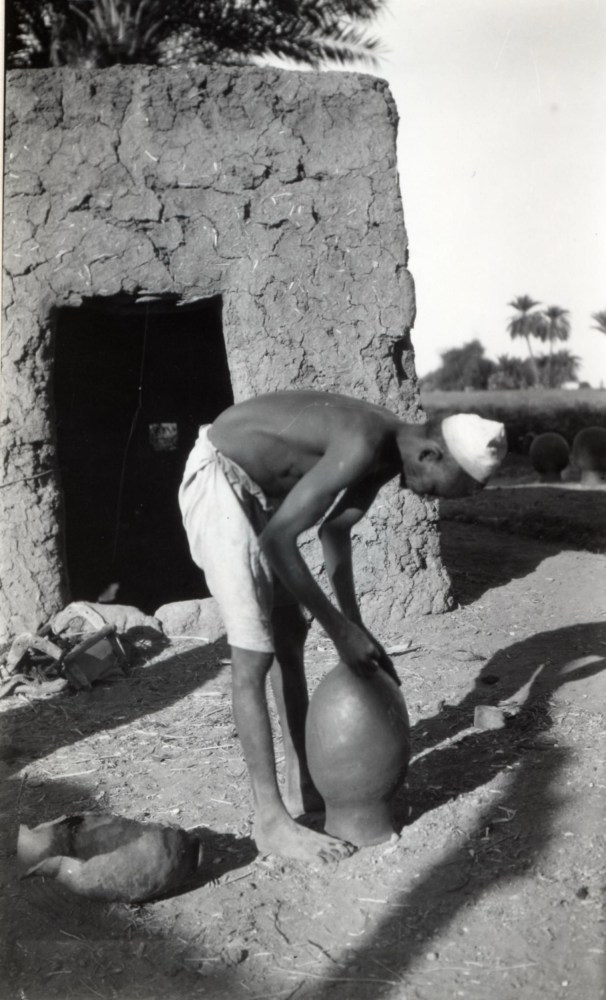
Top left, a an illustration of a Nile waterwheel from The English in Egypt and The Life of General Gordon, 1898 (personal collection). Above right, detail of a waterwheel with its water jars secured, John Winter Crowfoot, Trustees of British Museum. Above left, a potter making water jars in front of a flat roofed shelter, Shambat, Khartoum area, by John Winter Crowfoot, Trustees of British Museum.
After this rhapsodic description, Worsley goes on to tell of a “an old sagyia owner” he met, and that “He was suffering from a fearsome looking molar that required extracting. The sagyia man pushed forward a couple of slave women with aching teeth, to see how they fared first, before he took the plunge!”
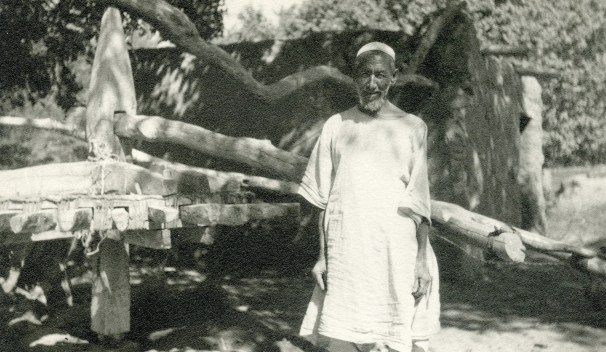
Below, portrait of a Sudanese man beside a waterwheel, photographed by Mary S R Sinclair, Trustees of British Museum, early 20th century.
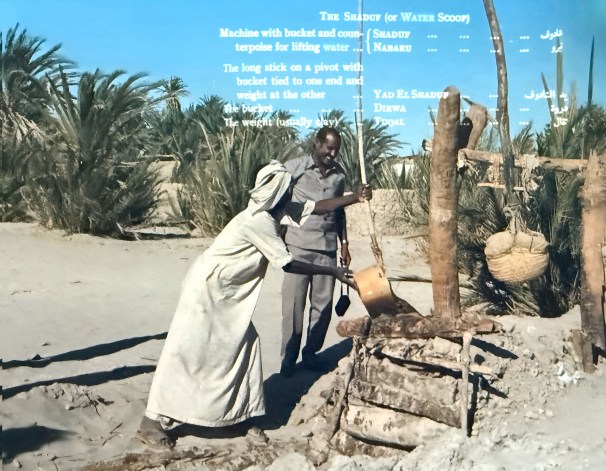
Below, a working shaduuf or water pulley / scoop, Northern Province, mid-1980s; to be featured in coming posts.
Below, more Saqia terminology, Sudan Notes and Records as above.
Below, Sudan Layout short video documentary on the history and technology of the saqia.
Enjoy too the exquisite cadences of Egyptian Nubian artist Hamza El Din:
“it is said that in the days of Abdullahi a fisherman was casting his net into the river and caught a girl about ten years old. He asked her whose daughter she was and she answered, I am a daughter of the River Folk. So he took her to the Khalifa who asked her the same question and how she got into the net. She said, Oh Khalifa, I am a daughter of the River Folk and I had just gone out of my house to chop up a little fire wood when the net swept me up. And when the Khalifa heard that she belonged to the River Folk, he was afraid to take her and after consulting with his advisers they put her into the fisherman’s boat and dropped her back in the river exactly where the White Nile meets the Blue.”

