

Prayer Bead Sellers of Khartoum
A Tribute
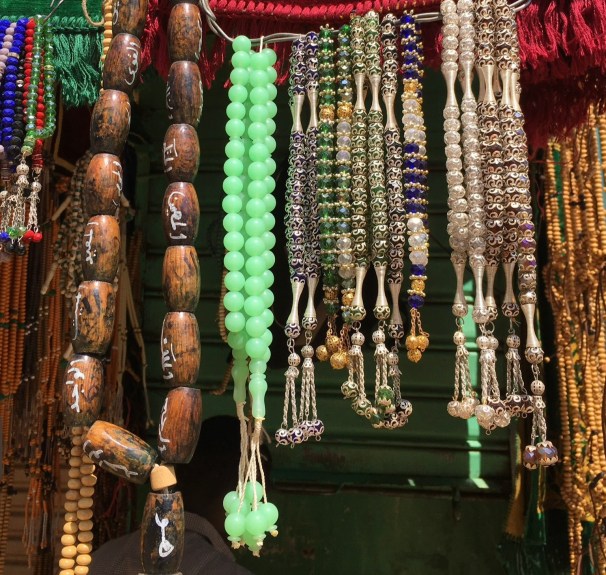
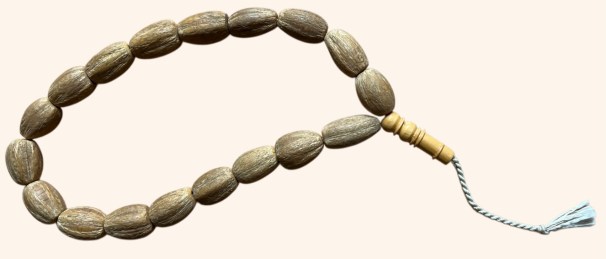
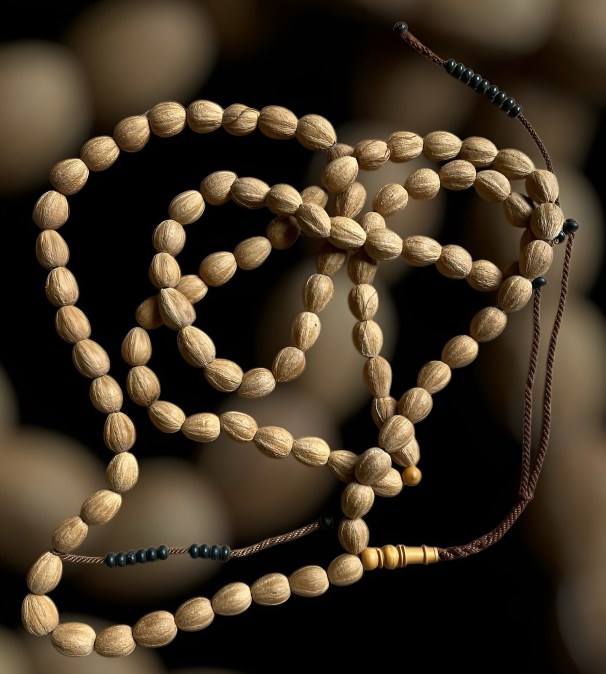
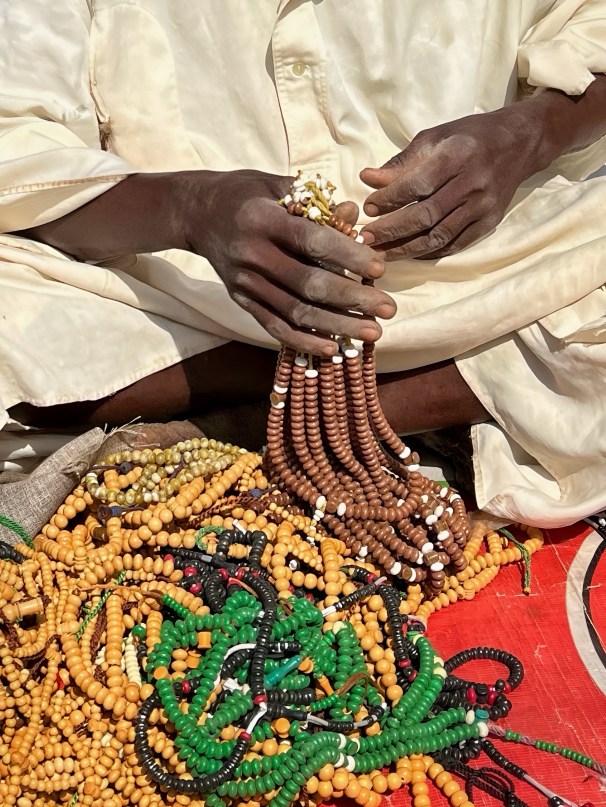
Sudanese and imported prayer beads or sibHa / subHa, (plural sibaH) on sale near the Great Mosque and Soug Al-Arabi, central Khartoum. Before the war, stall holders, seated amidst glowing skeins of sibHa while they threaded strands of beads were a familiar sight in this part of the city. Title photo, a Sufi sibHa made from laloob seeds and discussed below.
This article explores the spiritual, poetic and cultural relationship so many northern Sudanese have with the sibHa. It acknowledges that in other parts of the Islamic world, the sibHa may be viewed differently. My blog cannot enter into discussion on matters of religious orthodoxy. If you would like to learn the Sudanese Arabic terms related to the sibHa while watching a transcribed interview (Arabic) with a sibHa seller, see Prayer Beads in Omdurman
Setting the Scene
The SibHa Tradition in Sudan Types of SibHa
SibHa Sellers of Khartoum
Setting the Scene

The collection Tidal Waves is poet Enas Suleiman‘s voyage through the territory of grief. Written in the wake of her father’s death, the pain of loss and absence is palpable. In Beads, the poet finds spiritual consolation in the touch of her father’s prayer beads; “I count your prayer beads 99 times / between my fingers, / to hear your encrypted murmurs to God / when I can’t find peace”. This sense of consolation is echoed by another contemporary poet, Haneen Elmahdi. On returning to her homeland to attend a loved one’s funeral, she bears “witness / to baba’s strong hands wrapped in wooden prayer beads / his whispers of recitation, / splintered hands, earthly & steady”, These are the Unmakings of Me, Poetry by Haneen Elmahdi.
Emigré Rudwan Dawod, writing of the treasured prayer beads left to him by his late mother, tells us “I feel these beads are blessed by my mother’s prayers. To have them makes me feel protected somehow, and I also believe they bring good luck to my life”, Immigrant Story, Prayer Beads, Al-Gadarif, Sudan
The great Sudanese poet of the poor, Mohammad Al-Hassan Salim (Hummaid) opens his tragic epic, Abdur-Raheem with his humble, careworn protagonist at his morning prayers; “My omniscient, bountiful Lord,”/ he intoned, summing up his dawn prayers / in hums and whispers. / His string of beads shaking feverishly in his fingers, / invoking divine blessing on the loved ones” . Poet and writer Safia Elhillo’s “bride price” evokes all Sudanese grandmothers with these words; “women stung by the kitchen’s heat & our own hissing tempers / fingers sanded down by prayer beads”.
For so many Sudanese, especially those who, like Rudwan, find themselves adrift from their homeland, the sibHa is a reassuring companion, mooring them once again to their culture, a reminder of the unbroken continuity of their faith observed over the generations. Sudanese prayer beads are treasured as an aid to both the small daily rituals of worship and piety and those grander ones associated with special times of religious observance, such as Ramadan and Mawlid celebrations. At these times children and adults alike seek out new prayer beads. SibHa are also offered as gifts upon circumcision and during the Hajj season. As we saw above, the sibHa is imbued too with intense poetic resonance, woven as it is into the fabric of Sudanese life. It also carries symbolic and political weight, as we shall see below.
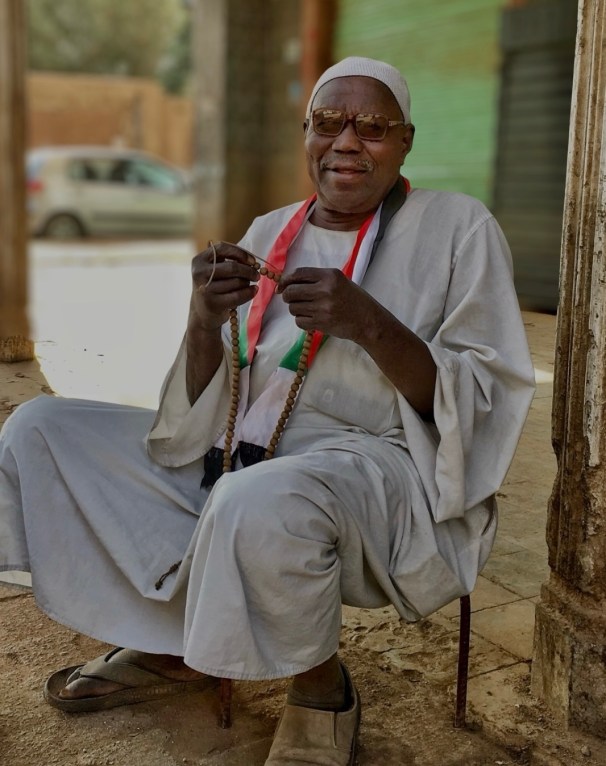
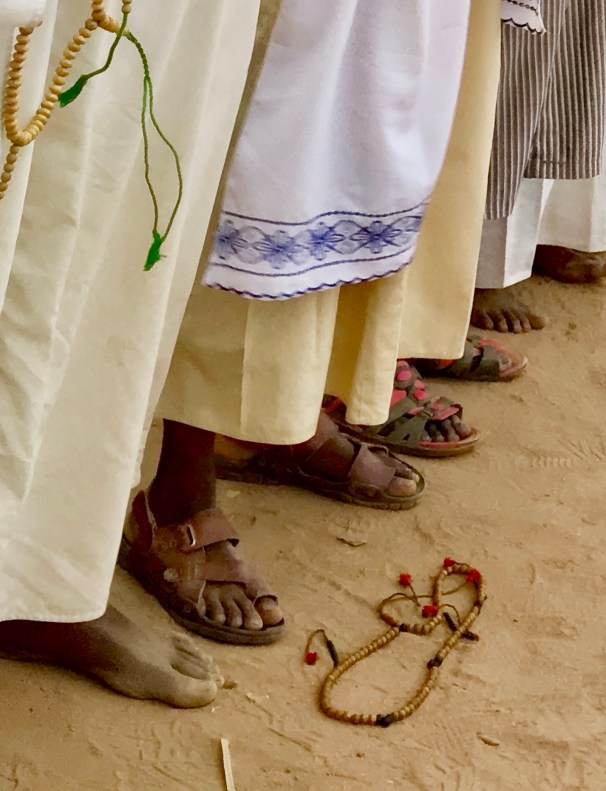
Above, top left, long burnished strings of al-alfiyya prayer beads favoured by many Sudanese Sufi orders, draping a mystic at a Friday evening zikr, Hamid Al-Nil, Omdurman. Bottom left, prayer beads at the feet of worshippers at a Sufi funeral, Hamid Al-Nil. Upper right, a gentleman telling his prayer beads while his shoes are polished in a tea stall, central Khartoum, lower right, a sibHa seller outside the Great Mosque in the capital.
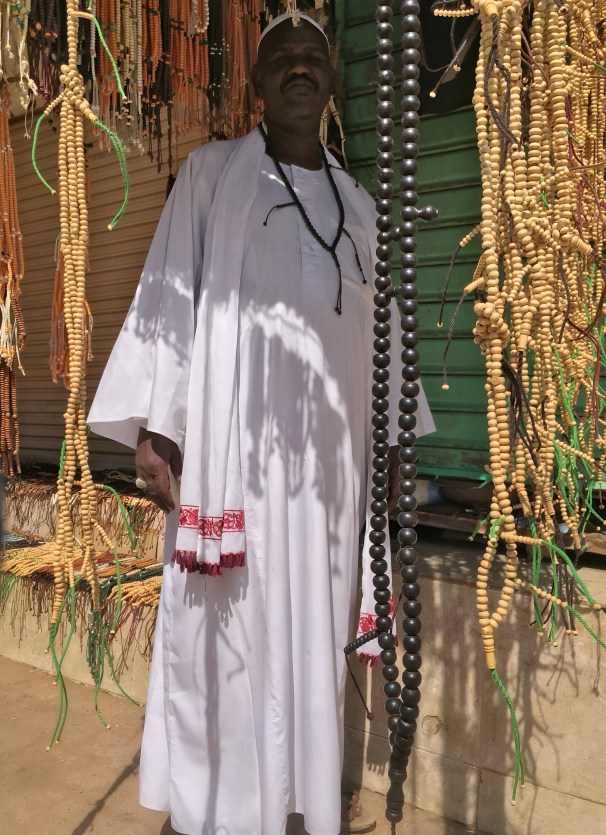
Below, a prayer bead seller near Souq Al-Arabi holds up a traditional wooden Sudanese sibHa, favoured by Sufis and which bears a hundred beads. The typical sibHa is thread with 33 or 99 beads for the blessed names of Allah. The longer sibHa has two smaller divider beads, or “shadid / shawaahid”, literally witnesses, at every 33-bead interval. The dividers can also take the form of small oblong wooden or bone beads. The two ends of the sibHa are joined by a longer, turned wooden handle bead, known as a minaret for its shape, or alif, representing the name of God. The Sufi sibHa also bears tongues of beads threaded on string or cord as seen below. These usually hold ten beads and are used to help the worshipper keep count of his hundred and ultimately thousand prayers. These are called jaraaya.
The SibHa Tradition in Sudan
“Thus Sheikh ‘Abd al Rahman b.Saih b. Bain al Naga imposed upon himself the pious duty of repeating the invocation of blessings 50,000 times a day for the period of a year, after which he contented himself with 12,000 times each morning, and at night repeating the majestic name 100,000 times; at the same time he used to read through the Dalā’il al khayrāt twice evert day. For the purpose of keeping count a rosary of a thousand beads (sibHa alfīy) was used.” Extract from Sudan Notes and Records, Volume 6, 0 1923.
The pious sheikh’s invocations of blessings described above encapsulates the primary purpose of the sibHa – as one Islamic website puts it; it makes tangible the intangible as the names of God, his praises and supplications to Him are repeated and tracked by the worshipper. This spiritual discipline with its “calming cadence” creates a meditative state where deeper connections with the divine can be made and a holistic understanding of divine nature may be glimpsed when all names are evoked. It is used for Takbir; the repetition of Allahu akbar, Tahlil; the intoning of laa ilaha illallah and TasbiH; that of Glory be to Allah.
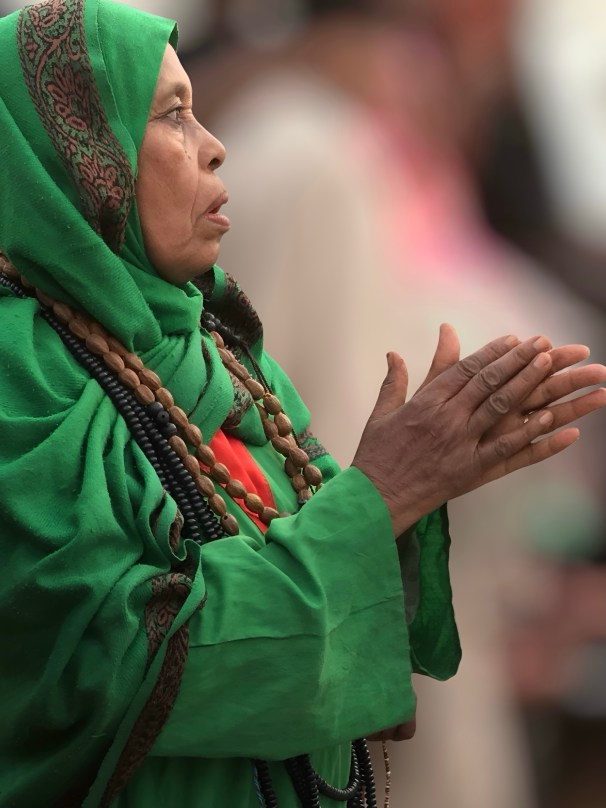
In Sudan the use of the sibHa is integral to the country’s Sufi orders and their practice of zikr / dhikr (see The Eternal Dance). Indeed, while the sibHa as such is not referenced in early Islam, it is generally believed to be of Sufi origin. For Dr. Ahmed Al-Safi, It is a reassuring symbol of piety and the rejection of worldly pursuits when seen in the hands of sheikhs and their Sufi disciples, the latter expected to carry a sibHa at all times. It speaks of a lifetime’s devotion in the hands of older women who have performed Hajj. Tell your sibHa, grandmothers would advise youngsters in times of trial and all will be well.
Of course, the sibHa can also be flourished as a statement of social status and wealth, especially when made of precious stones or silver. It can also be recruited by cartoonists and social critics as visual shorthand for false religiosity, as in a recent vignette showing a sibHa made of skulls dangling from a worshipper’s hand while he intones war cries. (See too Are You Under the Tree or in the Basement?). For some Sudanese, it may take something resembling talismanic qualities and indeed special sibHa are still used in Sudanese wedding and childbirth rituals, as we shall see below.
“These prayer beads are used as amulets to confer protection on the wearer, and because of the divine purpose they are used for, they are thought to have a blessed nature of their own.” Dr.Ahmed Al-Safi, Traditional Sudanese Medicine”

In the months leading up to the secession of South Sudan in 2011, Sudan Tribune reports, former president Omar Hassan Al-Bashir was photographed rallying leaders of Sudan’s Sufi orders. As he addressed the crowds, reaffirming his vision of the North’s cultural identity by invoking “the CPA’s endorsement of shariah law”, the former leader is seen holding aloft the unmistakable bulbous strands of an alfiyyah sibHa (Sudanese president asserts North Sudan’s Arabic, Islamic identity).
Right, the sibHa of Mahdist warrior Osman Digna, until recently displayed in the Khalifa’s House Museum, Omdurman. This is one of many artifacts reportedly looted by RSF forces from the museum over the past year, photo, Rihla Facebook.
In proudly brandishing the sibHa, the former leader was arming himself with a potent symbol of temporal and spiritual authority. The turban, sibHa and coins of the Mahdist era, researcher Kim Searcy claims, served as powerful insignia of Mahdist state authority; symbols he asserts that were “appropriated from Sufi brotherhoods and political entities of the Funj and Fur sultanates”, (Kim Searcy, The Formation of the Sudanese Mahdist State: Ceremony and Symbols of Authority: 1882-1898).
Dr Ahmed Al-Safi, in his discussion on the many cultural roles of the sibHa, noted that even the rebellious Beja were willing to submit to the guidance of a certain Shaikh Abd Allah Abu Raiyat; “it was enough for this shaikh to send his prayer beads to settle any dispute among them”, Traditional Sudanese Medicine.
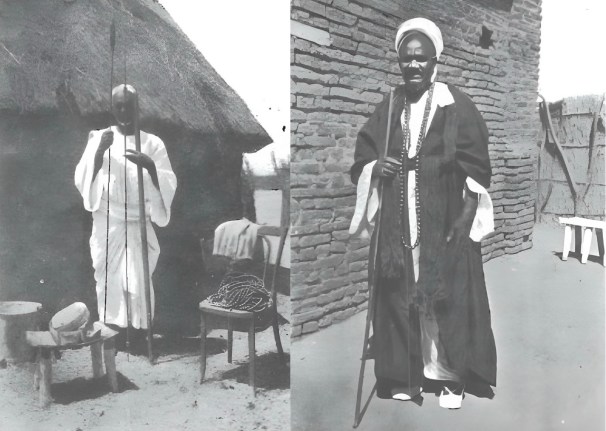
Above right, Sheikh Mohammed Tom wad Zobeir Abdelgadir, the Ya’qubabi Omda of Sabil, with the relics of Sheikh Musa Abu Qussa, of whom he is the khalifa. These relics include the kukur (the two middle legs are missing), the taqia, wooden shoes, two iron spears, wooden staff and immense rosary, (Sudan Notes and Records, Volume 15, 0 1932). Sheikh Ya’qub wad Hajju Abdelgadir el Masi’, wears the insignia of Sheikh Mohammed Tom wad Bannaga. Note the taqia, wooden shoes, large seal ring, large rosary, and the kukur in the background (Sudan Notes and Records, as above).
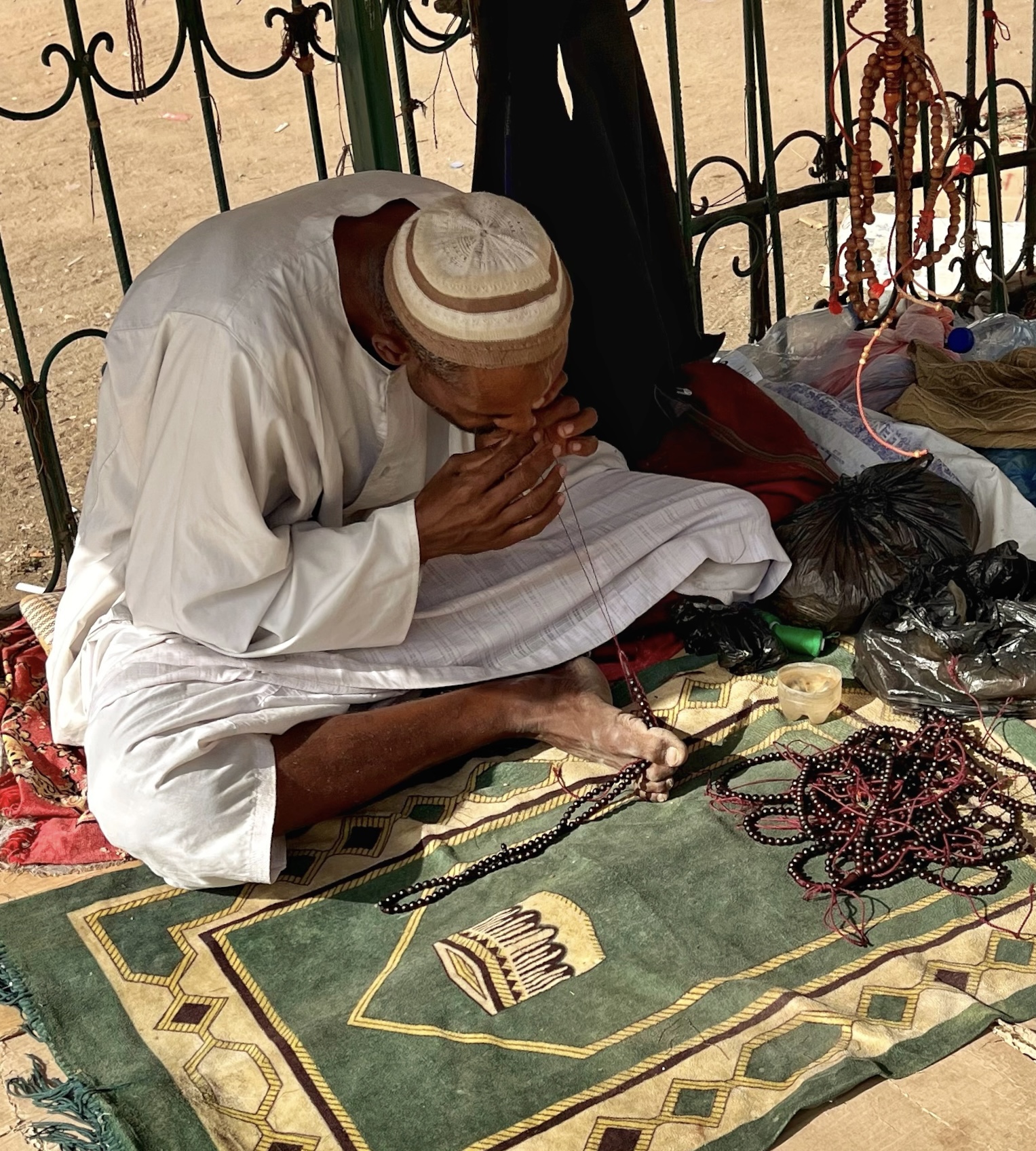
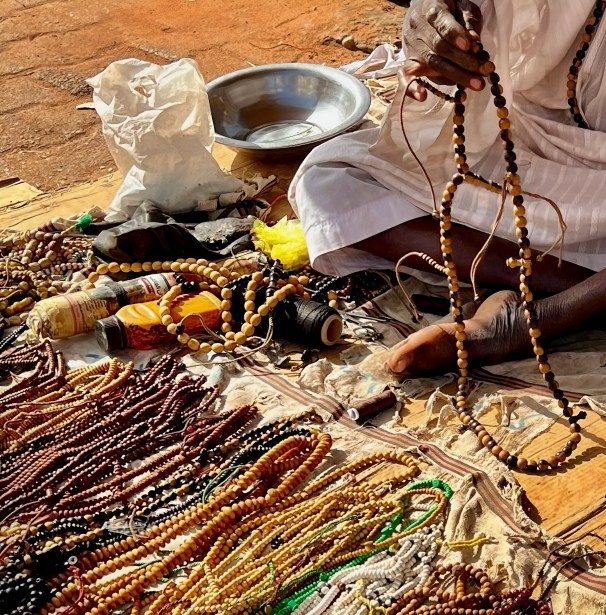
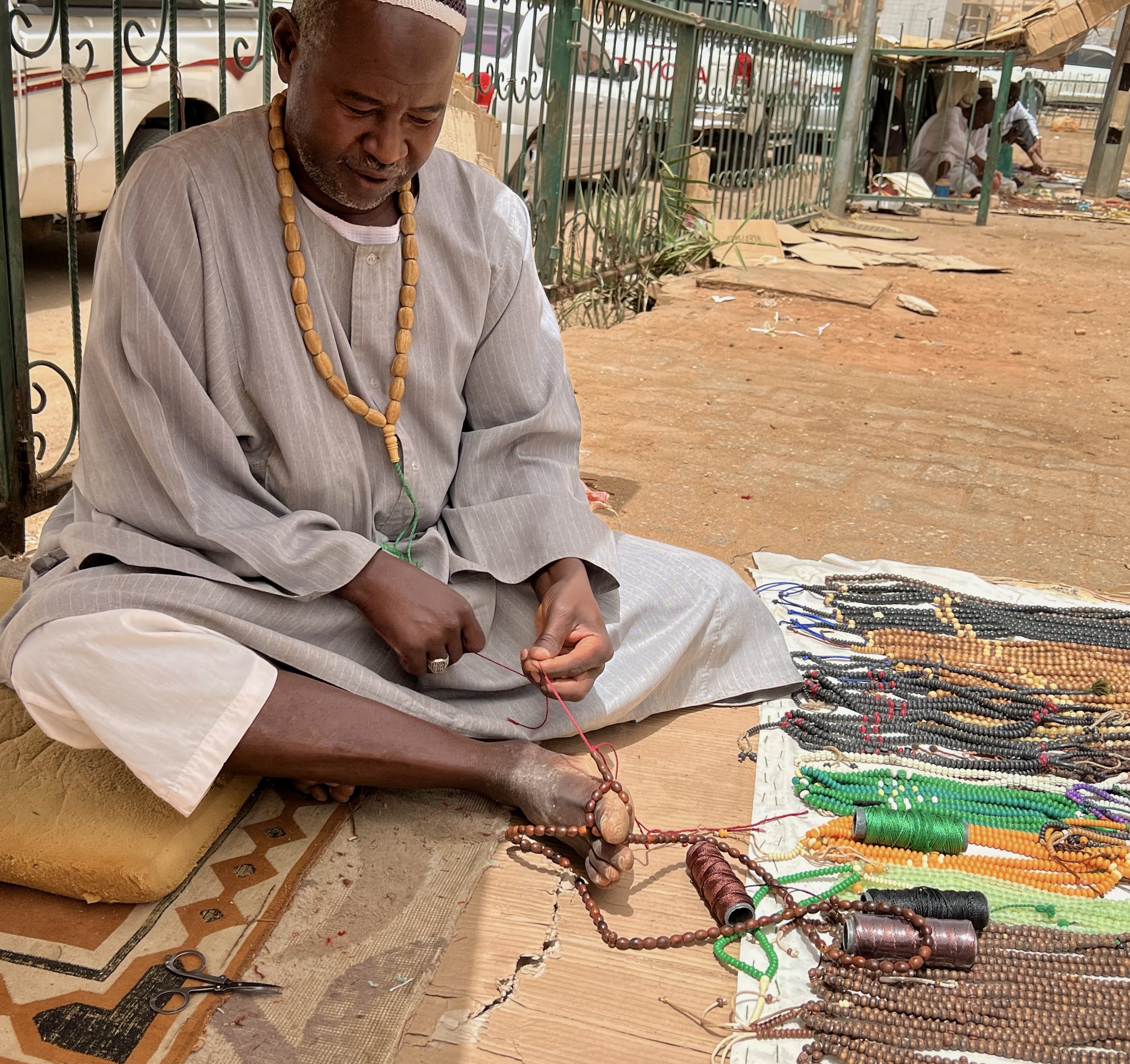
Above, threading a sibHa in a makeshift stall near the Great Mosque, Khartoum.
Types of SibHa and Sudanese Hand Turning

Although the first sibHa were thought to have been made of dried earth, today sibHa can be found of ebony, agate, turquoise and other precious stones, Red Sea black coral, ivory and amber; olive and sandalwood. Coconut wood, al-kuuk, is highly prized by the Sudanese, as is the light and strong boxwood, frequently imported from Egypt and Turkey. Boxwood beads are admired for the rich golden yellow patina they acquire with age and use. Woods indigenous to the Nuba Mountains such as the Qalanga and Iram, similar to the jujube tree are also used though increasingly difficult to source, as are Kordofan talH and Qaddeem. The prayer beads of Kordofan, Darfur and Sennar are also prized for their quality. As one sibHa seller lamented to Sudanese news agencies, it takes substantial capital to import prayer beads, leading to the market being dominated by just a handful of importers.

Specific Sufi orders may have their own sibHa, sometimes of a hundred beads, interspersed with bone dividers, and using imported woods from Turkey and China which are hand-turned in Sudan. Sudanese sibHa are famous for the quality of their hand turning and especially of the finish of the “minaret” and dividers. Before the war, most lathe workshops for sibHa were found west of Omdurman or along the widing alleys of Omdurman market with its very own “SibHa Street”. Hand turning has largely been replaced by machine lathes. Watch prayer beads being made in the traditional way here; صناعة السبح في السودان .. مهنة ترتبط بوجدان الشعب وتقاليده │ صباح النور

Perhaps the most striking of Sudanese sibHa is the al-alfiyya; from the Arabic word for a thousand, consisting as its name suggests, of a thousand beads. The beads are made from the seeds of the fruit of the hijliij or desert date tree, known as laloob, the finest examples of which are said to be found in Nyala. The fruit, pictured left, has a sweetish taste and is believed to have digestive and other curative properties. According to the Sufi sheikha speaking here, the word laloob is associated with the values of the straight, unswerving path to right devotion; the siraaT al-mustaqiim. A smaller version of the al-aflfiyya is known as an arija.
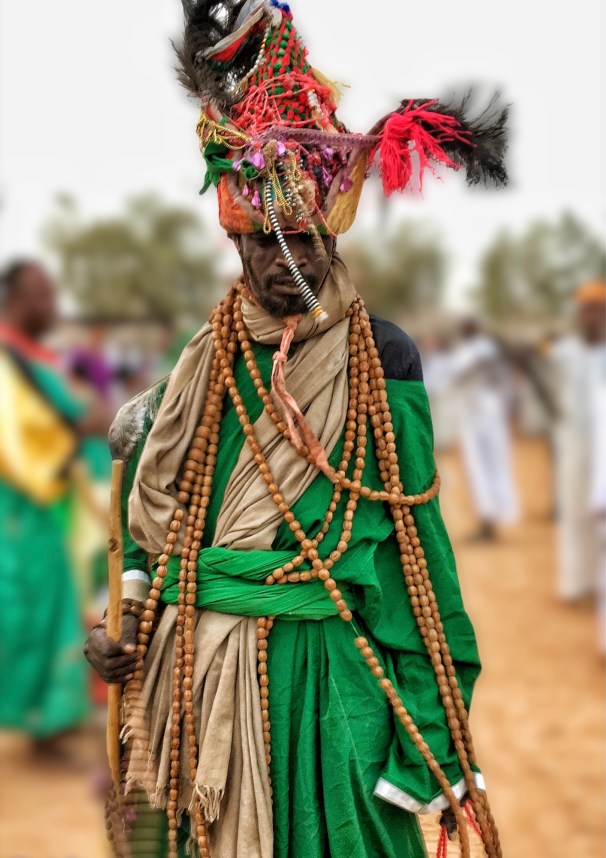
Below, a Sufi with his al-afliyya sibHa at Hamid Al-Nil zikr, Omdurman.
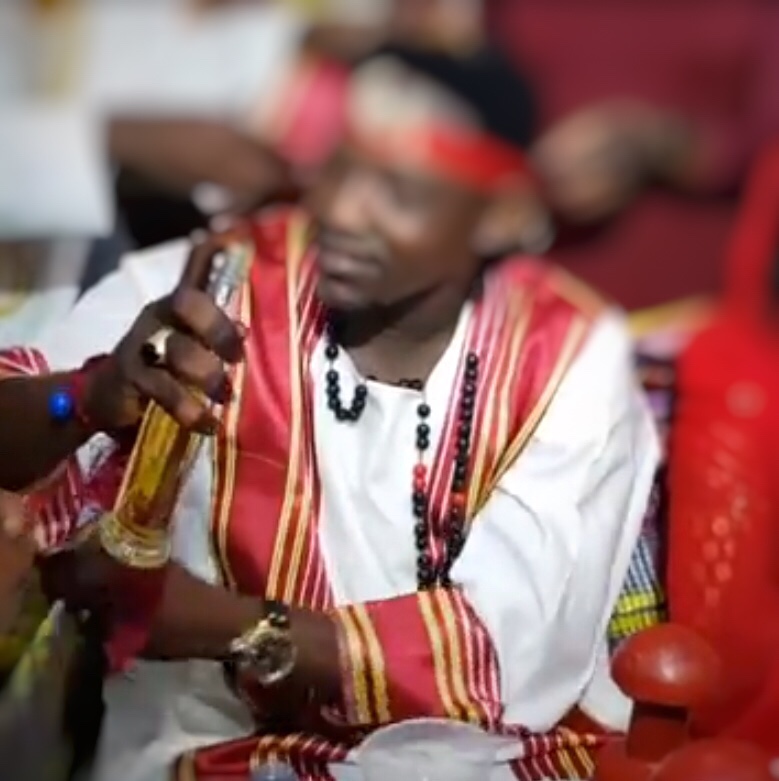
The sibHa al yasur, believed to guard against hardship, is made of black and red wood, pictured right. It consists of ninety-nine beads with eight dividers in red. It plays a central role in the jirtig ceremony as a wedding sibHa. Traditionally, the beads were soaked in milk and zirria’; the water of soaked sprouting dura grains, both symbolic of fertility, (Griselda El Tayib, Regional Folk Costumes of the Sudan). The sibHa al-yasur was also worn in the past as a talisman by pregnant women to ward off misfortune at this vulnerable stage of their lives through mushahara, a term derived from the Arabic for moon, shahr, and used to encompass “all the apparently inexplicable ailments to which a pregnant woman is exposed, and which would cause a miscarriage or a difficult birth (Abdullah El-Tayib).
A Tribute to the SibHa Sellers of Khartoum
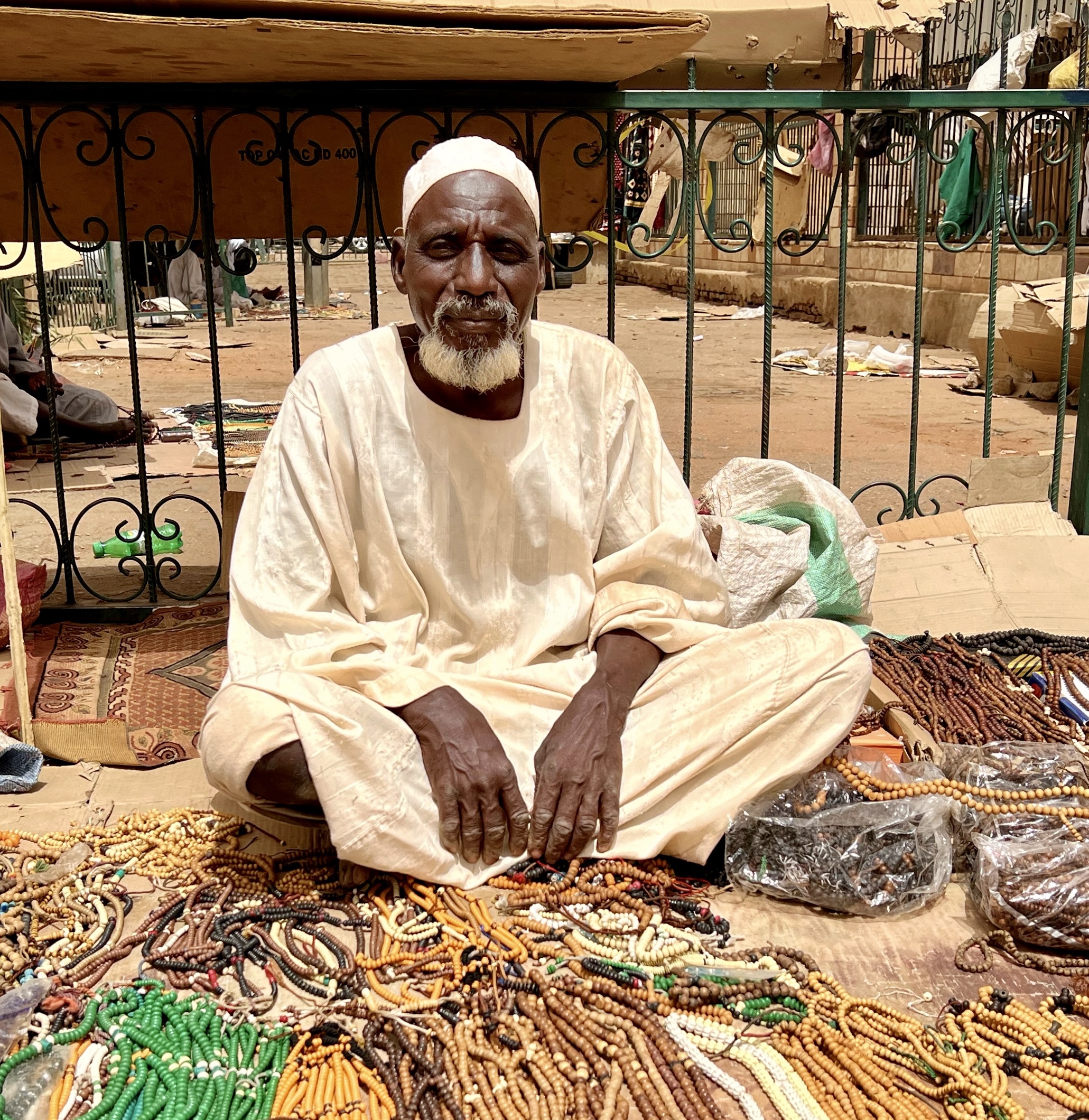
Below, some of the prayer bead sellers of central Khartoum whom I met in 2022. These friendly, kind and wryly humorous gentlemen invited me to take their photos and talked eagerly and with great pride about their sibHa, the skills needed to make them and the everyday challenges they faced at a time of soaring inflation and great economical instability. I can only hope they and their families have found safe refuge from the war.


Some Links
صناعة السبح في السودان .. مهنة ترتبط بوجدان الشعب وتقاليده │ صباح النور
سبحة(البقس)وسبحة(اللالوب)بالسودان+قانون ذكر الله والصلاة على سيدنا محمد صل الله عليه وآله بالعداد
 Women's literacy in Sudan