

Poet of Sudan’s Soul
Mohammad Al-Mahdi Al-Majdhūb / Majzoub 1919-1982
Poor man grown wealthy / On the fruits of his self-denying, / The patches of his robe / Make a garden of all color, / Stranger to this earth, Just a cane for company, / Prayer beads of Lalub / Looped around his neck
From Birth, translated by Charles Doria and Salma Al-khadra Al-Jayyusi.
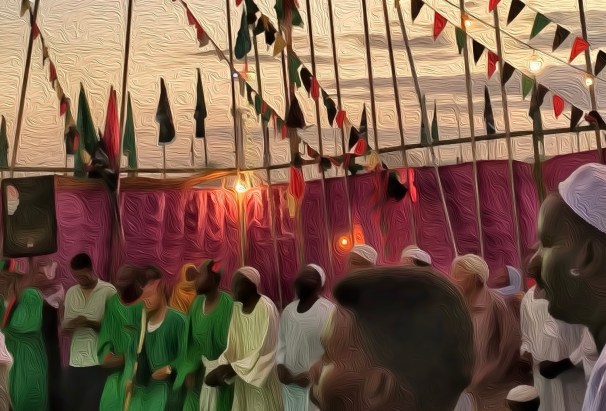
Above and title illustration, Sufi orders of Khartoum and Omdurman celebrating the Birth(day) of the Prophet, Mawlid An-Nabī Omdurman. For more on Sufism in Sudan, see Memories of Omdurman, A Thousand Prayers, Unfolding Blessings and The Eternal Dance

Poet, writer, campaigner for Anglo-Egyptian colonial independence and co-founder of the Republican Brotherhood, Mohammad Al-Mahdi Al-Majdhūb‘s poetry distills with intense compassion and painterly imagery the spiritual yearnings, layered cultural identities and social realities of Sudanese life. One of the poet’s most anthologized and best loved works is his Mawlid / Maulid / Birth or The Prophet’s Birthday Operetta, inspired by his memories of the Mawlid celebrations of his native Ad-Damar, quoted above and referenced below.
This week’s post is the first of a series of articles dedicated to this prolific poet and thinker. Below, I offer a very brief profile of Al-Majdhūb’s life and literary legacy, together with professionally translated excerpts from his work. In future posts I hope to provide deeper analysis of that legacy, accompanied by excerpts and rough, working translations from previously untranslated poems.
Mohammad Al-Mahdi Al-Majdhūb: A Brief Profile
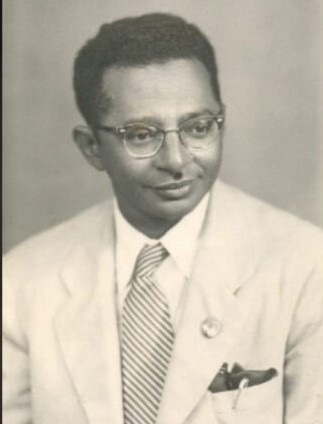
Mohammad Al-Mahdi Al-Majdhūb, Ad-Damar, 1919, was the son of prominent Sufi sheikh, Mohammad Majdhūb Jalal Al-Din. Steeped from an early age in the Quranic and the classical Arabic of the khalwa and his father’s scholarship, the young man travelled to Khartoum to receive a British colonial education, graduating from the School of Accountancy at Gordon Memorial College (now Khartoum University).

The poet’s work as an accountant led him to travel extensively in Sudan; something he later credited as informing the “Sudan-ness” that found expression in his verse. In addition to lecturing at Gordon College, Al-Majdhūb wrote for numerous journals and other publications.
With Mahmoud Mohammad Taha, he co-founded the Republican Brotherhood in 1945, dedicated to bringing about democracy, non-sectarianism and independence from colonial rule. He was detained by the British for his anti-colonial activism. The poet, who had composed verses in praise of Mahmoud Mohammad Taha, left the Republican Party in 1948, following shifts of direction within the movement.
For more on the inspiring figure of Mahmoud Taha, see Dr. Edward Thomas’s fascinating study; Islam’s Perfect Stranger. More on Mahmoud Mohammad Taha in coming posts.
Photos above, the young and older Al-Majdhūb, Wikipedia.
Meeting the Poet Through His Work
The Peanut Seller The Pickpocket The Wedding Parade
Maulid / Mawlid / Birth
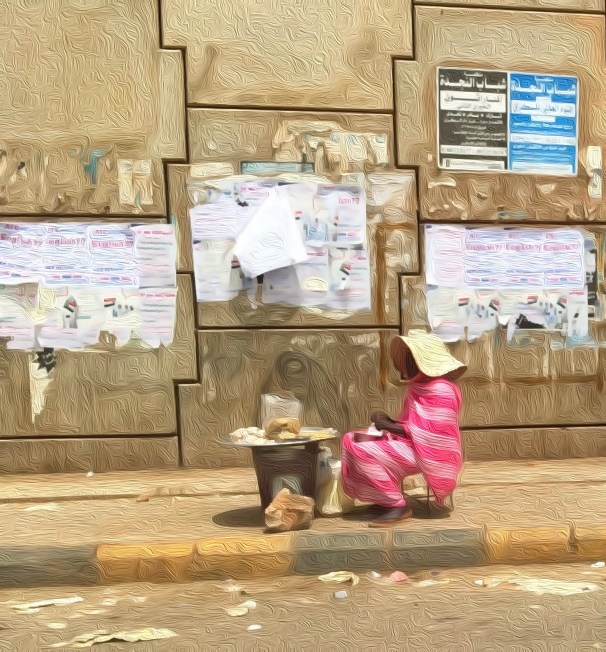
Above, a seller of nuts and seeds, central Khartoum, pre-war.
“My tradition is: beads and feathers and a palm tree which I embrace while the forest is singing around us.” Al-Majdhūb, quoted in Sudanese literature in English translation: an analytical study of the translation with a historical introduction to the literature.

Al-Majdhūb’s creative trajectory coincided with the emergence of the Fajr group, defined by Muhammad Abdul-Hai as “the beginning of a ceremony of belonging and rediscovery of the communal roots of identity and creativity that gradually found expression” among the younger poets of the 1940s. This seeking of belonging was to bring about a recognition and re-evaluation of northern Sudan’s African cultural legacy and a conscious re-integration of this “African-ness” into its Arab-Islamic identity. This philosophy would eventually find expression in the Jungle / Forest and Desert School.

Professor Abdul-Hai believes Al-Majdhūb to be “probably the first Sudanese poet to tap the possibility of writing poetry in the Arabic language with the consciousness of the Negro tradition.” For the poet himself, Sudan’s African heritage was liberating; “In the Negroes my roots are deep, though the Arabs may boastfully claim my origin” and he revelled in his “Africanness without the restriction of noble descent from Quraish and Tamim” (quoted by Thorraya Soghayroon). The poet’s verse is also said to have inspired later generations of poets with its liberation from formal constraints and rigidity of past poetic forms.

Al-Majdhūb is credited with elevating Sudanese vernacular “to the level of refined and sophisticated literacy expression” (Mohammad Abdul-Hai) and in his ten, stylistically far-ranging collections of poetry, served to drive “Sudanese poetry away from excessive rhetoric and romanticism, setting for it a new course more reflective of the present time.” For others, the poet’s work is “deeply rooted in modernity with echoes of Mutanabbi.” Many have also recognized Al-Majdhūb as a “poet of imagery par excellence”, sublimating his great love of representational art – art forms his father disapproved, of in his verse.
Selected sources: Conflict and Identity: The Cultural Poetics of Contemporary Sudanese Poetry, A Translator’s Canon of Sudanese Literature, مَن يَلحَمُ أبعادي – ملف الشاعر محمد المهدي المجذوب , Sudanese literature in English translation: an analytical study of the translation with a historical introduction to the literature, Wikipedia
Illustrations above from Working Hands
The Peanut Seller

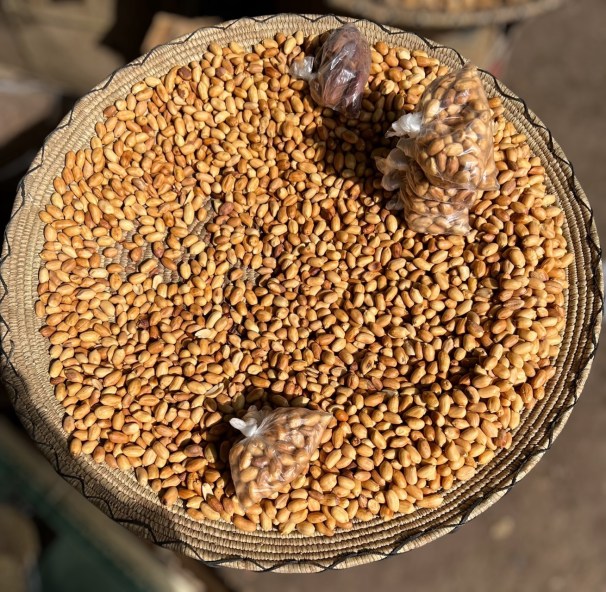
Above, a seller of nuts and seeds at her stall in Omdurman, pre-war, as backdrop to an excerpt from The Peanut Seller by Sudanese poet Mohammad Al-Mahdi Al-Majdhūb / Majzoub, first published in1982. The excerpt is quoted and translated into English in Sand in My Eyes, Eniko Nagy, as follows:
In every peanut / That is roasted and salted / There is a winged wish / Its eye brings victory / And the peanut seller in the street / Glows ever more intensely with her intense darkness / her heavy sweating / Embraced in her velvet blackness.

Osama Tag Al-Sir, speaking of the poet’s themes, quoted in Al-Jazeera, من ليل الدامر الساكن إلى صخب الخرطوم.. noted “He wrote about coffee shop owners, shoe-cleaners, pickpockets, the bean seller, the shard seller, the beggar, and so on.” There is profound empathy and sense of justice denied in Al-Majdhūb’s evocations of the life of the poor; “I have benefited a lot from mingling with people, especially the poor, for they have a striking sincerity that has benefited me and cured me” the poet acknowledged. This outflowing of compassion is evident too in The Pickpocket, below. See too the Kisra Seller, (Arabic) بائعة الكسرة …لمحمد المهدى المجذوب

Amidst all the dizzying vibrancy and plenty – sweetmeats, balloons, dolls, and feasting – of the Mawlid celebrations, the poet’s gaze turns to the marginalized, the deprived as the poem’s seamless spiritual focus ripples out from the passionate centre of dhikr rites: God! How their poverty wastes them! / The tiny children who come here / on Your Prophet’s Birthday, / longing for joy, but went home, / taste of dust in their mouths. / Weep for the mother / who’d give them stars / if they asked! …./ God! You sent an orphan child / into the world to stand up / for the right, for what is just. / He was kind to us.
Muhammad al-Mahdi al-Majdhoub “Birth (Al-Maulid),” Middle East Report 153 (July/August 1988), Sudanese literature in English translation: an analytical study of the translation with a historical introduction to the literature, من ليل الدامر الساكن إلى صخب الخرطوم
Upper left, roasted peanuts for sale on Qasr Al-Nil; above left, a kisra maker with her freshly baked flatbread. Above right, the pretty dolls the poet references in his work Mawlid, sold during the holy celebrations and which the tiny children of his verse will never have.
Below, Mawlid celebrations, Omdurman.

The Pickpocket
Hunger plunged him in a daze / His food: mere crumbs / from tables rich with food / Around him all was grilled with rust / Wrapped in mirage, darkened by passing clouds.
When justice against the pickpocket is meted out, it is brutal:
He fell within the court-room cage / HIs arms around the iron bars, his gaze upon the open chasm. / Justice looked down from the lofty place / Peace be with it / Dressed in clean robes, its voice a whisper / Wise-looking, turning page by page / Licking its chops / Making of every word a polished sword, / A dog with mangy, burning flesh / With empty patches in its fur / Its naked fangs agleam / Alive with rabid flame / HIs master taming him with a stone
From A Short Anthology of Sudanese Literature, published by Office of the Cultural Counsellor, Embassy of the Democratic Republic of Sudan, Washington, D.C
The Wedding Parade / The Wedding Procession

Above, opening lines of Al-Seyra, The Wedding Parade or The Wedding Procession, 1982, translated by Adil Babikir in his Modern Sudanese Poetry as follows:
In the heat of daluka drum beats, / the young girls were casting charms, / from kohl-lined eyes, / where beauty felt at home. / Tonight, mother of the bride, we brought you / our cream of the cream; / palm fronds in our hands, / a good omen for green times to come.

Above, Welcoming the rise of The Nile, G.N. Morhig, The English Pharmacy, Khartoum, personal collection. See too Angels of The Nile
Below the same passage rendered in Sand in My Eyes:
In the beat of the drums, / The girls hide their beauty and splendour / From eyes shaded with kohl / Which look for a glimpse and then fly / We come to you, mother tonight / With pure, good and beautiful things / We came to you carrying the palm leaves, / An omen for luck and prosperity
The closing stanzas of the poem reveal much of the poet’s vision and inner life; the constant tension between the profoundly spiritual and almost intoxicatingly sensual and sense-laden expression of Sudanese life, the recreation of the uniquely Sudanese – “Sudan-ness”, the yearning to return from his exile in “The City of the Turks”, as he referred to Khartoum, and the joyful interwoven-ness of African, Arab, pre-Islamic and Sufi rites.
The poem closes with:
The norm of love in my country is constraint / and unfailing observance of chastity. / My whole heart is devoted to you, my homeland; / it never swayed westward or eastward. / I never shared the lust for prestige, / of my fellow civil servants; / among the ranks of the poor I will proudly stay. / I long for my innocent village, / That knows nothing about my sufferings, / here in this alien city; / no relatives, or acquaintances; / swallowed in utter darkness; / climbing the rocky nights with a blind lantern; / longing for the deep massage of dilka, / the scent of karkaar, / and the silky garmasis gown; / watching the caravans of palm trees, / and the Nile as their escort and singers; / my water jar is full, / Treating myself to cold sips of Nile water, / from an engraved gourd utensil.”
From Wedding Parade by Muhammad El-Mahdi El-Magzoub, translated by Adil Babikir, Modern Sudanese Poetry, An Anthology.
Mawlid / Maulid / Birth

Below, three English versions of these iconic verses from Maulid:
Here, the Sheik’s circle of followers / Rocking back and forth / The drum he beats relentlessly sighs / Its sound resonates / It pulses in a roar and maddens / Around it other drums cry in the dust / Around them the circle / Goes round and round / Jumping in the deep of night / Under tall flags / Like a ship with many masts / On waves like mountains
Sand in My eyes, Enikö Nagy
Here is a circle. An old man swinging to the rhythm, / Energetically beating the grand drum. / It whines then breaks into magic roars. / Around it are drums covered with dust, / as the circle keeps rolling / under flapping banners / like a boat struggling amid mountain-high waves
Translated by Adil Babikir, A Translator’s Canon of Sudanese Literature
For it’s here an old man / Rocks to and fro, circling, / Pounding the Nuba dancer / keep circling, bowing, / Like waves, back, forth, / Up, down, their leaping / filling the night / under the long banners / That float from tent poles / Like a drunken ship / On the mountain sea.
Anthology of Modern Sudanese Poetry Osman Hassan Ahmed and Constance E.Berkley, published by Office of the Cultural Counsellor, Embassy of the Democratic Republic of Sudan, Washington, D.C
See a full translation of the poem, entitled Birth, translated by Charles Doria and Salma Al-Khadr Al-Jayyusi in the anthology above. This publication can be downloaded free through Google Books. The same translation includes these lines:
Now a moment of peace / Quells the ringing dance, / Now the body forgets self, / Spirit radiant with light / Relaxes, the old man’s eyes / Close on a universe still / Dreaming its great dream..
See further discussion of this complex, long and evocative work in Thorraya Soghayroon‘s thesis, Sudanese literature in English translation: an analytical study of the translation with a historical introduction to the literature
 Women's literacy in Sudan