

Rise and We Will Build Sudan Anew
A Poem Written and Recited by Iman Al-Mutawakkil
Aljazeera Direct Sudan
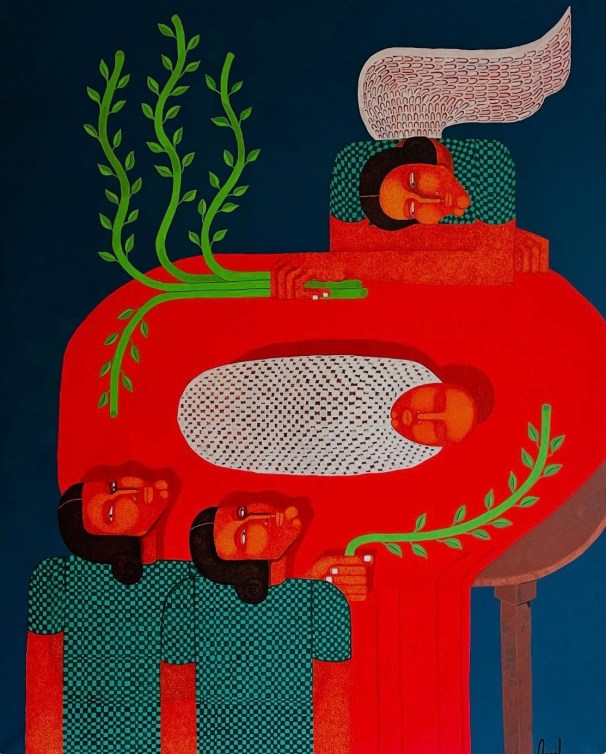
Above, a compelling portrait of the suffering of war by Sudanese artist Amel Bashier, entitled “At the negotiating table childhood dies”. Thank you, Amel for so kindly allowing me to reproduce your work here.
See more of the artist’s work in Amel Bashir Taha Delicate Defiance and The Exquisite World of Amel Bashir.
Rise and Build Sudan Anew
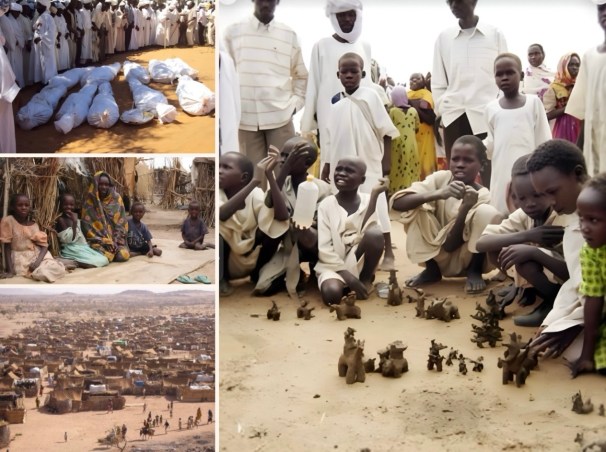
Above, visual testimonies to the cost of war; the dead and displaced of Darfur; young survivors being helped to overcome the psychological scars they have suffered, photographs, (CC), War in Darfur Wikipedia.
This week’s brief post offers a working translation of the poem قوم نبني سودان من جديد – Rise and let us build Sudan anew, recently recited by the poet in Aljazeera Direct Sudan’s series, Diwān As-Sūdān. The poem’s compelling rhythmic and alliterative force, reminiscent of dalouka drum beats, will draw you in even if you don’t speak Sudanese Arabic. It’s a work that evokes the brutal stripping away of Sudan’s resources and the vast human cost of the war. The poet speaks of the hardships endured by the Sudanese people, the indiscriminate nature of their suffering and the sheer anguish of grief and loss amidst the all-consuming flames of war. The betrayal of numerous failed peace deals, the arbitrary cycles of destruction, a silence mistaken for acceptance. All this is given voice to – openly and unequivocally as Iman Mutawakkil reiterates that the people’s silence is not in fact silence. The voice of the Sudanese remains steady and strong and is to heard clearly amidst the rubble. The poem ends with a message of hope and defiance.
I will be providing a detailed lexical breakdown of the poem in my sister blog shortly. My thanks to Muna Zaki for all her kind guidance, patience and instruction in the translation of this work.
Click on the link below to enjoy Iman Mutawakkil’s recital of the poem:
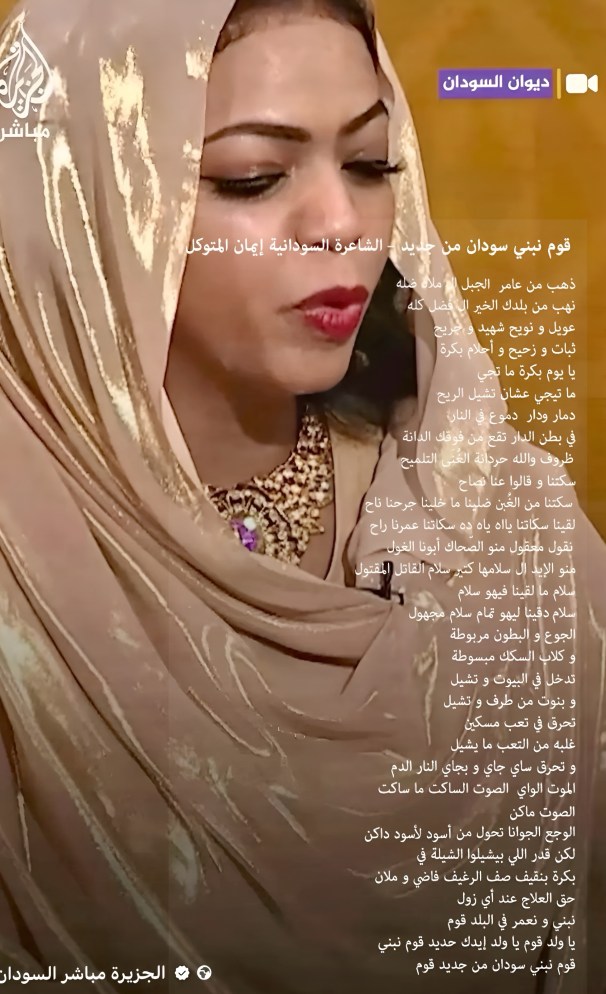
“قوم نبني سودان من جديد”.. الشاعرة السودانية إيمان المتوكل تلقي قصيدة عبر شاشة
Below, Only the Dead Have Seen the End of Wars – Amel Bashier
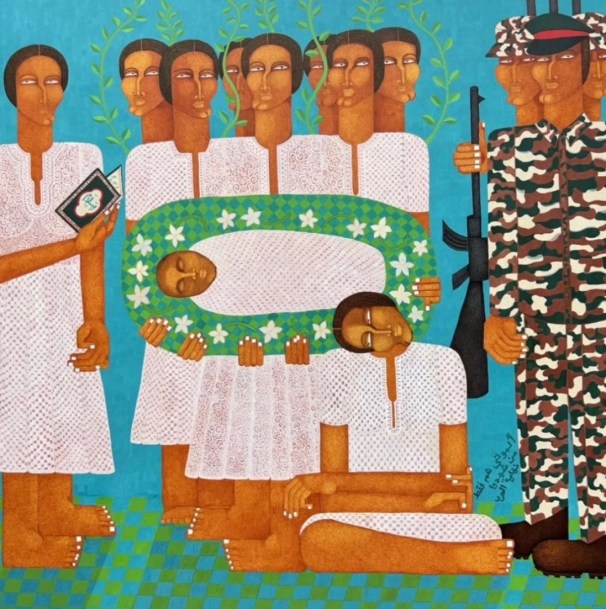
One of Amel’s canvasses exhibited at the Abu Dhabi Art Fair, 2023.
Rise and we Will Build Sudan Anew
A Working Translation
/ The gold of Jebel Amer with its kind, deep shade – all gone /
The poet is referencing the gold mines of Jebel Amer, a key strategic and financial resource to both government and RSF forces. The struggle for control of Sudan’s gold and its revenues has played a pivotal and tragic role in the ongoing conflict. See Chatham House’s Gold and the War in Sudan for a detailed overview. The squandering and destruction of physical resources – immense though they are, is surpassed by the war’s human toll, as the poet goes on to capture in her work.
/ Looted from your land all good things left /
/ Wailing and lamentation (Moaning, mourning), the martyred and maimed (wounded) /
/ Yet steadfast we edge forward (persist) – the dreams of tomorrow /
Despite the suffering meted out to civilians, the poet stresses, the Sudanese remain resolute and unbroken in their hopes for a better future, though the pain is such that neither land nor people are ready to receive it now:
/ O tomorrow do not come! /
Perhaps the idea here is that the coming days will only bring more destruction or at very least erase what little is left of people’s lives and homes:
/ Do not come with the scattering wind /
/ (erasing the fragments that remain of homes, lives) destruction, waste (loss), tears scorched (consumed) in fire /
/ The shell that crushes you to death in the bosom of your home /
/ By God, sickened now by circumstance I throw off (disown) gentle hints /
The poet is urging the fearless voicing of dissent. The Sudanese have paid too high a price for their silence:
/ (For) we said nothing and (so) they said of us we acquiesce (were content) /
not understanding that:
/ It was burning injustice that held our tongue; led astray we stifled our cries of pain /
/ In keeping our silence, alas, our whole lives were spent (lost)/
/ And we say (in disbelief) “who roused the Father of All Ghouls?” /
The ghoul is a recurring motif in Sudanese folktales; here perhaps the poet is referring to those who have unleashed the evils of war.
/ Whose hands were extended in peace – of both the killer and the killed /
The words here also have associations with the saluting by soldiers to their commanders. The poet is emphasizing the repeated failure of peace negotiations, the questionable validity of their participants, the human cost of that failure. The people celebrated peace accords only to be betrayed.
/ We found no peace in their peace /
/ Beating the (joyful) drum of a peace unknown ( perhaps also here unreal, hollow)
/ Hunger and bellies conjoined /
/ and the street curs content/
Here the poet speaks of the indiscriminate looting of homes and the kidnapping and rape of civilians of all ages. These war crimes are largely associated with the RSF paramilitary forces.
/ Entering homes and taking (seizing) all /
/ (even) young girls they grab wantonly /
/ Consuming in the flames of war the toil of those who toil /
/ Those overburdened with toil they cannot bear /
/ Burning aimlessly here and there in fire and blood /
/ The agony wail of death, the silent voice not silent /
/ A voice unshakeable /
/ Though the pain within us darkens to pitch black /
/ Yet still with agency to bear the load /
/ Tomorrow we will stand in line – be it short or long, for bread /
Whatever the future brings; plenty or scarcity, as a society we will endure and move forward, restoring basic rights and services:
/ Medicine the right of every man /
/ We will erect and build our land, “Rise /
/ Rise my son, with your hands of iron, rise and we’ll build! /
Rise and we will build Sudan anew, rise!

