

A Quiet Revolution
Palliative Care in Sudan; Part 1 Behind the Scenes
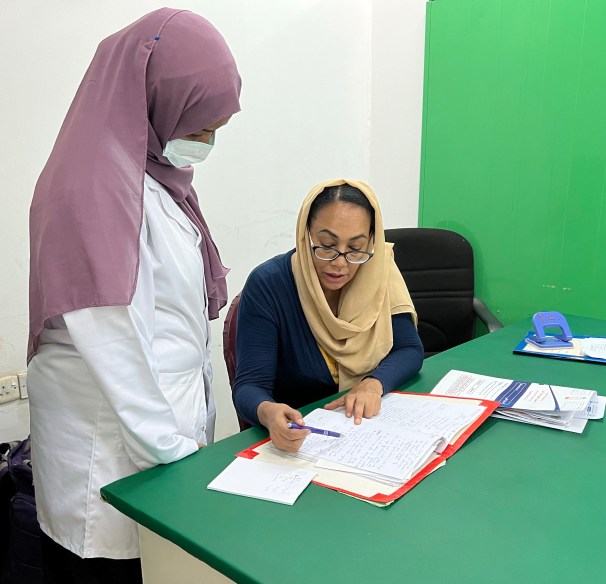
I’m taken into a small room on the second floor of Khartoum’s Radiation and Isotope Centre. Equipped with just a couple of desks, a few tired chairs and a narrow curtained-off examination area, it’s an unlikely setting for a revolution. And yet a quiet revolution is underway here. It’s a revolution fueled by compassion and informed by medical best practice. And it’s a revolution driven by Dr. Nahla Gafer, oncologist and Sudan’s leading palliative care specialist.
A new patient comes in and Dr. Nahla invites her to sit down. She’s a young northern Sudanese woman and she has stage three breast cancer. She speaks very softly, almost in a murmur. As I strain to catch her answers to the doctor’s questions, I notice her eyes are heavy with unshed tears. Dr. Nahla absorbs the young woman’s long pauses, waits, smiles, listens, reassures, explains, listens again. There is no hurry. Only when Dr. Nahla sees that her patient can leave with something of the weight of her illness lifted, will the consultation end. And when it does, both the patient and her husband who has sat silently by, his face blank with anxiety, look calmer – as if they have found their sense of direction again. (Photo above left, Dr. Nahla discussing case notes at the clinic).

At another desk, volunteer colleague, Jacqueline, is greeting her patient in Dinka. The elderly woman, her toub wound tightly around her, had entered the room head down. Hearing the greeting, she looks up for a moment and smiles. “I’m Lotuko,” Jacqueline explains,”but I always try to greet patients in their mother tongue.” Her patient smiles as she jokes about how shaky her command of Dinka is. Jacqueline then gently moves the conversation on. When the elderly patient goes to lie down – she is tired and in pain, Jacqueline explains to her son, “you know, your mother is suffering something which is different from typhoid or malaria. I can tell you a little more, if you would like me to. Would you like me to? OK….” Later she will show her next patient with a fungating breast cancer wound how to lie down comfortably and move her arm to ease the pain.
This is the beginning of a long day for Dr. Nahla and her small team of trained volunteer staff. She heads and was instrumental in founding the first palliative care unit in Sudan and Sudan’s citizens – and especially their poor citizens, desperately need access to palliative care. Dr. Nahla is determined to make that happen. “You see, it’s about ethics, it’s about the balance between intervention and dignity.” Dr. Nahla explains; “the ethics of making the care everyone should have available to them, irrespective of their economic status.” She continues; ” It’s so desperately needed because 80% of Sudan’s terminal patients die in needless pain and at least 30% of those who die sudden or unexpected deaths also suffer unnecessary levels of physical and psychological distress. And in the case of the latter, the bereaved are often left to cope alone with profound psychological suffering.” (photo above right, Jacqueline between consultations).

Dr. Nahla’s revolution has the odds stacked against it. Palliative care is still relatively unknown or misunderstood in Sudan and receives zero public funding. Medical degrees do not yet include training in the discipline. As a result, doctors are often at a loss how to communicate with terminal patients. Dr. Nahla wants to change all that. In a society where talking about death or mentioning the word “cancer” is taboo, many sufferers feel they should not voice their pain or psychological distress. Although cancer care in Sudan is good and morphine free, gravely ill patients often leave their home and everything familiar to them, journeying to Egypt in search of a cure, only to find tests are needlessly repeated, drugs must be paid for and their life savings soon run out. Palliative care here is restricted to cancer patients and early diagnosis of the disease is vanishingly rare, with most cases only detected when far advanced. Although morphine is readily available, oral morphine is only available at the three oncology centres that have palliative care units: Khartoum, Medani and Gedarif. (Photo above left, Amal Tower, Khartoum’s Radiation and Isotope Centre).
Against this unpromising backdrop, Dr. Nahla and her team calmly and determinedly offer their skills unpaid in their twice weekly hospital clinic and bimonthly home visits across the capital and its sprawling outskirts, in a program currently reaching twenty patients but with the capacity to double that. It has been a long journey from 2010, when the unit was founded and there is a long journey ahead but when you meet this remarkable woman, you cannot but be convinced that she will have her revolution. Indeed, it is already afoot.
Next week, the challenges Dr. Nahla faces, stories from patients, the transformative power of home visits and the remarkable people who work with her.
Read more about her work in the links below
Nahla Gafer, International Association for Hospice & Palliative Care
Palliative care for Cancer Patients to Sudan
Palliative Care for North Africa and the Middle East, Stories from Sudan


Learn more about our life changing educational work in
Scenes from Our Orphans’ Schooling Programme
See too Community Literacy, Latest News and At a Glance
 Women's literacy in Sudan
An important and moving post on the subject of palliative care in Sudan. Clearly very much needs to change and Dr Nahla Gafer’s work is ground-breaking.
LikeLike
That is such an excellent and moving article. I have been with family members and friends at the end of their lives and these deep and caring discussions with those who can give advice are so important
LikeLike