

The Esthetic Lexicon of Rashaida Women in Eastern Sudan
“One catches glimpses of these women as they seem to float across the landscape in their long, trailing, flowing dresses, often holding one end of a long sleeve panel over their heads to shade them from the sun.” Griselda El Tayib, Regional Folk Costumes of the Sudan.

Above, portrait of Rashaida women in the clothes typically worn inside their tents and compounds, Kassala State, Sudan. Photo by Eric Lafforgue, copyright, Alamy, used under licence.
Setting the Scene
The Rashaida women in Lafforgue’s superb portrait above fix us with a confident, steady gaze that reveals perhaps just a hint of a smile. They are swathed in their wimple-like head veils, known as ginaa`. Their clear eyes are etched with kohl and their noses flanked by beauty spots and fine vertical tattoos, known as mishaaly, half concealed by the taut silky mouth veil, or lithman. Their chins may well bear other tattoos – for their husbands’ eyes only, anthropologist William Young (see Part 2) relates, echoing the embroidered motifs “the women sew onto their clothing as decoration”. Fine beaded bands and tassels frame their chins and the cuffs of their black tob are studded with delicate geometric motifs of silver beading. A string of brightly coloured beads – perhaps talismans – can just be glimpsed emerging from the cuff of the woman on the right, and lacy scrolls of henna tattoos adorn her forearm.
The intricate interplay of textures – smooth, velvety, sheen offsetting depth, echoes the subtle contrasts in patterns; geometric, linear and floral. These are just some of the numerous elements that make up the complex and stunning palette of Rashaida women’s esthetics, echoed in the tents and textiles they hand wove from the wool and animal hair gathered by their husbands in the past. And it is an esthetic where women’s attire is unified through the harmonious complementarity of colour, texture, pattern, tightness versus looseness (William Young) of garments and adornments, the play of light on beading, buttons and coins, and the symbolic and talismanic power of silver jewelry, tokens of wealth, status and love.
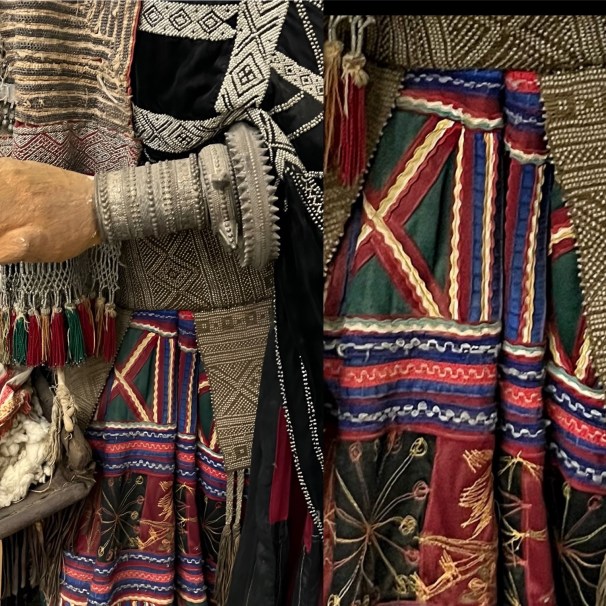
Above, detail of Rashaida dress (waist down), worn outside the tent and further afield (Sudan Ethnographic Museum, Imogen Thurbon). On the right, we can see the highly ornamental, bead-encrusted belt, known as the Sirdaag, which William Young explains, is tied securely to waist with the upper part of the belt hidden by loose folds of the wearer’s clothes so as not to accentuate her figure. The two large rectangular panels in front, he notes, “hang well below the waist and are designed to be seen”. On the left, we see how finely worked and close-fitting large silver cuff bracelets offset the flowing looseness of the heavy skirts and complement the bands of geometric beading that embellish the wearer’s veil.
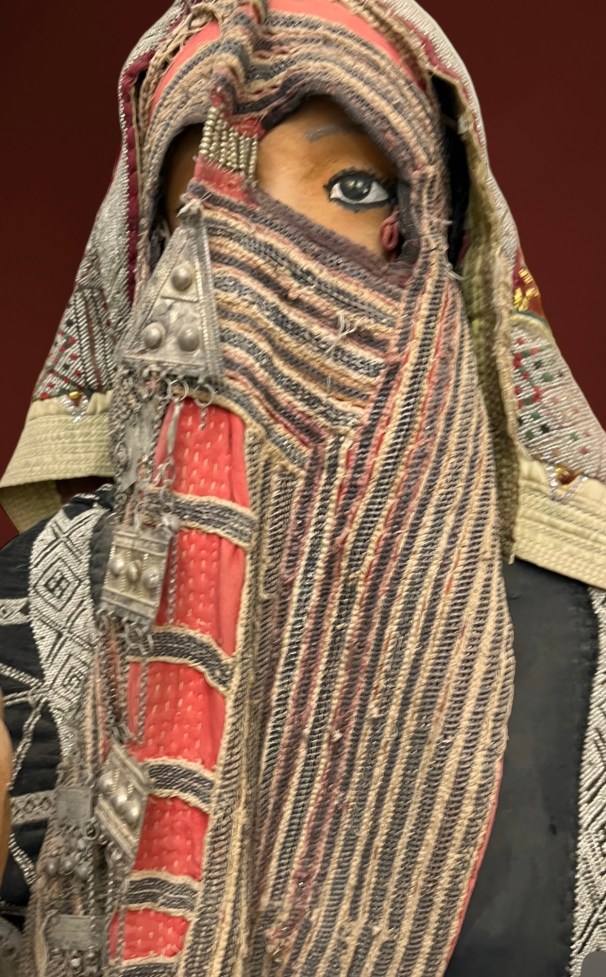
The silvery lead beads, known as rusas, are sold by Rashaida shopkeepers and sourced from the Hijaz (Griselda El Tayib). They are “much sought after and supply often falls short of demand.” (Griselda El Tayib). The delicate strips of rusas “already sewn onto bands of plaiting in zigzag patterns” are known as tilul, and their crafting, El Tayib notes, constitutes a “folk industry in the Hijaz”. On the right above, we can also glimpse the lower tasseled edges of what is perhaps the most exquisite element of Rashaida dress; the older girl’s richly embroidered face veil / mask, the mungab filaiti, and that of the married woman’s red – paneled burgaa, pictured right (more on both these in Part 2). No wonder Jane Perlez, writing in 1992 in the New York Times described the Rashaida women she saw as attired in western eyes “fit for a ball, astride a camel or walking barefoot in the desert amid a crush of goats.” (Jane Perlez, Sheeb Journal; For Bedouins of Africa, Sands Are Running Out 1992).

Above, delicate illustrations of Rashaida dress by Griselda El Tayib, discussed in Part 2 (Regional Folk Costumes of the Sudan, Dal Group, 2017, pp 54-64).
As Griselda El Tayib was careful to note, the form and structure of Rashaida dress exercises a profound influence on the “gestures, mannerism and gait” of its wearers, creating an exquisite visual and kinetic language all its own. Perhaps this is most clearly seen in the fluid movements of the women’s wedding dance:
“She did not sing or speak, but just raised her silver-laden hands and clapped them together lightly, in time with the singing. She turned around slowly, her long, colored sleeves and skirt flaring out around her body as she whirled. One of the men singers, inspired, unslung his sword from his shoulder and unsheathed it. He handed the sword to the dancer, and she took it in both hands, holding it delicately by the hilt and the blade, and rested it against her forehead. Its steel blade and the shining mother-of-pearl buttons on her burga’ gleamed. Turning to face one row of men, she saluted them by hopping toward them as she danced. They replied by jumping still higher as they clapped and sang.” (William Young, see below)
See stunning photos of an Eritrean Rashaida wedding in Africa Online Museum’s


It is clear from the description above just how central a role jewelry plays in informing this esthetic lexicon. We feel El Tayib’s wide-eyed delight as she describes how, in a moment of intimate trust, a Rashaida woman graced her with a glimpse of a remarkable piece of jewelry; “…then she reached up under her veil and untied from a string slung across her neck an extra set of very special rings, a pair of the most extraordinary rings called zigrah mishalshal. Such a ring has projections on three points of the compass from each of which dangle four chains about three inches long, terminating in pear drop silver plaques. Fatima placed these both on the middle finger of each hand and demonstrated how they would tinkle and swing around as she moved her hands when performing their traditional dance.” Extra pendants, chains and bangles are often worn in wedding celebrations to enhance their wearer’s graceful movements and add their bell-like musicality.
Above and below left, examples of Rashaida jewelry (Imogen Thurbon) Learn more about these pieces in Part 2. See too
Rashaida jewelry from the Red Sea – Rashaida pectoral hang
Sudanese Bedouin RIng Michael Backman Ltd
Clothes, jewelry and other adornments work in unison to create a perfect moving tableau and the grace and skill of women is to be publicly prized, as William Young observed:

“After some minutes of strenuous exertion the first women to enter the dancing ground were exhausted. They paused to breathe and adjust their heavy, silver-encrusted veils. This pause gave one of the men an opportunity to enter the arena. He approached one dancer and, using a safety pin, fastened a thick wad of ten-pound notes to the right side of her burga’. This was not a gift; it was a prize that the woman had earned by dint of her excellence as a dancer and a seamstress.” (William Young, quoted in: Weddings of the Rashaayda People of Sudan and Cultures of the Middle East / Professor Salih Who are the Bedouin? Debra Gorski, Primary source:The Rashaayda Bedouin; Arab Pastoralists of Eastern Sudan
If you are interested in Sudanese jewelry, you might enjoy “A Necklace of Shells from Distant Seas…”
Below, Rashiidi youngsters showing off their sword dancing skills today.
Today’s post is the first of three articles dedicated to a pivotal element in tribal identity and heritage, and one crafted, curated and conserved by women. I draw upon the work of American anthropologist William C. Young, who lived among the Rashaida of eastern Sudan for two years in the late 1970s and whose empathy and affection for the tribe shines through his work. I also rely on the meticulously detailed accounts of the late artist and expert in Sudanese dress, Griselda El Tayib, supplemented by contemporary analysis of the Rashaida and their changing way of life.
In Parts 2 and 3, published from next week, I discuss:
Background to the Rashaida in Sudan; Changing Worlds – From Child to Woman; Key Elements of Rashaida Dress
Tattooing; an Intimate Lexicon – Jewelry; Expressive and Symbolic Elements of Attire
Systems of Meaning; Dress and Heritage

Above, Rashaida women, imposing presences in their highly ornamental burgaa face masks, Sisters Under the Sun, The Story of Sudanese Women, Marjorie Hall and Bakhita Amin Ismail, 1981.
The women appear also to be wearing a folded red milaya over their heads. Described by El Tayib; “when folded, the part which is supposed to hang down the back is decorated with three vertical bands – 4 inches wide – of embroidery thickly decorated with heavy lead beads. At the bottom of this panel is a deep ornamental border of netted silk threads and a tasseled fringe of red and grebe silk interspersed with silver beads. This is a garment used for important occasions, and is worn with conscious pride and carefully folded and put away, often in a cloth or leather bag, when not in use.”
Below, a contemporary portrait of a Rashaida tribe teenage boy and girl in traditional clothing; Kassala State. Copyright, Alamy, used under licence.
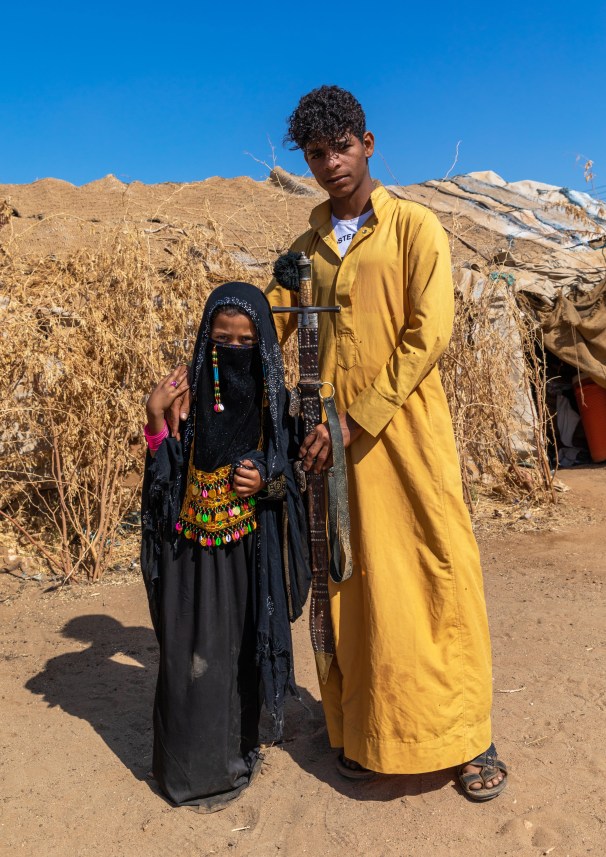
The young girl above shares both similarities and differences in dress with the youngster described by Griselda El Tayib several decades ago; “Her veil, called gargosh, was made of black shash decorated by her mother with tiny silver beads in a band which framed her forehead, and had a few touches of bead decoration at the corners to weigh it down. It covered her neck and shoulders at the back. Her face veil, called a mungab, was made of black material decorated with lead and sliver beads called rusas. It was worn just above the tip of the nose and usually fastened behind the back of the head usually with a leather thong in a way that cannot be seen under the head veil. Such veils would be decorated sometimes with leather tassels hung down at each side of the veil to disguise the ears. This face veil gave the appearance of being fairly rigid and was outlined in pearly buttons and bands of tilul. The centre of the face mask was weighed down by a vertical row of coins – some real and some imitation.
Below, Pinterest collection of Rashaida attire and adornments. The mungab on the left appears closer to that worn by El Tayib’s youngster.
The Rashaida are reluctant to be photographed. Below, a rare photographic tribute to their way of life:
Searching for the Rashaida of Northeastern Sudan
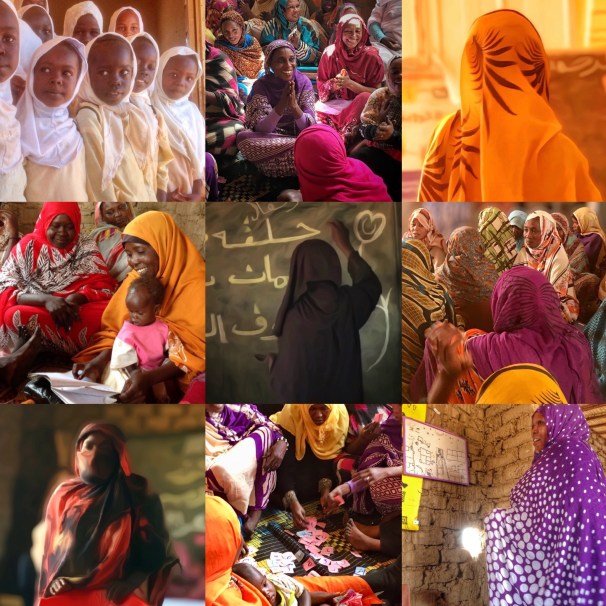
This is a cultural post for Women’s Education Partnership.
Learn more about our women’s literacy, orphans schooling and university scholarship projects programmes below:
Opening Doors – Our Women’s Literacy Programme
Our University Scholarships – giving bright young women the chance to go to university
Scenes from Our Orphans’ Schooling Programme and From Hardship to Hope Our Orphans Schooling Programme

 Women's literacy in Sudan