

Sudan’s Silver and Silver Filigree Craftsmanship
Sudan’s Silversmiths
Setting the Scene
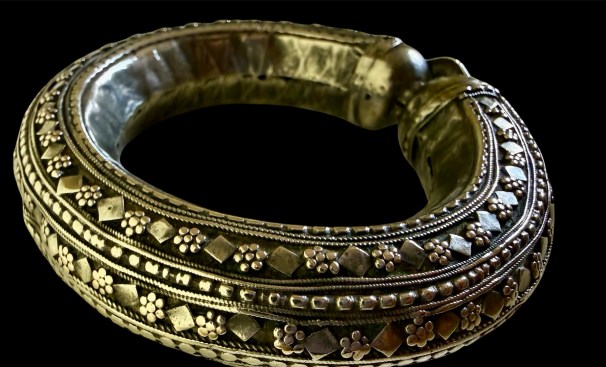
Above, a Rashaida silver bracelet, personal collection. This imposing piece embodies many aspects of Sudanese silver craftsmanship, with its bands of exceptionally fine coiled silver thread associated with filigree work, flower motif raised beading, or granulation, and soldered geometric forms that gleam in the light as its wearer moves.
In Sudanese Arabic, the term “shishtishi” or “jiftishi” is often used for filigree, with the word “takhreem” referring to perforation or open work. Jewellery expert Nisreen Kuku writes: “Shiftishi is an ancient jewellery making technique, based on shaping and soldering fine metal wires into intricate openwork patterns without a solid background, giving the piece a light and transparent appearance as if revealing what lies behind it. The roots of this technique date back to the Kingdoms of Kush and Nubia, where fine gold work appeared through intricate wirework and openwork ornamentation in the jewellery of queens.”
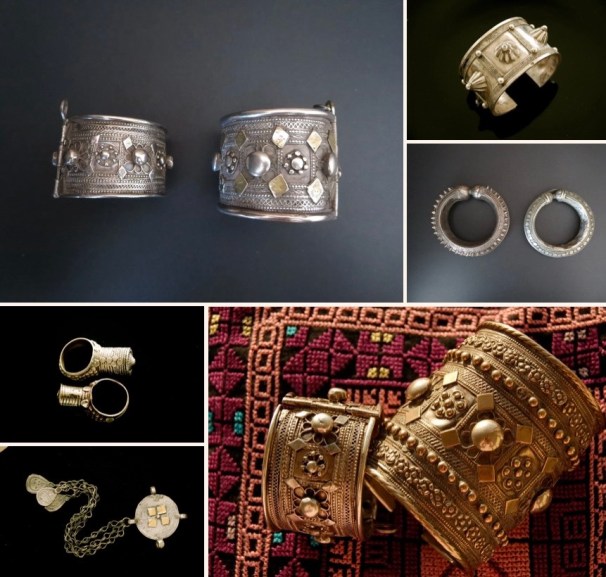
Above, Rashaida silver hinged cuffs with delicate granulation and filigree work, right, upper arm bracelets and “tower” or khatim rings. My thanks to Sigrid van Roode for these photos. See more examples of iconic Rashaida pieces in Rashaida jewelry from the Red Sea – Rashaida pectoral hang and Sudanese Bedouin RIng Michael Backman Ltd
For more on Rashaida adornment, see the three-part series of posts, Rashaida Dress and Adornment Part 1. For more examples of Sudanese silverwork, see Beads and Silverwork and Ethnographic Museum Khartoum.

Above, another stunning example of Rashaida silver work – in this case a wedding piece, with intricate, lantern-like filigree beads (exhibit at Sudan Ethnographic Museum, Khartoum, pre-war). Traditional necklaces such as the one above, as well as ornate earrings and pendants were often crafted using gold or silver filigree. Filigree work is still evident today, often adorning crescent and other shapes of Meroitic inspiration; see here a stunning modern interpretation of a gold filigree fidwa by Nisreen Kuku.
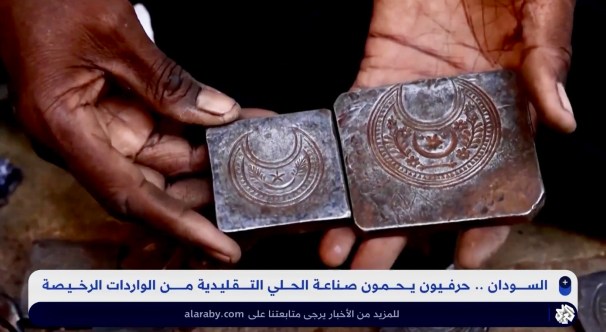
Above, still from السودان .. حرفيون يحمون صناعة الحلي التقليدية من الواردات الرخيصة, also embedded below, showing the enduringly popular crescent-shaped molds used by Sudanese silver and goldsmiths today.
Delicate amulet cases were also worked in filigree. As foreign influences from both Ottoman and European sources reached Sudan, filigree work was employed in the making of silver caskets, cigarette boxes, cigar cases and cheroot holders – see more below. A unique style emerged, marrying Sudanese and European motifs. Many items were designed for and sold to British servicemen and administrators as mementos, and the UK is home to many examples of fine quality Sudanese silver filigree.
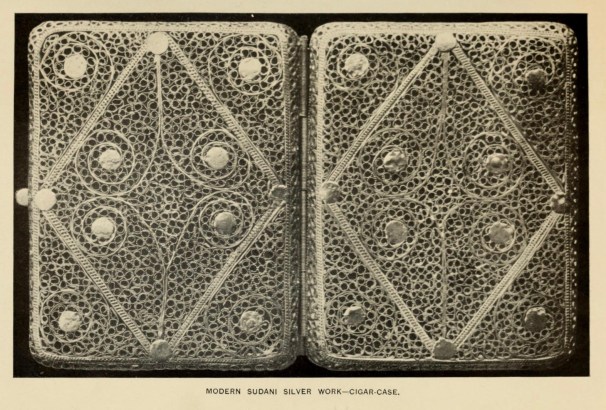
Above, exquisite filigree work, typical of the late colonial era, Sudan. Plate from The Egyptian Sudan, Volume II. by E.A.Wallis Budge, Kegan Paul, Trench, Trübner & Co, Limited, 1907.
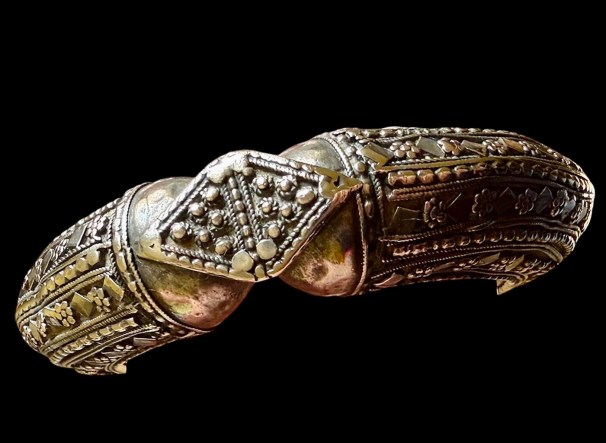
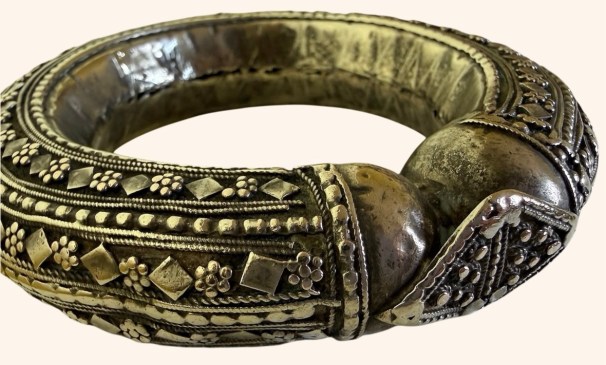
This week’s post offers a snapshot of Sudanese silver and silver filigree work. Sudan Notes and Records at Sudan Open Archive documents fascinating examples of occasions and ceremonies in which silver was worn during colonial-era Sudan, providing hints as to its rich, multilayered symbolism. These detailed accounts will be explored in coming posts. A form of wearable wealth, silver was also imbued with profound spiritual, propitiatory and protective powers. Worn at jirtig ceremonies embracing marriage, circumcision, pregnancy, and birth of a child, donning silver, in the form of bracelets, rings, anklets – even horns, also served as a visual signal for others to respond to, indicating spiritual, tribal, community authority or rites of passage to be respected or contributed to. Above left, detail of a Rashaida bracelet, with its finely beaded ornamental clasp.
Colonial Impressions of The Silversmiths of Omdurman Souq
Examples of Sudanese Filigree Work – Then and Now
Today’s Challenges to Sudan’s Craftsmen and Women
The Fate of Silversmiths: Two Colonial Tales
Setting the Scene – Then
Colonial Impressions of The Silversmiths of Omdurman Souq
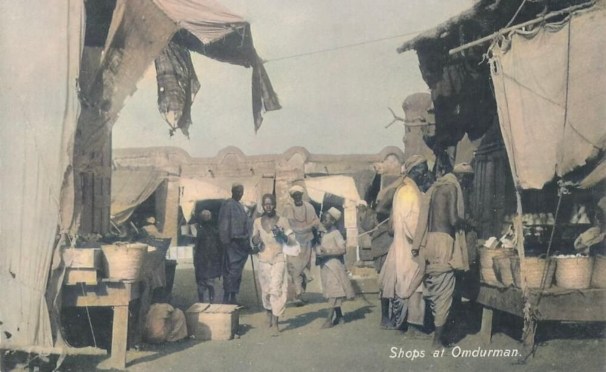
Above, colonial-era postcard of Omdurman market. See more in Postcards from Khartoum and Omdurman.
Writing in 1912, E.S. Stevens offers us a vivid glimpse of the silversmiths and bead workers section of the Omdurman souq of the early twentieth century. Both Khartoum and Omdurman have for centuries been hubs for gold and silver craftsmen. He writes: “The most pleasant souk of all is perhaps that of the silversmiths, where a gentle tink-a-tink on the small anvil tells of the craftsman at his work. Here filigree zarfs can be bought, the egg-cup receptacles for coffee-cups; heavy bangles, khalkhals or anklets, elaborate filigree boxes and earrings – though the work is not as good as it was in the days before the Mahdi.
Or perhaps the narrow souk of the bead-sellers, with its golden shade varied by sword-thrusts of fierce white sunlight, is more fascinating, where rows of necklaces hang in gaudy brightness, beads of amber, coral and silver among the rest. Hither come travelers from all parts of Sudan to bargain for trinkets to carry back to their womenfolk, and merchants to lay in their stock of currency beads according to the fashion of the moment; and long and patient are the negotiations, as in all the East.” (My Sudan Year, E.S. Stevens, 1912).
See more on Sudanese jewellery in “A Necklace of Shells from Distant Seas…” .
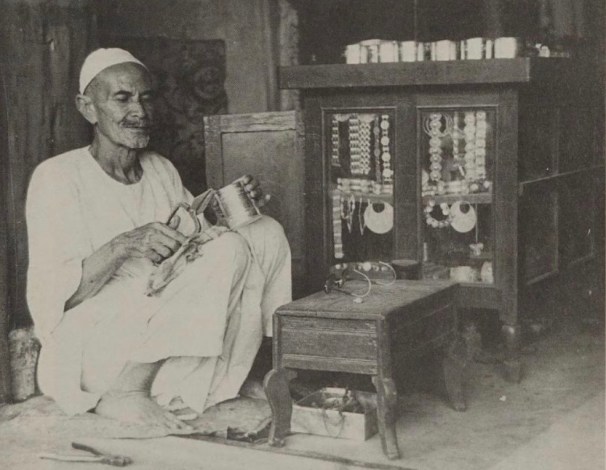
Above, a widely reproduced photograph of Sheikh `Awad al-Karim al-Hindi, leading silversmith of Omdurman in his shop, c. 1930, Disney Collection, photographer probably A.J.M Disney.
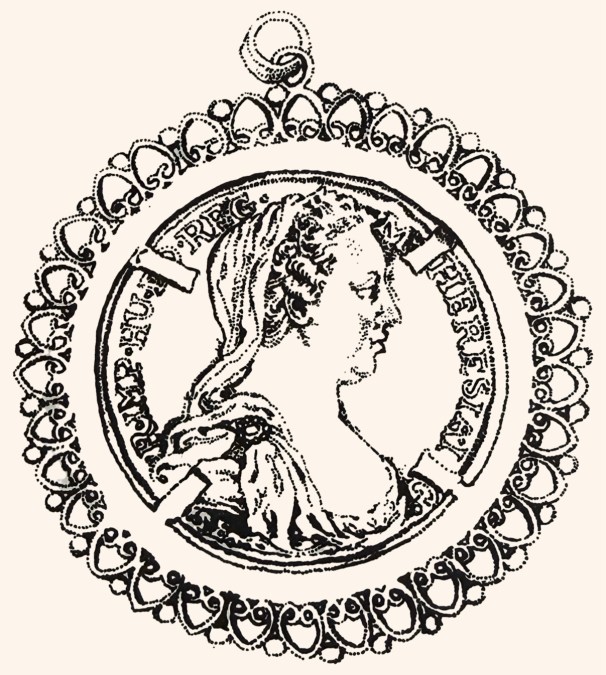
Forty years later, Anthony Mann, in the colonial apologist work Where God Laughed, The Sudan Today, describes his impressions of the same scene, recalling the tinkle of “silver beaten out on little anvils with with hammers” and noting that the favourite decoration on bowls and cups was “a Maria Theresa taler, the imperial Austrian coin…”. He goes on: “The silversmiths also produce jingling silver headdresses for the wives of rich Baggara cattle-owning tribesmen. A wealthy Baggara will pay between twelve and fifteen pounds for one of these trinkets. Also highly prized as personal jewellery are gold or gilt medallions cast from British war medals, but with subtle alterations to the inscriptions. One such, which struck a somewhat curious note, bore the head of George V, with the legend, “Medal for Egyptian Ladies, 1914-18.” (Where God Laughed, The Sudan Today by Anthony Mann 1954)
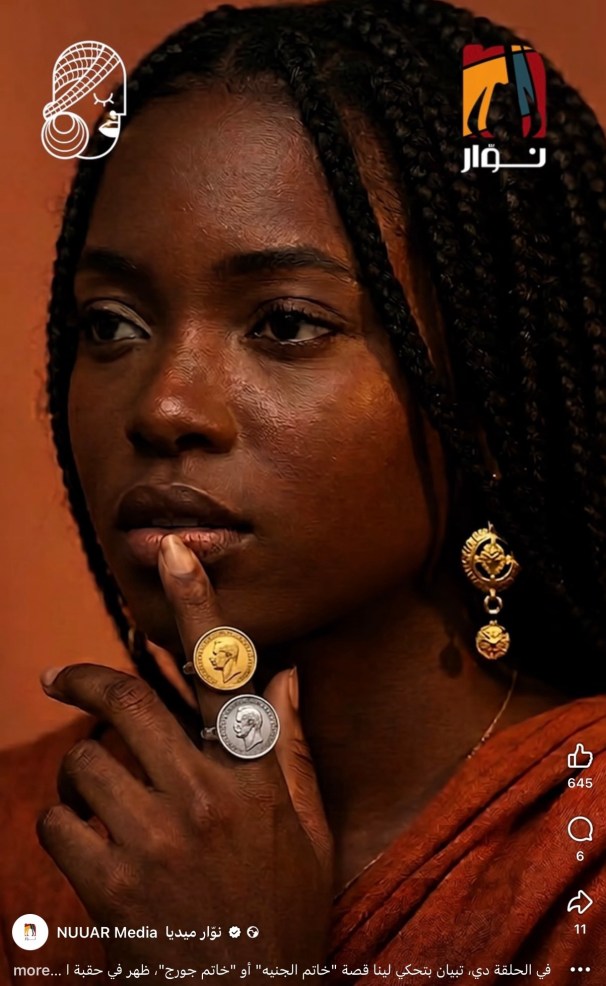
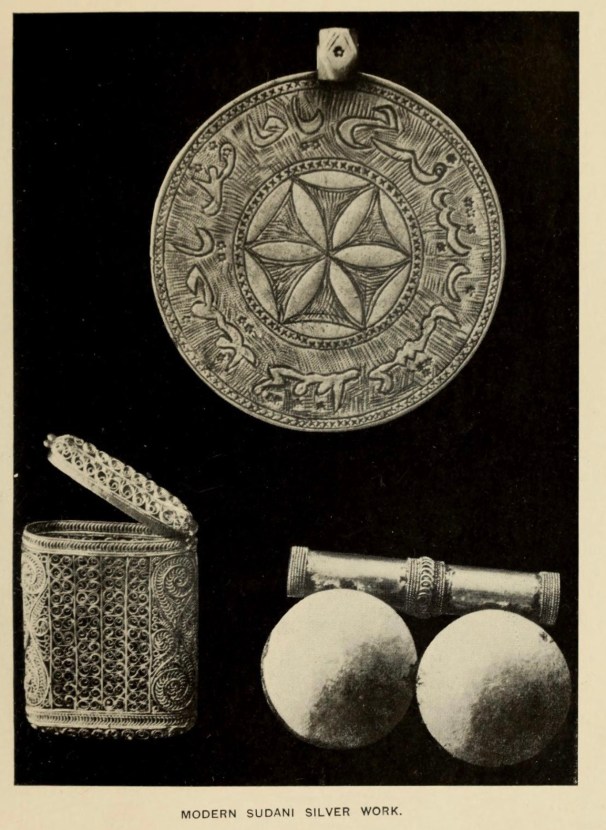
Upper left, more examples of Sudanese silver work, including a filigree cigarette case, also from The Egyptian Sudan, Volume II. by E.A.Wallis Budge, Kegan Paul, Trench, Trübner & Co, Limited, 1907. Above left, illustration by Margaret Potter of a gift of a silver-mounted Maria Theresa Dollar, Everything is Possible, Our Sudan Years, 1984. Filigree work came to incorporate gold and silver coins during the Ottoman and British colonial periods (Nisreen Kuku). Right, still from NUUAR Media’s fascinating report (English subtitles) on the “George guinea” ring – more on this in coming posts.
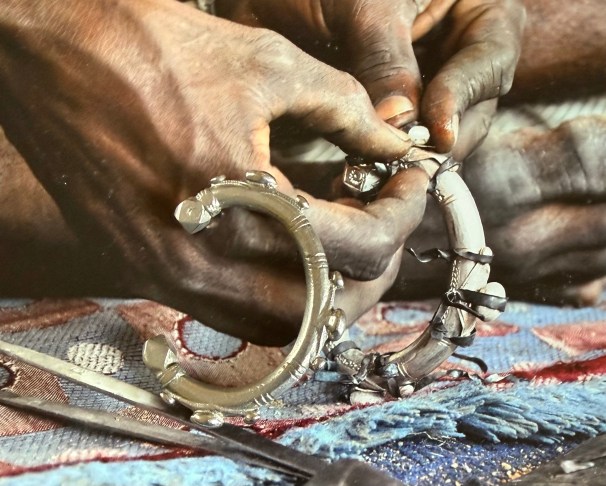
Below a modern Sudanese silver bracelet superimposed upon an image by Enikö Nagy of a silversmith at work. One of several portraits of silversmiths by Enikō Nagy, Sand in My Eyes. This stunning collection of photographs also includes one of an elegant conical shell-shaped silver snuff holder with delicate speckled motif.
See too a fine example of a richly engraved Sudanese silver kohl container, Beja Cultural Studies Centre at Sudan Memory.
Examples of Sudanese Filigree Work – Then and Now
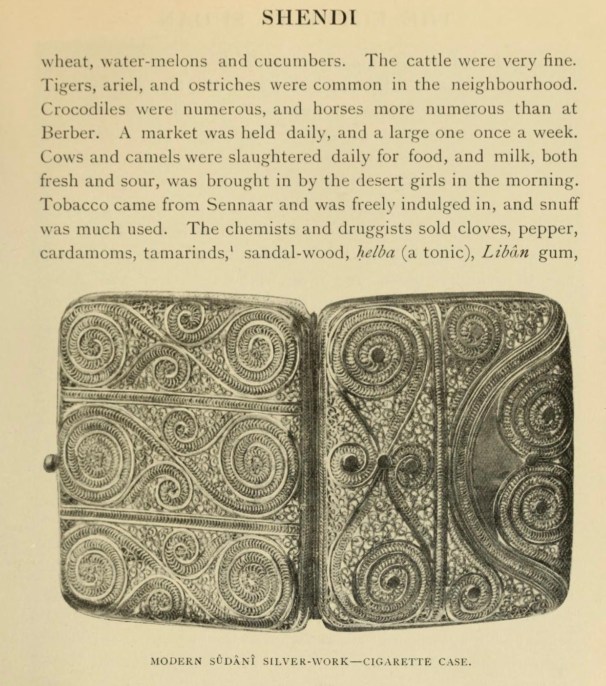
Above, filigree cigarette case, plate from The Egyptian Sudan, as above.
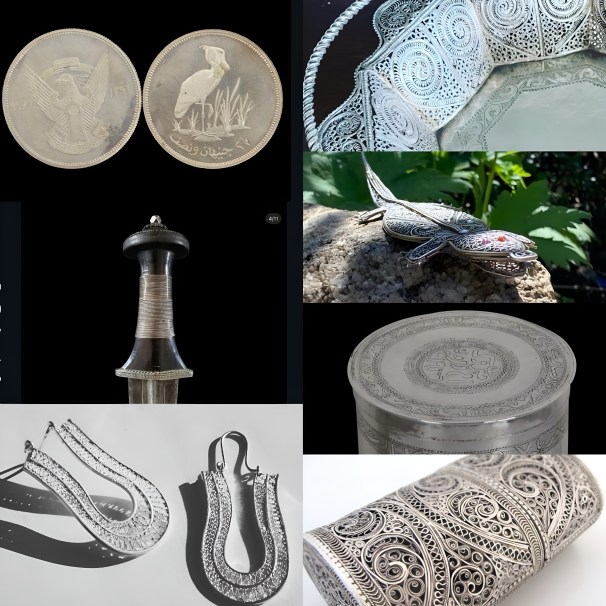
Above, a selection of silver and silver filigree work from Sudan. Top left, source, almutasim.alkhanjari, a 1976 Sudanese silver coin featuring the shoebill stork as part of a conservation series. Top right, Silver Spoon Antiques; a Sudanese filigree basket. Below it, a delicate filigree crocodile, Omdurman, c.1920, from Omdurman, Wynyard Wilkinson. Beneath the crocodile, detail of a large, inscribed Sudanese silver box, dated 1936, above a heavy silver filigree cheroot case, c.1920, Selling Antiques.
Antiques experts note that Sudanese silversmiths developed a unique style and form of decoration and a common form for marking silver- using stylized Arabic script consisting of three lines of Arabic. The top line bears the name of the silversmith, the middle line the name of city where the piece was made and the last line the year in which it was made. In westernized style, reading from left to right and often using the Western calendar.
Middle left, The Mansfield Collection, a Sudanese silver arm dagger with ultra fine silver threading, 1884. Bottom left, the work of contemporary designer and artist Maya Antoun, who re-interprets traditional forms in exciting ways; Maya Antoun Instagram.
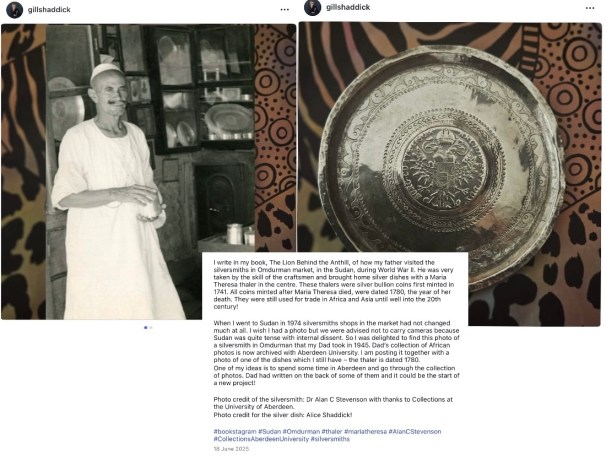
Above, a fascinating memory by Gill Shaddick, Instagram.
See too the delicate spun silver work of British silversmith Julia Stockwell Hamid, inspired by Sudanese forms such as incense burners.
Today’s Challenges – Continuity and Change
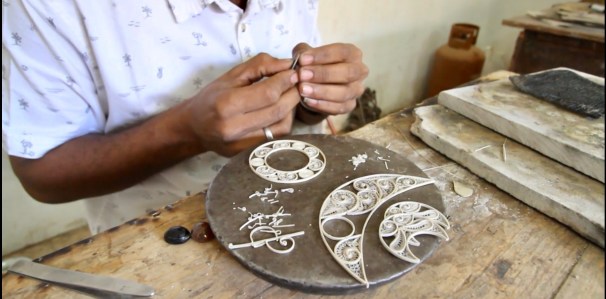
Above, still from Frédérique Cifuentes’ short film capturing the skills of Sudanese filigree silversmith Abd El-Hamid Hamza, also known as Al Bulbul, and his sons, who pursue their craft in their Bulbul Africa Art workshop, in a space established by their forebears 500 years ago. Watch the film African Art Jewellery workshop, Omdurman, Sudan on Vimeo here.
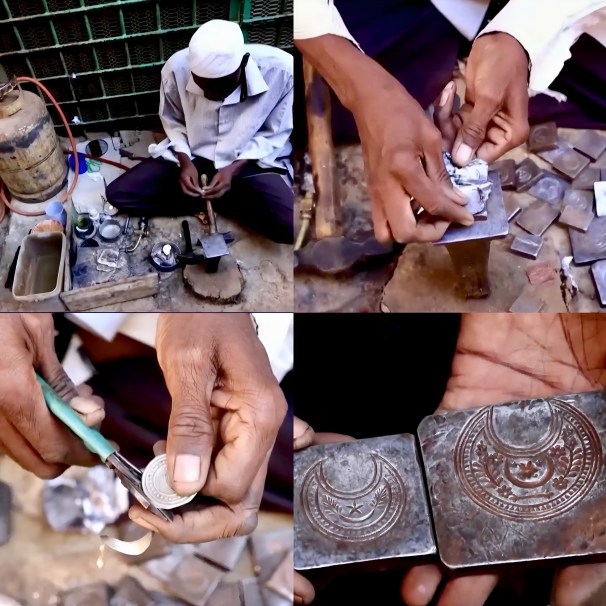
Even before the outbreak of war in 2023, profound economic pressures and instability had led to many Sudanese being forced to sell or melt down their treasured pieces of jewellery for their value in weight as gold or silver. Expert NIsreen Kuku explains that cheaper imported items from Morocco and India are starting to sideline traditional Sudanese wedding jewellery, a source of family wealth and continuity over the generations. Pieces from Saudi Arabia, Qatar, China and Italy are also threatening the livelihoods and traditional skills of Sudanese craftsmen and women.
Left, stills from an English language excerpt of a longer, Arabic video embedded at the close of this post. They show traditional Sudanese silver and goldsmiths at work in Omdurman. See the clip here: Sudanese Artists Preserve Traditional Jewelry – Reuters
Learn more in Conserving Sudan’s Timeless Treasures Part 1 and In Conversation with Nisreen Kuku.
The Fate of Silversmiths – Two Colonial Tales
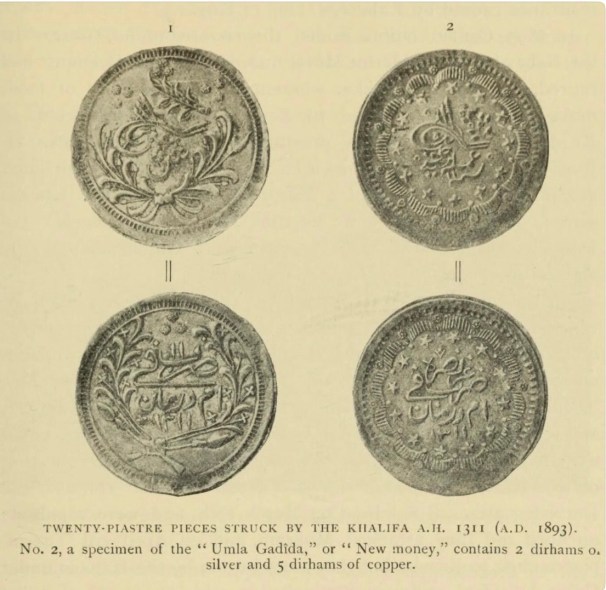
Above, cions struck during the Khalifa’s rule, The Egyptian Sudan, as above
Silversmiths in Sudan, in addition to crafting the jewellery that represented portable wealth and status of a family across generations, were often also called upon for the ornamentation of weapons such as swords and daggers as well as the saddlery of their elite clients. They were even commissioned to engrave the names of sultans upon their rifles. Often overlooked, however, was their pivotal role in establishing the autonomy and credibility of kingdoms, sultanates and not least the modern Mahdist state, as they lent their skills to the minting of coins and currency symbolizing new political and religious entities and their figureheads. Sudan Notes and Records describes the operations of Sudanese mints, while also providing fascinating details of the denominations and coins struck. Read more about the working day of a mint silversmith in The Coinage of the Mahdi and the Khalifa and The Coinage of Ali Dinar.
The role of mint silversmith, though highly respected, was not without risk. Below are colonial accounts of the precarious and sometimes unenviable fates of two such silversmiths in particular:
…Hamid Mohamed, the chief silversmith, quarreled with sultan Hassan wad Abukr Naga, the Beigo sultan, and was imprisoned by `Ali Dinar. When he was arrested his house was searched, and in it among other things was found a die with which Hamid had been making forged Kabbashi piastres. This gave `Ali Dinar the idea of issuing his own coins by altering the tughra and name of the mint on the die so that the coins should be his own. Unable to do this however, he visited Hamid in prison and persuaded him although reluctant to oblige before he was released, to make the necessary die...
The Coinage of `Ali Dinar, sultan of Darfur, 1898-1916, by A.J. Arkell, on Hamid Mohammad el Gorani, silversmith, SNR Vol 23 0 1940
And from Sudan Notes and Records, Volume 18, 0 1935:
Then there is the well-known story of the El Obeid silversmith. This man, we are told, being at his work one day and asked what he was making, lightly replied: I am making a ring for the nose of that wicked King Nasir, and thought no more of it. Nasir, however, hearing of this, took offence and swore to have his revenge. He succeeded in luring the silversmith to Tegali on the pretext of having work for him to do. The man, of course, came unsuspecting, and being given some silver by Nasir, melted it down and asked what he was to make with it. A ring for your nose was Nasir’s reply, and at his words the silversmith was seized and held by his feet while Nasir himself poured the molten silver into his nostrils until he died.
Report on the Challenges to Sudan’s gold and silver artisans (Arabic), referenced above and which includes an interview with Dr. Mohammad Al Mahdi Bushra – Professor of Folklore, Niileen University.

