

A Mile in Her Shoes
A Snapshot of Women’s Footwear in Northern Sudan
Setting the Scene
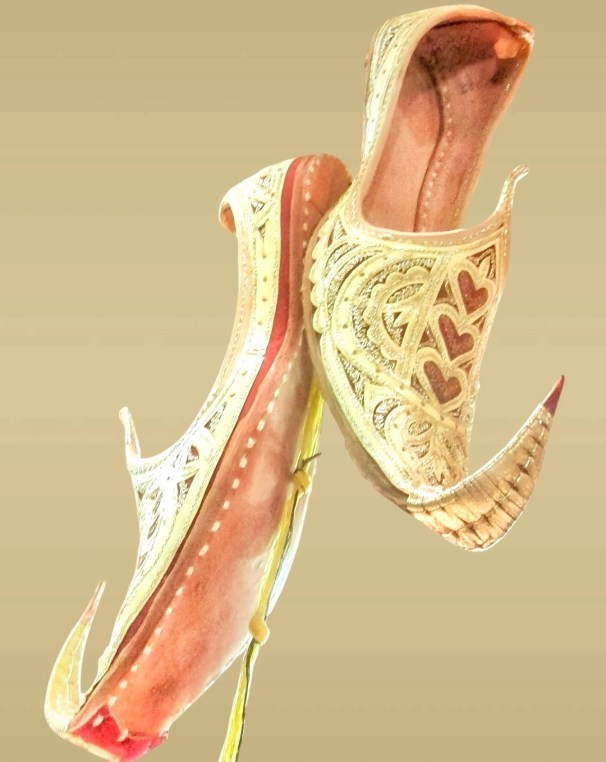
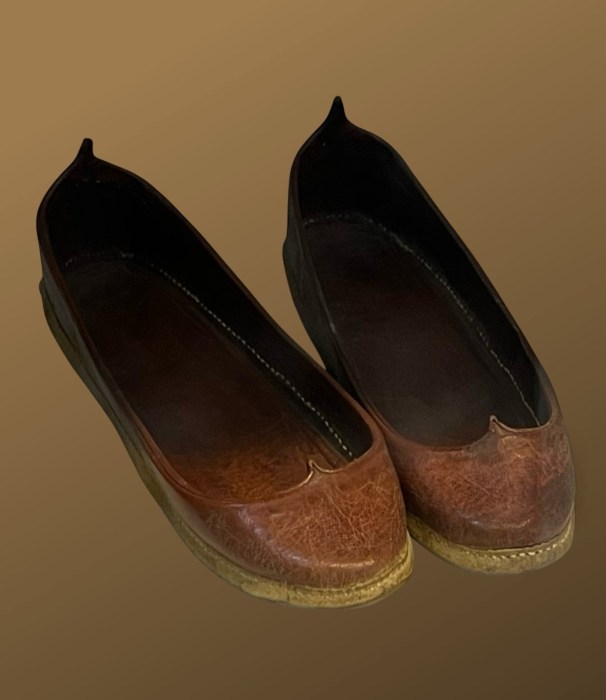
Above, “statement” shoes for special occasions, seen at Omdurman women’s market, 2014. With heelless, hand-stitched leather soles, exuberantly curled toes and delicate lacy oriental motifs, these shoes recall Ottoman and Indian influences and craftsmanship. Shoes such as these might well have featured in a young man’s collection of wedding gifts – the “shayla” or “shanta”, traditionally offered by the Sudanese bridegroom to his bride. Often comprising “a sizable bride wealth of new toubs, underwear, dresses, and shoes”, the shayla or dowry, researcher Marie Grace Brown explains, was intended to “outfit the bride for the next stage of her life”, allowing her both to express and experiment with her new identity and status through dress (Marie Grace Brown, Khartoum at Night). Sudanese costume expert Griselda El Tayib adds that “in the days when the toub was less transparent and revealing, shoes were a focal point of a woman’s attire” and a key element of her dowry (Griselda El Tayib, Regional Folk Costumes of The Sudan).

Above, Sudanese men’s markūb shoes. See more in “Sirwal wa Markub”.
Although there is still a substantial domestic industry manufacturing Sudanese men’s iconic markub shoes, most women’s shoes in Sudan, including those found in Omdurman market today are now imported from China – the largest supplier, or Turkey, Egypt, Saudi Arabia and India. There is, however, a growing industry in women’s shoes modeled on the markūb form and celebrating Sudanese traditional craftsmanship in fresh ways; see for example the elegant women’s markūb produced by Barkal.
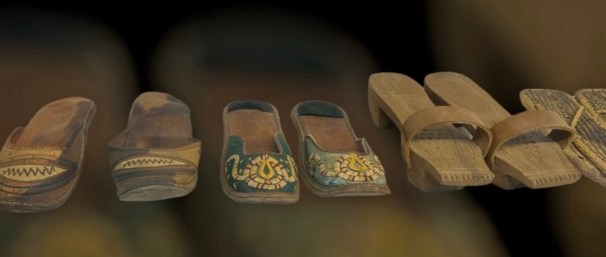
Above, a selection of colonial-era women’s leather shoes and slippers, as well as wooden pattens / clogs or qarqāb, exhibited at the Sudan Ethnographic Museum, Khartoum, pre-war. Scroll down to read more on these.
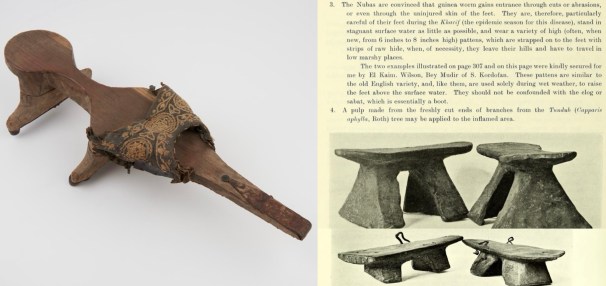
Below left, a fine example of a Nuba people’s wooden patten with iron supports and embroidered leather toestap, believed to protect the wearer from infection by guinea worm, 1890-1920, Science Museum Group, CC . Right another example of Nuba pattens, documented by R G Anderson in his Medical Practices and Superstitions in Kordofan. See more of his work in Unfolding Blessings.
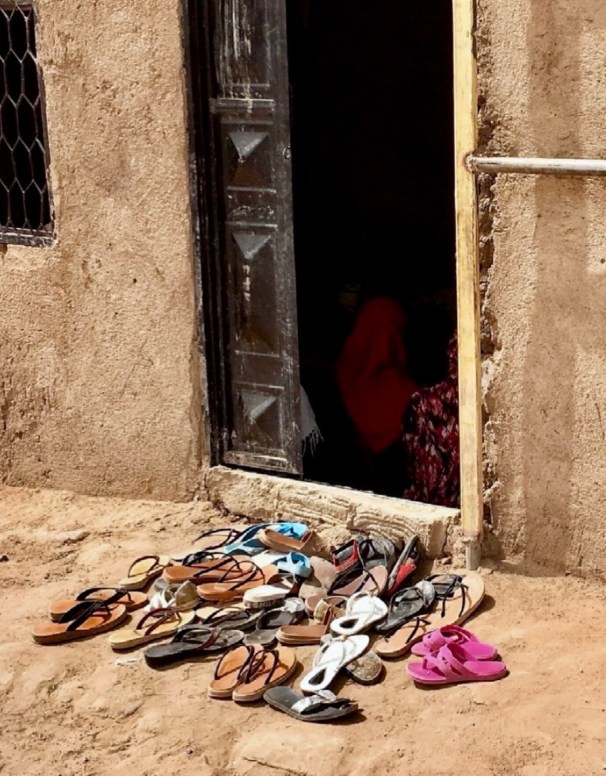
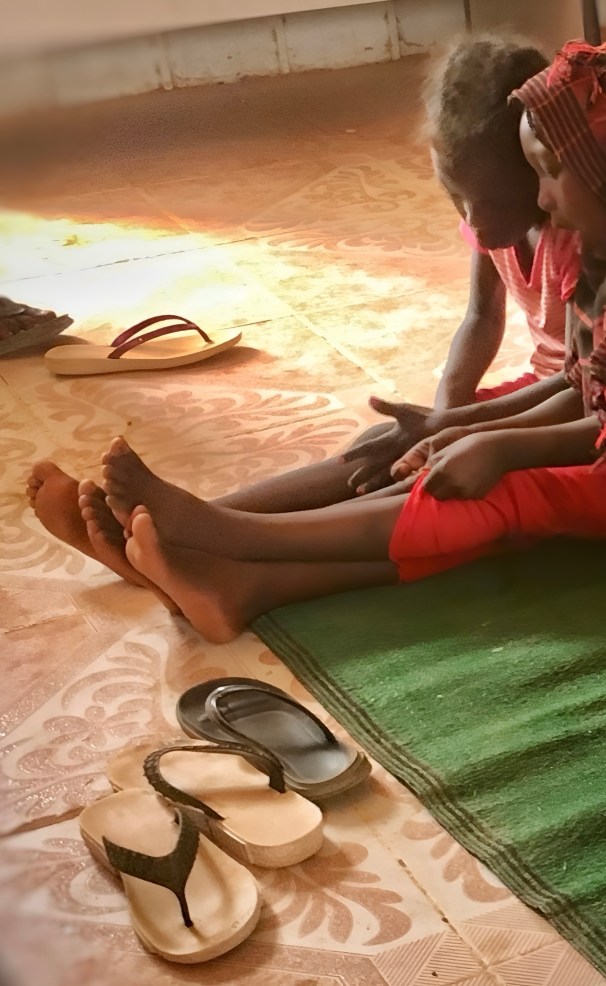
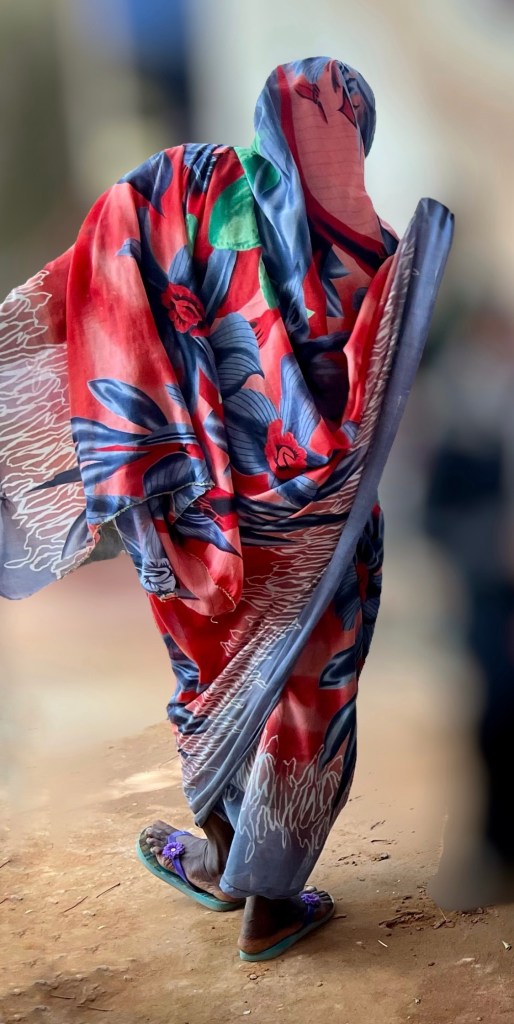
Below, working women and mothers of Jebel Awlia leave their shoes at the door of their literacy centre as they go in. The everyday practicality, comfort and affordability of plastic or foam rubber sandals and flip-flops (the latter known as safinja) have ensured that these remain the footwear of choice for so many Sudanese women.
A Mile in Her Shoes
Types of Shoes Described by Griselda El Tayib
Ancient History, Colonial Control and a Weapon of War
A Mile in Her Shoes
الشبشب والقرقاب بقو اصحاب
ash-shibshib wa l-gubgaab bigu aSHāb; literally “The slipper and the wooden clogs became friends”, the Sudanese equivalent of “birds of a feather flock together”.
This week’s post offers contemporary and historical examples of Sudanese women’s footwear. I draw extensively on the vivid accounts by costume expert, the late Griselda El Tayib, for detailed descriptions of regional footwear popular during colonial and post-colonial eras. This brief overview of a fascinating and under-documented field also references the work of Marie Grace Brown exploring the political and sociological subtexts of footwear choice under colonialism. I would be very grateful for any corrections or additional information readers can offer.
When I worked in Sudan forty years ago, I marveled at how the women I knew effortlessly navigated ruts, rubble, puddles and mud in their elegant footwear, always perfectly coordinated with their outfits. Unlike me, whose shoes were eternally caked in dust and mud, my friends unfailingly arrived immaculately shod to work. At home of course, they wore flip flops or soft moulded plastic or PVC house shoes known as arousa – literally “bride’s” slippers, shown below. Still worn today, they are durable, sturdy, waterproof and cheap, similar to today’s “jelly” shoes but often more rigid in texture. Arousa shoes would be worn while doing chores, negotiating wet ground and of course while resting. They also possessed a magic property that my Sudanese friends would eventually share with me. Within just a month in Sudan, my heels were relief-mapped with stinging crevasses that refused to heal. My friends revealed the remedy: rub vaseline ointment into cracked heels and toes and then encase them in arousa house shoes, sealing in the moisturizing balm and preventing the skin from drying out. Of course I took to wearing them everywhere only to be gently advised that while the arousa was fine for the house and wandering round the neighbourhood, it wasn’t considered suitable for wearing at work.
Another staple was the deliciously onomatopoeic shibshib; any form of open slipper whose name derived from the shuffling sound made while wearing it. The shibshib could be humble house wear or very elegant; such as the shibshib al-Henna, a heeled, often leather slipper chosen specifically to do justice to the delicate henna motifs tattooed on the feet and ankles on special occasions. You can see a fine example of a shibshib al-Henna in “A City Waking Up”. For more on henna, see “A Open Hand will Encounter Henna” – Updated. Many of my older friends, however, remember the dark side of the shibshib – the chilling moment when a mother would remove her shibshib, and brandish it menacingly. It then became a surprisingly effective weapon, hurled by a frazzled mother at a recalcitrant child just out of reach, or when caught, used to deliver a smarting slack on the leg.
When elegance takes precedence, acquiring shoes that complement toubs in tone, texture and heel while keeping abreast of changes in fashion – especially wedding toubs, is an art in itself. Griselda El Tayib reminds us that over many decades changing fashions in shoes became the “subject of much conversation, criticism and intense resistance”, with derogatory names appearing for new styles emerging. She cites the less than flattening “gadam al samak”; fish mouth, coined for the first shoes with pointed toes or “dababat”; artillery tanks, for the first platform soles. She also mentions the term “bartouch”, considered vulgar by some, used to refer to worn down old shoes used around the house as slippers, and referenced in the proverb below. For more names of Sudanese shoes, Al Rakoba lists forty terms – some colourful, click here.
كل جزمة مصيرها تبقى برطوش
kull jizma maSīra tabga barTūsh; every shoe is bound for wear and tear; a proverb reminding us that every perfection is destined for imperfection in the end.
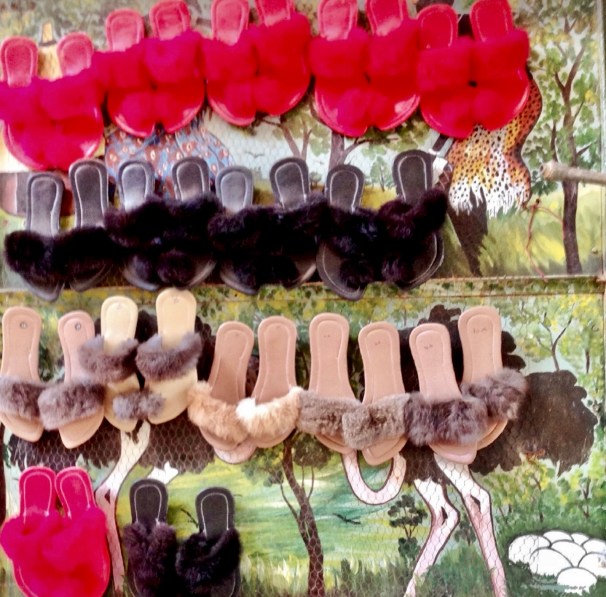
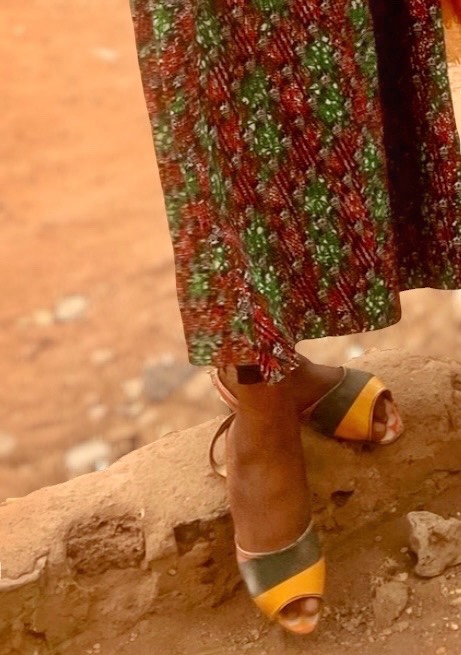
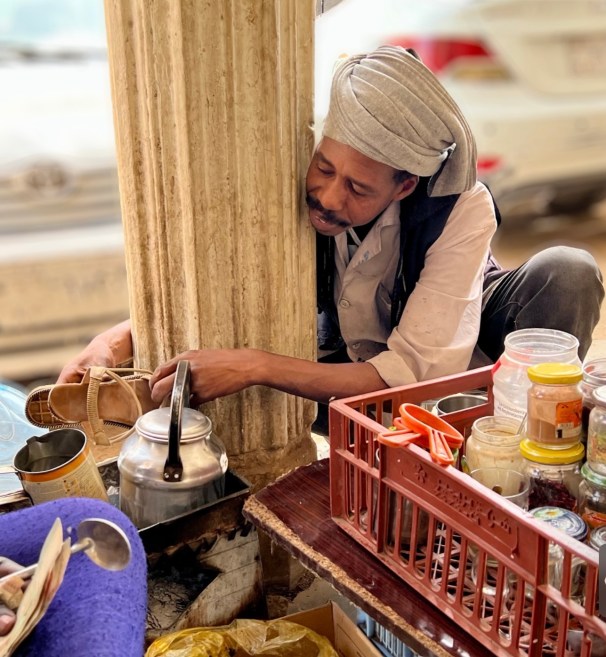
Above, top left, the striking, striped leather open-toe shoes of a young university student in Khartoum and below her, blue daisy flowers adorn flip flops that perfectly match the wearer’s toub. Above right, the shoes of mothers and daughters of a literacy group temporarily set aside and below it, the essential skills of a shoe repairer on display as the sole of a woman’s sandal is re-glued using steam from a tea lady’s kettle to fix the glue. Learn more about the role of the shoe repairer in Sudanese culture and literature in Al-Nugulti. Left, a hint of luxury: fluffy slippers on sale at Omdurman women’s market.
Types of Shoes Described by Griselda El Tayib

Griselda El Tayib is quick to acknowledge Turkish, Egyptian and Indian influences upon the form and style of Sudanese women’s shoes, brought about through trade and travel. She cites for example, the “hindi” sandal popular among women of the Hadendawa, probably brought into Sudan by pilgrims returning from the Hajj and imitated by Hadramauti shoemakers in Port Sudan. In her review of Riverain Sudanese women’s fashion from the 1950s onwards below, she outlines some of the most widely worn types of shoe:
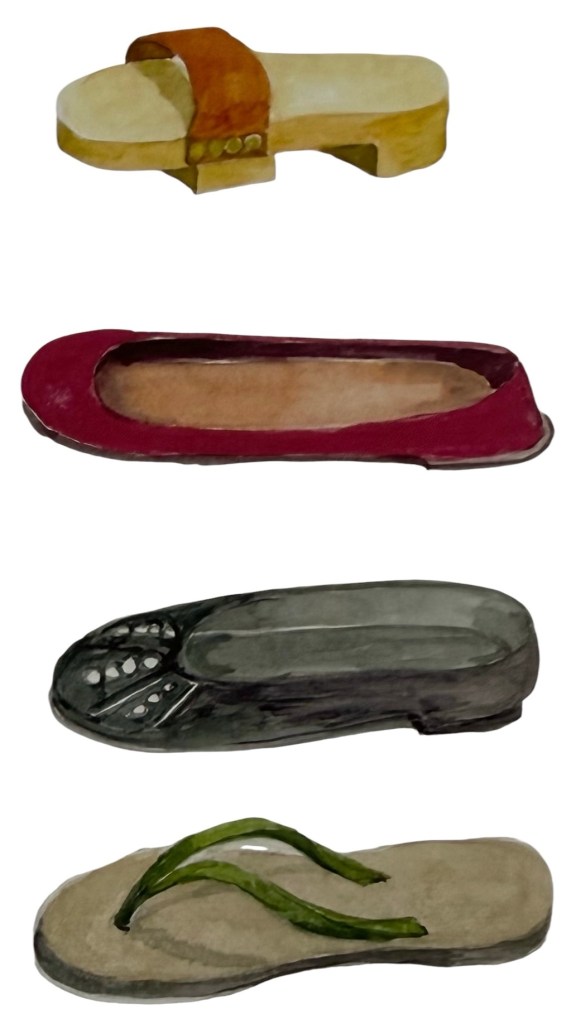
“Married women wore an elegant flat shoe called markūb abu gadum with pointed toe and heel and a decorative point over the arch, usually tanned in orange or dark red, with two or three layers of cowhide used for the sole. Later the uppers were cut very open so that half of the toes appeared and the toes had to be bunched-up in a special way to hold the shoe on; these were called markub kashif and are still worn by some older women.
Shibshibs and karkabs (gargaab) were worn inside the house. Shibshibs had a flat leather sole and just one strap over the toes and the scraping noise of the heel when it was dragged along the ground gave it its name. Karkab is also an onomatopoeic word describing the noise of its wooden sole on the ground. The karkab’s high wooden sole was carved locally and sometimes quite crudely, but occasionally a fine pattern was etched on its surface. It was also worn around the house when there was a lot of water around, such as when washing clothes and dishes, and sometimes worn to the well to protect the feet from the mud.”
Above right, Griselda El Tayib’s illustration from Regional Folk Costumes of The Sudan, showing from the top, the wooden karbak (gargāb), markub kashif, the arousa plastic house shoe and the ubiquitous sifinja flip-flop.
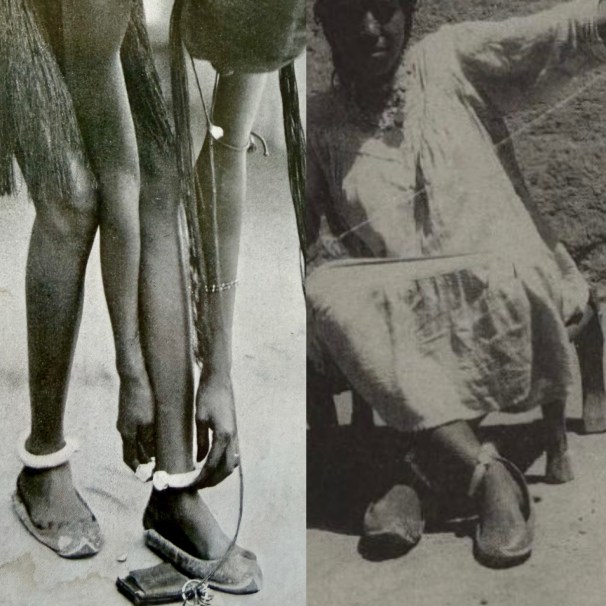
Below, colonial-era photographs of markub-style women’s shoes with pointed toe, similar to those described by El Tayib above.
Below, more illustrations by Griselda El Tayib, from Regional Folk Costumes of The Sudan.
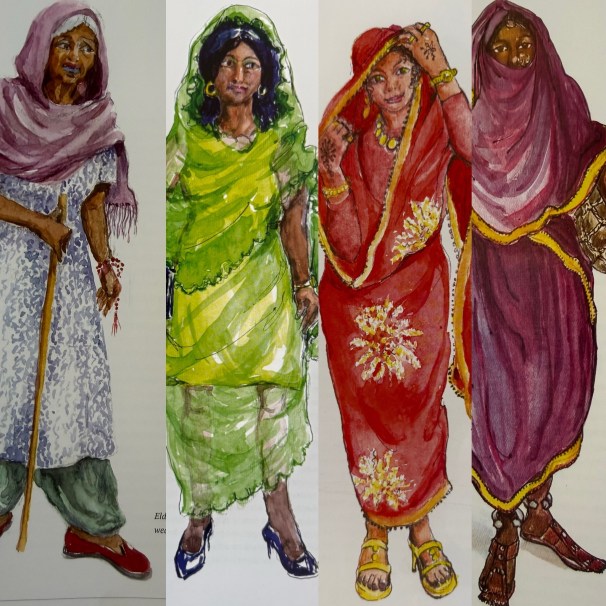
Above, left, an elderly Nubian woman wearing boja trousers and shoes with pointed arch as described above. Next to her, a woman wearing 1960s -70s transparent toub mufastan (serrated hem), over a short skirt. She wears a high wig, fashionable at the time and high-heeled European style shoes. The bride next to her complements her red and gold jirtig wedding toub with matching gold jewellery and shoes revealing her delicately hennaed feet. Right, a woman of the Hadendawa wearing sandals echoing the design of those of their tribesmen and known as nador kidat, shown below. The women’s version is “lighter and has more ornamentation and bits of coloured plastic embellishments”, from Griselda El Tayib’s Regional Folk Costumes of The Sudan.
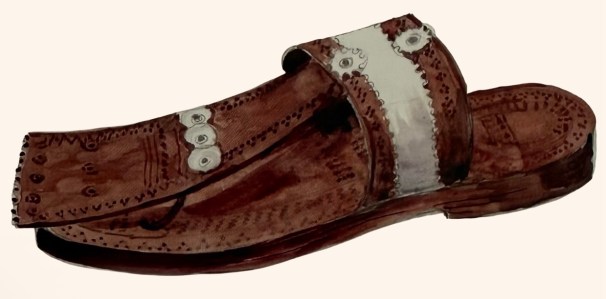
Griselda El Tayib, Regional Folk Costumes of The Sudan
Ancient History, Colonial Control and a Weapon of War
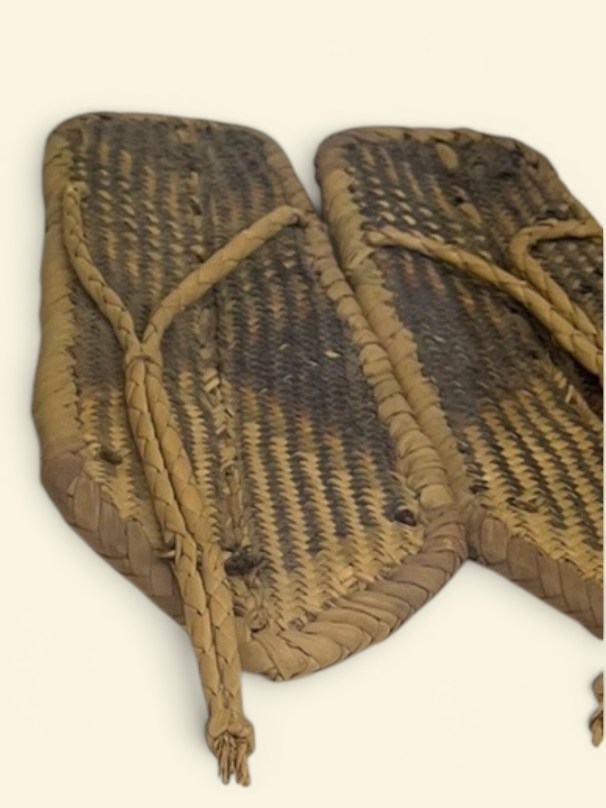
Leather footwear has been found in ancient Nubian and Sudanese graves dating from 2500 BCE. See the fascinating research undertaken by the University of Copenhagen; Fashioning Sudan. It is highly probable that Sudanese peoples, like the ancient Egyptians, also used shoes made from woven reeds and palm fibre, similar to the British Museum’s example of a Palm Leaf sandal.
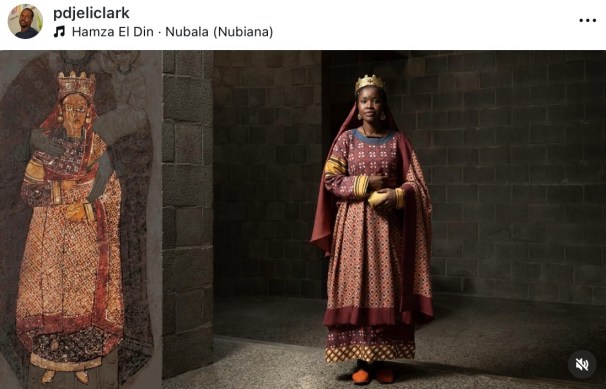
Griselda El Tayib, describing her search for traditional Nubian shoemakers still practising their craft after resettlement and citing the ancient Nubian term “dir” for shoe, reminds us that colourful and finely made women’s shoes feature in many of the Faras murals of the Medieval Christian kingdoms of northern Sudan. In Recreations of Christian Nubian dress, we see a a stunning modern recreation of the figure of an anonymous royal mother of a 12th / 13th-century painting from Faras Cathedral, also shown righ below, pdjeliclark, Instagram.
In Marie Grace Brown’s Khartoum at Night, a study of how Sudanese women’s “bodies experienced imperial power”, the researcher emphasizes the two-tier system of control exercised by British colonial powers when it came to men and women’s dress codes. While male Sudanese university students, many of whom often wore western suits and Ottoman-style fez, were encouraged or indeed coerced into returning to traditional attire of turban, robes and markūb as a buffer against what was seen as incipient nationalism, young women were urged to wear western style dress that accorded with colonial understandings of modesty and useful, productive activity.
The wearing of western shoes by men was seen as “uppity”, Brown claims, relating the experiences of a young Yusif Bedri who was stopped by District Commissioner J N Richardson for wearing a gift of western shoes from a brother. After being sent back home to change, Yusif recounts that the commissioner proceeded to inspect all the shoes worn by students and those wearing European shoes were also sent home to change. It appears that women at this time enjoyed more freedom to experiment with western clothes, adapting dresses and accessories into styles they enjoyed. It must remembered too that, as part of the colonial consumerist project, it was “no coincidence that imperialists introduced imported soaps, clothing, hats, hairpins, shoes, and packaged foods as requisite accompaniments to civility.”
Brown gives as an example of gendered colonial policy, a photo of young women in immaculate white toubs and slingback shoes, sewing kits in hand, arriving to a social welfare class in a Gazira village ca . 1954. It echoes photos of girl guides wearing tennis shoes “intended for bodies in motion, parading across a school ground or hurrying to attend patients in a hospital.”
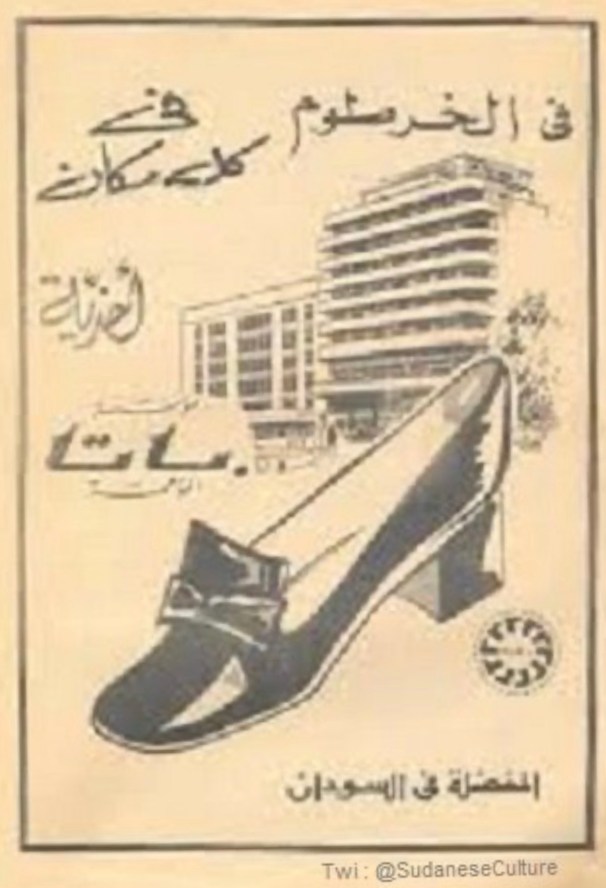
As foreign shoe manufacturers and European styles gained ground in post-independence Sudan, concern for and control of the sociological and political semiology of Women’s dress shifted to indigenous movements of both conservative-religious and progressive movements. Brown cites The Sudanese Women’s Union publication, Sawt al-Ma’ra, whose articles included columns on beauty and style, coiffeur, manners and behaviour. In one cartoon strip, a young woman goes to Bata and buys a pair of high-heeled shoes. She eagerly puts on new shoes only for them to become entangled in the folds of her toub.”She yells ‘my veil!’ just before falling to her knees”. In the final frame, Brown relates, she stands barefoot with her head down in shame; her old sandals are in her hand, and the troublesome high heels are nowhere to be seen”
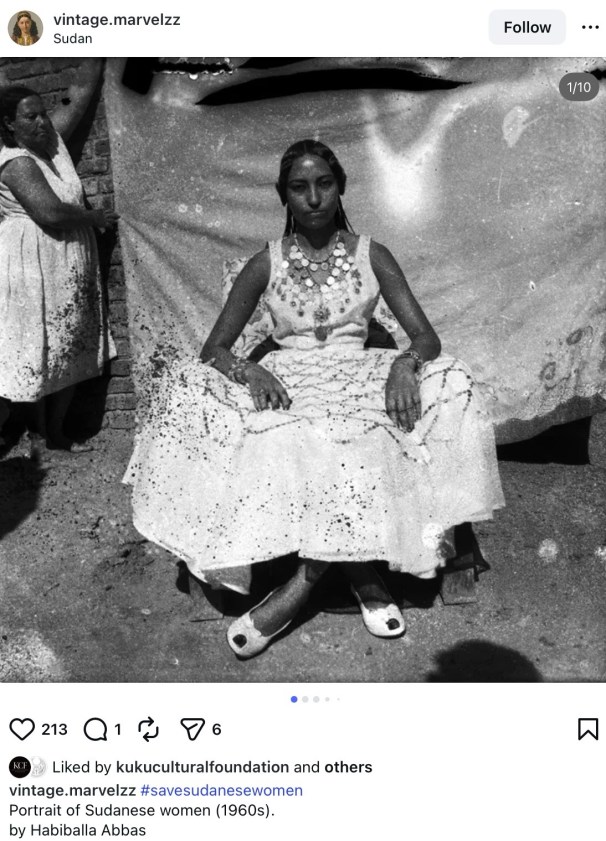
Above top left, a woman’s palm fibre sandal, colonial-era, Sudan Ethnographic Museum. Left, an advertisement widely reproduced on social media for Bata Shoes, Khartoum. Right, a young bride wearing western-inspired white peep-toe shoes to complement her wedding gown.
In 2014, photographers documenting the plight of South Sudanese refugees fleeing war, captured something of the tragedy of displacement in their photographs of the battered and worn shoes of men and women who had walked hundreds of miles to safety. Photographer Shannon Jenson depicted a pair of flip flops apparently worn down to half their original size by miles of walking. “It turned out they belonged to an eight-year-old girl who had cut them to fit her small feet.” See too Threadbare Shoes of Sudanese Refugees Tell Stories of Long and Harrowing Journeys. Sadly, history is repeating itself with thousands of Sudanese fleeing the ongoing conflict on foot.
Tragically today, Sudanese women captured by warring factions in the country’s ongoing and brutal civil war have been subject to countless indignities, physical and sexual. Many tell of being stripped of their toubs and forced to give up their shoes, making escape arduous if not impossible across scorching, rugged terrain. This treatment aimed to immobilize and disempower women echoes that meted out to those protesting for democratic change in the 2018 / 19 revolution. Hara Al Karib recalls the testimony of one such protestor: “B explained that as the protesters were nearing the army headquarters on Africa Road, they were confronted by live ammunition and soldiers holding whips. B said she was beaten by two soldiers, who struck her all over her body, called her degrading names, and forcibly removed her Toub and her shoes. She said that she managed to flee, but left behind a woman laying on the ground bleeding.” (Sudanese Women on the Front Lines of Resistence).

