

Patient Motherland – يا صابرة
Excerpts from Azhari Mohammad Ali’s Elegy to Poet Mohammad Al-Hassan Salim Himmaid
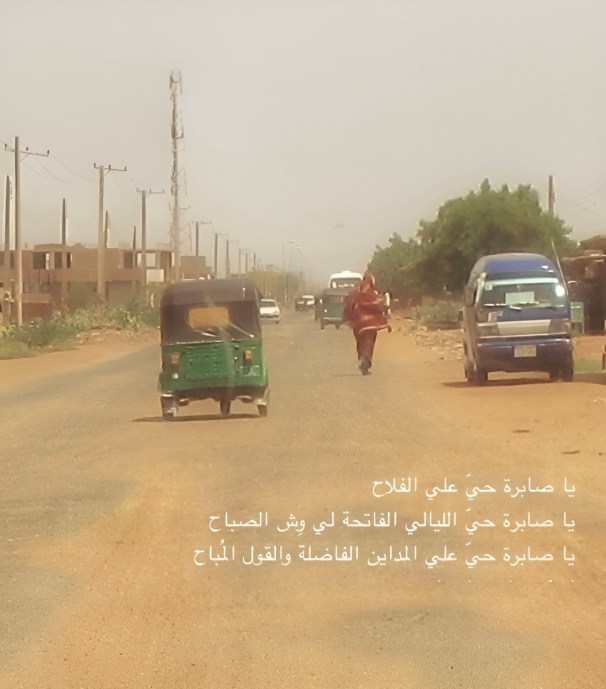
Setting the Scene
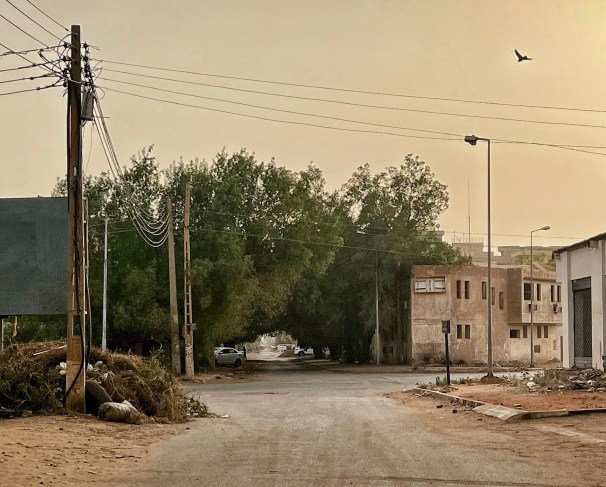
Above, a Khartoum scene, pre-war as a backdrop to Azhari Mohammad Ali’s iconic lines:
O Patient Motherland, hasten to success / O Patient Motherland, hail the (dark) nights’ parting into breaking day (literally “opening up to the face of the morning”) / O Patient Motherland, hasten to the virtuous cities and thoughts openly expressed /
For many of his admirers, the brief lines above epitomize the ethos of Azhari Mohammad Ali‘s poetic work, seamlessly interweaving the cadences of Sudanese spiritual life with a nation’s yearning for political and societal change. Echoing the phrasing, rhythm and lyrical power of the Islamic call to prayer, the poet, as cultural muezzin, layers in multiple interpretations to the religious supplications that punctuate the northern Sudanese day.
Preceding these lines, the poet writes that he would call to his homeland, The Patient Motherland, in that profound darkness that precedes the dawn, urging both spiritual and cultural awakening and with them, the shrugging off of oppression – all in a moment infused with profound hope and confidence in a new political dawn. “Hasten to prayer, hasten to (all-embracing spiritual) success / salvation / spiritual prosperity (falaaH)” are the widely accepted translations of the opening lines of the call to prayer.
The opening sura of the Quran or Fatiha is frequently invoked to bless journeys, agreements and many other undertakings and perhaps here the dawning of a new Sudan is invoked for similar blessing and spiritual justification. In the last line above, the poet is possibly alluding to the Virtuous City, Al-Madina Al-Fadila, of philosopher Al-Farabi; whose qualities the poet’s “true” Sudan would embody. The expression “al-guul al-mubaaH”; literally permissible speech, refers to opinions, criticisms or topics open for acceptable public discussion. Some translations of this expression use the words “free speech” and the poet is certainly advocating for the freedom of expression, but within Sudanese and Sufi cultural sensitivities. The poet here may be evoking too the famous reference to this expression in Scheherazade: “sakatat `an al-kalaam al-mubaaH”, when at dawn, the heroine must cease her “guul mubaaH” and fall silent – although this interpretation may well be fanciful.
You can hear the poet reciting this section of the work by clicking on the link below and forwarding to minute 1.40 of the Al-jazeera clip:
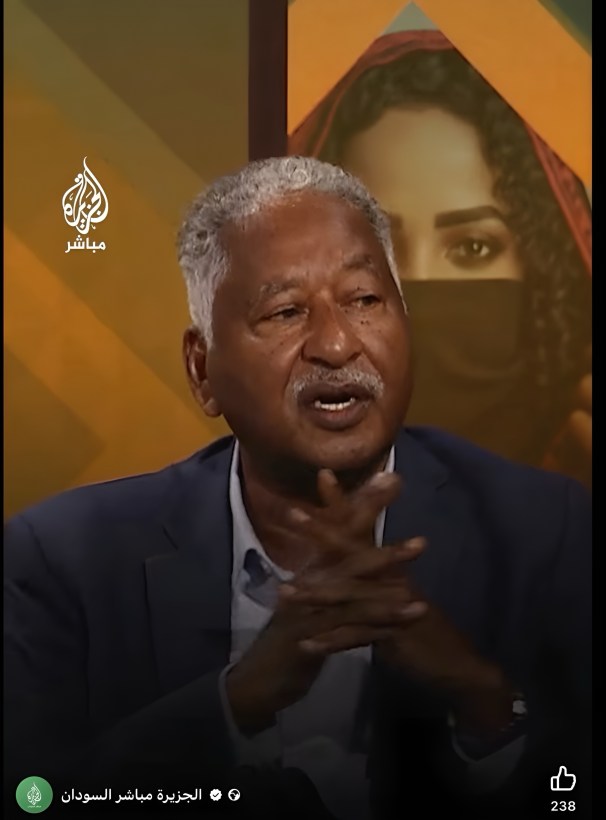
بصوت شاعر #السودان.. أزهري محمد علي يهدي بلاده أبياتا من القلب: “يا صابرة حي على الفلاح يا صابرة حي على الليالي الفاتحة لوش الصباح لو كنت أقدر أنزعك من مخالب الخوف وجلجلة السلاح ما كنت تاني رجعت لكي خاوي اليدين دامي الخطى ومكسور الجناح” #الجزيرة_مباشر
I have included the time stamp of each excerpt referenced below.
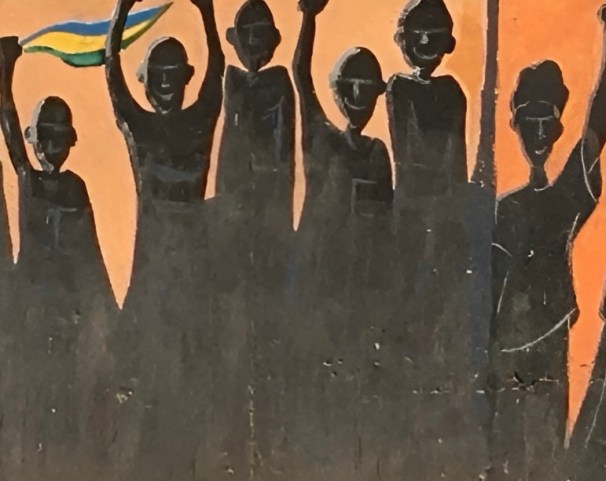

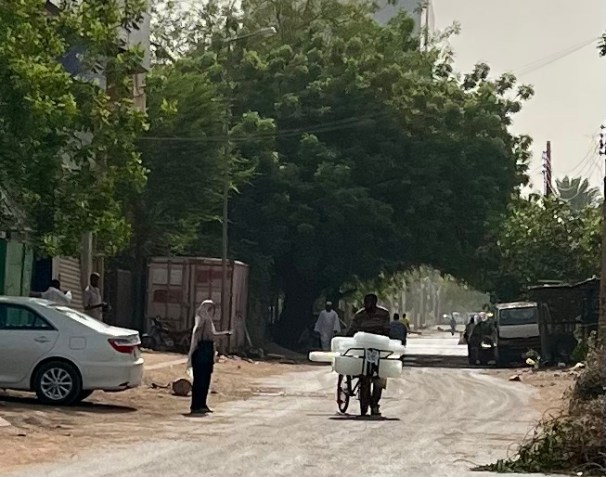
Above, a warm greeting on the streets of Khartoum.
“Azhari’s poetry has deservedly been described as an aesthetic project characterized by a deep awareness of the present moment and a second sight into the future”, ArabLit A Drizzle of Bullets: Poetry of Dissent in Sudan.
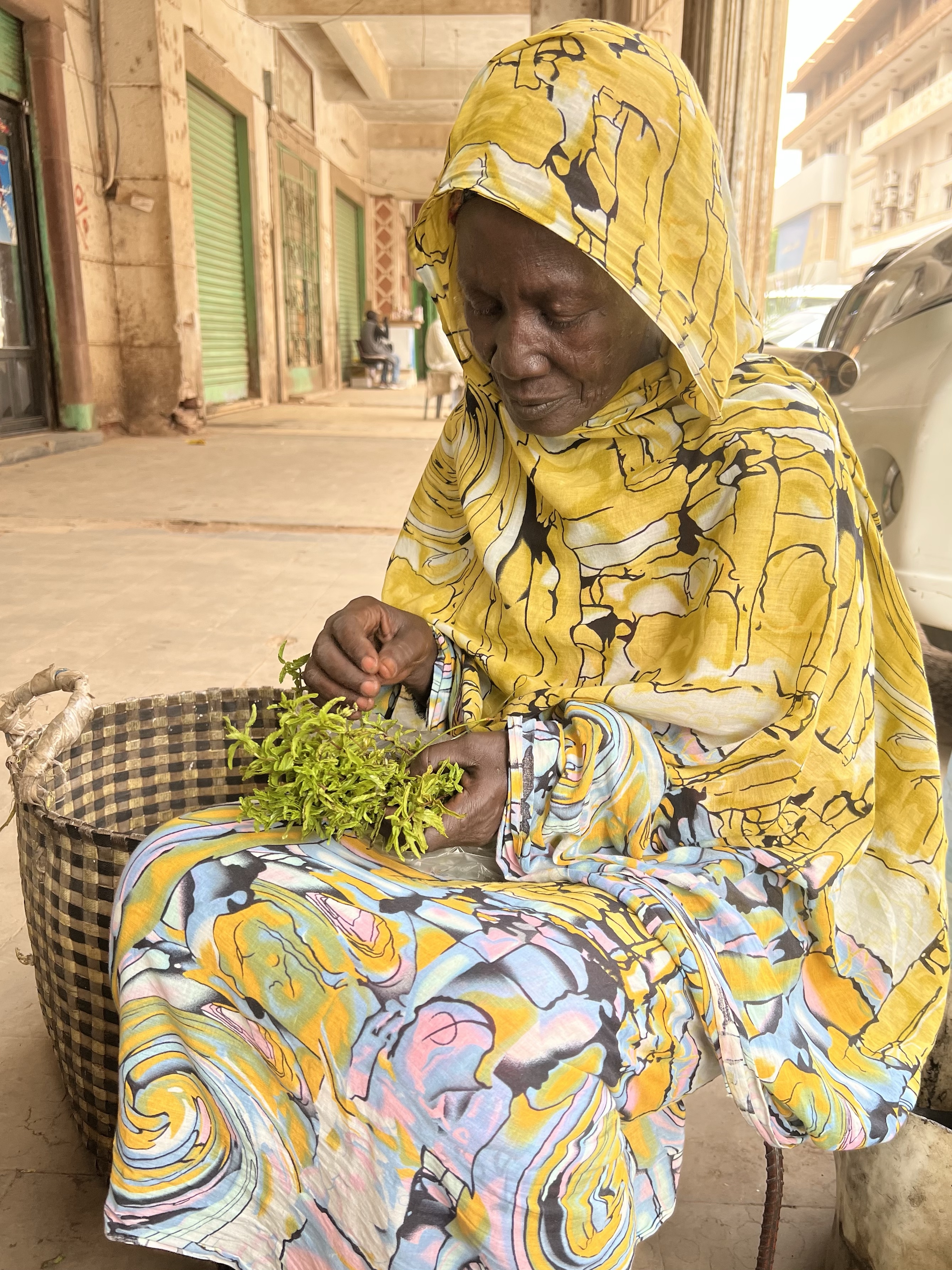
This week’s brief post hopes to communicate something of the evocative power and lyricism of the poem Yaa Sabra, while touching on the cultural context of the work. Although it offers initial, working translations of just a handful of verses, a detailed lexical breakdown of these and several more will be available in my sister blog shortly. The poet, intellectual and political activist Azhari Mohammad Ali is a towering figure in contemporary Sudanese life. Most recently, his verses have been adopted as watchwords by young and old supporting the 2018-19 revolution – see Freedom, Peace and Justice and Watchwords and Slogans of the Revolution 2. Long before the sit-in massacre of June 2019, the poet was writing of hails of bullets showered upon civilians in Ya Sabra. He is a vocal advocate for peace in Sudan and member of many peace fora. You can learn more on his political and cultural views in the in-depth NUUAR Media interview embedded at the close of this post. The interview is subtitled in English.
The poem oscillates between cultural optimism and profound acknowledgement of painful truths. Ultimately it explores the power of poets and poetry to bring about meaningful change. In the Al-jazeera clip linked above, the poet movingly recites a large section of the work. You can read the full text (one of several versions online) in Arabic here.
The Poet and The Patient Motherland
/ With forbearance by the Lord endowed, / and vigor from the land gained, / all day she works hard. / When the night falls, / she goes in and waters her tiny plot, / to quench her plants’ thirst, / and feed her young ones. Back at home, / the dreams of the poor, / bleed out of her confused eyes. /
Nura and the Time-Tested Dream, Mohammad El-Hassan Salim Himmaid, translated by Adil Babikir, Modern Sudanese Poetry.

The poem, written in stages across four distinct political periods (2001-2012) appeared in the poet’s collection Tooba lil Ghuraba’. Its extended composition echoed and responded to the vicissitudes suffered by the subject of the work, the”people’s poet”, Mohammad Al-Hassan Salim Himmaid and political landmark events in Sudan over that time. The last stage, written in 2012 mourns the tragic sudden death of Himmaid. As in the verse of Himmaid, Azhari Ali’s work vibrates with the rhythms, direct, conversational lexis and unique imagery of colloquial Sudanese, while also referencing Shaygiya cultural terms. Deceptively simple phrases are laden with multiple resonances and plays on words.
Enjoy an English recital of Himmaid’s beloved The Tragedy of Abdur-Raheem here.
Like Himmaid, Azhari Mohammad Ali’s work explores the pain of a broken land, the dignity of its people, the forces of marginalization, the ethnic diversity of its peoples distorted and the sorrow of exile, or al-ghurba. While the poem explores the power of the poetic voice and its ultimate failings, as in Himmaid’s work too, the poem speaks to those abandoned or misused by power, the victims of systems imposed upon them. The homeland is personified as a woman of self-sacrificing endurance, bearing the weight of poverty and hardship with dignity and strength; Al-Saab(i)ra; a land whose future is imbued with the vulnerability of an exquisite child.
“Azhari’s poetry has deservedly been described as an aesthetic project characterized by a deep awareness of the present moment and a second sight into the future”, ArabLit, A Drizzle of Bullets: Poetry of Dissent in Sudan.

Poetry and songs written in Sudanese Arabic, the everyday conversations held in Sudanese colloquial and Sudanese political and social commentary in the media abound with references and exhortations to the virtue of patience. In the land of the patient, balad aS-Saabiriin or aS-Sabra, the Patient Woman, fellow countrymen and women are urged on, consoled, comforted and inspired by epithets, proverbs and prayers invoking infinite patience – the patience, aS-Sabr `ala al-jamr, needed to endure even hot coals or embers. The archetype of the patient mother embodies for many Sudanese an essential element of the national identity and for Ustez Azhari the homeland itself is a patient mother, exhausted yet unyielding in service to those she loves. Patience here should not be understood as passive resignation. For Azhari Mohammad Ali and many other intellectuals, patience is a refusal to surrender, a quiet resilience in the face of continued crises, disasters, destruction and war. It is both a profoundly spiritual discipline embedded in Sudan’s Sufi traditions and a refusal to be broken by circumstance. In this sense, it might be seen as a form of resistance. A land that has endured so much will surely overcome present trials. Thus the virtue of patience allows for hope.

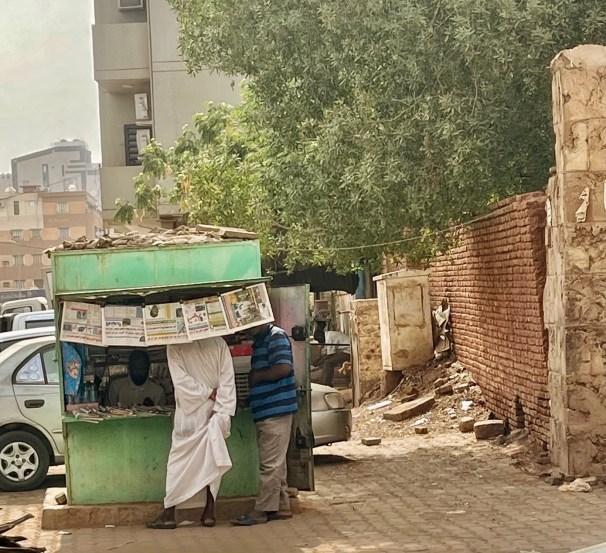
Above, Khartoum at breakfast time, Baladiyya Street, pre-war.
Excerpts
Below I offer an initial working translation of these selected excerpts. A thousand thanks to Muna Zaki for all her input, guidance and corrections. Any errors in tone, meaning or subtext are mine alone and I very much welcome readers’ comments and advice.
The poem opens with a tribute to Himmaid, evoking the profound influence the poet has had on Sudanese cultural life. A creative and artistic life, Azhari Mohammad Ali feels intensely, that was weaned on and flows from his work. The poet’s courageous and unwavering commitment as the voice of the marginalized and the put-upon is central to this homage, as Ustez Azhari goes on to mourn for the pain of his homeland, bereft of Himmaid and suffering the indignities of injustice. The expansive, welcoming essence of his homeland, the poet writes, is being consumed and / Like all birds, ever yearning for their homelands / It is not the homeland that shrinks but the prison cell that expands….. / The poet’s gentle words, “dropping like honey”, “settled upon your heart like salt (on open wounds)” (minute 0.9). The words of the poet are misunderstood, discredited or devalued, the homeland engulfed in self-immolation.
The poet goes on to evoke the pain of exile, alienation and his profound longing for the true Sudan; a Sudan that vibrates to the daily rhythms of spiritual and communal life, the comfort of late afternoon shade enjoyed in kind company, the streets and houses a constant memory though now sadly changed. His soul yearns every day and in dreams for the earth of his homeland; his being is in fact cast from its very clay (minute 0.30).
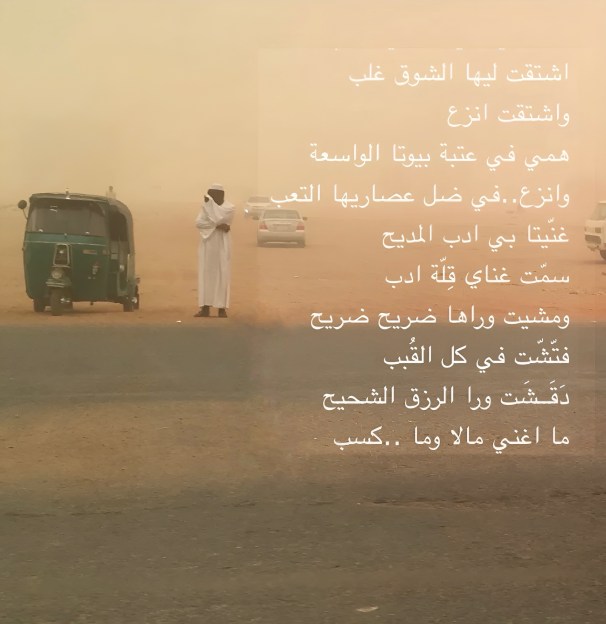
Minute 0.40
/ I longed for her and my longing overwhelmed me / I longed to cast off / my cares on the threshold of her spacious homes / cast off …in the kind shade of her late afternoons my weariness / I sang in praise of her as in our (beloved) Prophet’s sacred hymns / Yet she branded my songs uncouth / So I followed her from shrine to shrine / I sought her in every (saint’s) domed tomb / (only to find her) from door to door wandering in search of a meager living / wealth did not avail her (the homeland), nor that which was gained.
The poet here evokes what he feels is the true Sudanese Sufi essence of his homeland, epitomized in the holy men and women’s shrines and tomb that punctuate the landscape. Learn more in The Sudanese Gubba (Qubba), Darīh (DariiH) and Bayān
This last line appears to be a direct reference to sacred text (Quran 111.2), regarding an uncle of the Prophet Muhammad, Abu Lahab, who, Islamic sources claimed, said he would buy his way out of any divine punishment. The text is a call to true accountability.
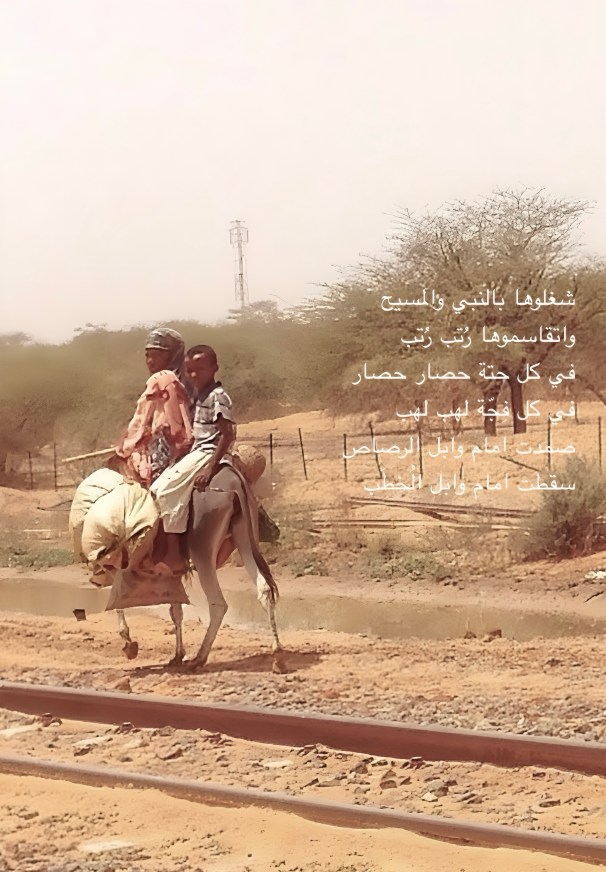
Minute 0.56
/ They distracted her in the name of the Prophet and the Messiah / they carved her up into rank and station (for their gain) / in every corner a siege, a siege / in every alleyway a flame, a flame / You stood firm against a barrage (or hail) of bullets / Only to fall beneath a barrage of (empty) speeches/
The verses above emphasize the tragic irony of a land that did not succumb to force or violent intimidation, yet fell to the false speeches of politicians. The words Samadat, to stand firm and saqaTat, to fall, are words often used by the poet and many others in revolutionary verse and slogans.
The verses above resonate with the words of Himmaid, in The Tragedy of Abdur-Raheem:
Governments out, to oblivion. / Governments in, over us they reign – / with fairy tales an illusion, / fallacies and game, / being their sacred constitution, the graveyards ruling us in the Prophet’s name
How many cycles you have to endure – / like a patient soil?
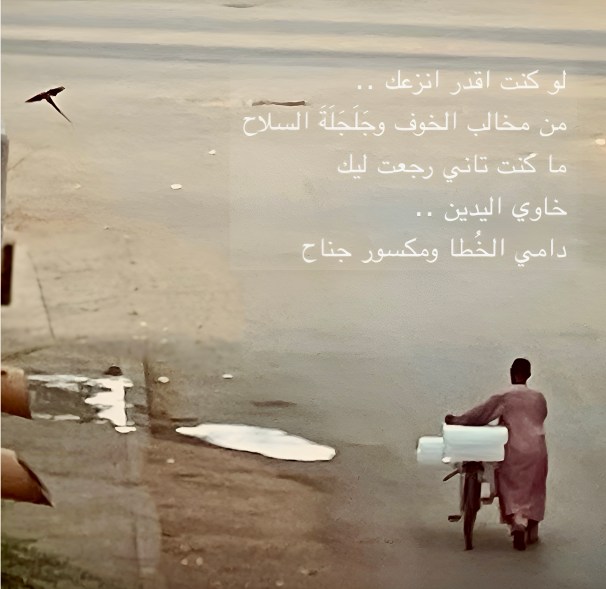
Minute 1.55
/ If only I could have snatched you / from the clutches (literally claws or talons) of fear and the clatter of arms / I would not have yet again returned to you / empty-handed …. / with bloodied step and broken wing /
Strongly reminiscent of passages in Himmaid’s Abdur-Raheem, the poet laments the fracturing of his homeland and the political weaponization of religion in statecraft and identity. He goes on to evoke the squalid reality of forced displacement and diaspora life. The poem now shifts to contemplate the future of Sudan, embodied in the all too vulnerable young child – more eloquent than the poet’s song, with her lovely braids like the banks of rivers and eyelashes like a trellis of clouds (minute 2.29). A child that at any moment could be engulfed by the forces of darkness, al-khafaafiish aZ-Zalaam (literally the bats of oppression, minute 2.17); corruption, evil-doing and endless cycles of coups.
The poem closes with a searing admission of guilt and profound sorrow. While the opening stanzas celebrate the courage and cultural heft of the socially committed poet, here the poet stands humbled before the enormity of a people’s suffering. Azhari Mohammad Ali acknowledges that the artist, the intellectual, the cultural advocate have all failed to alleviate the suffering of a single fellow countryman or woman. For this, the poet can only express his sorrow and heartbroken apology.
The Al-jazeera clip above cuts off before the poet had time to read this section.
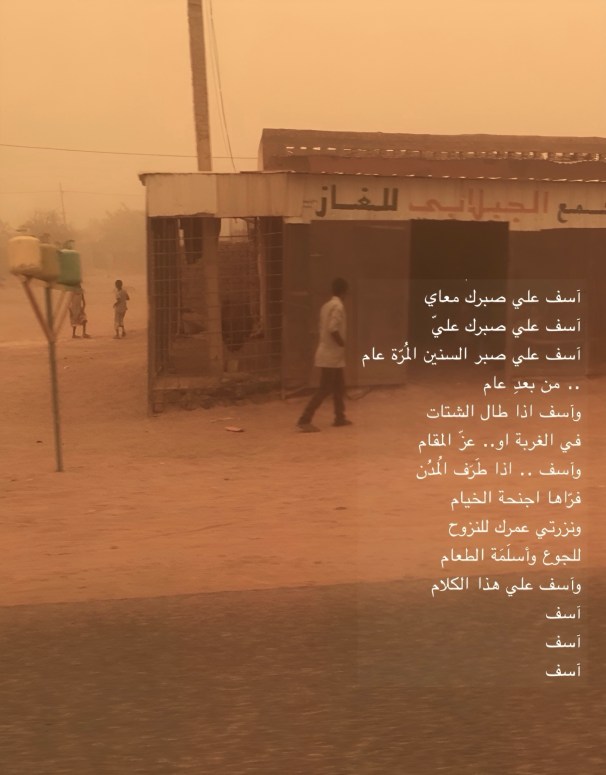
/ I am sorry for your patience with me / Sorry that I imposed upon your patience so many times / your long forbearance / Sorry for the patience of years turned bitter / … year after year / Sorry lest we remain a people scattered so long / in alien lands … forever far from our cherished goal */ And I am sorry if the edges of our cities / Spread wide their tented wings (referring to refugee and displaced persons’ camps) / and all your life is vowed to forced displacement / To hunger, to be the recipients of food / And I am sorry for these words / I am sorry / I am sorry / I am sorry * There are discrepancies of text here and we believe the correct word is muraam; objective, not mugaam as appears here.
Below, NUUAR Media’s interview with Azhari Mohammd Ali, subtitled in English.


wonderful. Echoes of the Song of Songs in some of the poems
LikeLike