

The Sudanese Jarjār
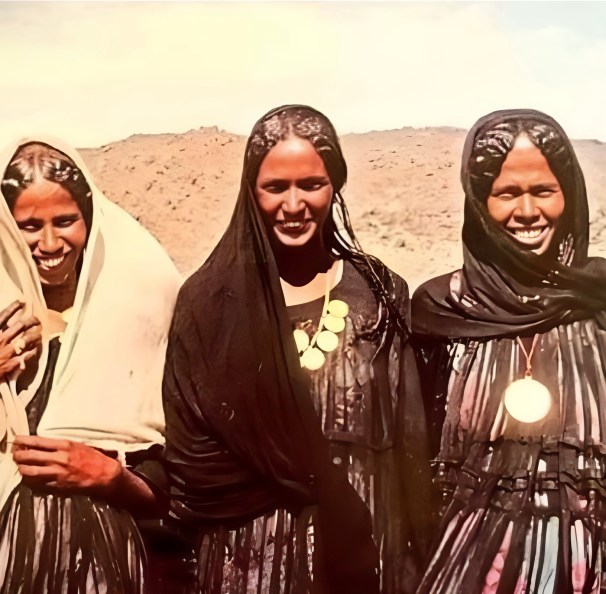
Above, Sudanese women wearing their black jarjār overdresses in a widely reproduced early to mid-20th century photograph. The diaphanous robe, with its oval neckline, loose folds and horizontal ruffles, acts as a graceful foil to the wearers’ glowing gold jewellery and brightly patterned undergowns. The late Sudanese costume expert and artist, Griselda El Tayib explains that an ordinary cotton dress “with a gathered skirt down to mid-calf”, sometimes with a coloured print and known as a kitti was usually worn under the jarjār. Widows, she notes, wore plain white under their jarjār.
Title illustration; an AI-generated recreation of the Basalwa jarjār, based on diagrams by Griselda El Tayib and detailed below.
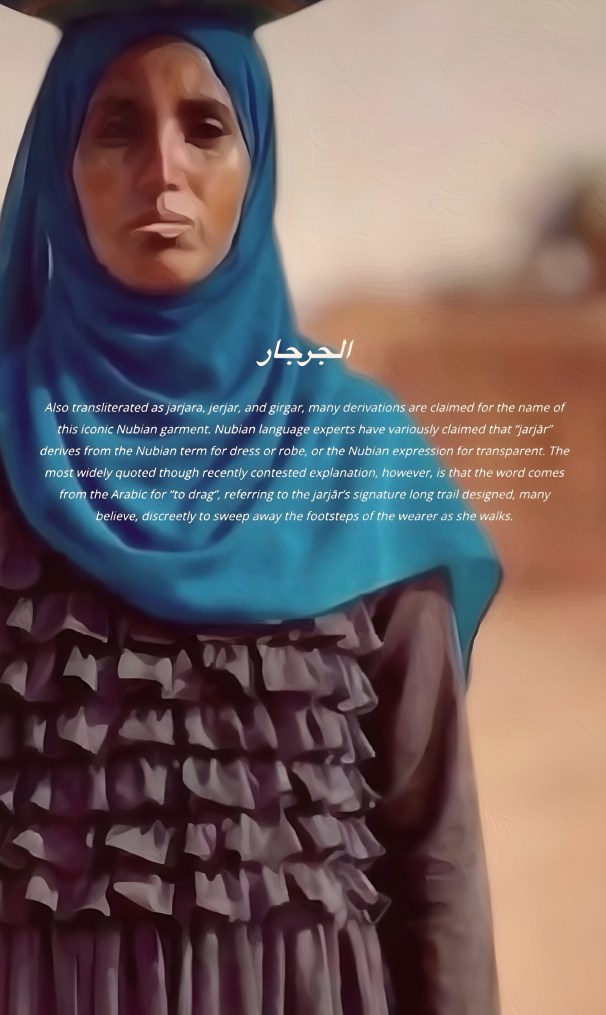
Above, AI-generated image of a traditional Merkasse jarjār based on diagrams (detailed below) and illustrations by Griselda El Tayib. The jarjār is generally understood to be voluminous and diaphanous though the thickness of the cloth varied according to the age and status of the wearer and inner linings and two layers of jarjār were also sometimes worn. Heavier fabric was often worn by older women, together with looser and wider sleeves.
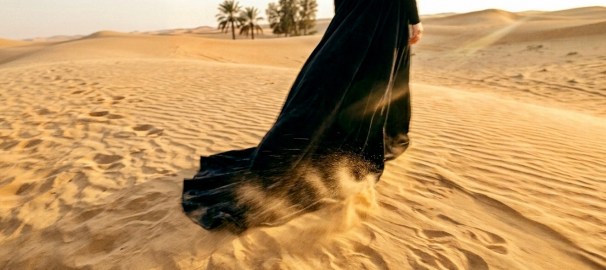
/ the banks are lush / with flourishing bush and wild acacia / and many tall date palms / the barefoot women walk in long jarjar / down a sandy path / to stand beside the river’s edge / one woman eats a little rice / then hurls the rest into the Nile /
From The Nile is Silk, Morning in Serra Mattu, A Nubian Ode Arif Gamal, capturing the evocative power of the jarjār and its intensely nostaglic resonances.

Setting the Scene Then and Now
Sweeping Away the Dust of the Past; The Train and the Jarjār’s Mysterious Origins
Griselda El Tayib’s Accounts of Sudanese Nubian Jarjār
Setting the Scene
Tracing the origin and evolution of the jarjār in her Regional Folk Costumes of the Sudan, textile expert and artist Griselda Al Tayib recalls that even until the late 1940s, “when Nubian ladies returned from Sudan to Halfa by train they would open their cases at the last desert station before reaching Halfa Dagheim halt, get out their jarajaras and put them on, and fold their black tobs away.” At that time, she goes on, it was considered “very outre” to appear at the station clad in the Sudanese toub rather than the jarjār. As an elderly Nubian informant told her, mildly scandalized; “Oh so and so is very forward; she even wears the tob and talks to her children in Arabic”. As Nubia’s cultural and geographical isolation was gradually eroded in the mid to late 20th-century, the Sudanese jarjār entered a phase of decline.
Al Tayib’s account reminds us of both the powerful hold the Sudanese Nubian jarjār once had on Nubian identity and its relatively swift fading away from Nubian life from the 1950s onwards, as displacement and migration to Khartoum for schooling and work took its toll.
This week’s brief post is a tribute to Griselda Al Tayib’s invaluable research into this emblematic garment and includes her descriptions of different types of jarjār. It also explores modern iterations of the dress and attempts to capture something of its beauty and cultural heft.
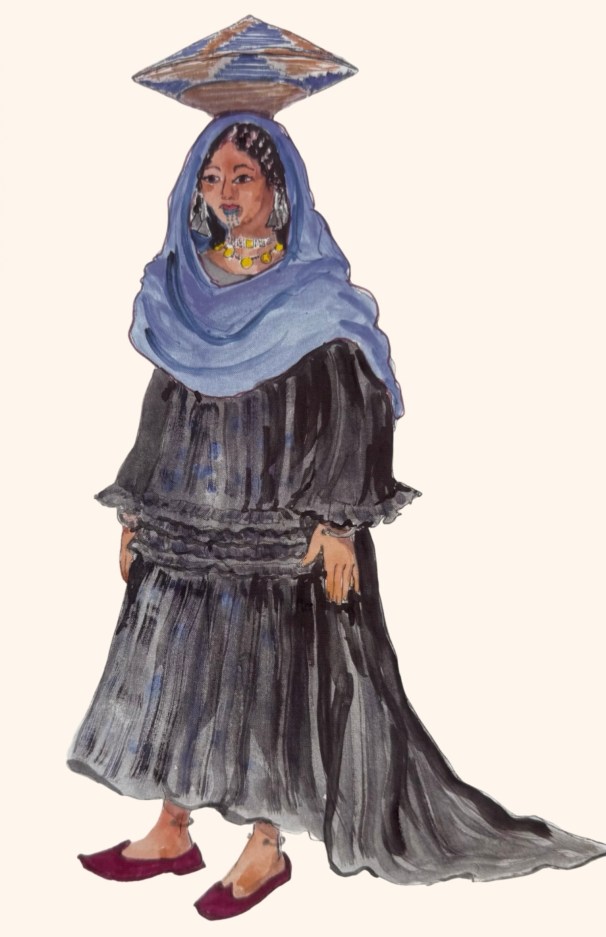
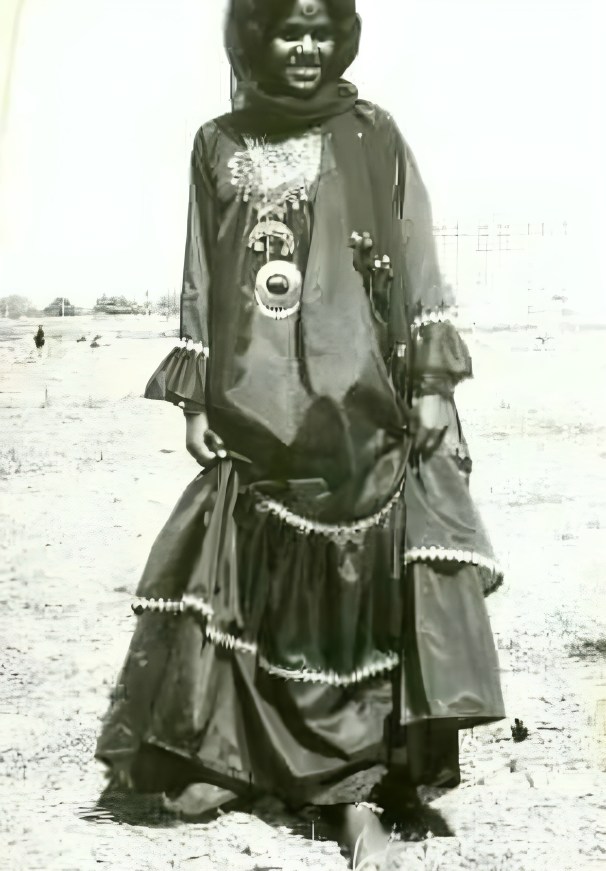
Above right, illustration captioned “A married woman of Wadi Halfa in 1960”, by Griselda Al Tayib, Nubian dress, Regional Folk Costumes of the Sudan. She writes: “This garment worn with great style and dignity has a beautiful silhouette. Women used to go to wedding ceremonies in groups – singing along as they went. each one would carry on her head her shallow aginde basket with its matching showir cover. The basket had an extra ring woven into its bottom to fit firmly on the head. Each basket contained its carrier’s contribution of flour or grain to the wedding feast. These widely sloping baskets on their heads must have complemented the shape of the spreading outline of the jarjara trail at ground level, offsetting the otherwise vertical effect of this long black garment. Left, a widely circulated photograph of a Sudanese girl wearing a jarjār, dated 1950.
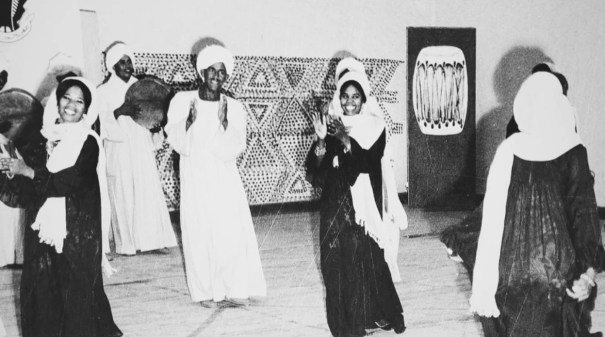
Above, the famous Sudanese group Al Balabil performing in jarjar.
Then and Now
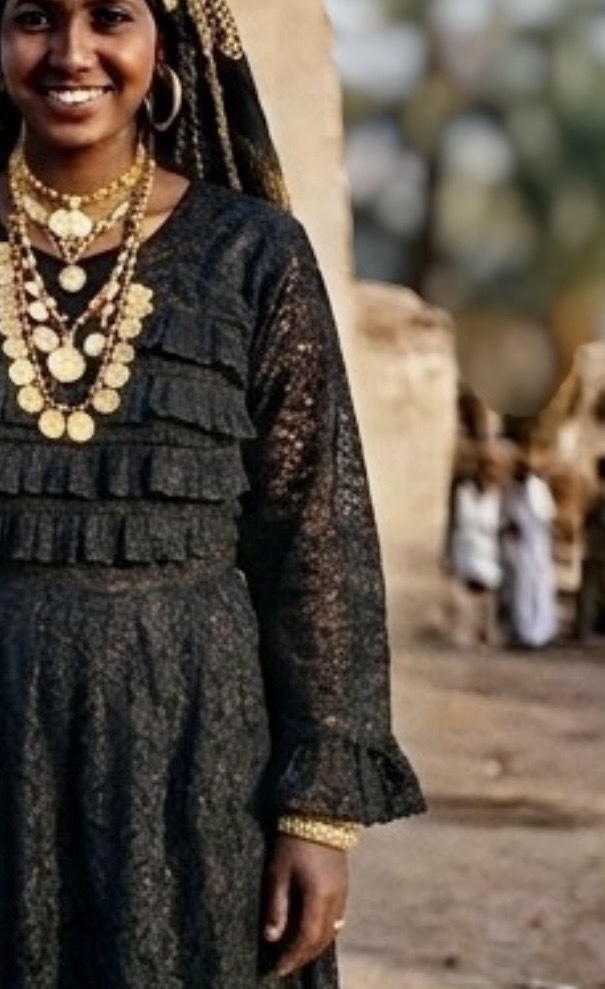
This graceful, often sheer over-robe, today made of voile, tulle, crepe or lacy transparent nylon mesh, was once standard dress for Sudanese Nubian women of the Wadi Halfa and surrounding areas. Designed to be worn over plain, brightly coloured or printed dresses, the jarjār was originally made of fine black cotton. In the early 20th century, the jarjār was still being worn by young and old for both joyful and solemn occasions. Its loose airy texture afforded protection from the heat as well as practical, modest coverage while going about the everyday chores of rural life – gathering water from the Nile, whitewashing and decorating homes and working in the country. See further affectionate reminiscences of Nubian Sudanese interviewed in حرص النساء النوبيات على ارتداء الجرجار التقليدي .
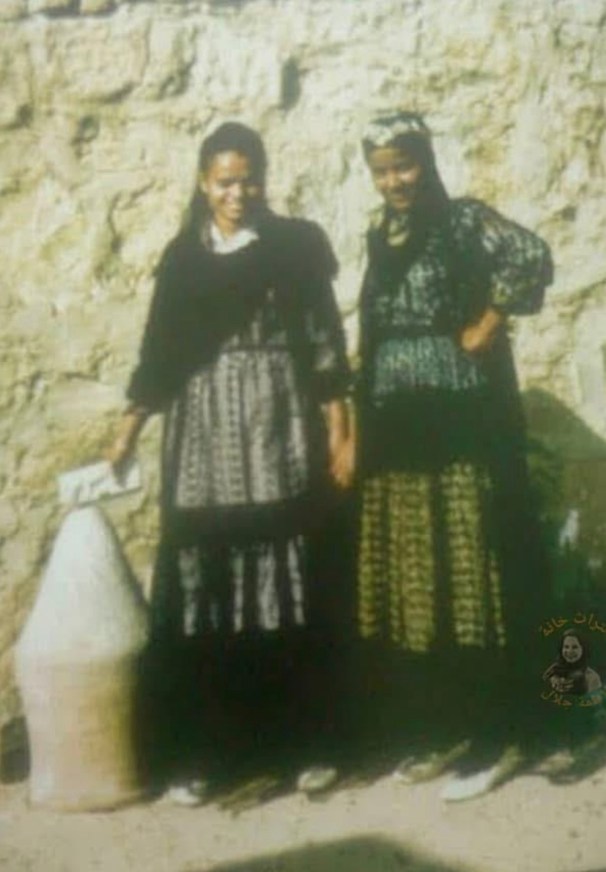
Over the past century, the jarjār has lost its distinctive train (see below) and its wide rectangular sleeves have become slimmer, often ending in cuffs or ruffles. Rigorous black has given way to vibrant stamped motifs on fine tulle or crepe, with embroidered and openwork designs.
While it is still widely worn in the Nile reaches of southern Egypt where it is even worn with pride by employees of high-end hotels, sadly in Sudanese Nubia the jarjār is now less common, though energetic efforts are afoot to celebrate and revive its use. In a strange and poignant turn of fate, the garment marginalized after the mass displacement of Sudanese Nubians in the 1960s may be making a comeback – if media reports are to be believed, as new waves of displaced Sudanese journey to the Egyptian border and become acquainted with the discreet elegance and practicality of the robe, see بين الحزن والحرب… «الجرجار» مجدداً تحت الضوء .
In recent years, Sudanese cultural advocates have also embraced the return of the jarjār as a Sudanese alternative to the Middle Eastern abaya and other sartorial imports gaining hold from the Arab Islamic world. As one commentator at a Sudanese Nubia cultural festival noted, the indigenous jarjār embodies the modesty, dignity and wearability of any imported rival. Today Instagram and Tiktok jarjār designers jostle for attention with sophisticated, colourful modern takes on the garment.
Above, left, an AI-generated image of a contemporary jarjār of densely machine embroidered fabric; above right, a colonial or post-colonial photograph of Sudanese women in finer, sheer jarjār. Below, contemporary designs showcased at a Nubian cultural festival, الجرجار النوبي – تصاميم جديدة ومعاصرة.
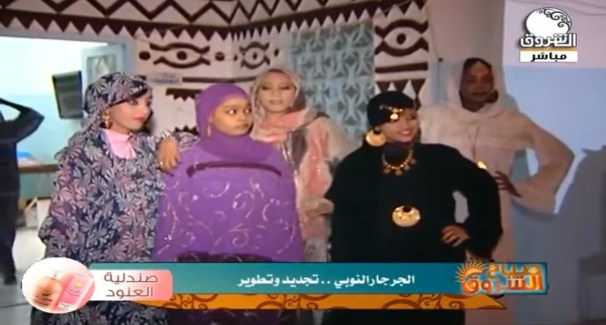
Below, vivid green against fine black jarjār with delicate, lacy motifs, a celebration of Sudanese Nubian Culture in the early 2000s.
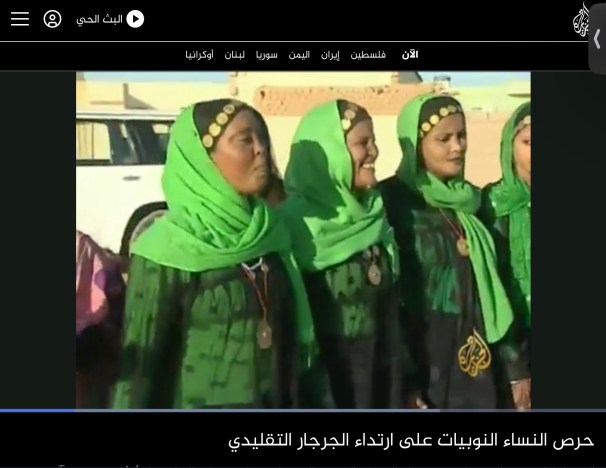
حرص النساء النوبيات على ارتداء الجرجار التقليدي
Sweeping Away the Dust of the Past; The Train and the Jarjār’s Mysterious Origins
Among the romantic myths that have grown up around the jarjār’s long flowing train, the most popular and perhaps appealing is that by erasing the wearer’s footsteps as she walks, it protects her from the sorcery of malevolent jinn who might use her footprints to cast evil spells, while its modesty and grace might also guard against the evil eye. In this vein the jarjār has been mined as a source of poetic symbolism; the sweeping away of the dust of hardships, the allure of hidden beauty, the dignity of modesty and power of stark visual contrast and teh passing of time. More down to earth explanations for the train see it as a means for protecting women for being followed or tracked by members of rival tribes or enemies.
Equally fascinating myths and theories abound concerning the origin of the dress. Griselda El Tayib identifies in the jarjār echoes of the robes worn by recent newcomers to Sudan from the Arabian peninsula, in particular the Rashaida and Bedouin women of the Sinai, as well as the long trailing clothes of early Arabia, referenced in early Ummayad poetry. Others claim a lineage flowing back to the attire of ancient Egypt and the later Kushite empire. There is widespread belief, still quoted by Sudanese Nubians today, that the Kandaka – the ruling Kushite queen or royal consort wore black jarjār in mourning for her king and lord, with Piye or his son, Taharqa often cited.
Many draw parallels with the Coptic dress of Christian Nubia as seen in the frescos of Faras Cathedral; tunics with ample sleeves worn by priests and nobles and which reflect the influence of Greek culture from the Ptolomies to the missionaries sent by Justinian and Theodora (Griselda El Tayib). This is a claim fiercely contested, however, by other Sudanese commentators. The tunic-like ancestor of the jarjār referenced above and discussed by early 19th-century explorers such Cailliaud and Burckhardt (cited by El Tayib), may also have evolved from a male garment of similar cut (see the Jarjār koman discussed below). It is interesting that the 19th-century historical sources El Tayib draws on note the relative simplicity of Nubian dress, referencing rahat style skirts and coarse tunics as the main attire. Researcher into Nubia (1960-70s), Marian Wenzel claimed the tucks and ruffled sleeves of the jarjār to be the fruit of the influence of European dress of the time.
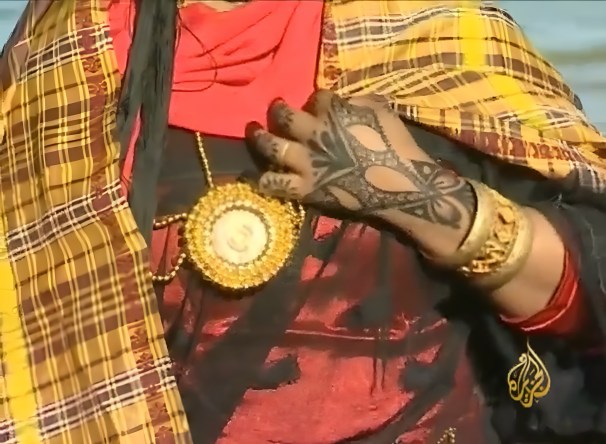
Whatever its origin, Griselda El Tayib claims the jarjār was “doomed to obsolescence accelerated by Nubian women’s resettlement in Khashm al Girba area.” When she was conducting research in 1972-4, she notes “very few wearers of the jarjara under middle age could be found in that area.” At the same time, there was a decline in local production of the garment as imported readymade jarjār from Egyptian Nubia gathered force. See Nubian experts for details on the local Sudanese cotton variety and processing employed before imported fabrics predominated in Ashorooq’s الجرجار النوبي – تصاميم جديدة ومعاصرة. Above left, a bride clad in her filmy black jarjār, offsetting the vivid red of her bridal robe, still from Al Jazeera, المهرجان السياحي الأول في النوبة شمال السودان.
El Tayib relates an intriguing popular legend explaining why the jarjār was originally made only in black. She explains: “Around 1818 a certain Omda Dawud of Dagheim heard of a death in his Omodiya and came hurrying to the house of mourning. He was already old and also weak in eyesight. By mistake he entered in upon a group of women and contrary to his expectations, no man stood up and stretched his hand to say the Fatha prayer. After a silent pause of some time, a woman said ‘the men have all gone to the graveyard’. So mortified and humiliated was the Omda Dawud by this incident, that he straightaway decreed that from henceforth all the women in his Omodiya should wear black jarajaras.”
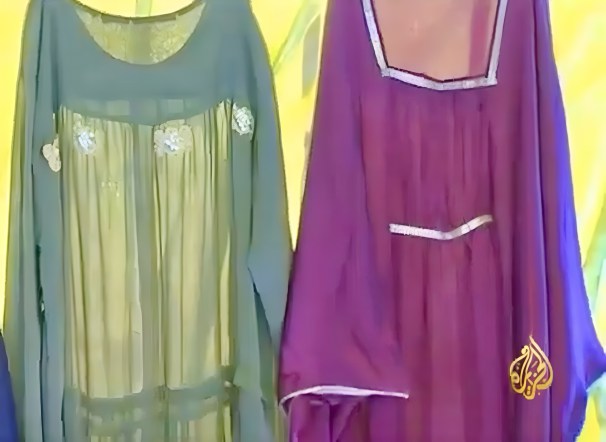
Above, vintage and contemporary jarjār designs, Imogen Thurbon Pinterest and right, a still from Aljazeera Sudan, linked above.
.
Griselda El Tayib’s Accounts of Sudanese Nubian Jarjār
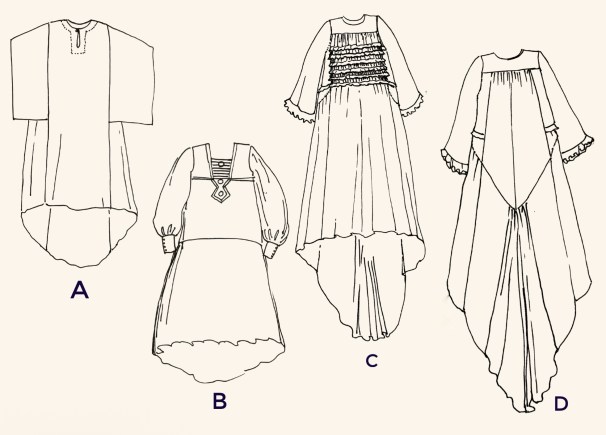
Above, illustration by Griselda El Tayib, Regional Folk Costumes of the Sudan. A: a jarjār koman, worn by widows, B: jarjār worn by the Basalwa; C and D: front and back view of the merkasse jarjār.
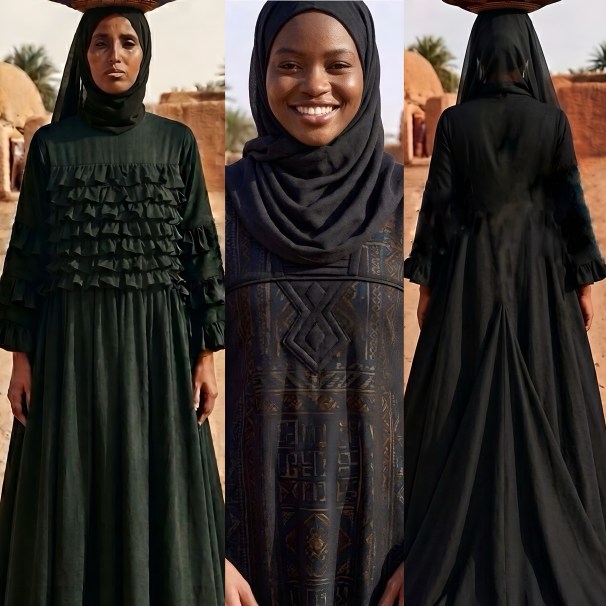
Above, AI-generated images based on El Tayib’s diagrams; left, C, front view of the merkasse jarjār, centre, B, Basalwa jarjār and title illustration, and right, D, rear view of the merkasse jarjār.
The Accompanying Veil
El Tayib explains that a veil, known as “benati” was worn with a black jarjār. Her understanding was that this was never white; a white veil might only be worn by women over their coloured underdress at home when saying prayers. She notes brightly coloured veils of wedding guests would provide a striking contrast to the black robe; the favourite colour being a peacock blue, known as dessi in Nubian. Black veils were worn by widows and “the effect was very sombre indeed”. “In addition to this”, she continues, on trips “which might mean walking an hour or so in the sun, women would carry a tob of black voile – about four metres long. This would most often be folded up and placed on top of their heads to protect it and their shoulders from the sun. Sometimes, if they were cold, the black tob would be opened up partly and used as a wrap around the shoulders.” At night, the toub was used as cover on long journeys.
Under the head veil, Nubians plaited their hair in a style called shirafi and a large golden ring was worn in the centre parting “such as that is still worn by women of the Beni Amer and Hadendowa” and known as “gusa rahman” (Griselda El Tayib).
The Jarjār Koman
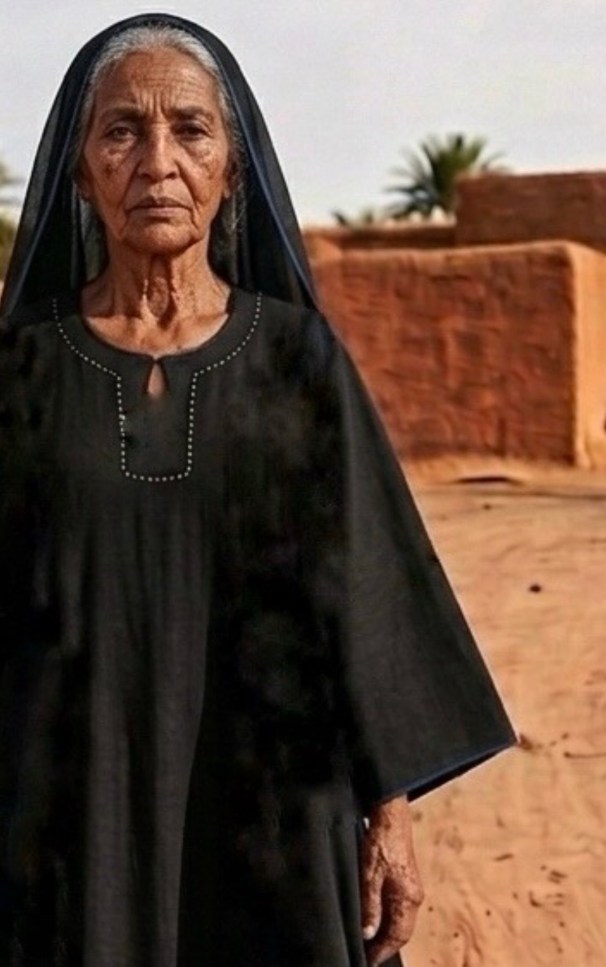
The jarjār koman, (diagram A and shown left) is described by El Tayib as the most austere form of the four varieties found in Khashm Al Girba area after displacement. The Koman was described by an informant as formerly worn by Nubian men, known as the koman bash and consisting of a simple T-shaped garment. The Nubians, she reminds us, had an “interesting legend indicating that at one time there must have been a transitional period of ambiguity between men and women’s clothes in shape and colour and that both genders at one time wore white. In the course of her research, Griselda El Tayib met an “impecunious widow” in her 40s wearing a Koman bashi, consisting of four metres of inexpensive black voile. She also refers to a second type of koman having very wide sleeves and no flounces; a garment considered “the correct attire for widows”.
The Basalwa Jarjār
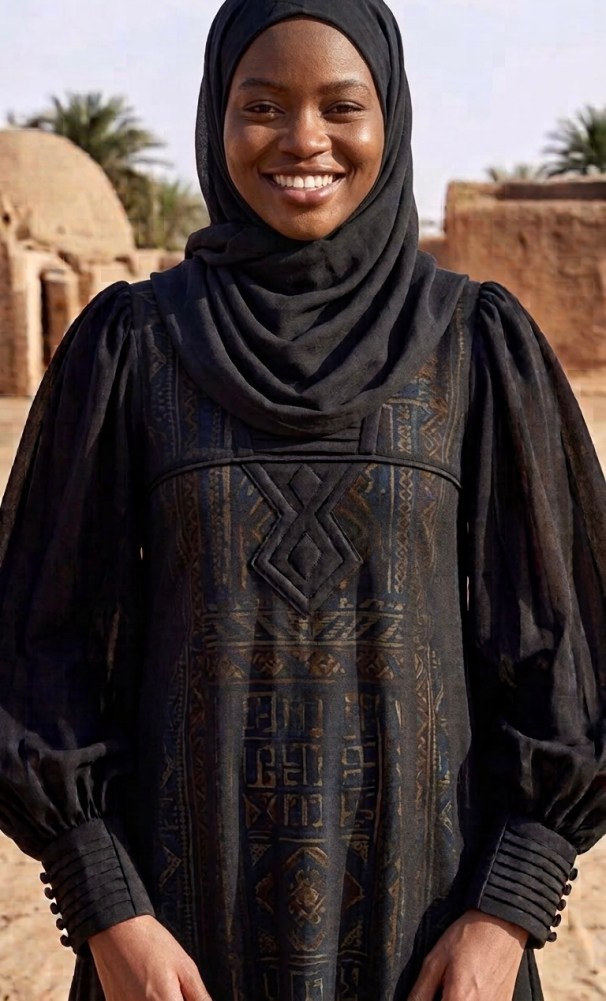
Above the Basalwa jarjār.
The Basalwa (diagram B) is described as a “border country garment worn in Upper Egypt and Nubia and now in Khashm Al Girba”, consisting of copious sleeves fastened at the wrist with deep buttoned cuffs. Younger Basalwa women wore two of these black jarjār on top of the other – “an inner one of fairly thick muslin and a top one of extremely transparent georgette, chiffon or nylon”; the upper one was purely decorative and “only the boldest woman would wear it over her coloured dress without the second thicker jarjara as a lining.”
The Merkasse Jarjār and the Magic of the Ruffles
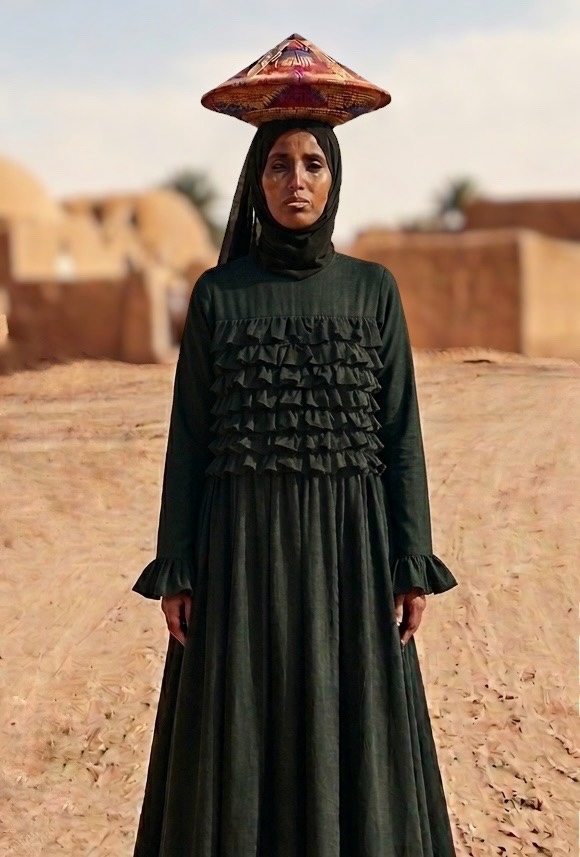
The jarjār known by Wadi Halfa Nubians as Merkasse, pictured right, was an “elaborate affair” made of “black gauze sometimes woven with bands of thicker and thinner weave”. As the fabric was imported and difficult to come by, “most commonly plain black muslin was used instead”. The garment was 7-8 metres long, voluminous and gathered into a yoke lined with the same material. It had an oval-shaped neck opening called sufra. Across the breast there are several horizontal tucks. El Tayib notes that the number of tucks used varied according to village and was thus an important marker of group identity. They also served as striking elements of decoration and helped to give the garment extra weight across the breast and knee. This in turn prevented the garment “from suddenly blowing up in the wind”. “This elaborately tucked style is described by Nubians as tentanelli.” The sleeves were worn wide and loose with flounces at the end and occasionally one or two tucks at the elbow, serving to add weight and enable shortening or lengthening of garment by letting out tucks or taking more in. El Tayib notes that “these and the trail form the pleasing horizontal feature in an otherwise vertically emphasized garment.”

