

Three Sudanese Proverbs and the Stories Behind Them
A Harvest of Regrets
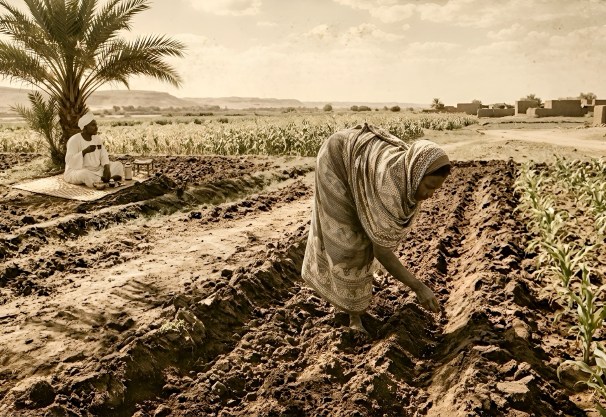
حشاش بدقنه
Hashshaash bi-dign-hu (o); literally, cutting grass or weeding with your chin (or beard). The verb “Hashsha” describes clearing grass or weeds, from farmland, often by hand, using a hoe, sickle or scythe. The word “dign” in Sudanese colloquial can refer both to the chin or beard.
This famous Sudanese proverb warns against the age-old trap of mistaking words for actions and the announcing of grandiose promises for their fulfilment. Beware, it reminds us, of those who talk of great schemes but never roll up their sleeves or keep their word. Perhaps a reasonable equivalent is the American saying; “The master farmer of the South / Who does his farming with his mouth.”
You can watch an engaging animation of the story behind this and the other proverbs featured here, by قصة ولسة . Dedicated to Sudanese folktales, stories and words of wisdom, the site is a wonderful resource for anyone interested in Sudanese culture or improving their Sudanese Arabic.
Watch and listen to the story here.
Below, a rough translation of the most relevant parts of the text.

A bad person isn’t a lazy person; a bad person is someone who confuses words with action and promises with actual achievements. A long time ago there was man and woman whose farms lay side by side. Every morning the woman would take up her hoe and till a small patch of ground which she would then sow and plant. Meanwhile, the man took up his seat in the shade and watched on. And while he watched her he would laugh and gesturing with his chin towards a distant spot, would say “Tomorrow, I will clear the ground from here all the way to over there.” Tomorrow came, and the day after that and all the while, little by little, the woman was working on her patch of land. And every day the man would gesture with his chin to a piece of land and tell his stories to any bigwig who came by. Days passed and harvest time came. The woman’s land had grown lush and full of bounty while the man’s land remained barren; he had sowed nothing and harvested nothing but regrets and remorse. From that time on, when we speak of someone who is all words and no action, we say “So-and-so scythes with his chin or beard”.
So often we fail not because we can’t achieve something but because we talk about our dreams more than we actually work towards them. So don’t distain on that small step for it is small steps that bring tomorrow’s shade and sustenance. Don’t put off beginning that task waiting for you.
The Pot, the Bull and Um Hamid
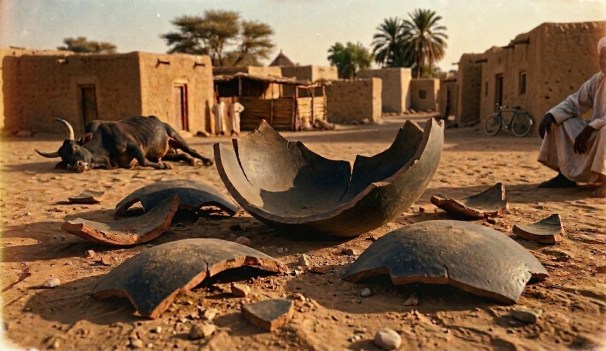
عشان تنقذ القلة خسرتهم التور
`ashaan tanqiz al-gulla khasarta-hum at-tor; literally, to save the pot, you lost the bull.
Short-sighted decisions based on unquestioned advice can exact a high price. The bull, an invaluable rural asset is sacrificed for the sake of a gulla; a modest earthenware pot or jug that is easily replaceable. Sometimes even those we trust for good counsel can be mistaken, as is the case with Um Hamid, a “basīra”, a respected community figure. The title often refers to a traditional bone-setter and healer but it is also given to those gifted with intuitive wisdom and astute problem solving powers.
A possible equivalent to this proverb is “stepping on a dollar to pick up a dime”.
Listen to the story here.
This story was told though the teller must answer for its truth. Once there was a bull that got its head stuck inside a gulla and couldn’t free itself. The people of the village tried both to free the bull and save the pot. They tried and tried but tried in vain so they decided to go to basīra Um Hamid, saying “she certainly will know what to do.” And Um Hamid came. She eyed the bull and then proceeded to pour oil over its head. The villagers tried again to free the animal but failed yet again. Um Hamid thought a little and then said with absolute conviction, “slaughter the bull”. And that’s where everything went wrong. The villagers didn’t even discuss or question Um Hamid’s plan, yet alone consider an alternative. Straightaway they killed the bull and again tried to retrieve the pot and again they failed. Um Hamid thought a little and said ” That’s it then – break the pot!” So in the end, of course, they lost the bull and the pot. The blame, however, doesn’t lie with Um Hamid alone, of course. All those who took her advice on trust must also share the blame.
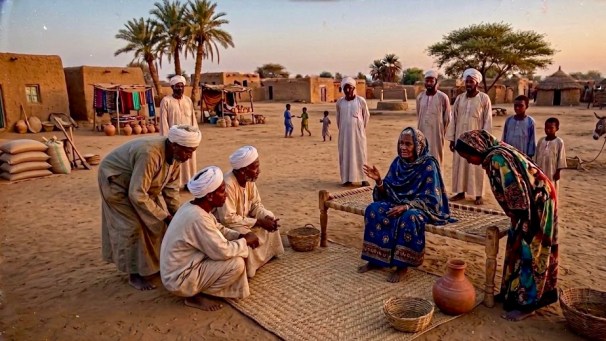
The narrator closes his tale by drawing parallels with modern social media use and the amplifying of false information by unreflecting users.
A Burial Delayed
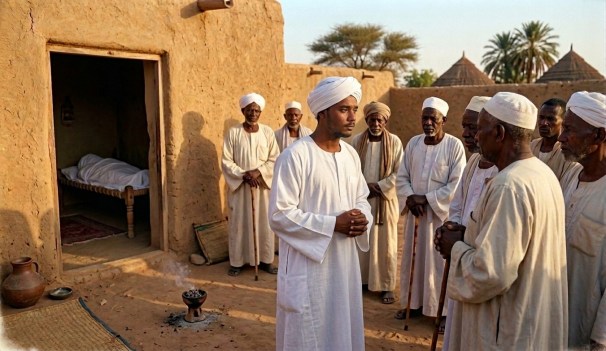
جو يساعدوه في قبر أبوه، دسّ المحافير
joo yusā`idū-hu (oo) fī gabr-i abū-hu, dass al-maHāfīr; literally, they came to help him bury his father and he hid the spades (or digging tools).
Burying the dead both swiftly and with the help of the community are sacred duties in Sudan. Hiding the tools at this critical time would appear both senseless and ungracious. This famous proverb is multilayered in its message; ingratitude towards those who offer aid and irrational stubbornness are often the key takeaways. This version of the story, however, offers another, more subtle interpretation.
A thousand thanks to Muna Zaki, expert in Sudanese proverbs, for her kind and patient input on all the proverbs featured here. For more on Sudanese proverbs, see The Dung Beetle and the Moon.
Listen to the story here.
Imagine if people came to help someone bury his father and the bereaved goes and hides the shovels and spades! You’d think he was mad, wouldn’t you? Or might there be a secret behind his actions?
The story is told though the teller must answer for its truth. There was once a man who passed away. When the people of the neighbourhood heard the news, they rushed to help him dig his grave and prepare for the burial. However, they suddenly discovered that all the shovels had vanished. They searched high and low, until they finally learned that the deceased man’s own son had hidden them. The people grew furious and began hurling accusations at him. How could they come to help him honor his father, only for him to hide the tools from them? Out of the sheer absurdity of the situation, they coined a proverb that remains to this day: ‘They came to help him bury his father, and he hid the shovels.’ Yet, when they demanded to know his reason, his reply completely turned the tables, forcing every accuser to rethink their judgment. He told them, ‘My father has died with debts and obligations still bound to his name, and I will not allow the earth to cover his body until every right is restored to its rightful owner.’ As the proverb says, `If the reason is known, bewilderment will end.’
The moral of this tale is that not every action you fail to understand is a mistake. Sometimes, we wrong others because we judge their actions without knowing their motives. And what of you? Have you ever judged someone, only to discover, once the truth was revealed, that you had done them wrong?
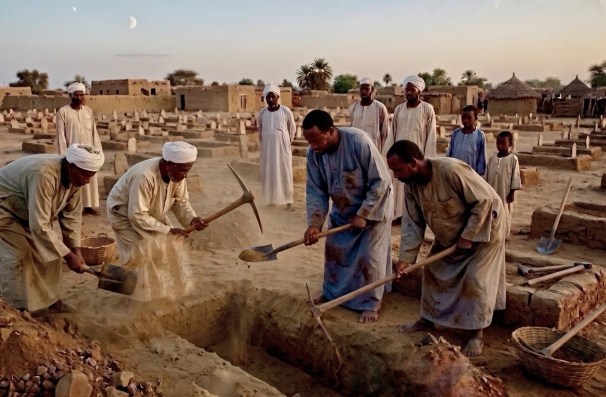
All illustrations above were generated by me using Google Gemini.

