

The Sudanese Gourd
Vessels of Culture
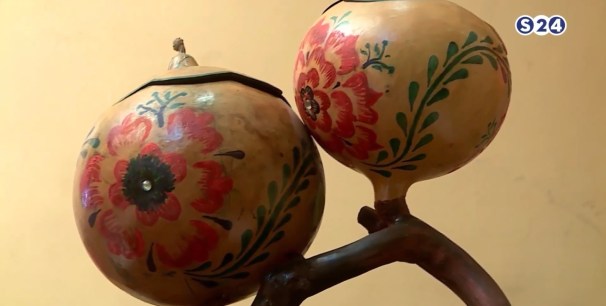
Above, still from a Sudania 24 report on gourd artisans, dedicated to the work of craftswoman Abīda Bashir Muhammad. Other striking pieces by Abīda, together with details of her craft techniques are featured below.
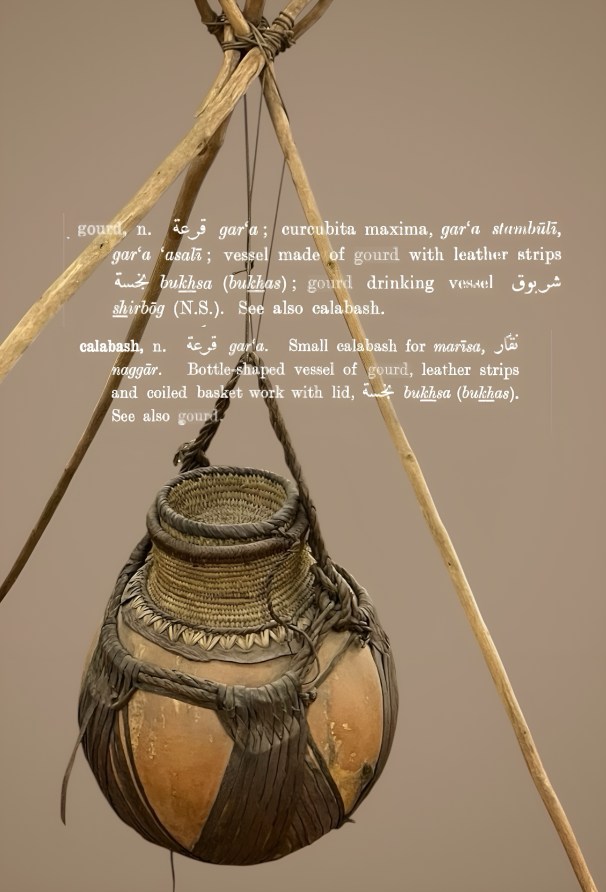
Above, a busksa, a gourd vessel central to rural and nomadic life, used for the churning of milk and butter and the making of buttermilk or rob / roub / roob, a key ingredient in many of Sudan’s signature stews. The gourd used is usually the fruit of the lagenaria peucantha / lagenaria siceraria family. The gourd here was exhibited at Sudan’s Ethnographic Museum in Khartoum, pre-war. See more of the museum’s stunning collection in Sudan’s Cultural Treasures Looted 1. Scroll down to learn more on the bukhsa. Inset definitions, from Sudan Notes and Records, Sudan Open Archive.
From Vine to Vessel
The Gourd’s Role in Food Preparation and Conservation
The Calabash Canvas

From Vine to Vessel
بادر الضيف ولو ببرش و قرعة موية
baadir aD-Deef w law be-birish w gar`at mooya.
This proverb, reflecting deep-seated Sudanese values of hospitality and generosity reminds us that everyone, irrespective of means, has a duty to “Engage in honouring your guest even if with (just) a reed mat and a gourd of water.”
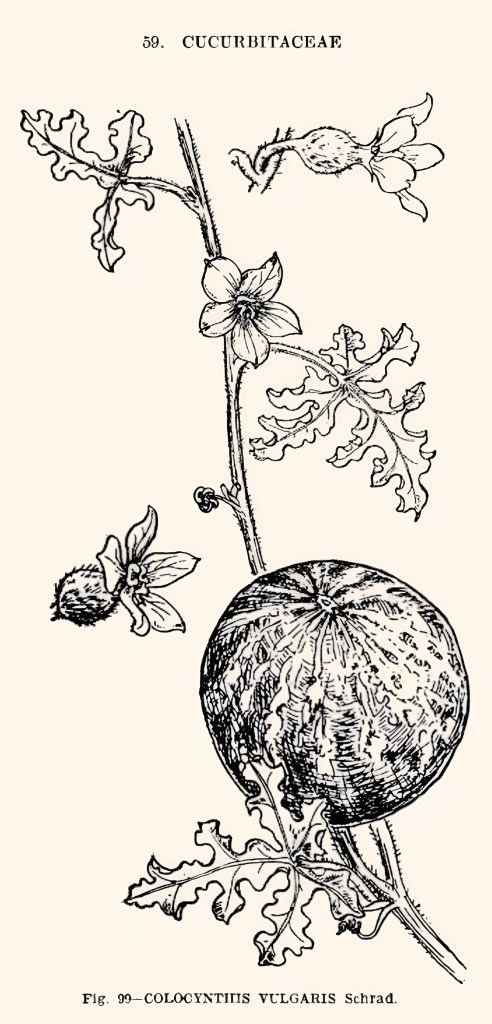
In his beautifully illustrated, three-volume series The Flowering Plants of the Anglo-Egyptian Sudan, (see Sudan Notes and Records Volume 1 Cycadaceae – Tilaceae 0, 1950), botanist to the Sudan government of the 1950s, F.W. Andrews meticulously recorded the many plants of the gourd family indigenous to Sudan. More recent research has identified six major wild gourd / cucurbit species, with local surveys often documenting seven to eight species striving simultaneously in the same region. Darfur and Kordofan enjoy a central role in the cultivation and use of gourds.
Key among gourd varieties is the bottle gourd or calabash (lagenaria siceraria) – the focus of this article, the luffa gourd, and Sudan’s many varieties of pumpkin and squashes. The seeds of several varieties are believed to have medicinal qualities and perhaps the best known is the drought hardy desert gourd, also known as bitter apple or cucumber, widely used in Sudanese traditional medicine (See for example Dr Ahmed Al Safi’s Traditional Sudanese Medicine) and whose remarkable therapeutic properties, especially in the treatment of diabetes are now being extensively researched. It is perhaps the many medicinal powers attributed to gourds that have given rise to a rich and intriguing tradition of spiritual and talismanic folklore surrounding them. Dr Ahmed Al Safi relates, for example, the custom among the Nuba Itambel clan when healing wounds caused by iron; “A man who has received such a wound will be taken to the house of an Itambel man; he will stay there for seven days, after being sprinkled with water from a new gourd by his doctor-host, after which time the wound would close.” Among the Fur people, Al Safi noted, “Gourds are rattled in pots when a distant boom of remote thunder or of the wind echoes in the hills is heard….”
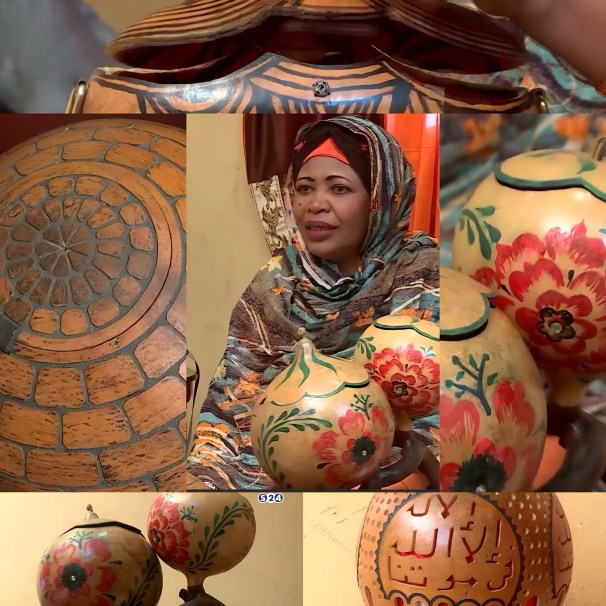
Above, the exquisite work of craftswoman Abīda Bashir Muhammad, interviewed in فن النحت على القرع ابداع بنكهة غرب السودان – ملامح مهنة – صباحات سودانية Abīda’s work reflects both the versatility of the gourd and the creative imagination of the craftswoman, as she explains the process of making lampshades, handbags and centre piece ornaments in her interview (English subtitles).
The gourd inspires affection – fascination even, among the Sudanese, many of whom attribute blessings and protection from evil for those who use it in vessel or other form. A source of livelihood, craftsmanship and practical utility within the home, the gourd has perhaps most importantly proved a key element in food preparation, serving and storage. It continues to play an invaluable role in nomadic life (see below).
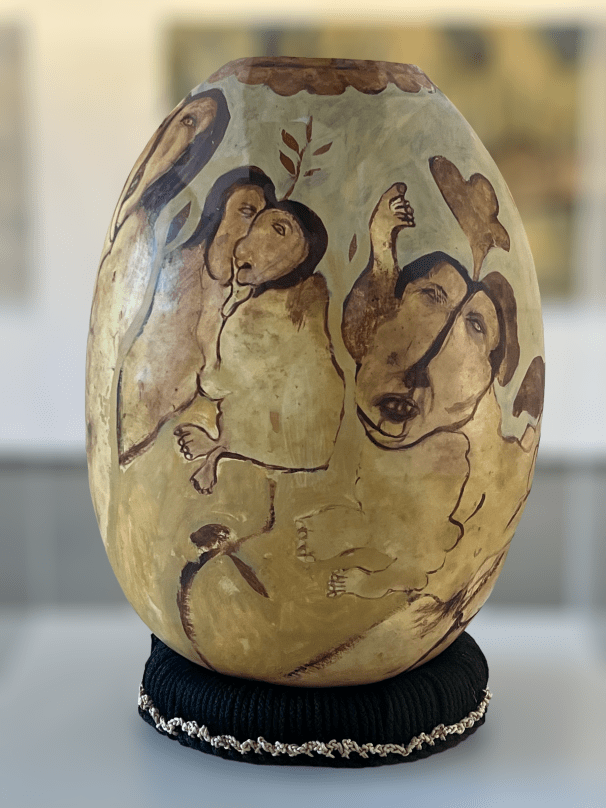
Shards of gourd were often used in pottery shaping and burnishing, as Sudan Notes and Records reminds us in its descriptions of the making of saqia waterwheel pots. Worked with woven or stitched leather or palm fibre to form necks, spouts, lids and handles to vessels, the gourd becomes a centre piece to be displayed with pride in the home. Decorated sets of gourds used as presentation trays for foods are still sought after for special events and can afford a modest income for those, like Abīda, who make them. Its appealing shape, texture and hues have come to inspire skilled artisans and renowned artists alike. For Kamala Ishag (q), the gourd may symbolise Sudanese values of resilience, endurance and self-sufficiency, or more disconcerting themes – the fractured strangeness of identity, for example.
Both Dr Ahmed Al Safi and contributors to Sudan Notes and Records document a wealth of intriguing examples of the ceremonial significance and symbolism of gourds in the past, especially among the Nuer and Nuba. Most striking perhaps, are the accounts of Shilluk religious rituals and the diviners and spirits associated with them; see for example Volume 18 0 1935 SNR Volume 3,0 1920. Gourds featured in numerous birth and burial rituals; SNR records the custom among the Ingassana of conserving the afterbirth in a gourd hung from the branches of a specific type of tree (Volume 10, 0 1927) and that of a gourd containing the heart and intestines of a sacrificed goat or young bull mixed with simsim placed alongside the departed among the Daga people, SNR Volume 21 0 1938. These are just two of several hundred references recorded in SNR.
Given its prominence in Sudanese homes and daily life, it is not surprising that the gourd should feature in folktales and nursery rhymes, see for example The Dog and the Jackal, Sudan Notes and Records, Folk Stories of the Sudan Volume 24, 0 1941, or this cheeky excerpt from a nursery rhyme recorded by S Hillelson in 1918; Dove and pigeon / with the soft throat / the khalifa said to you; / make marissa / in a clean gourd, / that we may drink and make merry (SNR, Arabic Nursery Rhymes S Hillelson Volume 1, 0 1918)
Among the most creative and joyful cultural legacies of the gourd is its role in music in the form of rattles, trumpets, horns and stringed instruments. This will be the focus of Part 2, coming soon.
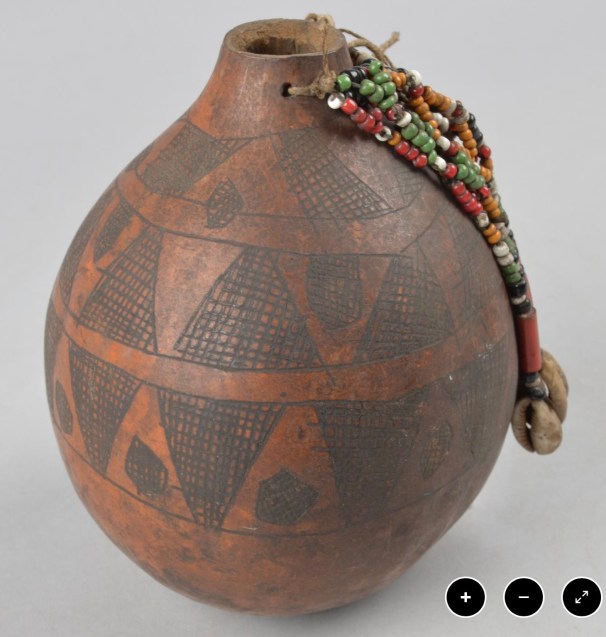
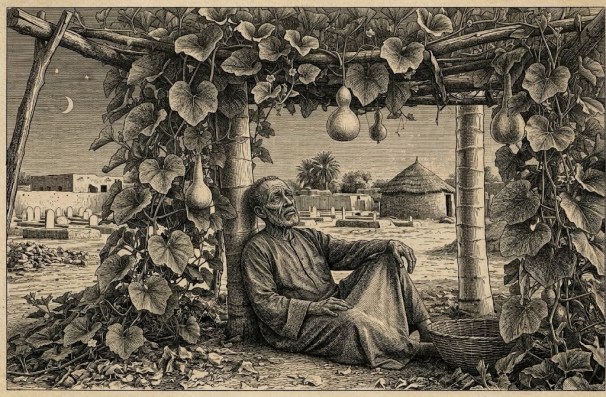
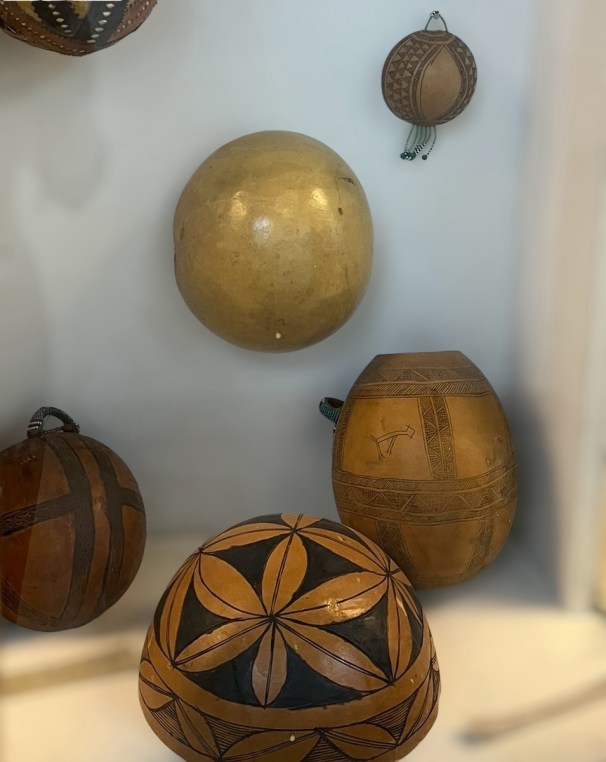
Above, top left, an illustration from Andrew’s The Flowering Plants of the Anglo-Egyptian Sudan. Below it, one of several works by Kamala Ishag(q) using gourds, exhibited in Kamala Ishag, States of Oneness, Serpentine Galleries, London, (see Kamala Ishag – A Homecoming). Bottom left, examples of gourds displayed at the Sudan Ethnographic Museum, Khartoum, pre-war. Top right, a Bisharin made gourd decorated with beads, Trustees of the British Museum, one of several fine examples of gourd vessels held at the British Museum. Below it, a biblical illustration of Jonah, shaded under a gourd vine, an account shared in Islamic tradition and viewed by many Sudanese Muslims as evidence of the gourd as a divine blessing. Bottom right, a gourd rattle with cowrie shells, personal collection.
الدلع و شراب الشاي بالقرع
ad-dala’ w sharaab ash-shaay be-l-gara’.
The overindulging that allows someone to drink his tea from a gourd; a mollycoddled person would get all his requests fulfilled, even if he asks to drink tea from a gourd.
My thanks to Muna Zaki for the proverbs quoted here.
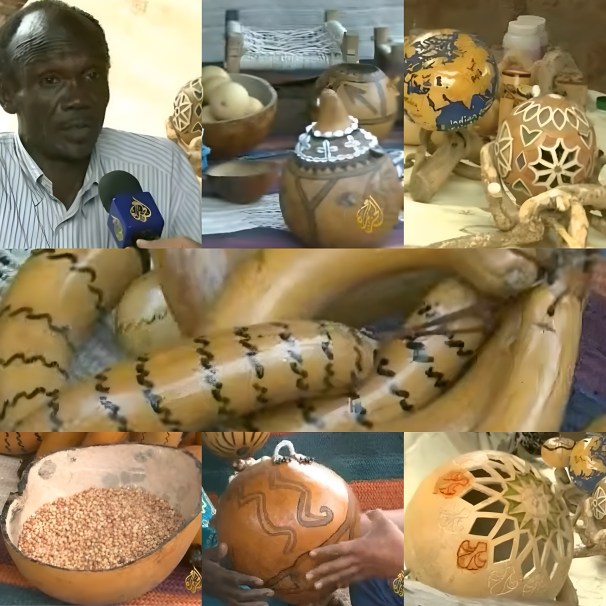
Above, stills from an Al Jazeera report on the heritage of gourds in western Sudan, featuring the remarkable collection of one Darfuri craftswoman seeking to renew cultural pride in the gourd, and the innovative work of a craftsman striving to marry traditional and contemporary designs.
استخدامات ثمار القرع المختلفة في غرب السودان subtitled in English.
The Gourd’s Role in Food Preparation and Conservation
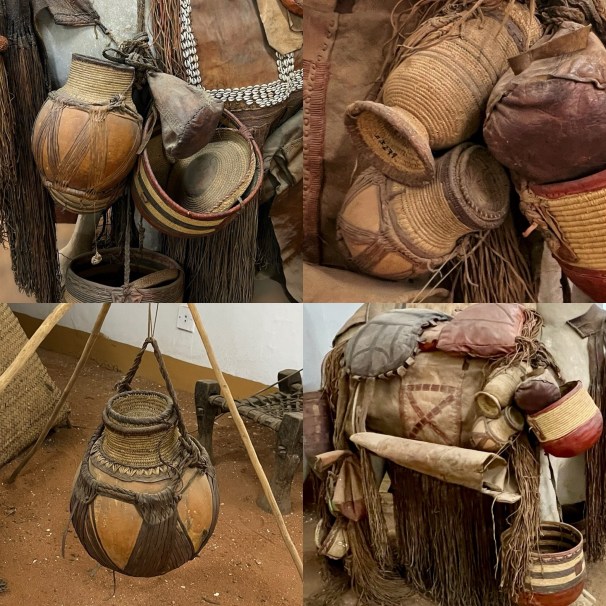
Above, examples of bukhsa with their tall, woven fibre and leather neck, leather-lined lip and lid, suspended from their churning tripod or pack bull, exhibited at Sudan’s Ethnographic Museum, Khartoum, pre-war. Portable and sturdy, the bukhsa remains central to rural and nomadic life in Sudan.
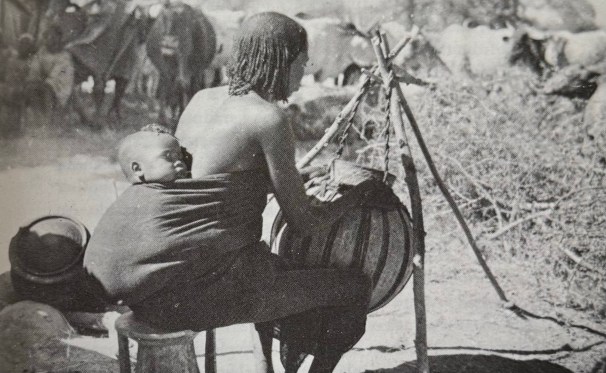
Above, Baggara woman making butter, illustration from Sisters under the Sun, The Story of Sudanese Women, by Marjorie Hall and Bakhita Amin Ismail, Longman, 1981. Women play a central role in the production of fermented milk products, butter and ghee.
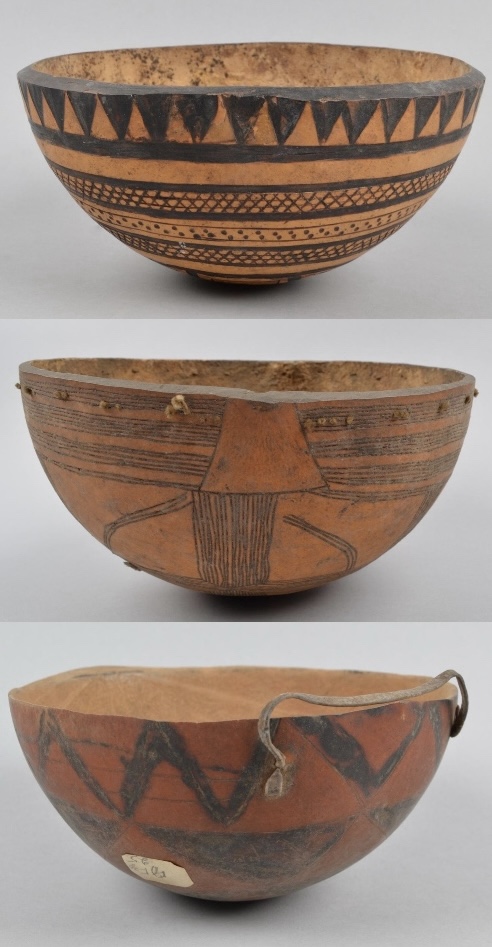
In addition to being hollowed out to make vessels for the storage and transporting of seeds, butter, sour and fresh milk and other beverages, gourds are fashioned into utensils; carved into ladles, known as kubsha, scoops or mighraf, see Gourd Scoop Sudan Memory, as well as large bowls, (see too Al-Gadah)
Sudan Notes and Records offers a tantalizing glimpse into the lives of young Baggara herders in the early 1930s. Describing the tiny boys and girls working as graziers, the account explains that they were furnished with only “a small gourd filled with water” and it was “a wonder they were not eaten by lions”. The account go on to say the cattle, if in open country free from lion, are often driven out to graze at night or in the early morning before being milked. “The milk was put straight on the fire and warmed and most of it poured into the gourd churns wherein the women make their butter.” (Sudan Notes and Records Volume 16, 0 1933 The Baggara Tribes of Darfur). The gourd churns or bukhsa referred to here still allow nomadic peoples to preserve and make use of any surplus milk they have through the process of fermentation, so vital to community survival during food shortages and drought. See more on fermented foods in The Amulet by Hamid Dirar Sudanese Fermented Foods Part 2 Kisra. Women play a key role in their production.
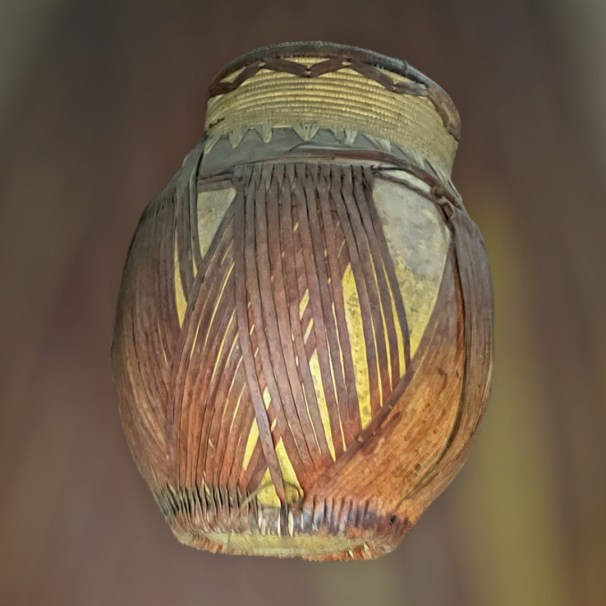
The bukhsa is used to make fermented milk; buttermilk or rob / roub / roob, butter or furssah, and ghee, churned from cow, sheep or goat’s milk. The gourd is harvested before it is fully ripe and while its outer skin is still firm and suitable for shaping. After removing the pulp, the gourd is repeatedly soaked in water to eliminate bitterness and any residual matter. The hollowed fruit is left to dry out and its woody shell allowed to harden for several days. The upper section is then carved to form a small lid or stopper, often decorated by women with leather or bright fabric strips. The bukhsa often formed part of a bride’s trousseau in the past and would be hung high within the quttiya or tent and carried by pack animals by the nomadic tribes of Darfur and Kordofan.
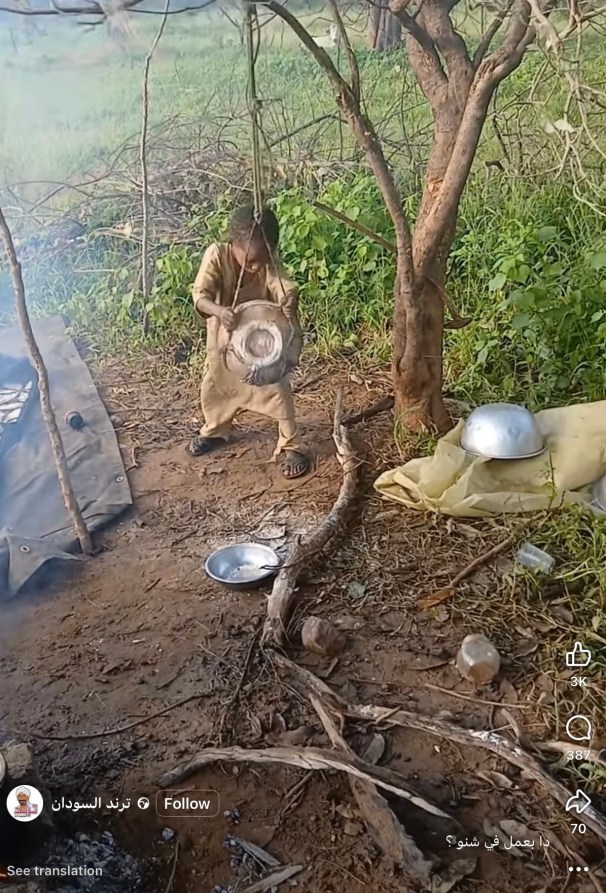
The surplus milk is typically poured into the bukhsa or other container and enriched with a starter from the fermentation from the previous day. The mixture is left to ferment overnight and churned early in the morning. When drunk fresh, it is said to have a pleasantly tangy taste. After one or two hours the rob turns sour and can also be drunk at this phase. Known as ghobasha, it is diluted with water and added sugar. Rob is also used for sauce making or given to young animals as a milk substitute. As the curd is churned small amounts of very cold water are added to accelerate the butter making process. The butter is often subsequently heated to make ghee or samin, a food source that can be conserved and kept for several months. The vigorous, rhythmic art of churning is known as dagg al-bukhsa and is described in fascinating detail in The Economic Life of the Nuer, Sudan Notes and Records, Volume 20 0 1937, page 261-2. It would be fascinating to learn of any songs or rhymes chanted during the churning process.
Unlike the animal skin si`in churn, the bukhsa is washed and cleaned, left to dry and then smoked with certain type of wood from selected trees.
Rob can be mixed with powdered okra to make okra soup, or cooked as a stew with dried okra powder, ground beef, spices and salt. In the west It is often eaten in a salad of roub and grated fruit from plant known as feggous (cucumis melo). A similar urban version of the salad, selatat roub, is made with cucumbers and roub or yoghurt. Roub may also be incorporated into selatat awsad – fried eggplant and soured milk. Signature dishes such as mulah roub abyad, and stiff aceda porridge prepared from fermented sorghum also feature rob as a key ingredient and enjoy pride of place at Ramadan fast-breaking. See more in Two Ramadan Dishes.
Top left, examples of decorated gourd scoops and bowls, from the Crowfoot collection and those donated by Dr. Siegfried Frederick Nadel, 1938, Trustees British Museum. See too Ornamented Gourd Sudan Memory. In the past, designs were often burnt or scorched into the gourd shell. Bottom left, still from a widely reproduced clip on social media showing a young boy energetically churning using a bukhsa. Right, a bukhsa from Sudan Ethnographic Museum.
The account above draws on the research published in Traditional Sudanese Foods; Sources, Preparation, and Nutritional and Therapeutic Aspects, edited by Abdalbasit Mariod and paper published by Science Direct, Characterisation of the dominant microbiota of Sudanese fermented milk Rob.
The Calabash Canvas
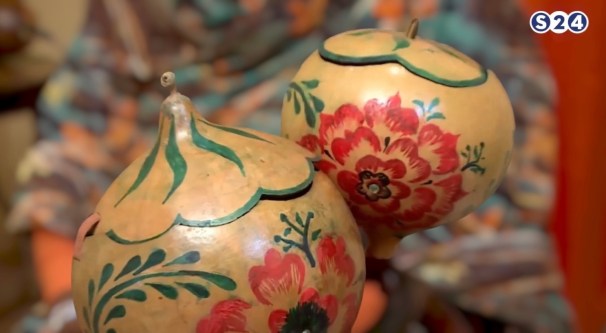
Abīda Bashir Muhammad’s work, ,فن النحت على القرع ابداع بنكهة غرب السودان – ملامح مهنة – صباحات سودانية
Artisan and Artist
The Artisan
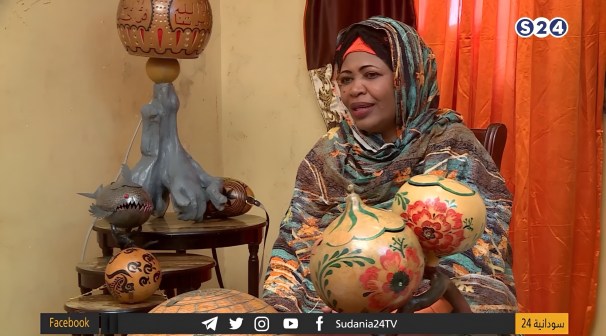
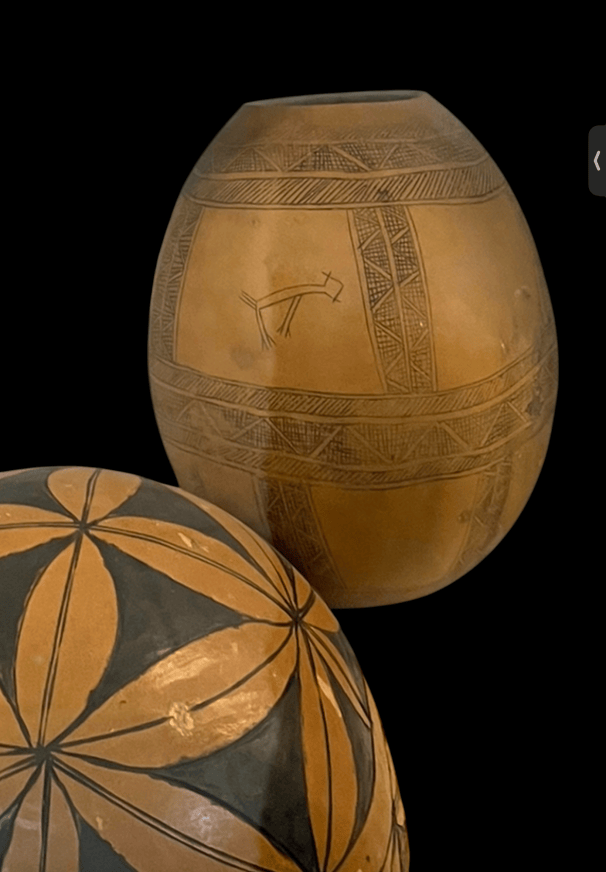
Abīda is one of many artisans inspired by the medium of gourds to express her creative skills. While she laments the lack of opportunities to enable her to develop her craft, she acknowledges she has been able to generate a modest income from her work. The main challenge, she stresses, is being able to earn enough to compensate for the high cost of the gourds themselves, a result of the challenges involved in transporting them from Darfur and Kordofan to Omdurman. She tell us she takes her inspiration from the shape of the gourd, creating fabric-lined lampshades, animal figures such as turtles and fish, as well as statement handbags.
Abīda explains that the gourd, once purchased, is soaked for some time before the outer rind is scraped away with a razor blade or stanley knife. She then begins to trace the design she wants with the aid of compass and stencil paper. While she finds the painting, using water colour or oils, and patterning with decorative perforations straightforward to achieve, the engraving and carving take great care and must be done slowly and very gradually so as not to make an irreversible mistake.
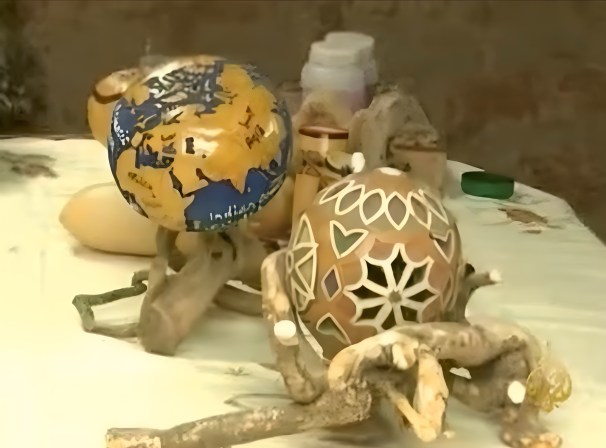
Above, original globe designs on branch stands, by the unnamed western Sudanese artisan interviewed in استخدامات ثمار القرع المختلفة في غرب السودان I was presented with a similar, beautiful gift from the Nuba Mountains many years ago, which I still treasure.
The Artist
Below, gourds used as medium for psychological exploration by Kamala Ishag(q).
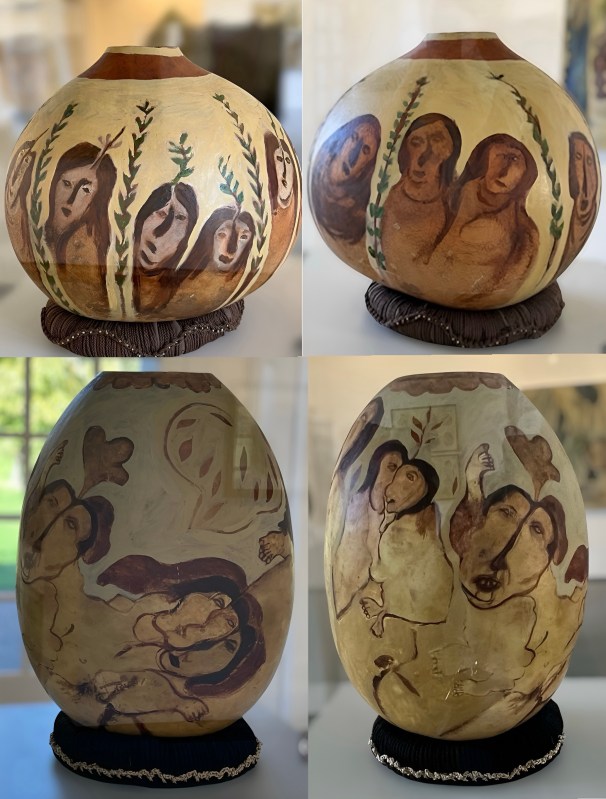
Exhibited as part of Kamala Ishag at Serpentine Galleries
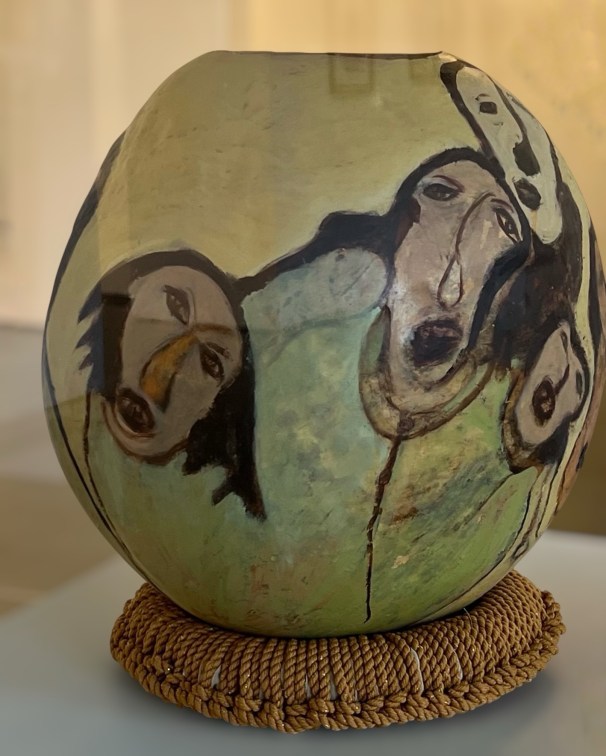
“Plants and flora have appeared within Ishaq’s paintings and drawings since the 1970s, for example as studies and elements incorporated into compositions of Zar paintings. In the late 1990s, plants became a central focus for Ishaq, inspired by the abundance present in her Khartoum garden.”
“The world of nature is rich in forms, and unlimited aesthetic possibilities… I believe vegetation and humans are one and the same. We grow from the soil. We eat plants for sustenance, we die and we are buried. We eventually become sustenance for plants.”
“Ishaq’s more recent work is defined by a sense of interchangeability, and a metamorphosis between human and plant life.”
“The artistic practices of the women in her family, who would skilfully decorate items in the home, have also remained central to her work. This is one of the reasons she paints on surfaces other than traditional paper or canvas, exploring the landscapes of wooden screens, the leather tops of musical drums, and embellishing calabash gourds.”
Excerpts taken from States of Oneness: Healing Zar With Kamala Ishaq
See too Forests and Spirits
“On these calabashes, Ishag depicts figures that recur in her work—women in a screaming state, caught in a trance-like moment, or women in a serene pose, their fissured heads intertwined with roots and leaves. By painting women’s bodies on the outer surface of these containers, Ishag is challenging the notion of containment: she renders the women visible, powerful and spiritually transcendent, presenting their interior worlds on the outside.”
Sharjah Art Foundation Kamala Ishag Composition
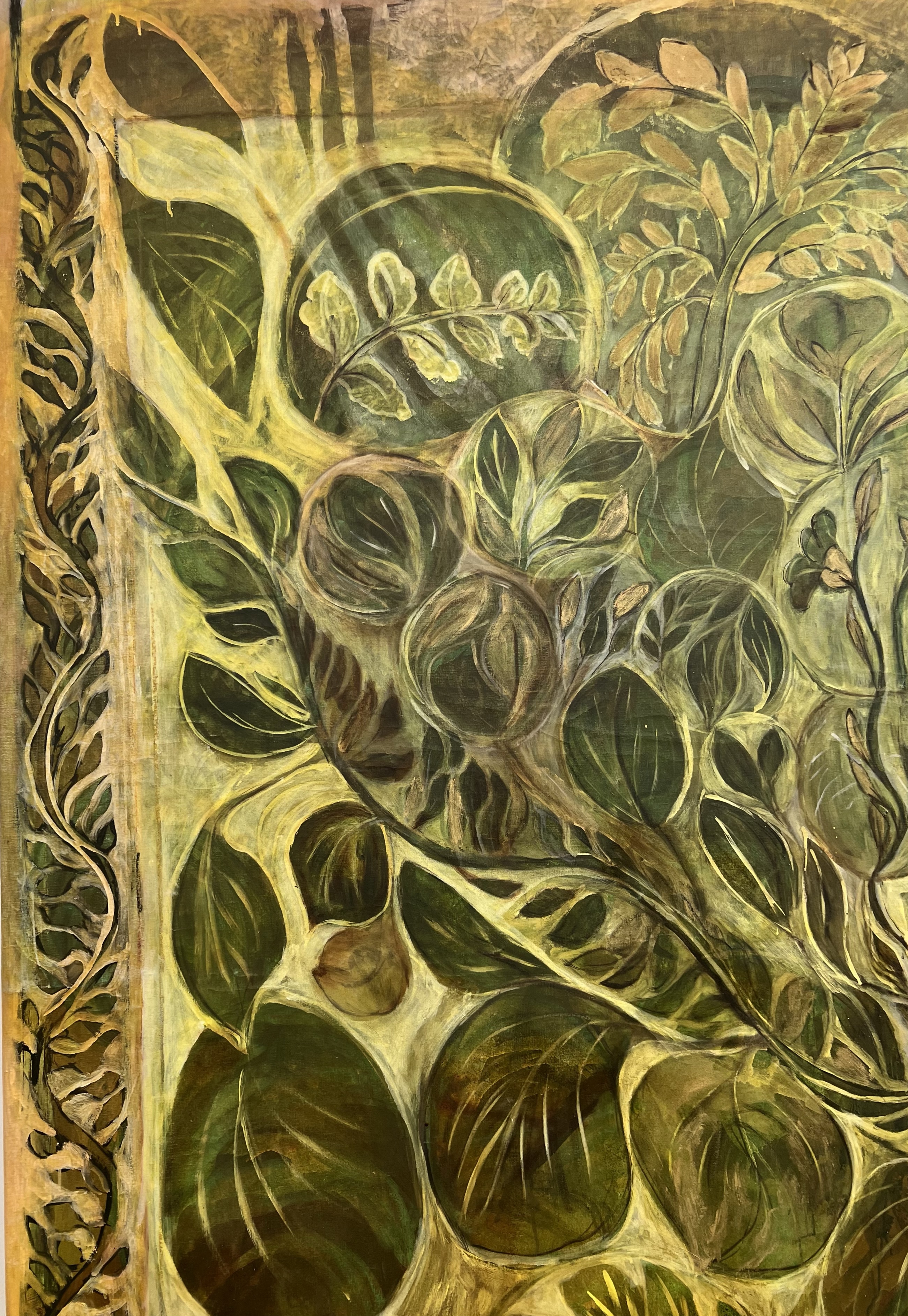


Above, details from works exhibited in States of Oneness. Tender fronds, leaves, ferns and flowers crowd the canvas. Plant-like spirit forms float and merge into fluid backgrounds and leaf faces frame and entwine her female figures.


One comment on “The Sudanese Gourd Part 1”