

Traditional Basketry of Darfur
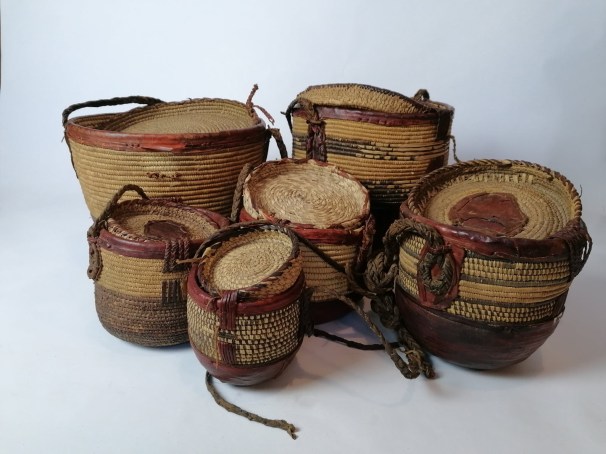
Above and title illustration, fine examples of traditional Darfuri wedding baskets with their burnished red leather trimmings and snugly fitting saucer-style lids. This photograph was kindly provided by Sandy Creighton, who recalls acquiring the baskets while in Nyala, Southern Darfur during the 1980s. Wedding baskets such as these were crafted with pride by the women of the groom’s family to be presented to the bride upon her marriage as a versatile, lifelong resource. They were sometimes also embellished with cowrie shell floral motifs.
Scroll down for a 2-minute auto-dubbed (English) Aljazeera video report on a Darfuri wedding, embedded below.
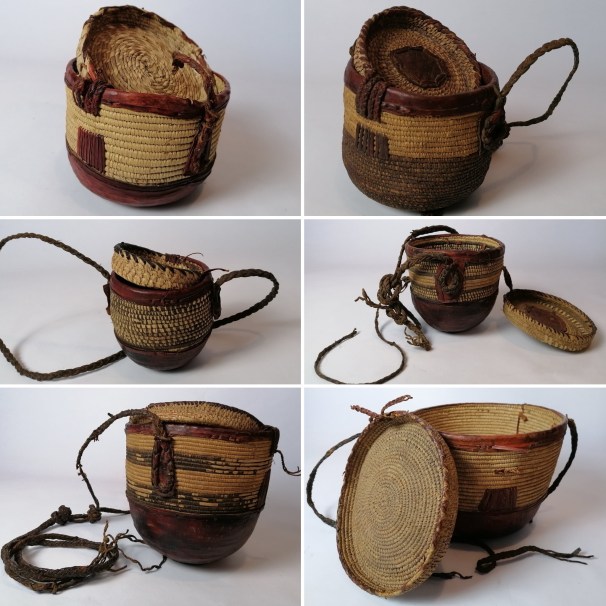
Above, details of Sandy’s collection. Note the fine leatherwork clasps and plaited handle straps; leather basket trims and the rounded leather-clad bases that serve to reinforce and secure the structure.
Traditional Basketry of Darfur
Darfuri Basketry of 1970s-1980s
The Wedding Baskets of the Rizayqat, as recounted by Researcher Natalie Tobert
Setting the Scene: Art in the Coils
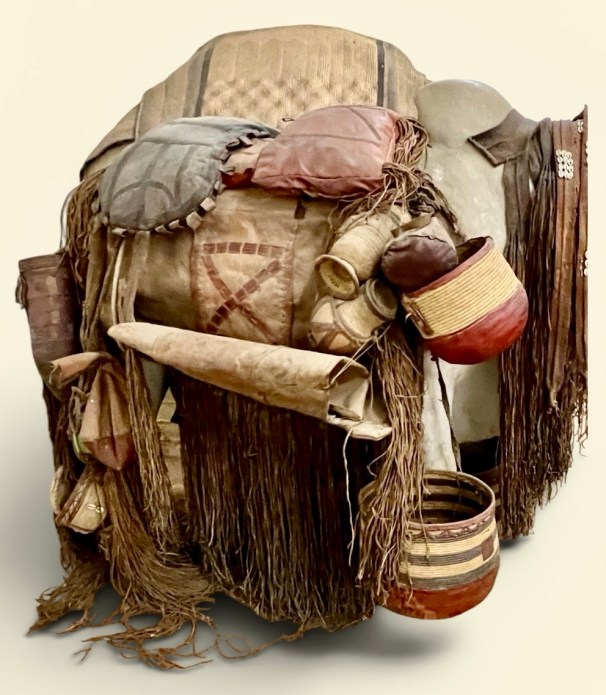
Below, a richly adorned Baggara pack bull or tor shayl (Sudan Ethnographic Museum), laden with the possessions of a family on the move. Mats and tent coverings woven from doum or other palm fibre, baskets sealed and adorned with tanned or dyed sheep or goatskin are borne by bulls trained by the family as beasts of burden and ridden by women.
The baskets of western Sudan are invaluable to its nomadic and settled peoples alike, treasured as symbols of social status, self-sufficiency and ethnic pride. As researcher Natalie Tobert notes, they act as highly sustainable, portable cupboards and storehouses. They are also vital sources of income for their makers and are prized throughout Sudan.
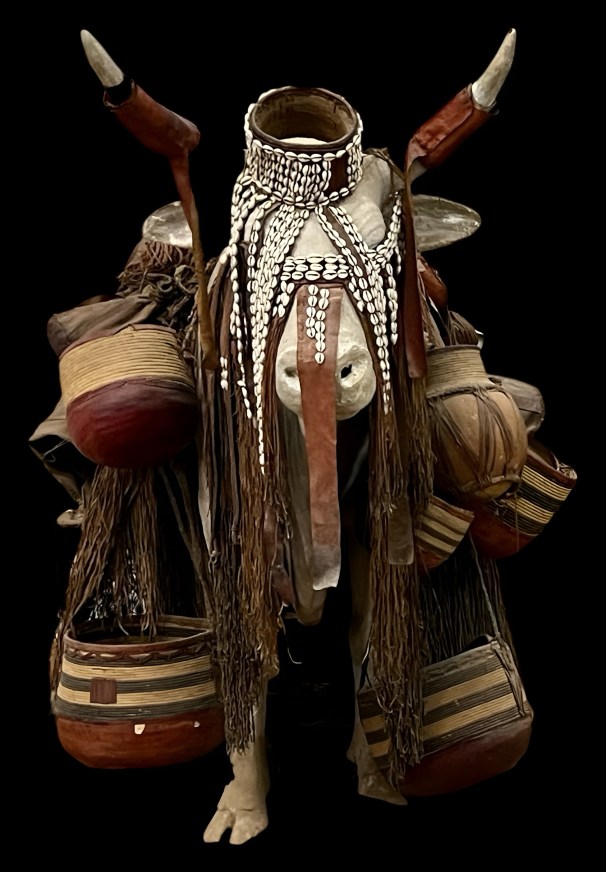
See more on the Baggara pack bull in Sudanese Leatherwork and Basketry. See too Cowries in Sudan.
This week’s brief article showcases examples of Darfuri craftsmanship, with special focus on the plant fibre, coil-woven baskets and vessels common among the Baggara and Rizayqat. These are predominantly made by women and in Darfur are usually woven from doum palm or root fibre, with dyed or tanned leather edging, straps and tasseling. They can also be fashioned from gourds and are often used to carry flour, milk and other foods.
Natalie Tobert’s research, recounted below, offers a fascinating glimpse into Darfuri basket making in the early 1980s. Her detailed descriptions of vessel type and use serve to bring alive the immense skill and cultural relevance of these artifacts both then and now. Their robustness and portability so obvious to Sudan’s nomadic peoples take on renewed importance at a time when tens of thousands of civilians have become involuntary nomads. She notes that it was during her time in Darfur in 1980s that she started to see new unused, smaller and more decorative baskets for sale to settled populations and aid workers, especially during the severe drought of that time. These vessels were “hastily made” for sale in return for cash urgently needed to buy grain.
The making of sustainable plant-based vessels such as these enables rural and nomadic communities to resist the seductive sway of urbanization while opening up flexible income generating opportunities for women and their communities. Recent government campaigns have sought – with some success, to publicize the ecological gains of biodegradable containers over plastics whose remnants continue to scar the Sudanese landscape. Continuity of design and weaving methods – largely unchanged over centuries, has also allowed space for contemporary innovation and creativity.
Coming posts will explore in detail the plaited palm fibre strip method of making baskets, ceremonial and household mats and tenting, also a key craft among settled and nomadic peoples in Sudan. For more detailed analysis in Arabic, see تنمية وتطوير حرفة السعفيات في منطقة مروي شمال السودان
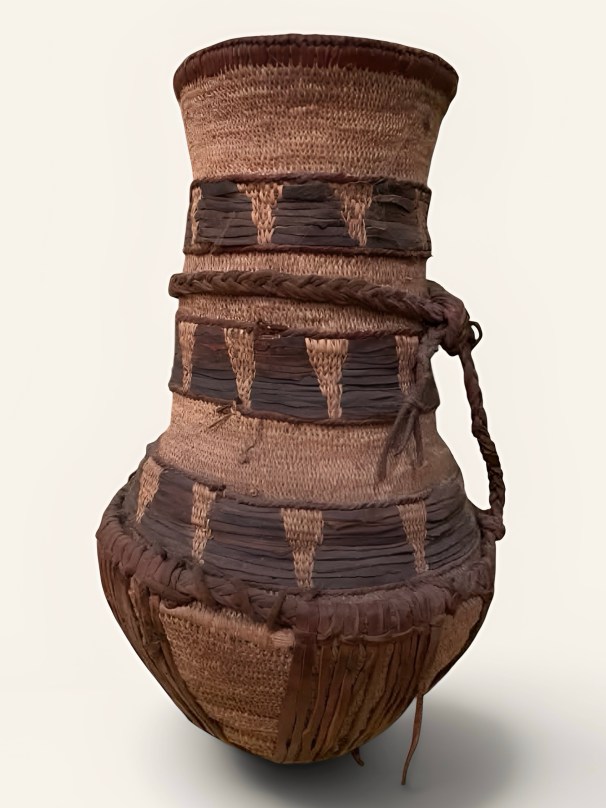
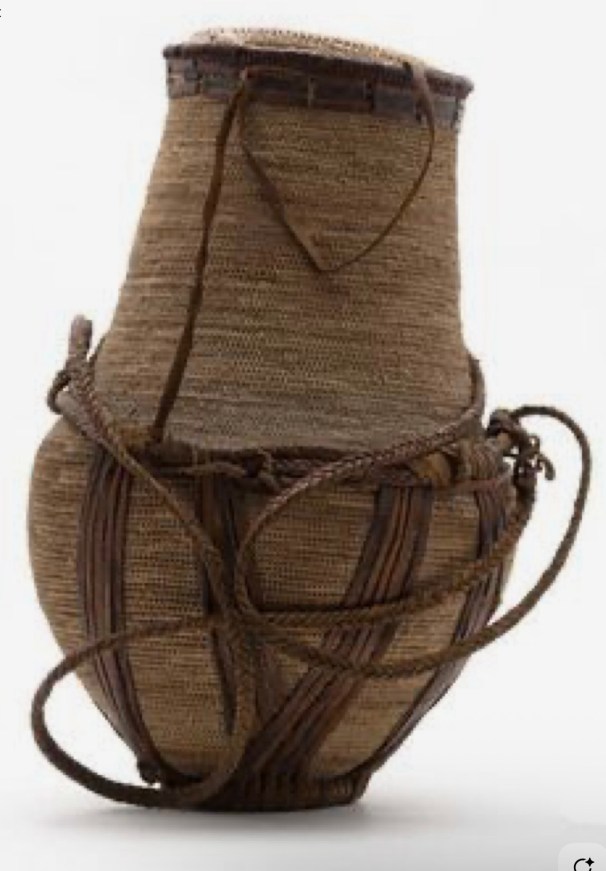
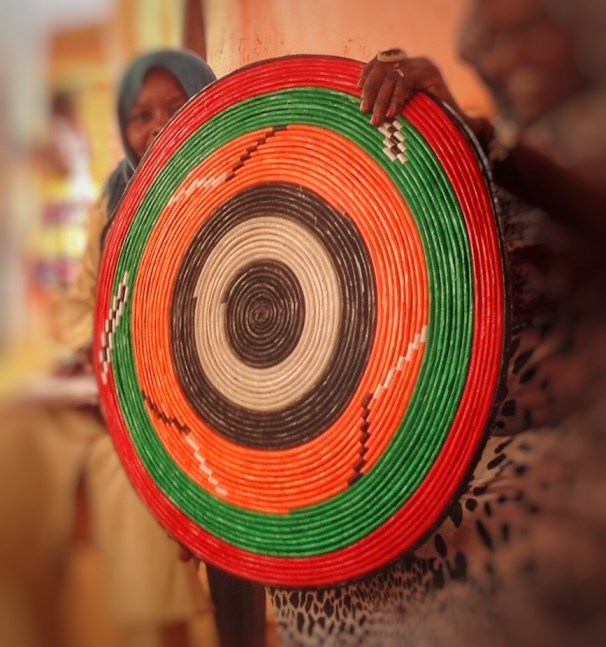
Top left, detail of a Baggara pack bull laden with palm fibre baskets, matting and tent coverings, Sudan’s Ethnographic Museum, Khartoum, pre-war. Below it, water container with lid, made from coiled grass, suspended in leather straps, dated 1962 (Pinterest). Above right, a basket from Mellit, North Darfur; my thanks to David Granville for this photo. Right, a stunning Darfuri-style tabag made by literacy participants in Khartoum as part of an income-generating program. The tabag here is made of recycled bicycle plastics. See more in Weaving Brighter Futures – Updated.
Below, still from an Aljazeera report highlighting Kordofan mat making.
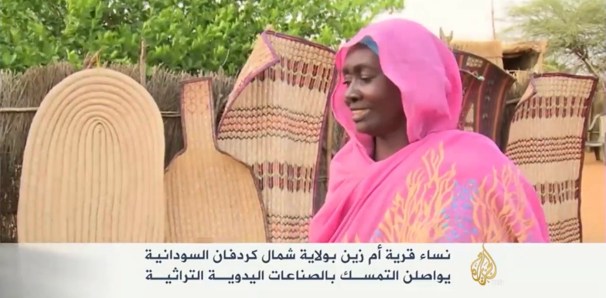
My thanks to Sudan Teachers Facebook Group for the photographs they have kindly shared with me for this article.
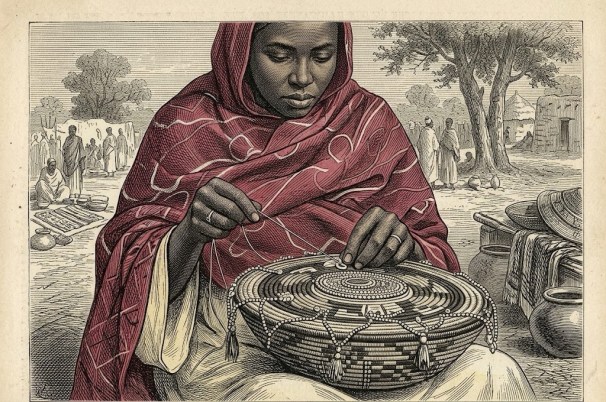
Above, sketch of a Darfuri woman putting the finishing touches to a mandola basket. See more on the mandola below.
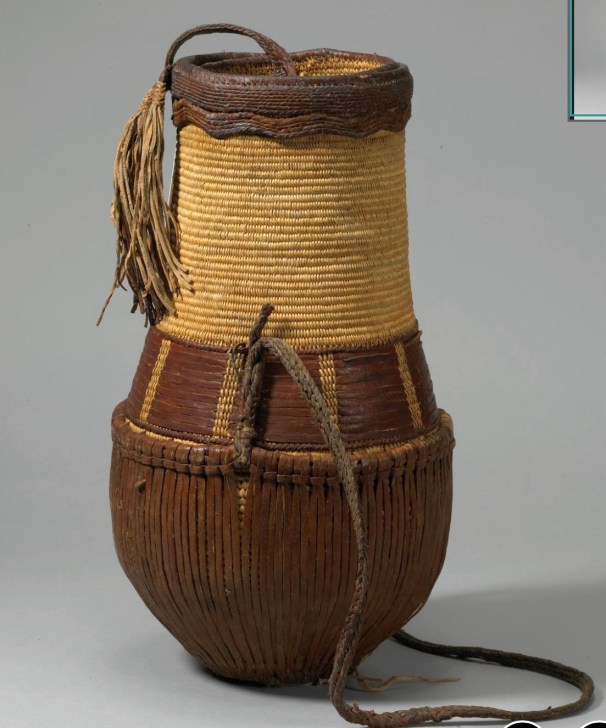
Below, more beautifully crafted examples of western Sudanese basketry from the 1980s, held at the British Museum, photographs Trustees of the British Museum; text, British Museum exhibit notes. Left, a tubular lidded basket, made of vegetable fibre, “erig”, surrounded by a decorative holder and hanging strap of plaited leather straps. A circular lid is attached to the basket with a leather strap and there are groups of tassels around the rim and base. Such baskets contained scents and sweet-smelling woods and are hung inside the Baqqara wedding tent. Made by the Baggara / Rizayqat. Top right, a storage basket or “omra rakta”, made of coiled vegetable fibre in alternate plain and black-dyed hoops, and with reinforced base of red leather. There is a circular lid attached to the rim of the basket with plaited leather thongs, together with its long suspension strap, also of plaited leather. Large omra are often made of undyed doum palm leaf and palm leaf rib.There is a triangular patch sewn in the centre of the lid. Made by the Jammala / Rizayqat and acquired in Darfur. Below it, a similar omra storage basket. Bottom right, another omra basket made by the Fulbe, acquired in Rajaj, Darfur.
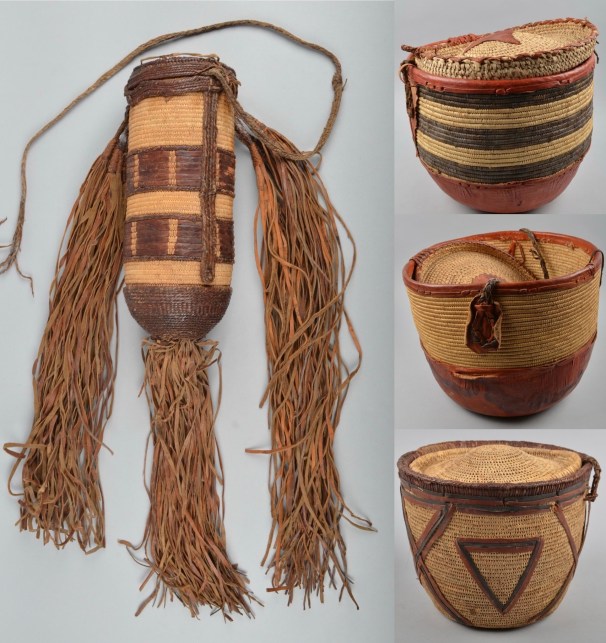
You can see more fine examples of Sudanese basketry, including cowrie-embellished water containers and colourful conical patterned coffee pot holders in The Horniman Museum Collection online.
Fine basketry is not the preserve of the Arab nomadic tribes of western Sudan alone. The Fur and Tama peoples also craft emblematic pieces, such as the striking Fur Mandola below. Often used to hold communal Al-Gadah bowls and the traditional asida porridge of the region, the mandola enjoys pride of place in cultural celebrations and during the Sudanese revolution of 2018-19 became a symbol for inter-ethnic unity. See more in Two Ramadan Dishes. Photo below, Wikicommons.
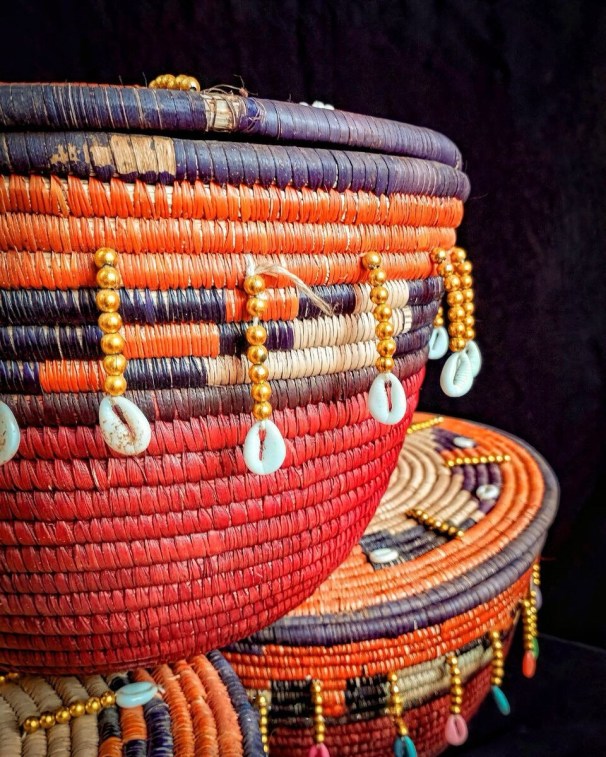
Mandolas have a base of oruk; root fibres from a tree of the acacia family, and walls of grass stem or banu. They are striking in their colours, geometric motifs and ornamentation.
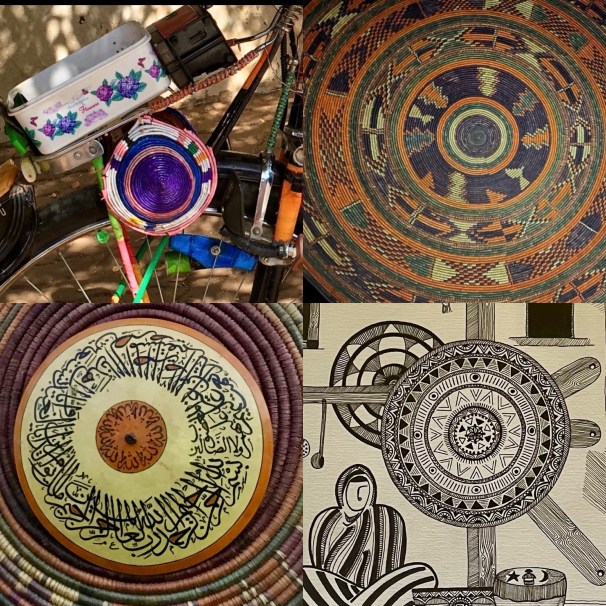
Throughout Sudan, Darfuri food covers known as tabag are sought out for their craftsmanship, durability and striking decorative motifs. Learn more about this iconic household item that has been taken up as both a defiant and wistful symbol of Sudanese identity by artists and activists alike in The Sudanese Tabag and Icons of the Sudanese Home.
“I was particularly fascinated by how she made the ‘tabag’ (woven food covers) and ‘rayka’ (large storage baskets for bread and traditional Sudanese flatbreads like kisra and gorrasa). The process of making them was similar to that of mats and baskets. The fronds were soaked in water to soften them, then a long frond was selected and coiled in a spiral until the desired size was reached. The edges were then tightly stitched using coloured fronds, while the ‘rayka’ was usually left in its natural color.”
A granddaughter’s moving tribute to her grandmother’s weaving skills in The Palm Frond Weaver, Safeguarding Sudan’s Living Heritage.
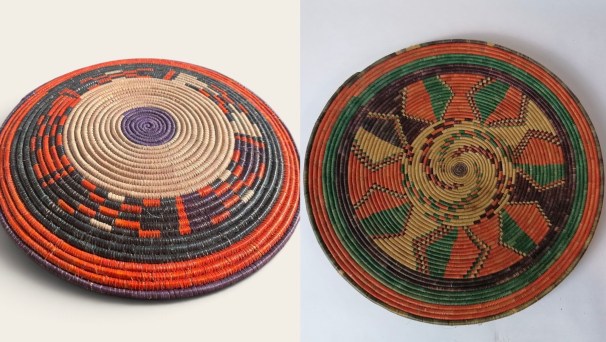
Above, stunning examples of tabag from Darfur. My thanks to Alan Johnston (left) and Sandy Creighton for these photos.
Similar to tabag are birtal, food covers made of fine grass stems. They may be dyed or used in their natural golden colour. They are made by many groups in Darfur, usually in the hot dry season after the crops have been harvested (source: Natalie Tobert).
Excerpts from Natalie Tobert’s Accounts of Rizayqat Wedding Baskets
Rizekat Wedding Baskets, Sudan Natalie Tobert
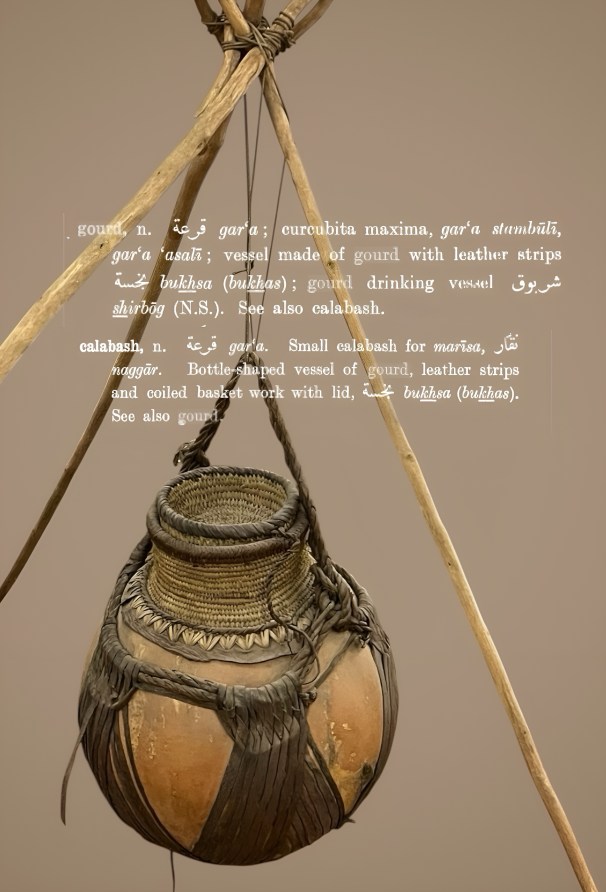
Above, a bukhsa or gourd milk churn, a vital part of nomadic life, referenced in Tobert’s work.
Learn more in The Sudanese Gourd Part 1
From the late 1970s to mid 1980s, Natalie Tobert undertook fieldwork surveying housing, seasonal camps and craft technology in Darfur. Her work spanned a region inhabited by settled non Arab Fur and Tama peoples, the camel herders of the Rizayqat and the semi-nomadic camel and cattle herders of the Zaghawa of the north, as well as Baggara And Beni Hussein cattle pastoralists to the south. It was during her time in Kebkebiya that she met members of the Rizayqat and studied their basketry craftsmanship.

She explains that the tribe’s seasonal migration routes wove across Darfur and eastern Chad and in the markets they visited, they would sell milk, yoghurt, ghee, animal fat and dried meat in exchange for the tea, sugar and grain needed for their journeys. In times of drought, they would also sell animals for grain. She notes that in the 1980s fibre baskets made by the Rizayqat could be seen in markets and the nomads not only sold milk and fats from the baskets but that “they also had new unused containers for sale. Finely coiled and decorated with red leather thonging”, the baskets were popular among all ethnicities of the region.
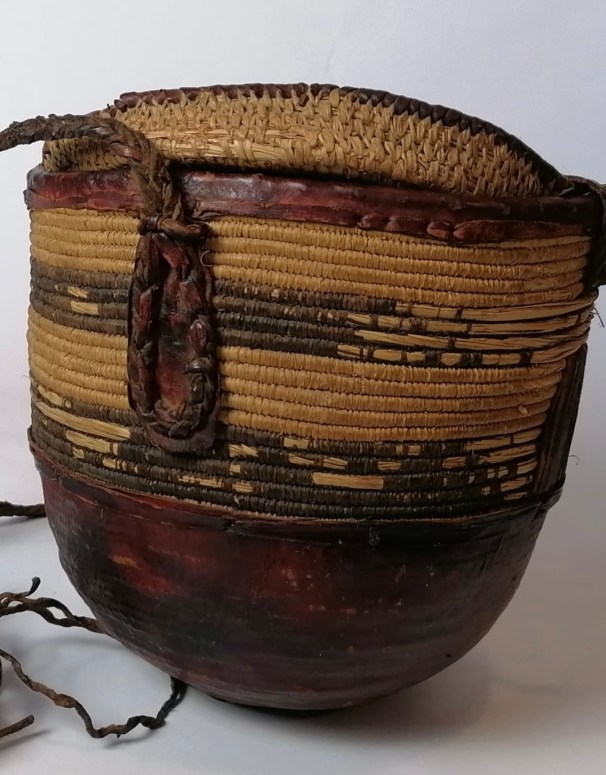
The fine basketry crafted by the Rizayqat form an essential part of a bride’s wealth and her community’s wellbeing. The gifts offered by a future husband to his bride such as “jewellery, clothes, perfumes” are all presented in these fine baskets, which, as mentioned above, Tobert aptly likens to portable “storage cupboards or wardrobes”. The baskets are all made by the women of the groom’s family, who “must complete a full set of the red leather thonged baskets to offer the bride” and who also undertake the tanning of the red leather decoration. The weaving skill, elegance and durability of these baskets are a source of family and community pride to both the women making and receiving them. The bride’s wedding baskets with her marriage goods and gifts are tied to the richly worked wedding hawdaj or utfa as she is led in procession upon her marriage.They will also grace the more modest workaday version of her hawdaj on the tribe’s seasonal migrations. Tobert also records seeing red leather marriage baskets “hung up for show” from the rafters of temporary huts or gutiya or set out on wooden benches. It is important to note that red is associated with healing and propitiation in Sudan, featuring in wedding and circumcision rituals; see Anointing in Red and Gold: Update.
Top left above, a Rizayqat marriage basket, dated 1970-1980, British Museum Trustees. Below it, detail of a wedding basket from Sandy Creighton’s collection. Above right, the richly tasseled, cowrie-encrusted trappings of a western Sudanese howdaj, Sudan Ethnographic Museum. Learn more about the camel litter in Al-Hawdaj.

The baskets are made of palm fibre, root fibre and may consist of a gourd base. See more on gourd receptacles in The Sudanese Gourd Part 1. Hankuk, the rib of the doum palm leaf are gathered together in bundles and used as a base of support fibre around which sa`af, palm fibre – most commonly in western Sudan from the split leaf of the doum palm, or banu is worked. The sa`af can be dyed and “is matt in appearance”. Baskets may also be made of oruk; the root of the haras tree of the acacia family. Tobert explains it is the strongest of all basketry materials used. Banu are grass stems, dried and split into thin lengths; “its shiny surface makes it the finest, most delicate material” and is used mainly for making birtal and mandola. Left plain, it has a “pale golden colour” but is often also dyed.
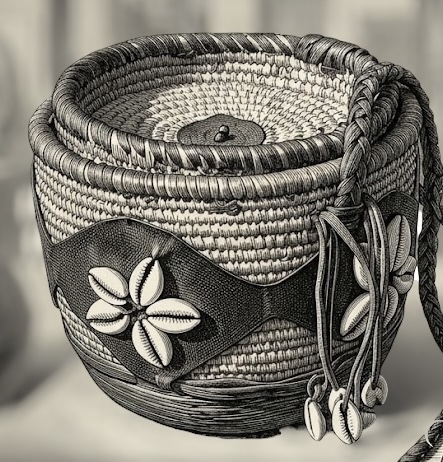
Cowhide leather is used for the decoration of kerio and hangar baskets and kitchenware. It is plaited to make strong rope for tying the baskets securely during migration. Goat’s leather is dyed red and used to decorate baskets holding wedding gifts, such as clothes and perfumes.
In Torbert’s account, baskets begin from a central coil of dampened bundles of palm rib. Women use an awl to pierce through the foundation of the previous coil through which they pull through the fibre – sa`af or banu – they are using. The awl is a ten centimetre tool with wooden handle. The centre of the beginnings of the coils are sometimes made of oruk as it is stronger.
Left, sketches based on Tobert’s illustrations of some of the vessels she encountered, togehter with her descriptions.
Top: bokhsa mashfiyeh; used for the storage of marriage goods. It has a gourd base and woven palm neck, decorated with red goat leather, up to 51 cms tall.
Below it, an omra for storing marriage goods. The lower part is covered in red goat leather and the basket is generally between 46-51 cms wide. Tobert notes that smaller versions of the omra could be seen during the 80s drought, and she describes them as hastily made baskets adorned with thongs or cowrie shells, produced for quick sale to settled peoples and aid workers in order to raise money of grain.
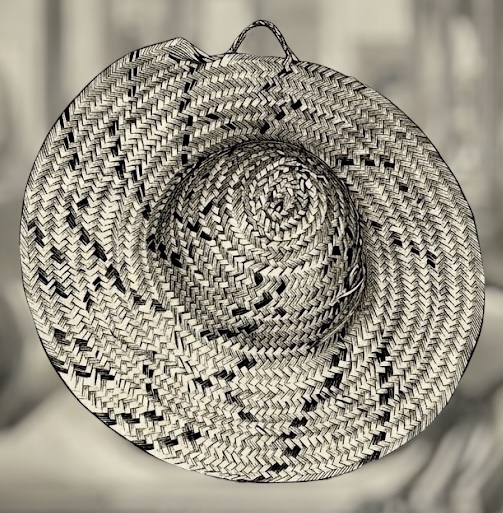
Middle image, a squatter version of the omra, a kerio, also designed for marriage goods. When made of palm fibre, often used as a container for flour. When made of root fibre, it is used for milk as the fibres swell when wet and prevent leaking. It has cattle hide thonging.
Below it, a kambowt; a cattle hide decorated container, used for separating curds and whey. Bottom image, a hangar. Similar to a kerio, decorated with red leather, it is used for the storage of marriage goods; when with cowhide thonging it is used for foods such as milk or flour. Upper right, sketch of a cowrie-decorated wedding basket. RIght, a coil woven sunhat, also typical of the region and elsewhere.
Below, 2-minute auto-dubbed (English) Aljazeera video report on a Darfuri wedding.

